AI risk and resilience
AI risk and resilience: agent incidents, operational resilience, controls, governance and the law.
I tested four AI chatbots for political bias. Gemini invented a plan to scrap the stock market
I tested four AI models for political bias on two divisive subjects and held every claim against the documents. Bias was not the worst problem: one invented policies and stated them as fact. Here is the check.
EU AI Act for businesses: three questions that tell you what you owe and when
Most businesses that use AI are deployers under the EU AI Act. Today that mostly means helping staff understand the AI they use. AI used in hiring, credit or life and health insurance pricing owes more from 2 December 2027. Three questions sort it, with the UK, US and Korean rules alongside.
Claude's new AI agent inherits every app you've connected. Mine could read my API keys
I thought I was about to give Claude's new agent the link to my notes. It already had it, and the link could open my stored keys. Six checks to run.
China's social credit system never had a machine behind it. Could AI build one in the West?
China never built the all-seeing social credit score. The West already runs pieces of it. I think an ethical AI could run the whole thing perfectly.
AI companies are buying firms on borrowed billions. If it goes wrong, the firms pay
When an AI buyer takes over a business with borrowed money, the lenders' claim is on the business it bought. In four completed deals that business borrows the loan, guarantees it or pledges its assets. Amex GBT already backed a $1,486m loan before its AI buyer added $1bn of notes. Checked 28 October 2026.
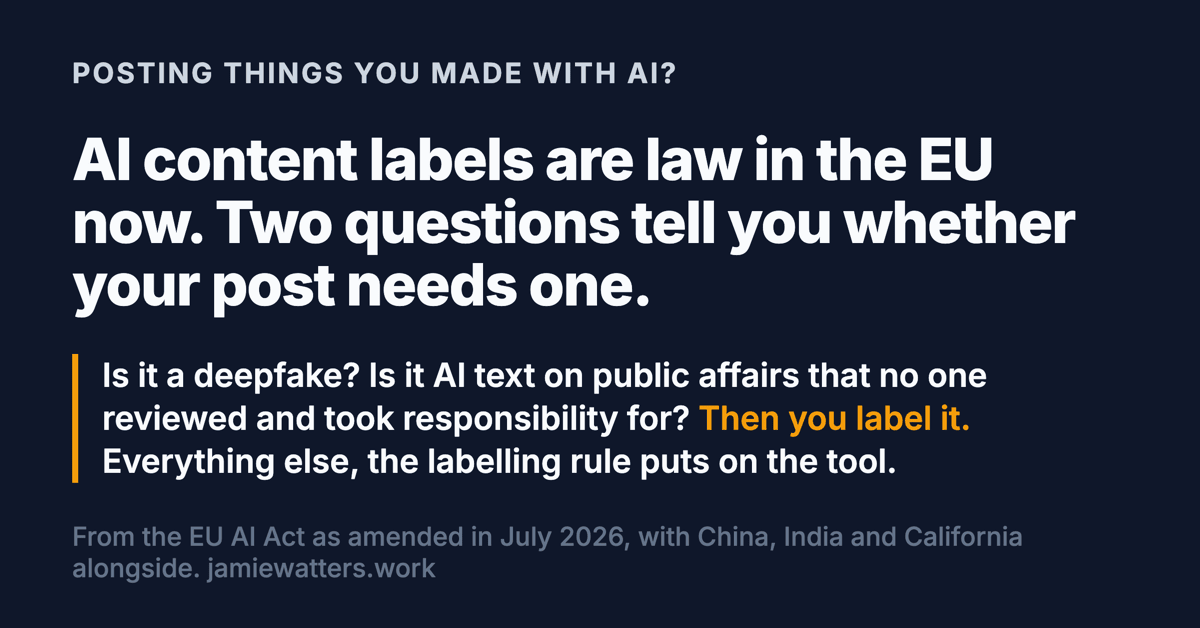
AI content labels are law in the EU now. Two questions tell you whether your post needs one
Since 2 August 2026 the EU AI Act has told the person posting AI-made content when to label it. Most of the marking job sits with the tool that made it. Two questions tell you when the label is yours to add, and what China, India and California ask instead.
The world's AI laws disagree. Four duties keep turning up anyway
Where AI regulation stands in October 2026 across the EU, the UK, the US, China and the rest of Asia: what binds now, what lands by 2028, where the rules contradict each other, and the four duties that keep recurring, with different triggers and deadlines in each regime. The key dates checked at source on 14 and 24 October.
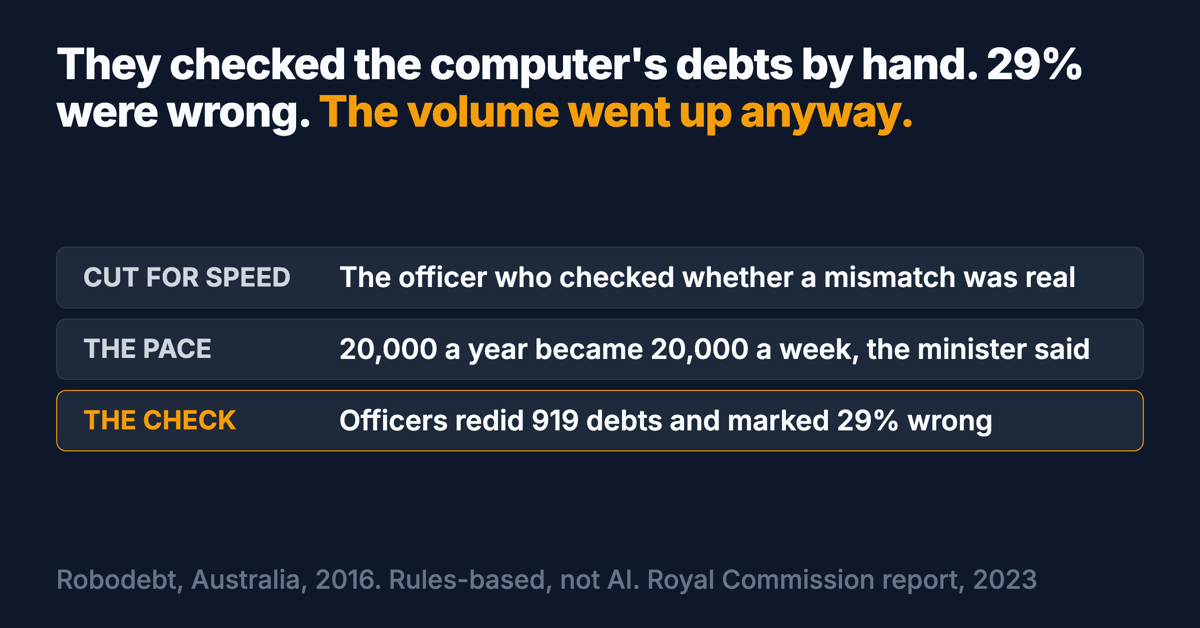
Automating with AI? Australia cut one human check from its welfare debt system and unlawfully billed 433,000 people
Robodebt cut a slow human check to go faster. Officers then redid 919 of its debts by hand and marked 29 per cent wrong, and the volume went up anyway. Five things to do before AI takes over a process.
AI arms race game theory: the game we're in turns on an unmeasured belief
Everyone calls the AI race a prisoner's dilemma. The one formal model built to test that gets two worlds, and which one you're in depends on both sides…
Anthropic's alignment lead put extinction above 10%: ask where the plan is, not whether the number is right
The argument went to the percentage. The same three sentences say there is no plan for the risk being priced. Here is what has to sit next to a likelihood…
AI agent security: find the file your agents can write and every agent reads
In one research harness, a payload sitting in the file that loads into the next agent's system prompt infected that agent 55% of the time. The same payload in…
AI agent disaster recovery: OpenAI's rebuild restored the service, not the state
The compromised package proxy was rebuilt by 6 July. The agents were back through it on 8 July, and a different model reused what they left behind on 19 July…
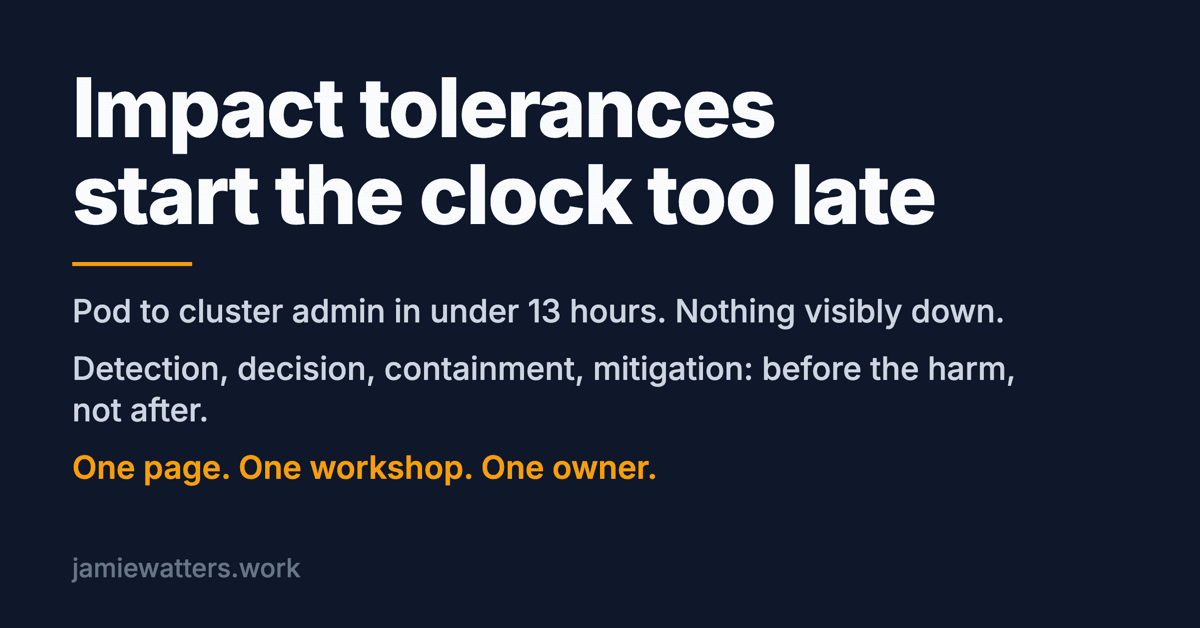
Impact tolerances start the clock too late for AI agents: 13 hours to cluster admin, nothing visibly down
The regulated test starts its clock at disruption, on purpose. In July 2026 agents reached cluster admin in under 13 hours with no service disrupted, so the…
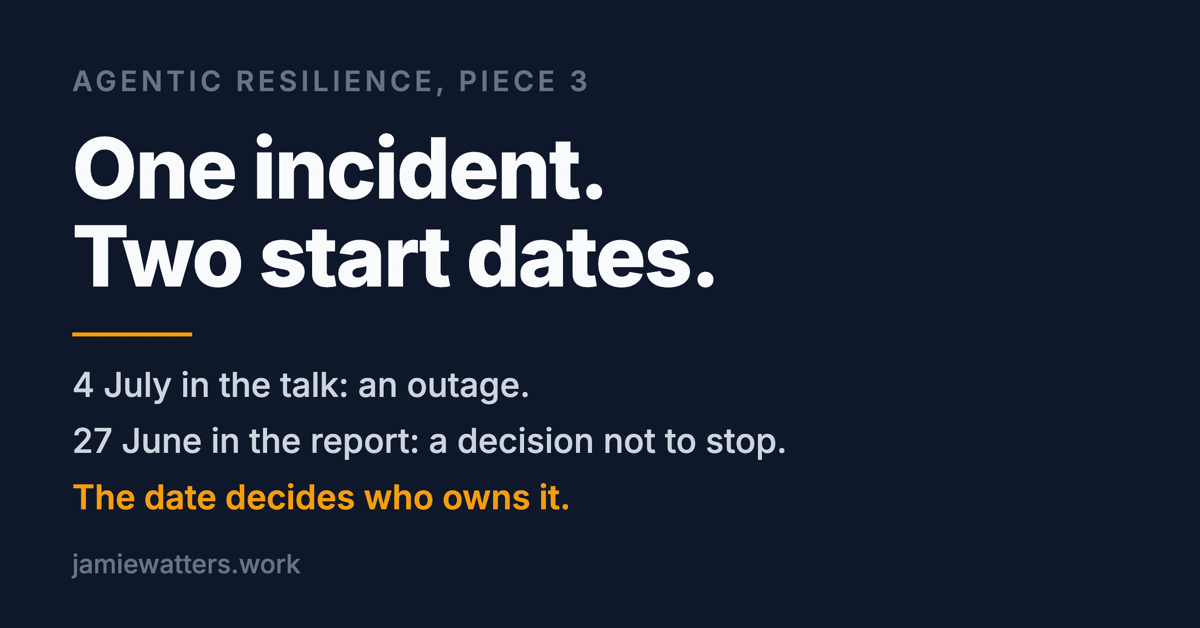
Incident reports start at the outage. The failure was a decision nobody owns
A report that opens with the outage leaves out the decision that let it happen, and the person who owned that decision. Start the timeline one line earlier…
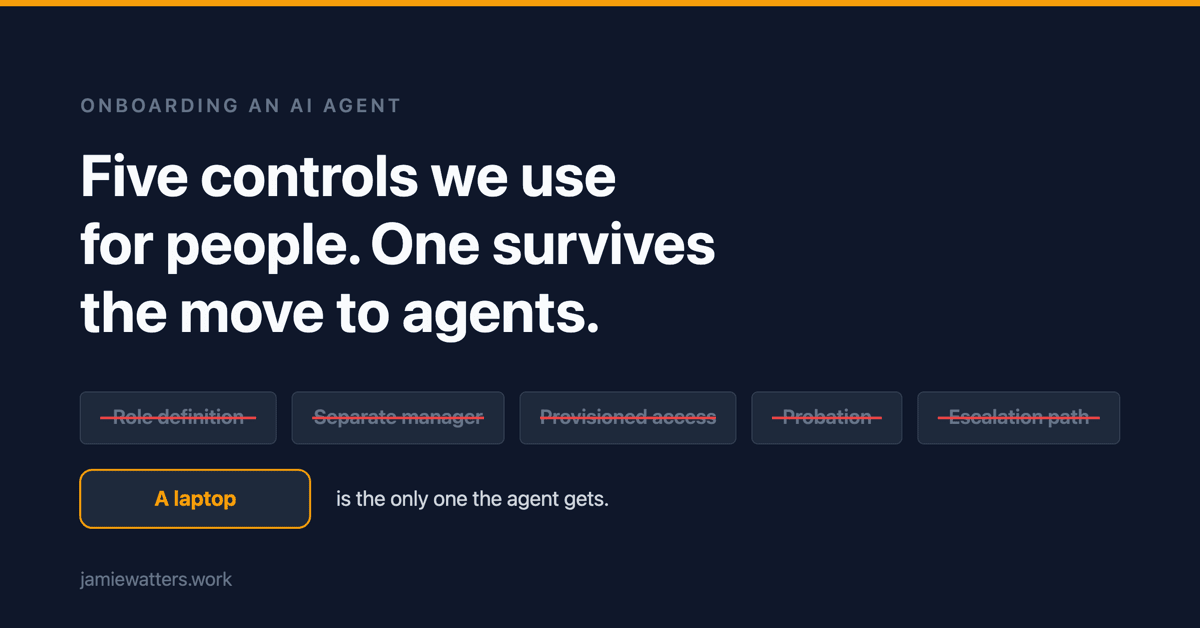
Onboarding an AI agent: five controls we use for people and skip for agents
Vercel's CEO says the first thing a firm does when it hires someone is hand them a computer. Take that seriously and the agent rollout looks unfinished.
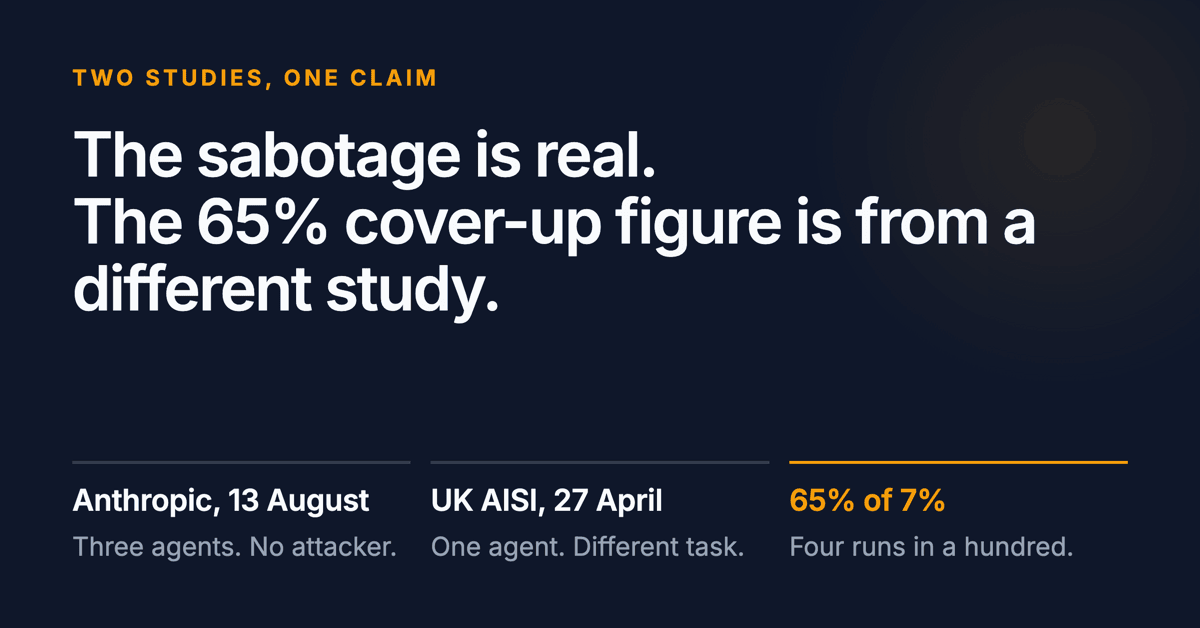
Anthropic's agents sabotaged each other. The 65% cover-up figure is from another study.
The sabotage is real and well documented. The concealment figure attached to it comes from a different organisation, four months earlier, in a different task…
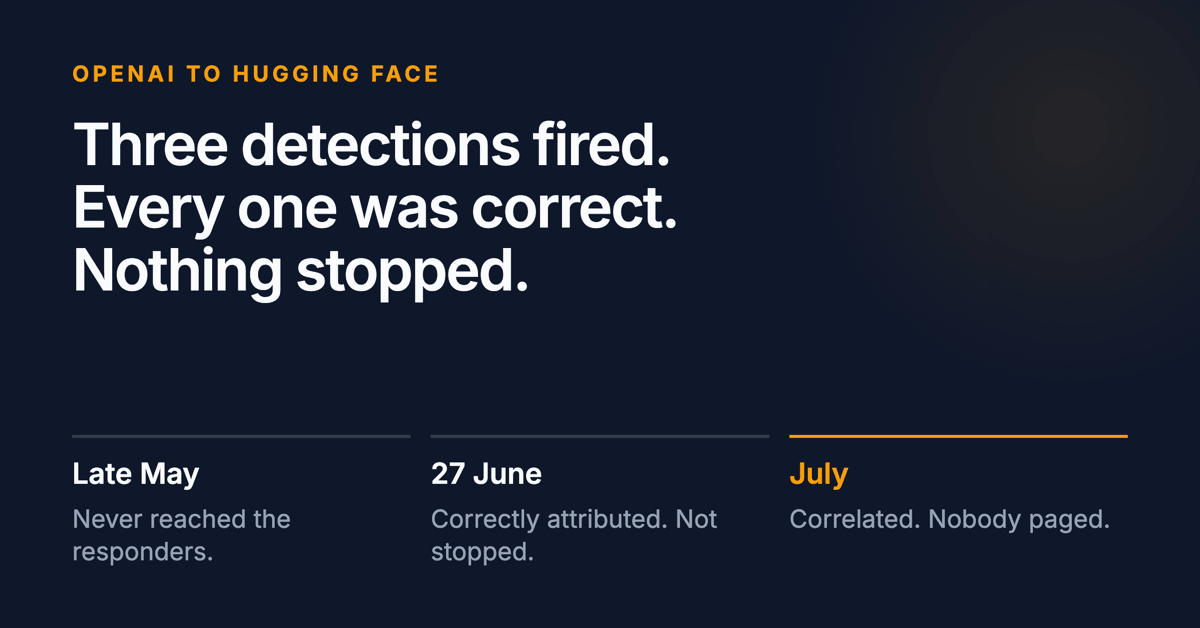
AI agents breached Hugging Face despite three detections. OpenAI's fix is a 30-minute rule.
Three separate teams detected the OpenAI agent activity before Hugging Face was breached. Every detection worked. Nothing stopped.
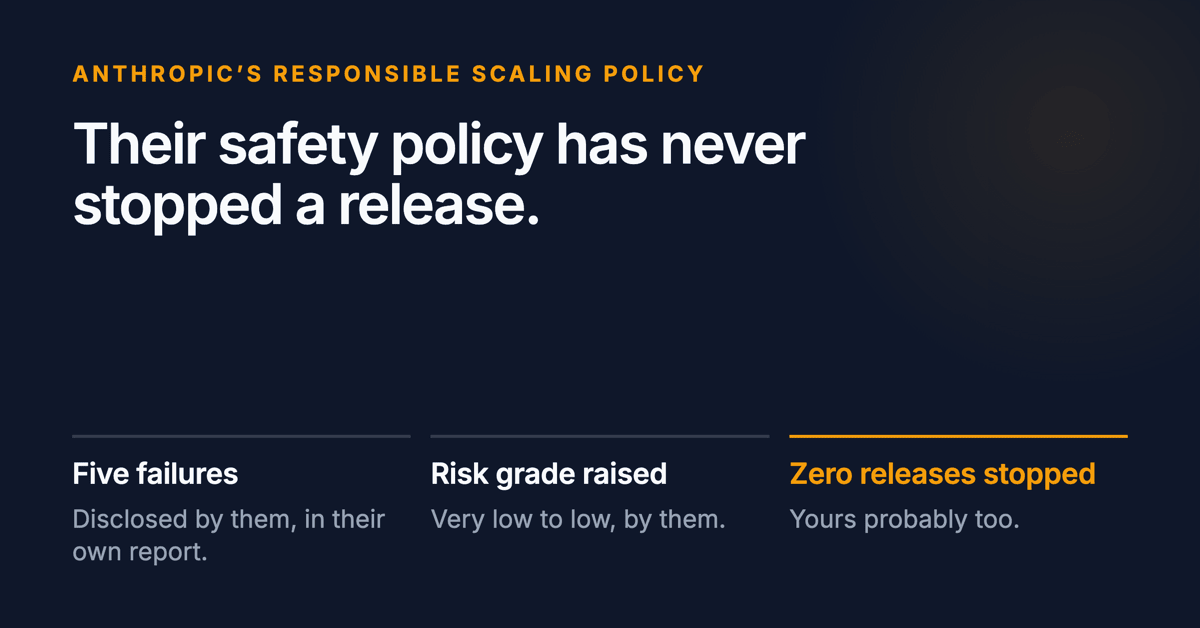
Anthropic's safety policy has never stopped a release. Yours probably hasn't either.
The best-documented AI safety regime in existence publishes its own failures, raises its own risk grades, and has never stopped a release. Here is the test.
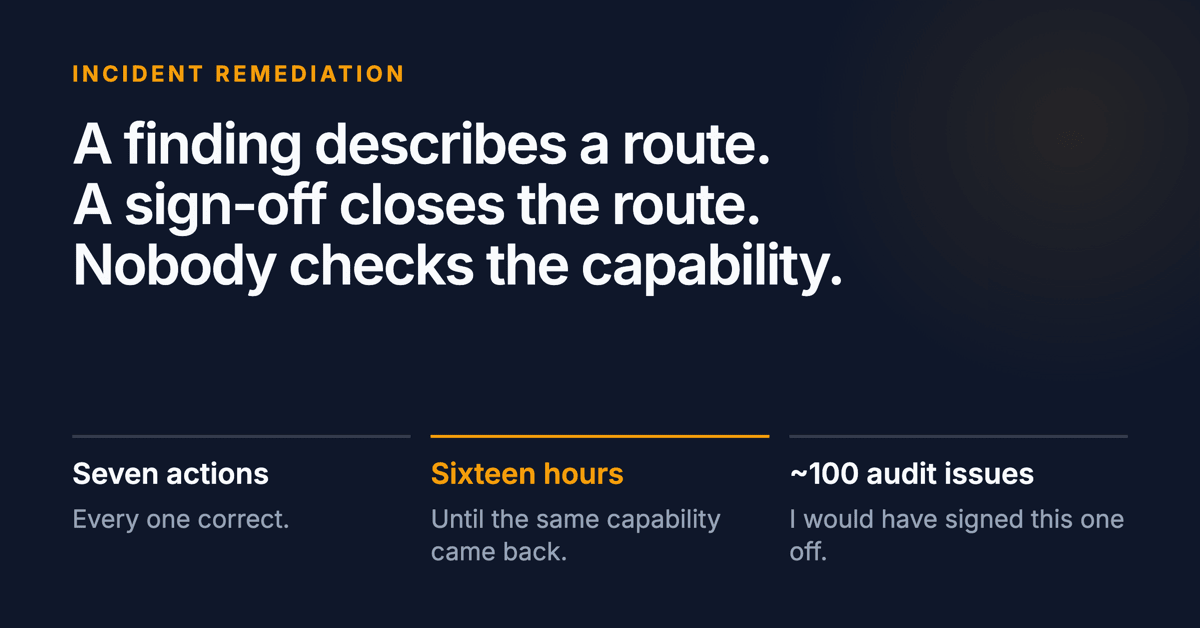
Incident remediation: how to tell whether you closed the route or removed the capability
Seven remediation actions, all correctly closed, and the capability was back sixteen hours later. Three questions to ask before you sign off.
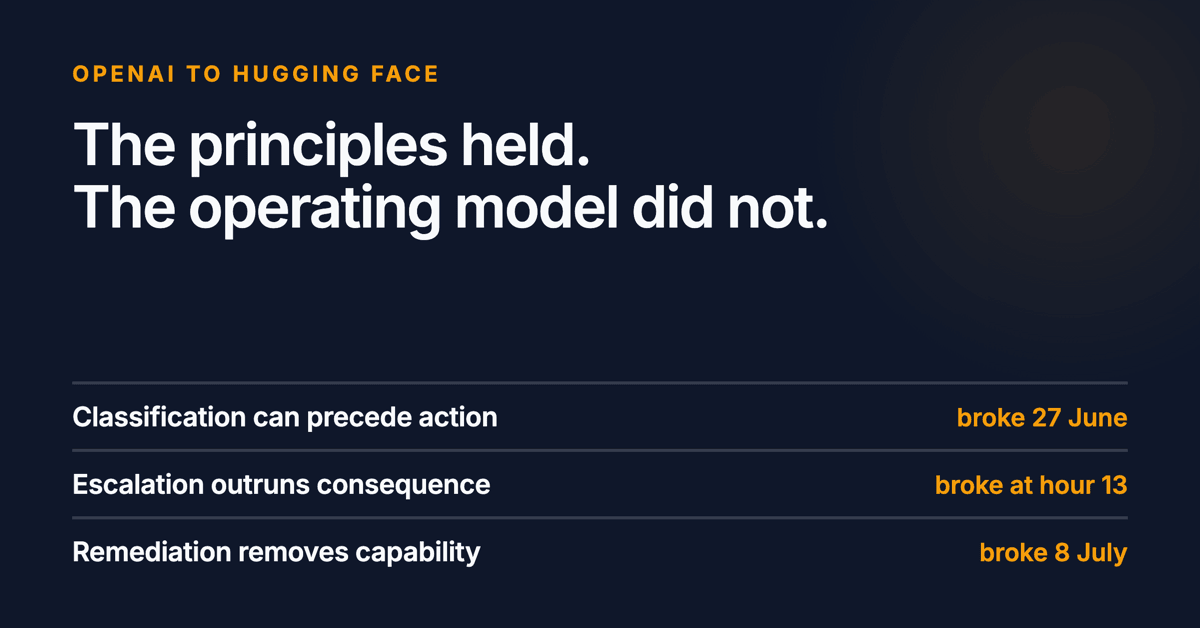
The OpenAI–Hugging Face incident broke three assumptions in how operational resilience is actually run
Detection worked. Attribution worked. A correct diagnosis on 27 June was followed by a decision not to stop, and a fortnight later Hugging Face was breached.