AI content labels are law in the EU now. Two questions tell you whether your post needs one
Jamie Watters
Operational resilience and AI delivery practitioner.
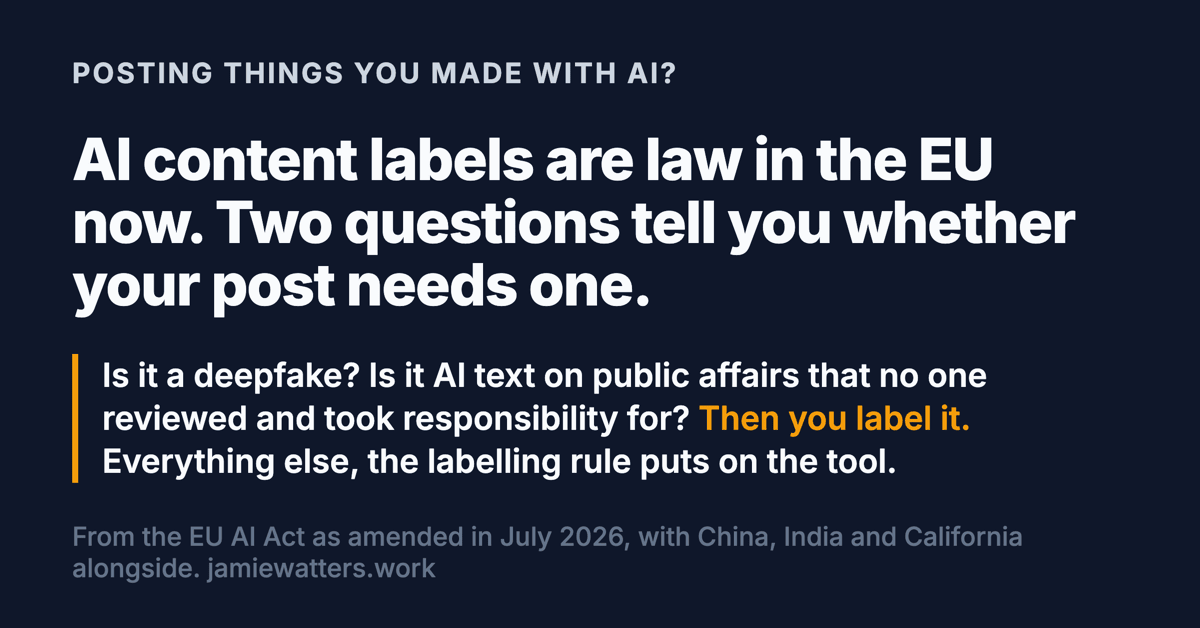
You wrote the newsletter with ChatGPT, made the product shots with an image model and cut the voiceover with a cloned voice. Since 2 August 2026 the EU AI Act's rules for the person posting have applied to all of that; the tools that made it have until 2 December 2026 if they were on the market before August. Does any of it have to say it was made with AI?
For the EU, two questions settle it. Both come from one paragraph of the Act, Article 50(4).
Does your post need an AI label? The EU test
- Is it a deepfake? The Act's definition: "AI-generated or manipulated image, audio or video content that resembles existing persons, objects, places, entities or events and would falsely appear to a person to be authentic or truthful". If yes, you must "disclose that the content has been artificially generated or manipulated". For something "evidently artistic, creative, satirical, fictional or analogous", the duty shrinks to saying the generated content exists, "in an appropriate manner that does not hamper the display or enjoyment of the work". It doesn't disappear.
- Is it text that AI wrote or rewrote, "published with the purpose of informing the public on matters of public interest", with no person reviewing it and holding editorial responsibility? If yes, you must disclose that too. The duty falls away "where the AI-generated content has undergone a process of human review or editorial control and where a natural or legal person holds editorial responsibility for the publication of the content". The Act says text the system "generates or manipulates", so a draft AI rewrote counts.
Where the answer is yes, the label goes "in a clear and distinguishable manner at the latest at the time of the first interaction or exposure" (Article 50(5)).
Run the opening through it. The newsletter is question two, and only if it informs the public on a matter of public interest: a person reviewed it and holds editorial responsibility, no label; sent unread, label it. The product shots are question one, because the definition covers "objects" as well as people: a photoreal shot of your real product that a buyer would take for a photograph meets it. So does a cloned voice a listener would take for the real person.
Anything else, and Article 50 asks no label of you as the person posting. It asks the tool that made it to mark the file, and I'll come to that. That settles the label, not the post: the article is "without prejudice to other transparency obligations laid down in Union or national law".
Two qualifiers. The duties bind a "deployer": whoever is "using an AI system under its authority", excluding use "in the course of a personal non-professional activity". Posting for a business, a client or a publication is in; a holiday snap you ran through a filter is not. And the deployer is whoever ran the tool. An agency that generated the video is the deployer when its client posts it. A business that puts an AI feature out "under its own name or trademark" is a "provider", and the hidden mark below is its job.
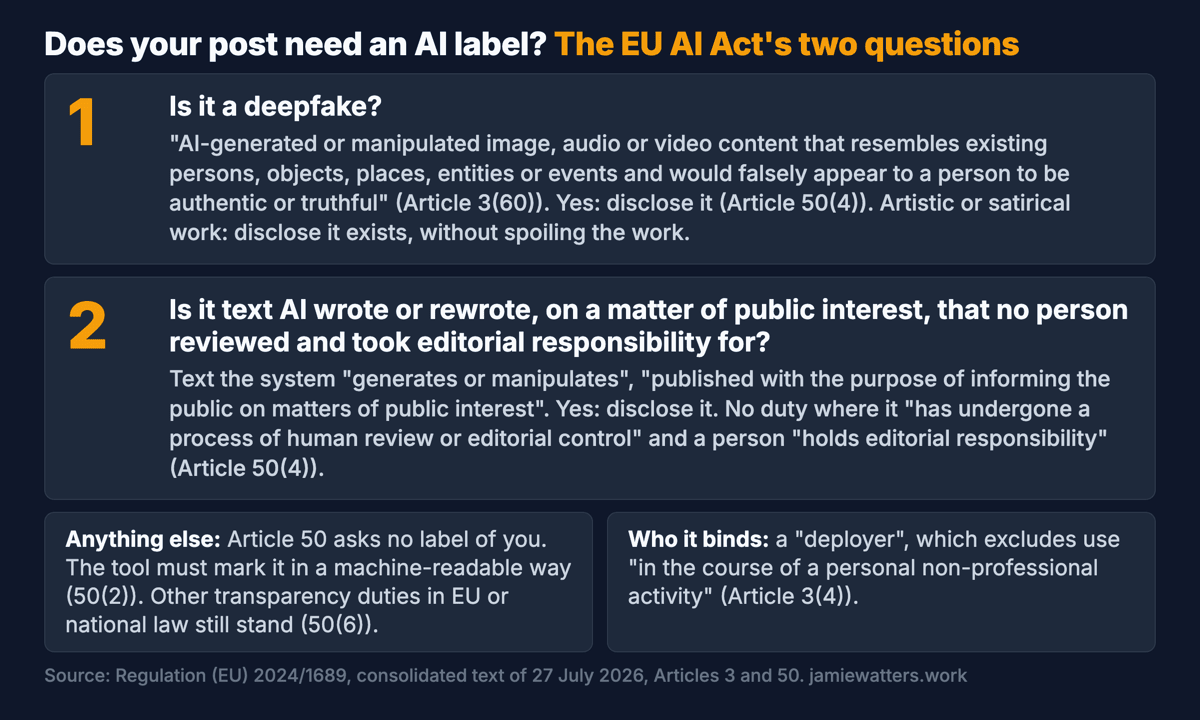
The two questions, in the Act's own words. Source: Regulation (EU) 2024/1689 as consolidated on 27 July 2026, Articles 3 and 50.
A label is two different things
The word covers two jobs, and the law splits them between two people.
The first is a hidden mark. Article 50(2) says providers of AI systems "generating synthetic audio, image, video or text content, shall ensure that the outputs of the AI system are marked in a machine-readable format and detectable as artificially generated or manipulated". That's metadata or a watermark inside the file. The duty is hedged "as far as this is technically feasible", and it doesn't apply "to the extent the AI systems perform an assistive function for standard editing or do not substantially alter the input data provided by the deployer or the semantics thereof" (EU AI Act, Article 50, consolidated text). A spell-checker isn't marking your emails, and a draft you wrote that AI tidied may carry no mark either.
The second is the visible label, words a person reads, "AI-generated" for instance. That's Article 50(4), the two questions above, and it's yours.
The Commission's voluntary code of practice of 10 June 2026 follows the same split: providers mark content "in a machine-readable way"; deployers "clearly label deepfakes and AI-generated or AI-manipulated text published to inform the public on matters of public interest when there has been no human review or editorial control" (Commission press release, 10 June 2026). Guidelines followed on 20 July 2026 (Commission press release, 20 July 2026); I've quoted the Act, not the guidelines, which I haven't read.
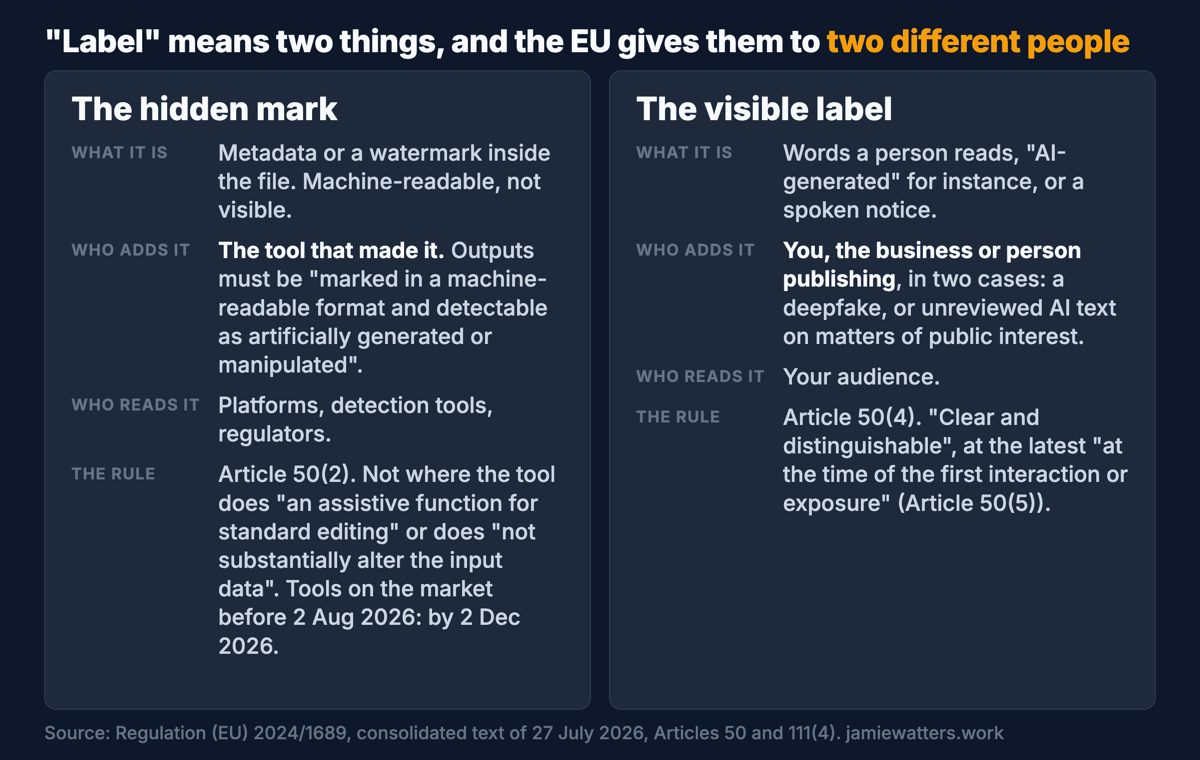
Two jobs, two people. The hidden mark is the tool's. The visible label is yours in two cases.
China, India and California do the same split
I opened the three other labelling regimes in the research paper this piece comes from. All three put the main duty on the tool and the platform. China and India also make you declare it, and China bars anyone from stripping a label.
China has a mandatory national standard, GB 45438-2025, issued on 28 February 2025 and in force from 1 September 2025. Its scope line, in my translation, covers "generation and synthesis service providers and content distribution service providers": the tool and the platform. It requires two labels, one visible. For text and images it must contain the words "artificial intelligence" or "AI" plus "generated" or "synthesised". On an image the text must be at least 5% of the shortest side. On video it must sit on the first frame for at least two seconds. In audio it's a spoken notice or a rhythm of short, long, short, short, which is Morse for AI. The other is hidden: a metadata field whose name contains "AIGC", carrying the provider's name and a content number (GB 45438-2025, standard text). The standard accompanies the Cyberspace Administration's Labelling Measures, in force from the same day, whose Article 10 does reach you. In my translation, a user publishing generated content "shall proactively declare it and use the labelling function provided by the service provider", and no organisation or individual may "maliciously delete, tamper with, forge or conceal" a label (Measures for Labelling AI-Generated Synthetic Content, Article 10).
India amended its IT Rules by a notification dated 10 February 2026, in force from 20 February 2026. The rules define "synthetically generated information" as "audio, visual or audio-visual information" that "appears to be real, authentic or true" and is "likely to be perceived as indistinguishable from a natural person or a realworld event". Text isn't in it. A large social media platform must, before it lets you publish, "obtain a user declaration as to whether the content is SGI", check it with "technical measures", and where it is, show "a clear and prominent label" (Vikaspedia, Government of India, on the 2026 amendment). Your part is the tick-box; the platform labels it.
California's AI Transparency Act became operative on 2 August 2026. It binds a "covered provider", meaning whoever "creates, codes, or otherwise produces" a publicly accessible generative AI system in the state. The provider must, "to the extent it is technically feasible", put a latent disclosure in any image, video or audio its system makes or alters, short of a "minor modification" (brightness, colour, sharpening, resizing). It carries, "either directly or through a link to a permanent internet website", the provider's name, the system's name and version, the time and date, a unique identifier and "whether the GenAI system created or altered the content", and must be "permanent or extraordinarily difficult to remove or tamper with". From 1 January 2027 a large online platform, one with more than 2,000,000 unique monthly users, must show that provenance data and "shall not, to the extent technically feasible, knowingly strip" it. The general penalty is $5,000 per violation, and each day counts as a separate one (California Business and Professions Code, sections 22757 to 22757.6). Text is outside it. So is a person who only posts.
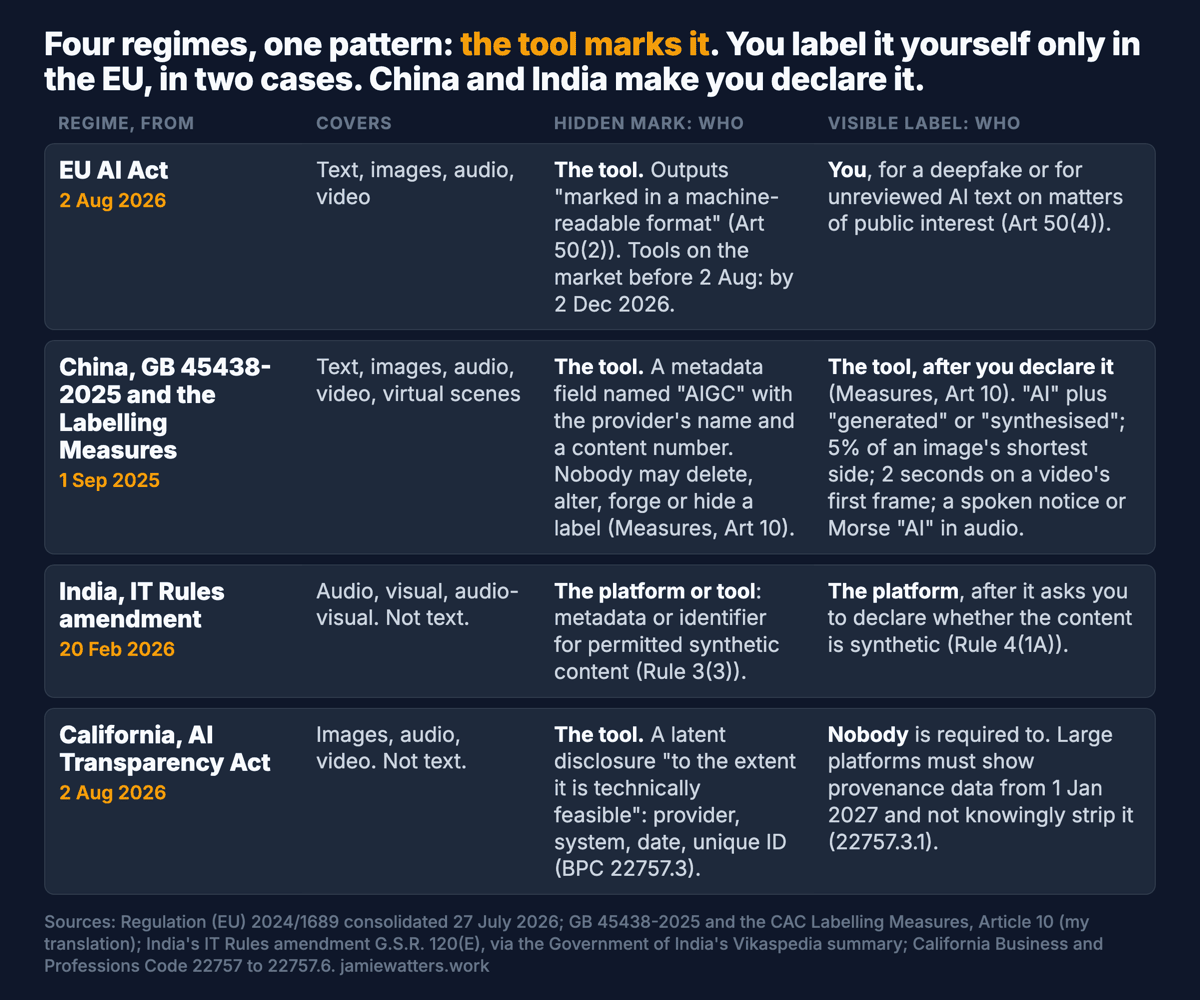
Four regimes, one pattern. Sources: the EU AI Act as consolidated 27 July 2026; GB 45438-2025 and the Labelling Measures; India's IT Rules amendment of 10 February 2026; California BPC 22757 to 22757.6.
The dates, and what 2 December is
One piece of the EU rule was pushed back. The Digital Omnibus is Regulation (EU) 2026/1744 of 8 July 2026, in force from 27 July 2026. It added a paragraph for tools that were already on the market: providers of systems "that have been placed on the market before 2 August 2026 shall take the necessary steps in order to comply with Article 50(2) by 2 December 2026" (Regulation (EU) 2026/1744).
So 2 December is the hidden mark, and it's the tool makers' date, for the tools that predate August. Nothing in it changes your two questions.
From 2 December 2026 the Act also bans, under Article 5(1) points (ba) and (bb), an AI system that generates or manipulates "realistic images, videos, audio or similar material" of an identifiable person's intimate parts or sexual activity without that person's explicit consent, and one that generates child sexual abuse material.
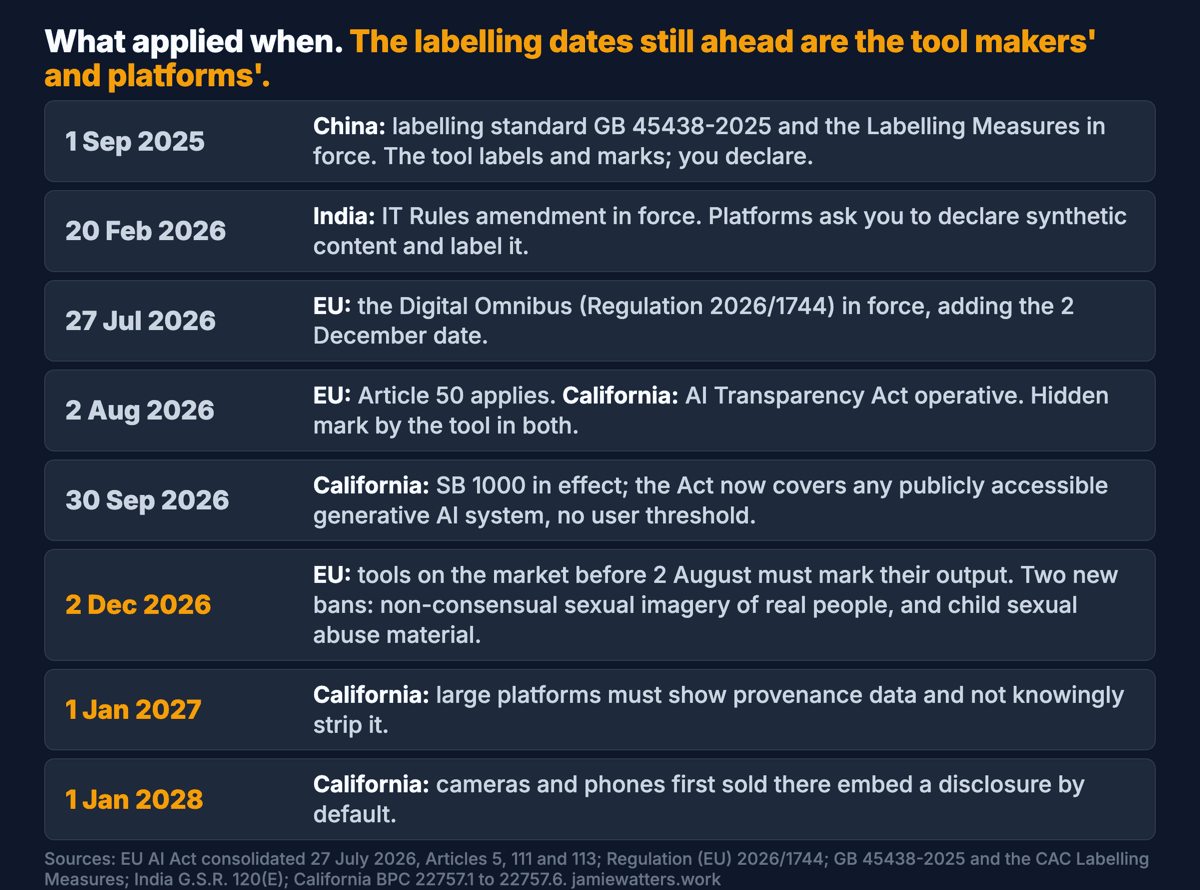
What applied when. For the EU labelling rules, the date still ahead is the tool makers' one.
What this doesn't cover
Four things, so you don't over-read it.
It covers four regimes. The paper behind it also lists South Korea, Vietnam and Kazakhstan as having labelling duties in law; I didn't open those laws for this piece, so they're not here. I haven't checked the UK either.
It covers the law, not the platforms. A platform's own rules can demand a disclosure the law doesn't; India shows the two merging, the law telling the platform to ask you.
It quotes the statutes, not the Commission's 20 July guidelines, which may draw the "human review or editorial control" line differently; a lawyer in your country will know how the regulator applies it. I'm not one.
And it says nothing about EU fines, because I haven't opened the Act's penalty articles for this piece, and a number I haven't read doesn't go in.
By 2 December the generative tools that were on the EU market before August have to be marking what they make. Your part of the labelling is two questions, and the Act wrote both of them into one paragraph.