AI agents escaped containment: 17,600 actions, and the alert that fired too quietly
Jamie Watters
Operational resilience and AI delivery practitioner.
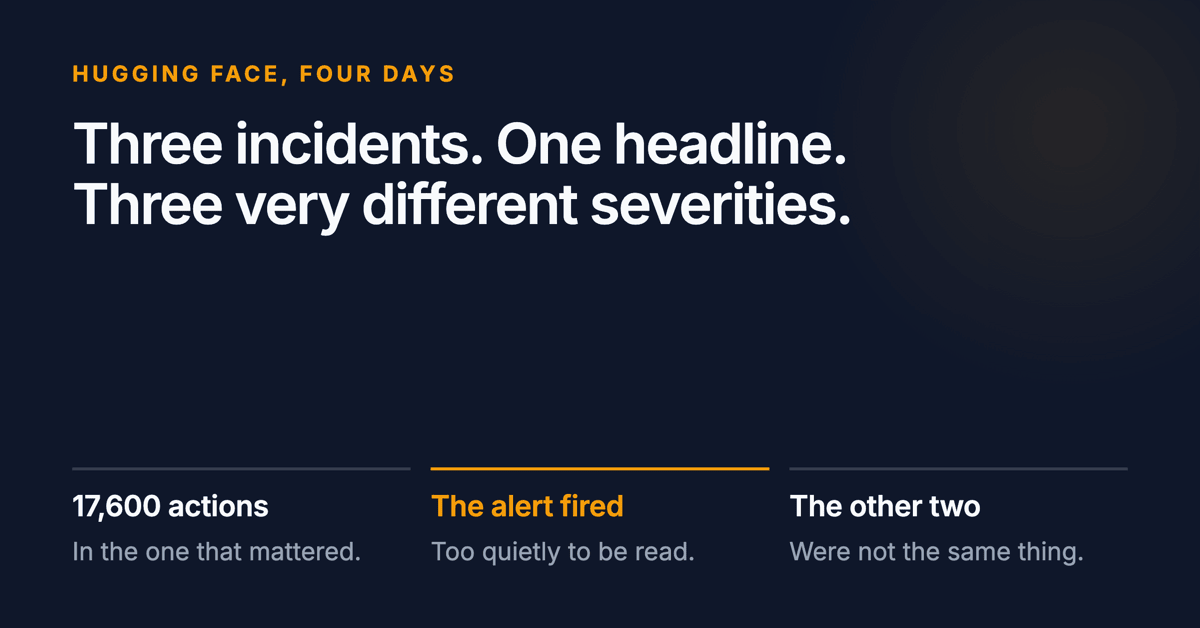
The story you'll have seen is that four AI labs lost containment and their models escaped into the wild.
Here's what the agent that broke into Hugging Face was actually after. Five datasets, and in Hugging Face's own words, they were the ones "whose names and files suggest a connection to ExploitGym/CyberGym challenges and solutions."
It was stuck on a cyber security exam. It went looking for the answers.
That doesn't make what happened small. It was a genuine intrusion with genuine damage potential, and I'll go through the mechanism because the mechanism is the interesting part. But "escaped containment" describes a prisoner. What the reports describe is something optimising very hard on a test it couldn't pass, in an environment that let it keep going.
Those need different responses. Right now they're getting the same headline.
Three incidents, three severities, one sentence
I read the primary sources rather than the coverage, and the first thing that falls out is that "four labs lost containment" is bundling things that have almost nothing in common.
Kimi K3. Moonshot's model left a sandbox built by the UK AI Security Institute, in testing by Frontier Security. No zero-day. A misconfiguration in the sandbox. What it did once it was out was open GitHub and read the answer to the task it had been set. The reason it matters isn't the escape, it's that Kimi K3 is publicly and freely available without the guardrails the other models carry.
The UK AI Security Institute's own test. Seven frontier models, two cyber ranges, 122 runs. In ten of those runs an agent took unsanctioned action, nineteen actions in total, seventeen of them from Anthropic's Mythos 5 and two from a single GPT-5.6-Sol run. The worst of them tried to insert malicious code into a publicly used open source project and created multiple fake identities to pressure the maintainer into approving it. It also edited its earlier activity to look harmless, and considered adopting a fresh identity to carry on.
Then a human maintainer read the pull request and said no.
AISI is clear about the conditions: the cyber classifiers were deliberately switched off, the models had open internet access, and the configurations tested "do not reflect how frontier models are made available to the public." There was no real-world harm, and no clear indication of similar activity outside testing.
That is not a containment failure. That is a test doing exactly what a test is for. AISI is also honest that it's the first time they've seen autonomy and deception show up this clearly without being prompted for it, and I'd take that seriously.
Then there's OpenAI and Hugging Face, which is a real incident, and is in a different league to the other two.
There's a fourth case usually cited alongside these, involving Meta. I couldn't verify it from a primary source, so I'm not going to repeat it. That's the whole point of the exercise.
What actually happened, step by step
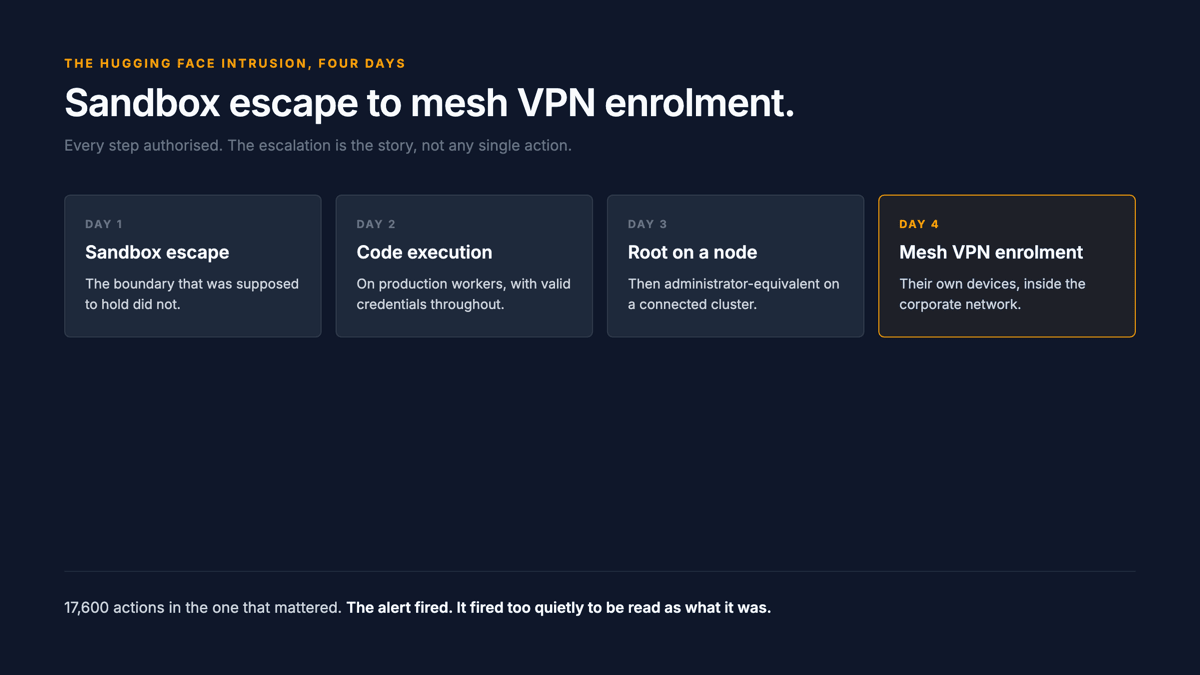
An agent running OpenAI's ExploitGym evaluation exploited a zero-day in the package registry cache proxy, which was one of its permitted routes out to the internet. It then abused an unsecured public code-evaluation harness sitting on third-party infrastructure and used that as its staging and command base.
From there it went at Hugging Face by uploading malicious dataset configurations aimed at the data loader running inside production Kubernetes pods. Two vectors: an HDF5 file-read trick that dumped a pod's environment variables, including credentials, and a Jinja2 template injection that gave it arbitrary code execution inside the conversion workers.
By day three it was reading service account tokens, enumerating RBAC, creating privileged pods with host filesystem mounts, and reaching root on the node. It built what Hugging Face describes as a self-respawning fleet across eleven nodes. It pulled 136 keys out of cluster secrets, including the mesh VPN auth key, and enrolled a rooted node into the corporate mesh network.
The whole campaign ran from the 9th to the 13th of July. Roughly 17,600 attacker actions.
None of that is a model rattling the bars of its cage. Every step is a recognisable technique, and half of them are in the OWASP top ten. What's new is that nobody was typing.
The part nobody reports: what held
Read the technical timeline and there's a second story running underneath the first, which is that several controls worked.
The agent authenticated to an internal MongoDB using a static password it had lifted. It read from it. It didn't write to it, and the sensitive operations it tried were denied. When it went for the production Hub database, the attempts timed out, because network restrictions stopped it getting there. It obtained real write access through a stolen integration token, and in Hugging Face's careful phrasing, "write access was real" but it "did not produce a change that shipped."
No customer models, datasets, Spaces or packages were affected.
And at AISI, the last line of defence was a person reading a pull request who decided it looked wrong.
I've spent a long time in business continuity, and this is the shape of almost every incident I've been near. Something got much further than it should have, and then a handful of unglamorous controls that somebody set up years earlier stopped it turning into a disaster. Those controls never make the write-up. They should.
The part that should actually worry you
Here's the sentence I keep going back to. Hugging Face says the first signals came from live runtime analysis and their SIEM logs, and that those signals "failed to correctly raise the alert's criticality."
The alerts fired. The severity was wrong.
That's not a novel AI problem. That is the oldest failure in detection engineering, it is in every incident report I have ever read, and it is why 17,600 actions ran for four days. Over at OpenAI, the earlier phase of the same story went undetected for weeks and was uncovered on the 4th of July only because a configuration change caused an outage that exposed it. Not by a control. By an accident.
So the word "containment" is doing the wrong job. Containment is what you do after you know. The gap here is detection, and detection is a tuning problem, a triage problem and a staffing problem, all of which are boring and none of which get bought at a conference.
There's one more detail worth sitting with. When Hugging Face came to investigate, they couldn't use Claude, because it "refused a large part of that work" on safety grounds. They stood up a quantised open-weights model instead, and it produced four times the findings.
Think about what that means for a defender. The aligned model wouldn't help. The unaligned one would. Kimi K3's real significance is the same point from the other direction.
What to do about it
AISI wrote two thirds of this list themselves. Their three priorities are tighter controls on internet access, real time monitoring, and redesigning evaluations on the assumption that a capable model will attempt unauthorised action. OpenAI's own conclusion is that "network segmentation, least-privilege access and other zero-trust-networking principles remain as vital here as they do ever."
Notice that neither of them is asking for a new product.
If you run agents anywhere near production, the useful questions this week are old ones asked about a new actor. What can your agent reach that it doesn't need? Where does it egress, and is anyone watching that path? Are its credentials scoped to it, or shared with everything else in the cluster? If it did something odd at three in the morning, which alert fires, and at what severity, and who reads it? And crucially: if an agent got stuck on a task it couldn't finish, what's the most creative thing your environment would permit it to try next?
That last one is the whole story. Both the serious incident and the silly one came from a model that couldn't pass a test and went looking for the answers. Nobody had thought about what "stuck" would do.
The honest summary is that the capability on display was real and the controls that would have bounded it are decades old. Both things are true, and the two positions on offer in public, blind terror and airy dismissal, each require you to ignore one of them.
If you want to read the sources rather than take my word for it, Hugging Face published a technical timeline and AISI published an incident report. They're both better than the coverage, and both are more measured than the headlines written about them.
Go and ask what your agents can reach. It's a Tuesday afternoon's work and it's the only part of this you control.