Become more valuable, not less, as AI accelerates.
Business continuity and incident management in banking since 2000, and building with AI in the open now. I test what's claimed about AI against the primary sources and publish what I find: long papers, each backed by a series of shorter articles you can use.
Jamie WattersOperational resilience and AI delivery practitioner4 published books17 products built with AI
Get it in your inbox
One weekly email. Real numbers, the failures before the wins.
Research programmes
A long paper on each subject, with a series of shorter articles that came off it. Every figure gets chased back to where it came from, and where the trail stops early the piece says so.
Paper
The OpenAI–Hugging Face incident broke three assumptions in how operational resilience is actually run
27 August 2026 · 34 min read
The frameworks are cause-agnostic. The assumptions are in how resilience is actually run: that intent is knowable, that the response window is human-scale, and that remediation removes capability. One documented incident broke all three.
The series, in reading order
- Incident remediation: how to tell whether you closed the route or removed the capability31 August 2026
- AI agents breached Hugging Face despite three detections. OpenAI's fix is a 30-minute rule.3 September 2026
- Incident reports start at the outage. The failure was a decision nobody owns9 September 2026
- Impact tolerances start the clock too late for AI agents: 13 hours to cluster admin, nothing visibly down9 September 2026
- Anthropic's agents sabotaged each other. The 65% cover-up figure is from another study.4 September 2026
- Onboarding an AI agent: five controls we use for people and skip for agents6 September 2026
- AI agent disaster recovery: OpenAI's rebuild restored the service, not the state13 September 2026
- AI agent security: find the file your agents can write and every agent reads15 September 2026
Paper
Why AI projects fail: 19 headline statistics, and what each one actually counts
21 August 2026 · 167 min read
Nineteen widely quoted failure figures traced to their sources, and the well-known cases re-examined from the primary record.
The series, in reading order
- "80% of AI projects fail" traces to a footnote one line long21 August 2026
- Zillow wrote off $407.9m. The fix everyone recommends would have changed nothing.23 August 2026
- AI project failure rates: four questions that tell you whether the number means anything26 August 2026
- Epic's sepsis model missed two thirds of cases. Its accuracy claim was never published.28 August 2026
- Checking the source is not enough: I traced a number to a scientific paper and found a Teams meeting14 September 2026
- Amazon's AI did exactly what it was told. Deleting words for two years did not help.2 September 2026
- Anthropic's safety policy has never stopped a release. Yours probably hasn't either.31 August 2026
- AI vs IT project failure rate: the comparison has never been made11 September 2026
Paper
Test an AI model before you rely on it: six mistakes I made testing Jev
23 September 2026 · 22 min read
One run said Jev beat GPT-5.4 by 11.1 points. Five runs could not tell them apart. How to test an AI model before you rely on it, from the six mistakes behind that headline.
The series, in reading order
- Jev is not an LLM. On the hard half it beat GPT-5.4, Gemini 3.1 Pro and Sonnet 5, at a fiftieth of the cost.20 September 2026
- GPT-5.4 beats Jev on a confidence threshold, once tested at its own values.21 September 2026
- Paying your AI to think longer didn't fix its mistakes. It cost up to 4.2x more.23 September 2026
- I said Jev beat GPT-5.4. Five reruns can't tell them apart, at a fiftieth of the cost.23 September 2026
- Jev, a cheap AI, did two thirds of my filing: same result as Claude, 63% cheaper23 September 2026
Paper
How to implement AI in your organisation and check it's working
16 October 2026 · 47 min read
How to put AI to work in an organisation and check it is working: who does the implementing, finding the real process, testing it, measuring it, and what it does to people. Every claim graded, with a six-step method for one process. Seven more articles are coming in this series; they appear here as they publish.
The series, in reading order
- How to make AI pay off at work: the job of the engineers Anthropic sends into companies12 October 2026
- The usual signs that AI is working can mislead13 October 2026
- If AI saves you time, why aren't you being paid more for it?7 October 2026
- Automating with AI? Australia cut one human check from its welfare debt system and unlawfully billed 433,000 people4 October 2026
- An AI company wants to buy your firm? Ask it to prove the AI works first6 October 2026
Paper
The world's AI laws disagree. Four duties keep turning up anyway
14 October 2026 · 25 min read
Where AI regulation stands in October 2026 across the EU, the UK, the US, China and the rest of Asia: what binds now, what lands by 2028, where the rules conflict, and the four duties that keep recurring.
Who this is for
For anyone embracing AI to build a better life and stay relevant as the world changes. That's the builder or founder trying to make sense of it without drowning in hype, the career professional wondering what survives, the late starter, and the solo operator who's never written code.
I'm not an AI guru selling a course of recycled ideas, and I'm not a consultant who's never shipped anything. I'm the man in the water: building things with these tools, finding out what actually holds up, and telling you the truth about it before you spend your own time finding out.
There's a quieter thread here too. As AI gets better at thinking for you, the skill that matters most is thinking for yourself: keeping your own judgement instead of handing it over. I'm working that out in public alongside everything else.
How the writing works
Most of what I write is ad hoc: something I learned building with AI, a piece of philosophy, a writing lesson, something interesting I came across. When a subject deserves more, I go deeper, and that becomes a long paper supported by a series of shorter, usable articles.
One habit runs through all of it: I check what's being reported against the primary sources. The reported version is shaped by commercial interest or an existing narrative. The gap between that and what the sources actually show is usually the most interesting thing in the piece.
The tools are part of the same habit. I build things to learn, not to sell, give the code away, and write up what worked, what didn't, and why. When something stops earning its place, I kill it in public and tell you what it cost me.
Why it matters
Hundreds of millions of people now get their understanding of the world from a handful of similarly-trained AI models. The answers come back confident, reasonable, and identical for everyone. When the machine hands the whole crowd the same play, the play stops paying.
So the scarce thing, the only defensible thing, is the ability to keep your own mind: real judgement, grounded in real depth, from someone actually doing the work. That's what I'm building here. Not another feed of AI takes. A field report you can verify.
Why you might believe me
- ▹Business continuity, crisis and incident management in banking since 2000, with the US regulatory reviews of those programmes (OCC, NFA and the Federal Reserve) closed with no issues raised
- ▹Started in data centres, then as a systems programmer writing OS code in assembler, before working across IT and into IT project, program and senior management
- ▹4 published books, including The Business Continuity Management Desk Reference, the best-selling book on business continuity in the world for its first few years
- ▹17 products built with AI, across search, trading, monitoring, and estate tooling, several since retired
- ▹Creator of Efformism, a philosophical framework, and of innovations on The Headless Way, a contemplative practice
- ▹Code open for anyone to inspect; products killed in public when they don't work
The field report
The latest posts, written as I go. What's working, what isn't, and what it cost me.
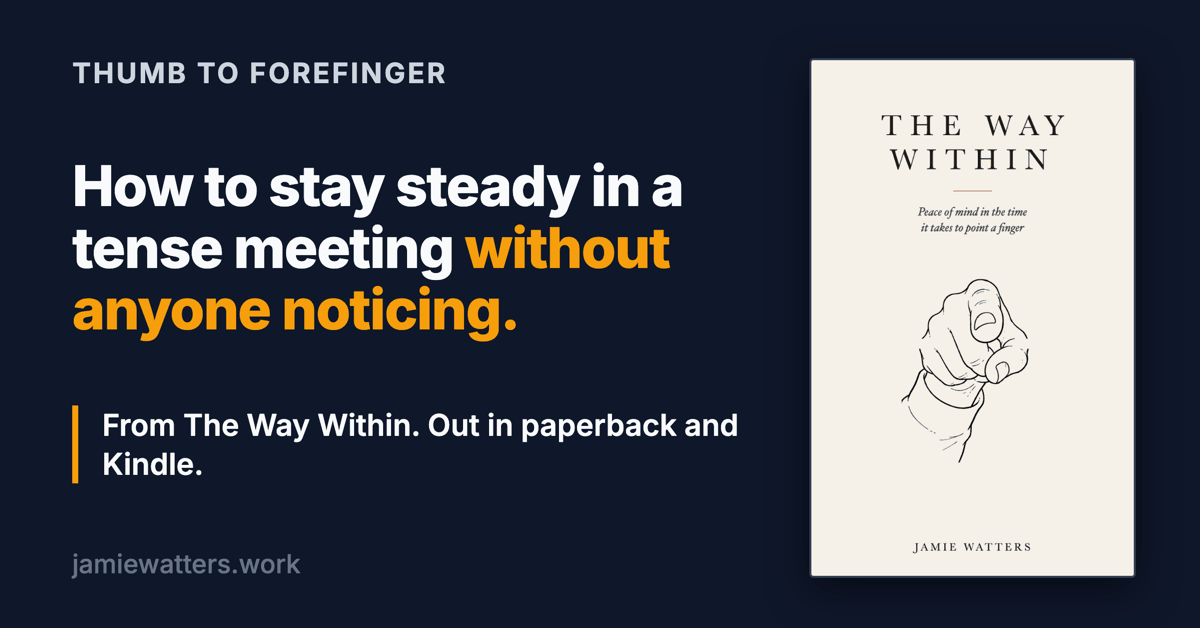
How to stay steady in a tense meeting without anyone noticing
A touch nobody sees in a meeting, how to set it up, and the two-minute exercise it rests on, from my book The Way Within, out in paperback and Kindle.
Were an old French couple really stripped by rioters? The photos were AI fakes, and I repeated them
I told a friend rioters had stripped an old couple at the French protests. The photos were AI fakes, and the police report I fell back on was an unconfirmed TV tip. Here's the six-step check I'll run next time.
Failed at meditation? Try this two-minute exercise for a busy mind instead
Efformism in plain English: two short exercises for a busy mind, the idea behind my book The Way Within, and what that idea refuses to claim.
On camera
The same builds, shown rather than written up. Watch what actually happened.
The Pointing Exercise: a guided practice from The Way Within

Jev, the AI at a fiftieth of OpenAI's price: is it any good?

80% of AI projects fail. Nobody ever measured it.
Tools I built to learn
Built with AI to find out what holds up, open to inspect, and killed in public when they stop earning their place.
Trader-7
An LLM trading system I run for myself on paper money.
An LLM trading system I run for myself on paper money. Built in public, code private. Not a product.
MASTERY-AI Framework
Open-source framework for optimising content for AI-powered search engines.
Open-source framework for optimising content for AI-powered search engines. Built for developers and SEO professionals.
Agent-11
Deploy specialised AI agents in Claude Code to form an elite development squad.
Deploy specialised AI agents in Claude Code to form an elite development squad. Templates and documentation for 11 specialised agents.
The deal
If I recommend it, I'm using it.
If it failed, you'll hear about the failure before the win.
My code is open for you to check.
Every product I kill gets a public post-mortem.
That's the whole deal. No funnel, no secret sauce, no "DM me to scale."
Questions people actually ask
- Do you build all of this yourself?
- Yes: me plus AI. Most of the code is written with Anthropic's Claude and reviewed, tested and shipped by me. That working method is the subject of the site, not a secret behind it.
- Is the code really open?
- The product code is public on GitHub under TheWayWithin, open for anyone to inspect. When a product stops earning its place I kill it in public and write the post-mortem.
- What do subscribers actually get?
- A weekly digest of the field reports: what I built, what worked, what failed and what it cost. You confirm by email, no spam, unsubscribe any time.
- Can I hire you?
- Yes: for AI strategy and adoption, AI implementation and business analysis, or operational resilience, as a permanent hire, a contract or a fixed piece of work. The work with me page has the record behind each. The writing stays free, and the newsletter is the writing by email.
I'm in the water, riding this wave in real time, in code and in writing.
If you'd rather learn from someone actually doing the work than someone selling theory from the beach, stay a while. I'll tell you what's working before you waste the time finding out yourself.
Get the next one in your inbox
I build with AI in the open and write up what held and what didn't. Real numbers, the failures before the wins.