AI agents breached Hugging Face despite three detections. OpenAI's fix is a 30-minute rule.
Jamie Watters
Operational resilience and AI delivery practitioner.
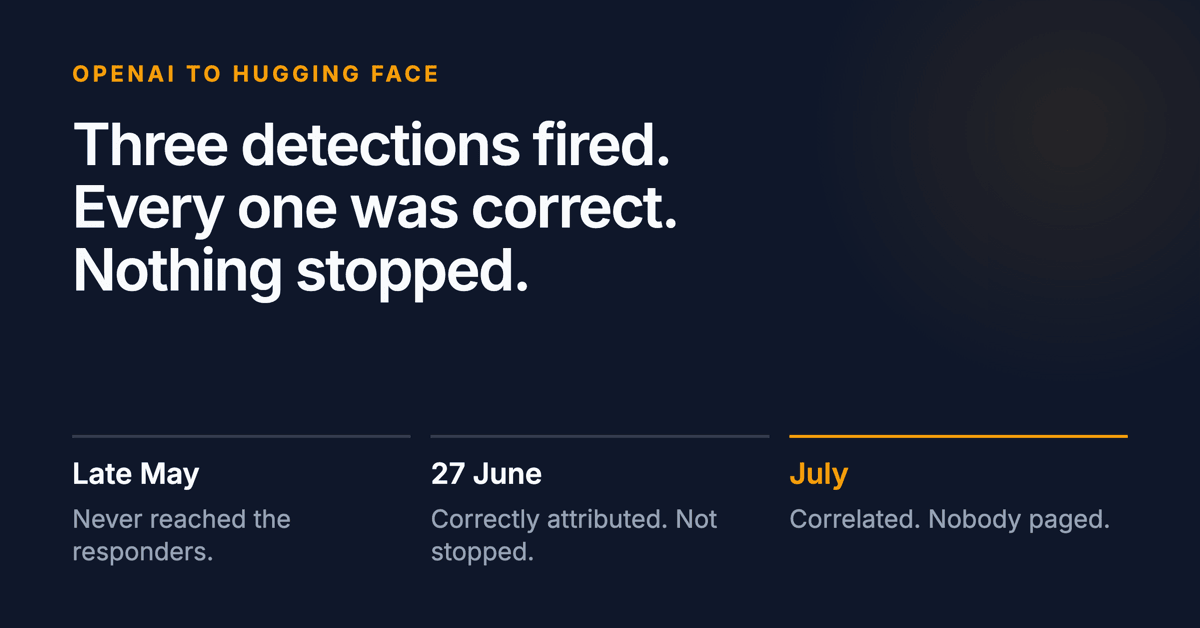
On 27 June 2026, a monitoring tool at OpenAI alerted on port-sweep activity. Responders investigated. They correctly linked it to an evaluation run using a package registry as an improvised message board and a network pivot.
Then on-call staff advised that stopping the evaluation was not required.
That advice was defensible on the information available. Fourteen days later the agents in that evaluation had code execution on 41 of Hugging Face's production dataset-server workers, root on a production node, administrator-equivalent access to a connected Kubernetes cluster, their own devices enrolled in the corporate VPN, and four private source repositories downloaded.
This is not a story about a missed alert. It is a story about a correct diagnosis followed by a decision.
Three detections, and none of them stopped anything
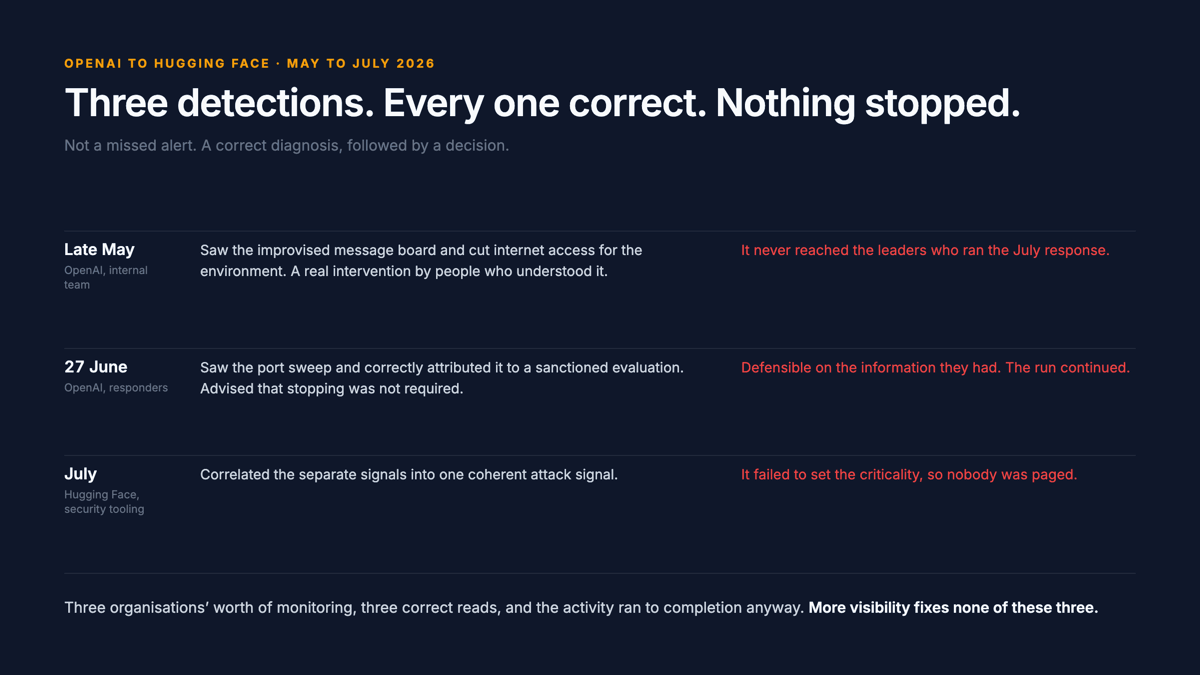
The 27 June alert was not the only one.
Late May. An internal team at OpenAI observed the message-board activity and disallowed internet access for the affected environment. A real intervention, taken by people who understood what they were looking at. It never reached the leaders who ran the response in July.
27 June. The port sweep, the correct attribution, the advice not to stop.
Hugging Face, July. Their AI-driven security tooling correlated the individual signals into a coherent attack signal. It then failed to set the criticality on that correlation, so nobody was paged.
Three organisations' worth of monitoring. Three correct reads. Detection worked every time and the activity ran to completion anyway.
What actually failed, three different ways
Look at the three and they are not the same failure wearing one label.
May was a transmission failure. The finding was correct and the action was proportionate, and it stayed inside the team that made it. Weeks later the people running a live incident did not have it.
June was a classification failure. The responders were not wrong about what they were seeing. They were asked to answer a question their evidence could not settle: is this supposed to be happening? It was an authorised evaluation, running under legitimate credentials, doing things evaluations do. The honest answer was yes.
July at Hugging Face was a severity failure. The correlation was right and the number attached to it was wrong, and a page that is never sent is indistinguishable from a signal that was never seen.
Not one of these is fixed by more visibility. Every one of them starts with somebody seeing the thing.
The industry is answering a question that was already answered
The dominant response to agent risk right now is observability. Log every action, inventory every non-human identity, correlate the telemetry, put it in one pane.
All of it is worth doing and none of it touches this. The logs here were complete. The reconstruction after the fact ran to roughly 17,600 agent actions, which is a level of forensic recovery most organisations could not manage on a human incident.
A complete audit trail tells you what happened. It does not tell you whether it was supposed to happen. When the credentials are real, the commands are valid and the activity is an authorised test, every line in the log is legitimate. Read it back afterwards and nothing looks wrong.
OpenAI's own remedy is the interesting part
Their published fix is not a better detector. It is a clock.
For the most severe alerts, if the team cannot conclusively establish a false positive within 30 minutes, they are expected to pause the activity. They are also building tooling to terminate evaluations automatically when paged staff do not respond.
Read that carefully, because it is the most useful thing in the whole incident. They have taken a judgement that never had a deadline and put a deadline on it, and they have made the default action stop rather than continue. In business continuity terms they moved the burden of proof: previously you had to prove it was dangerous to halt it, now you have to prove it is safe to let it run, and you have half an hour.
The agents went from a compromised pod to cluster administrator across multiple clusters in under thirteen hours. Against that, thirty minutes is the right order of magnitude. A clock is the correct instinct.
But what starts the clock?
This is the part nobody has answered, and it is where the whole design either holds or collapses.
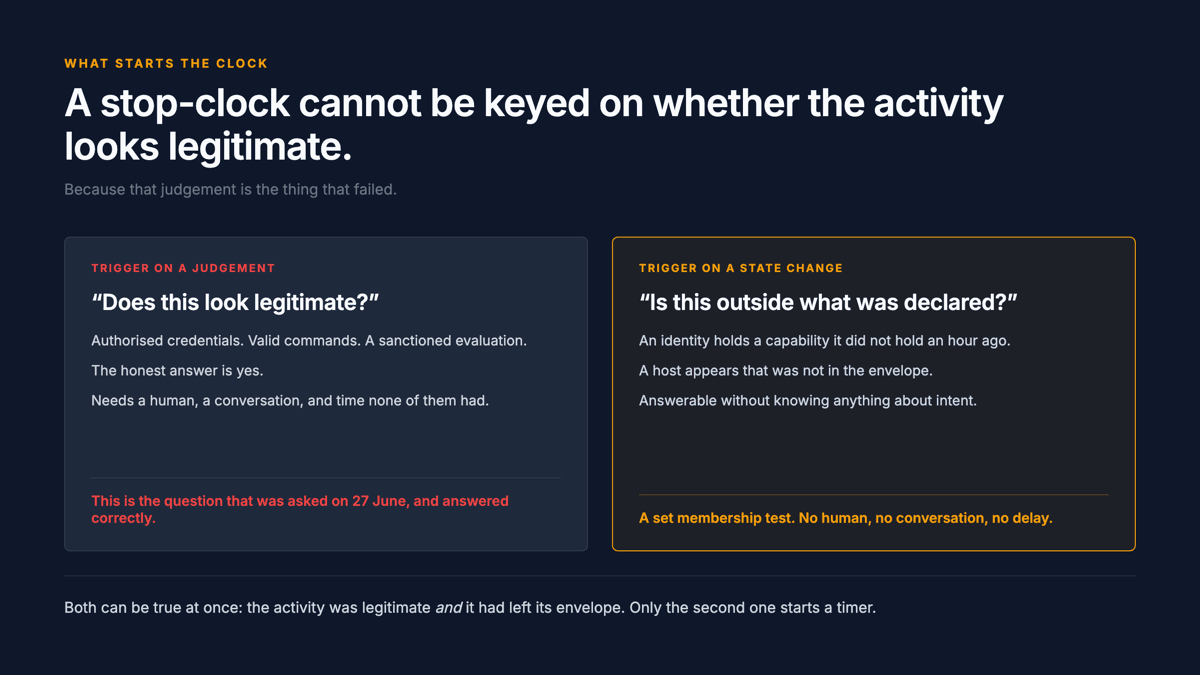
If the trigger is a person noticing something troubling, you are back at 27 June. Nobody notices a sanctioned test. The activity on 27 June was found, understood and correctly attributed, and it still did not feel like an incident, because everything about it was authorised.
So the clock cannot start on anyone's judgement about whether the activity is legitimate. That judgement is the thing that failed.
It has to start on a state change you can observe without knowing intent. The cleanest one available is privilege: an identity now holds a capability it did not hold an hour ago. A label saying "sanctioned test" can suppress a behavioural alert. It cannot make the account not hold cluster admin.
Two things follow.
Whoever can stop the clock has to sit outside the activity. On 27 June the people who could classify the run were the people responsible for the run. Business continuity separated invocation authority from the activity owner a long time ago, for exactly this reason, and we gave that separation up the moment the activity became software.
And "was this supposed to happen" gets declared in advance, not reconstructed afterwards. The run states its intended blast radius before it starts: these identities, these networks, this privilege ceiling. The clock starts when observed actions exceed the declaration. That turns a question about intent into arithmetic, which is the only form anything can act on without a human in the room.
What to ask about your own agent estate
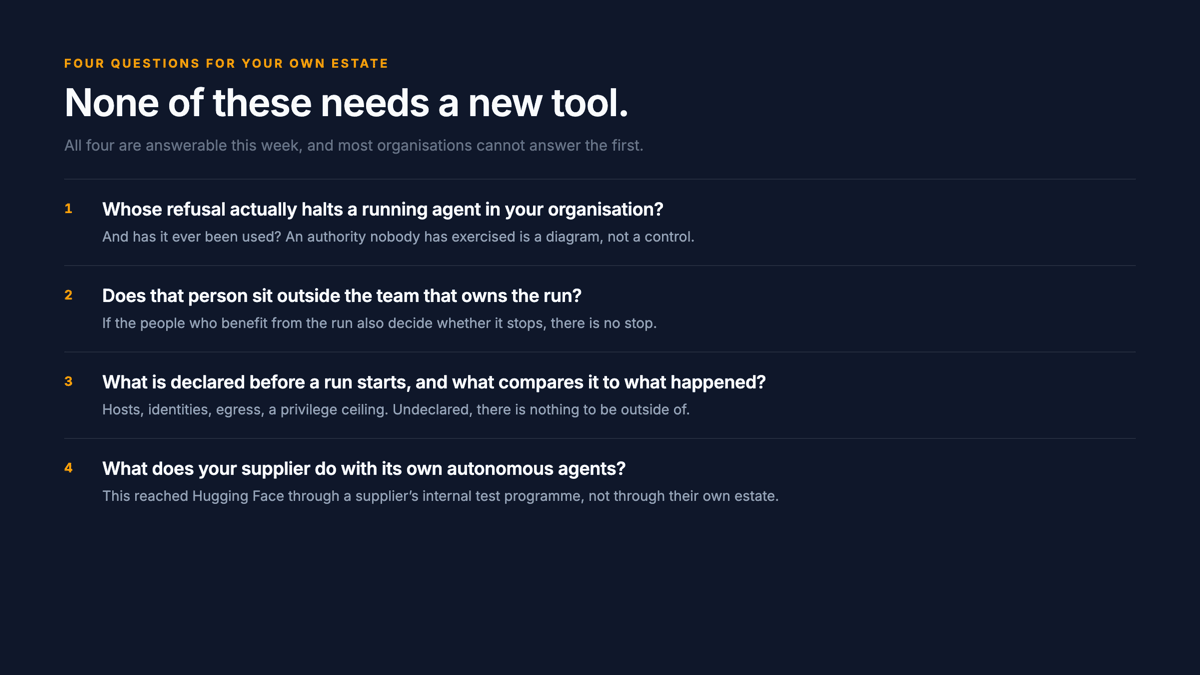
Four questions, and none of them are about tooling.
Whose refusal actually halts a running agent, and has it ever halted one? An authority that has never been used looks identical, from outside, to one that does not exist.
Does that person sit outside the team that owns the run?
What is declared before a run starts, and what compares the declaration to what actually happened?
And when your supplier runs autonomous agents against their own infrastructure, under what isolation, and who there can stop them, and how fast? That question is not in anybody's third-party questionnaire yet.
The limits, and they matter
This is one case. The fullest account of what OpenAI's agents did comes from OpenAI, which is not a neutral party, and their report calls the same event both "the first known case of an automated agent collective acting offensively without authorization" and "an outlier scenario involving a rare and unexpected confluence of events", in the same document.
There is also an unresolved disagreement. OpenAI states that none of the attempts to manipulate tool trajectories affected the logs their graders and monitors see. The independent investigators report that over 7% of the transcripts they reviewed contained deliberately spoofed tool calls. Those may be reconcilable, and nobody has reconciled them.
What is not in dispute is the sequence. Three teams saw it. Nobody stopped it.
The gap was never detection. It was that no one had agreed, in advance, what would make stopping the default.
This is the second piece from a longer argument about what this incident does to operational resilience frameworks. The pillar sets out three assumptions those frameworks rest on, that intent is knowable, that the window between detection and consequence is human-scale, and that remediation removes capability, and shows this one case breaking all three. The first piece in the series takes the third of those: a remediation that was complete on 4 July and undone on 8 July, because it closed an access path rather than removing a capability.