Trading
The trading system: models, guardrails, and what the market teaches.
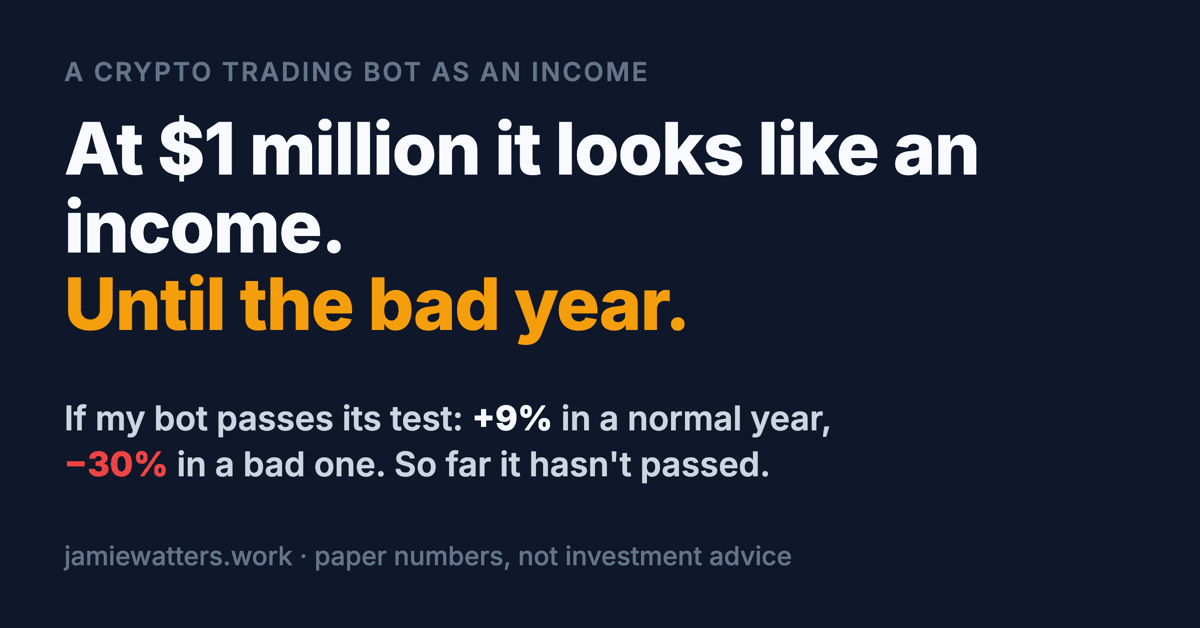
Can a crypto trading bot pay your bills? Mine would need at least $1 million, and a bad year would take $300,000
A crypto bot making $450 a year on $5,000 looks like it only needs more money to become an income. If mine passes its test, $1 million would expect $90,000 in a normal year and plan for losing $300,000 in a bad one. So far it hasn't passed. The three-step test to run before you scale any bot.
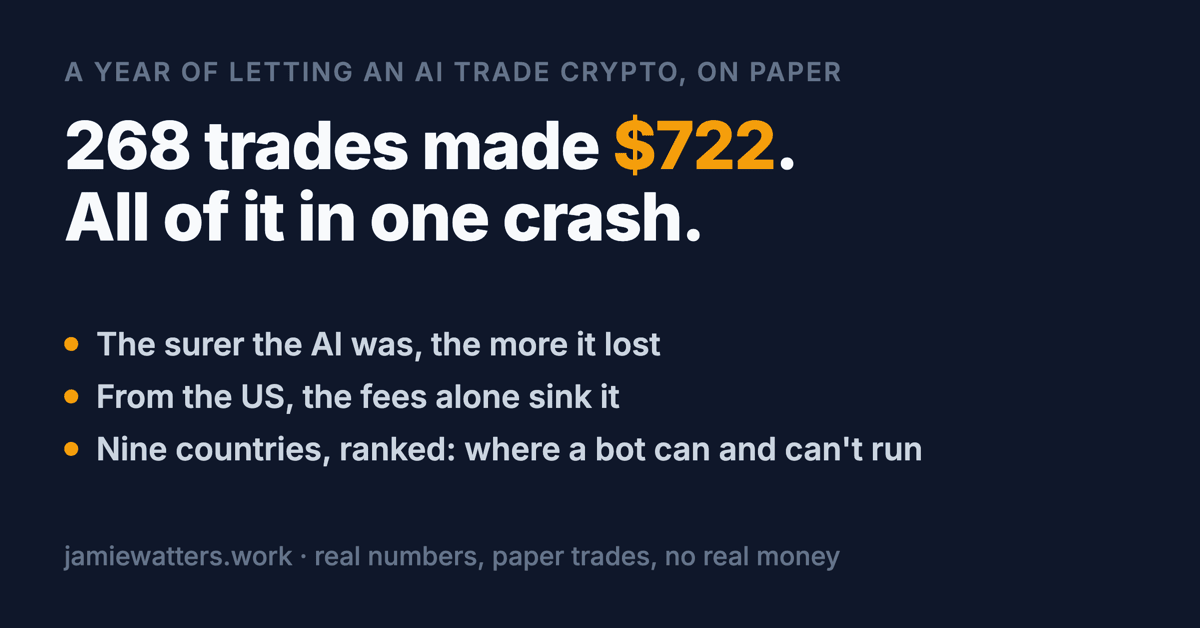
Thinking of buying a crypto trading bot? One year, 268 trades and $722 of profit say read this first
A year of an AI picking crypto trades, 268 of them on paper, made $722 and all of it in one crash. Fees, the exchange you can legally use and the country you live in decided more than the strategy. The five numbers to get before you build or buy a bot, and where it can't be run.
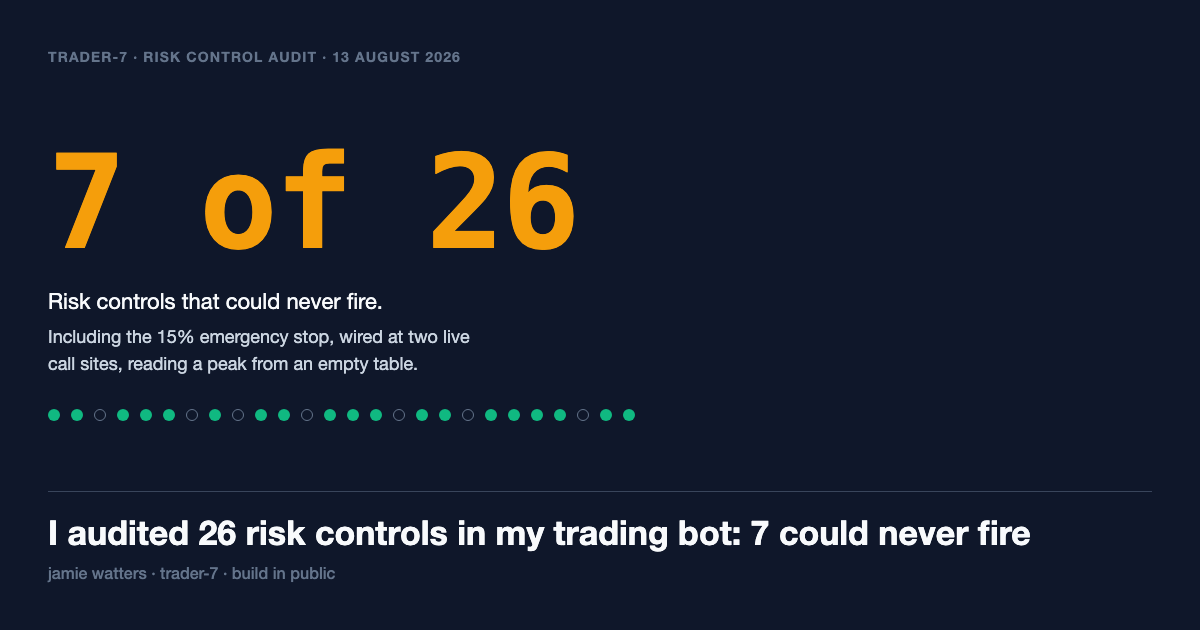
I audited 26 risk controls in my trading bot: 7 could never fire
The 15% drawdown halt was wired into two live code paths and could never fire. So I checked all 26 risk controls. Seven were dead. A control you cannot…
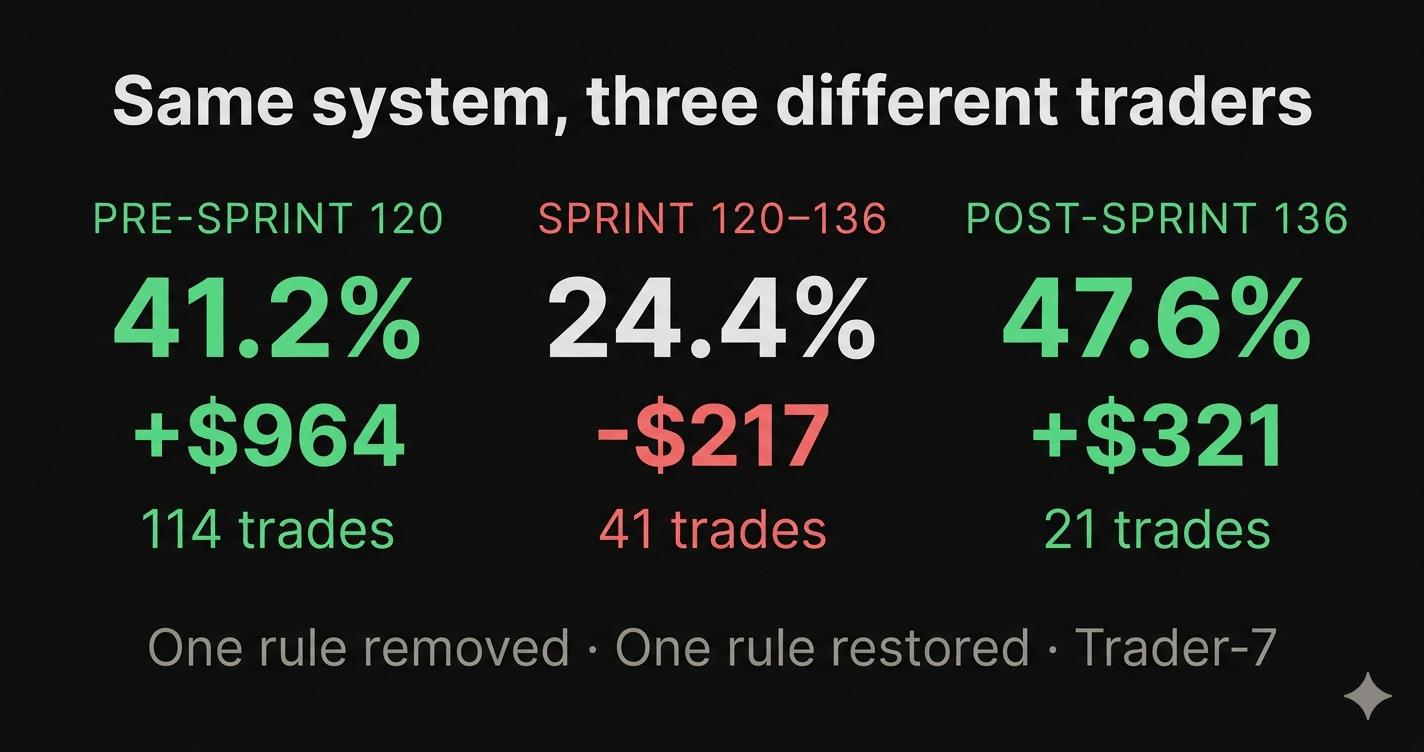
Same system, three different traders
Same code, same market, three time periods. One made $964, one lost $217, one's up $321. The difference wasn't the algorithm.

Building David, Not a Smaller Goliath
How a trading agent reveals the game retail can actually win — by playing where the funds can't or won't go, and learning to love the play.
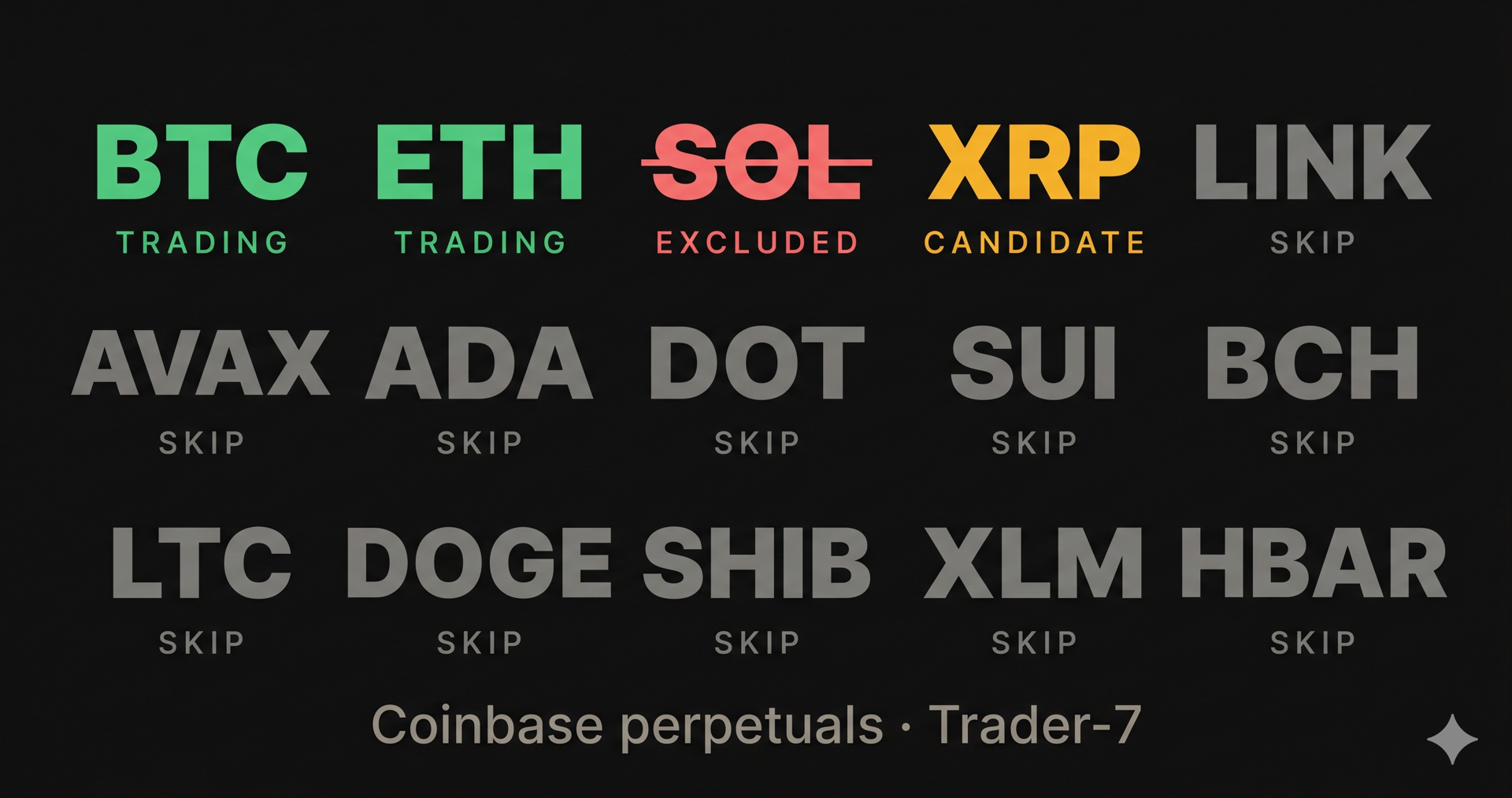
I trade three coins, not fifteen
Coinbase lists 15 perp markets. Most alts are leveraged BTC with noise. The case for staying with three, and the one coin I'd seriously paper-test.
What Building a Trading Bot Taught Me About Building Trading Bots
Across 200 trades, the bot was rarely wrong about the market. It was wrong about itself. The dominant failure mode wasn't strategy. It was a system lying to itself about what it was doing.

The House Always Wins. But Retail Can Still Play.
The first move is to see the game. The second is to refuse to play it on the funds' terms — and find the one you can actually win.
The House Always Wins: Why Retail Crypto Trading Is About to Get a Lot Harder
Three forces are converging on retail crypto traders, and none of them favour the small player. The edge isn't intelligence anymore. It's owning the table.
Ten days of letting the check do the work
April 23rd I shipped a blog post about how I'd nearly shipped a fix that referenced three database fields that didn't exist. Author-reviewer collapse. I'd ...
I wrote the rule. Then I skipped it.
Four days ago I published a blog about a bug I'd nearly shipped. The spec referenced two database fields that did not exist — trade.risk_amount and `trad...
Sprint 120 removed a safety rail. 41 trades later, I got the bill.
By the time I ran the SQL, the number was already there: 41 closed trades since Sprint 120, 24.4% win rate, minus $217 net. Before that month, the system h...
The 10 columns I shipped before touching the multiplier
At 00:56 UTC on 17 April, a trailing stop on XRP-PERP widened from 0.69% to 1.56%. Two-point-three times. The trade took the widened stop, held for 15 hour...
The market is smarter than you. That's the feature.
Sprint 130 added a risk-reward floor: no trade below 2.0:1 post-ATR. Three expert reviewers signed off. The logic was clean, the code was tested, the deplo...
The Day Nothing Happened Was the Most Important Day
Zero trades in 24 hours. +$134 in 72 hours. Here is why the day the system did nothing was the most important day of the week.
The AI Pricing War Just Got Real: GPT-5.4 vs Claude Opus 4.6 and What It Means for Your Budget
GPT-5.4 launched at $2.50/$15 per million tokens. Claude Opus 4.6 holds at $5/$25. The mid-tier is where the real battle is happening. Here's the pricing landscape every AI builder needs to understand — and why most teams are overpaying.
Every AI Trading Bot Claims Dynamic Regime Detection. Here is What It Actually Looks Like in Production.
Most bots show pnl, not Sharpe. Here is why that matters.
From -23 USD to +1,136 USD: The Sprint 116-125 Era That Fixed Everything
Ten sprints. From a broken system to +1,136 USD profit.
My AI Trading System Did Nothing for 15 Hours. Then It Nailed Two Trades.
15 hours of silence, then two profitable trades in 3 hours. The hardest edge is trusting the system when it is doing nothing.