Building David, Not a Smaller Goliath
Jamie Watters
Operational resilience and AI delivery practitioner.
Who this is for. Retail traders and solo builders wondering where a small operator can actually compete against funded institutions. By the end you'll have the four stages this went through and the specific places size stops being an advantage.
Skip it if you want the current state of the trading system. This is from May 2026 and the build has moved since; what holds is the framing, not the numbers.
On the length. Thirteen minutes, and it is a build log rather than a method. The argument about where retail can play is in the last two sections.
Trader-7 isn't a trading bot. Or rather, it is, but the trading is the smaller half of what it's for.
I didn't know this when I started. I thought I was building a strategy that would make money. What I've actually been building, across the four prior posts in this series and seven months of operational reality, is an instrument. The trades are the readings the instrument produces. The interesting question isn't whether the readings are profitable. It's whether they tell me where the shallows are.
That metaphor takes some explaining and it's the heart of this final post.
Most retail traders treat find your niche as a one-time move. Find a corner of the market the funds ignore, plant a flag, run your strategy. The problem is that niches don't stay still. The shallows fill in. The funds eventually find them, the retail bots crowd in, and yesterday's quiet edge becomes today's overcrowded trade. Find a niche treats the game as static. The game isn't static. It mutates across regime, microstructure, technology, regulation, capital flows, and the behaviour of every other operator in the market. Yesterday's shallow becomes tomorrow's hunting ground.
The David move isn't to find one good shallow and live in it forever. The David move is to keep finding shallows as the old ones fill in. That requires an instrument. Not a strategy. An instrument that lets you read the mutation as it happens, surface where the next thin water is forming, and play there with enough attention and flair that you'd stay even if Goliath disappeared.
This post is about what that instrument actually does. Not what I thought it would do when I started. What it's becoming, now that I can see what it's for.
Four stages, in order
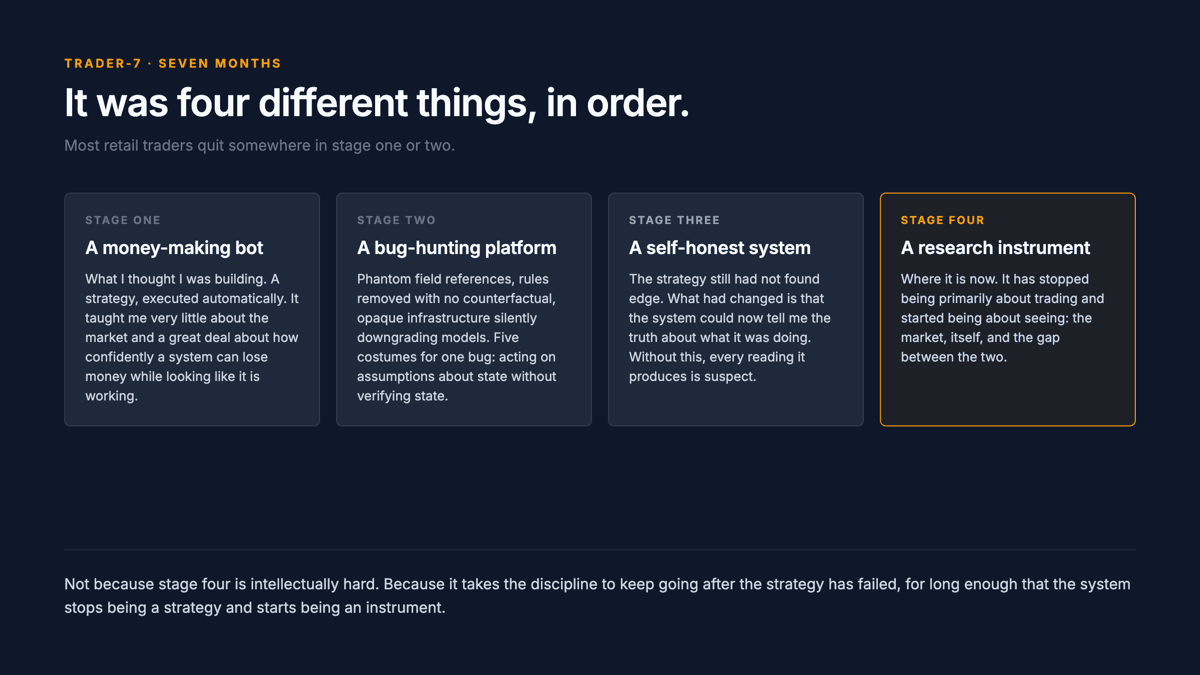
Trader-7 has been four different things in sequence. Each was a stage I had to go through to get to the next.
Stage one: a money-making bot. What I thought I was building. A strategy, executed automatically, producing returns. The premise was that a careful retail trader with good tooling could find an edge the funds had overlooked. The premise was wrong, or at least premature. Stage one taught me very little about the market and a great deal about how confidently a system can lose money while looking like it's working.
Stage two: a bug-hunting platform. What the bot actually was for several months. Phantom field references, removed rules without counterfactuals, design collisions between sprints, opaque infrastructure silently downgrading models. Five different costumes for the same underlying bug: a system acting on assumptions about state without verifying state. Stage two cost me weeks and four-figure sums in ways post three documented in detail. It also produced the verify-before-change discipline that nothing else in this stack would work without.
Stage three: a self-honest system. Once the verify-before-change tooling was real and the operational layer was trustworthy, the system had genuinely changed character. It could tell me the truth about what it was doing. The strategy hadn't found edge. The operational layer had become trustworthy. Without stage three, every reading the system produces is suspect.
Stage four: a research instrument. Where the system is now. The bot has stopped being primarily about trading and started being primarily about seeing: surfacing observations about the market, about itself, and about the gaps between the two that I couldn't see by trading manually.
Most retail traders quit somewhere in stage one or two. The ones who reach stage four are vanishingly rare, not because it's intellectually hard, but because it requires the discipline post four described, sustained for long enough that the system stops being a strategy and starts being an instrument.
The diagnostic foundation
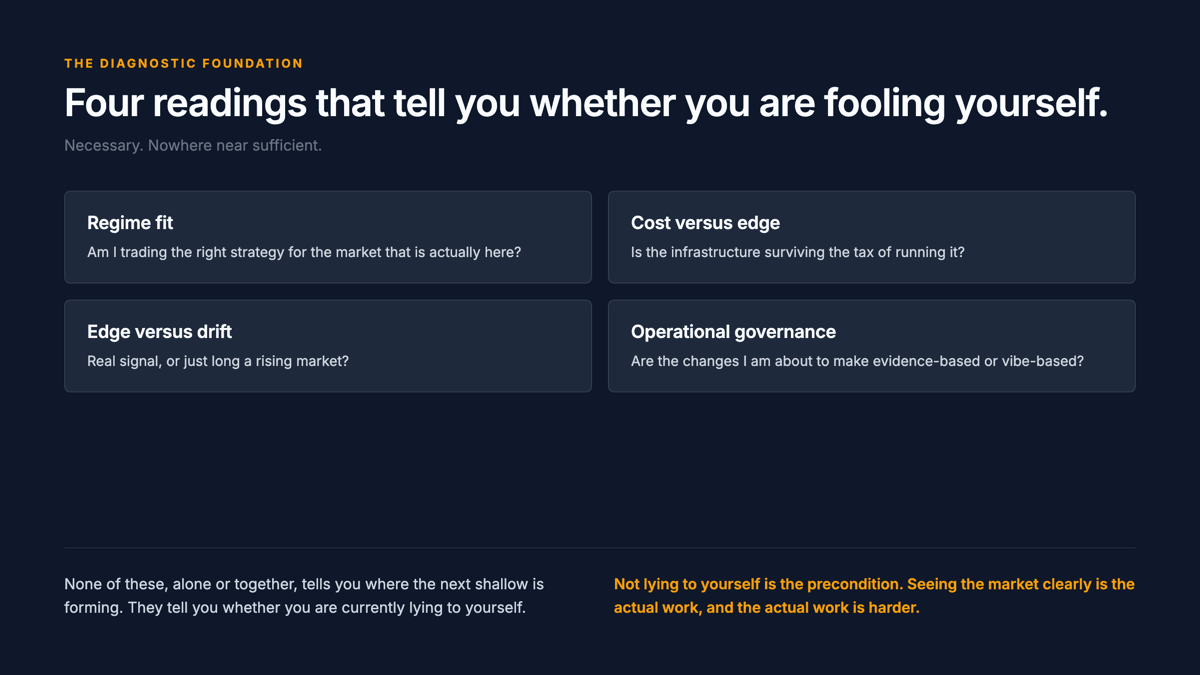
Before the instrument can find shallows, it has to be able to see itself clearly. That's the operational layer, and it's mostly hygiene. I'll name it briefly because the rest of the post depends on it being in place.
The bot now produces four diagnostic readings continuously. Regime fit: am I trading the right strategy for the market that's actually here? Cost versus edge: is the infrastructure I'm running surviving the tax of running it? Edge versus drift: am I picking up real signal, or am I just being long a rising market? Operational governance: can I trust the changes I'm about to make to be evidence-based rather than vibe-based?
These aren't insight. They're not the David panel. They're the maintenance layer that keeps the instrument honest. Most retail trading systems don't have any of this. The ones that do have only some of it. None of these readings, individually or together, tells me where the next shallow is forming. They tell me whether I'm currently fooling myself, which is necessary but not sufficient.
The reason I'm naming the diagnostic foundation explicitly is to draw a line between not lying to yourself and seeing the market clearly. The first is a precondition. The second is the actual work, and the actual work is harder.
What the instrument is starting to surface
This is the section I held back from writing for two weeks because I wanted to be honest about what I have and what I don't.
I do not have a finished insight engine. I do not have a list of trades I know retail can take that the funds can't. What I have is a sense of the game, which is a different thing, and the early shape of an instrument that lets me sharpen that sense over time.
Here's what the instrument has started to show me.
Behavioural fingerprints in the order flow. The bot has been observing a basket of crypto markets across hundreds of cycles. It logs not just what trade was taken but what the strategist saw and decided at every cycle, including the ones where it decided to do nothing. Over time that produces a dataset of how the market behaves at specific levels, at specific times of day, around specific kinds of news, around the boundaries between regimes. A fund's analyst is too busy and too rotated to assemble this. A retail trader who lets the instrument do it for them, and then actually reads what comes back, has access to a kind of contextual texture that the funds genuinely don't have.
The gap between what the strategist sees and what the market does. The most useful single thing an instrument can produce is here is a thing the strategist consistently flags that the market consistently doesn't reward. That gap is where the strategist's training data, all the trading research the funds have also seen, has become a commodity. It's everyone's signal, which means it's no signal at all. Conversely, here is a move the strategist missed that turned out to be real is potentially virgin territory. Both gaps are insight. Both come from running the instrument long enough to accumulate them. I'm starting to see the shape of where these gaps live in my system. I do not yet have enough clean data to name them publicly. I will when I do.
The shape of where the funds are absent. When the bot identifies a setup, the volume profile and order book texture say something about whether large liquidity hunts are forming around the trade. The funds being absent from a setup is itself a signal. It often means the trade is too small to matter to them, the venue is awkward for their compliance perimeter, the time horizon doesn't match their fee structure, or the operational complexity isn't worth the AUM impact. Any of those reasons creates a structural reason retail can take the trade, if it's a real trade. The instrument's job is to help distinguish the trades the funds avoid because they can't take them from the trades they avoid because the trades aren't real.
Retail-bot crowding as a signal. Every time Trader-7 underperforms in a specific way, it's also potentially underperforming in the same way as every other retail bot running similar momentum logic. The places where my system gets its stops harvested most aggressively are the places where retail crowding has hit critical mass and the funds are happily eating the crowd. The places where my system finds genuine asymmetric setups are, by definition, places the crowd hasn't found yet. The bot's losses aren't just losses. They're a sample of where retail-shaped strategies have stopped being differentiated. The losses are themselves part of the map.
These four observations (fingerprints, strategist-market gap, fund absence, crowd density) are the early shape of the instrument I'm actually trying to build. They're not yet a polished instrument panel. They're more like the early sketches of one. The point of the rest of stage four is to develop them into something I can act on systematically.
The game keeps moving
Here's what I'm increasingly sure of after seven months of watching the bot operate.
The market isn't a fixed contest. It's a multi-dimensional system that mutates continuously. Strategies that paid in 2024 stop paying in 2026. Venues that were uncrowded last year fill up this year. Regulatory changes open and close trade types. AI agents enter the market and reshape the order flow. The behaviour of every other participant changes the game for every other participant. There is no stable optimum.
This is bad news for anyone whose plan is find the right strategy. There isn't one. There are strategies that work for a while, in specific regimes, until enough other operators find them. Then they decay. The retail trader who picks one strategy and runs it forever is, structurally, running a decaying asset.
The funds survive the mutation by having enough mass to absorb it. They have armies of researchers refreshing models, infrastructure teams rebuilding systems, capital reserves that let them sit out bad regimes.
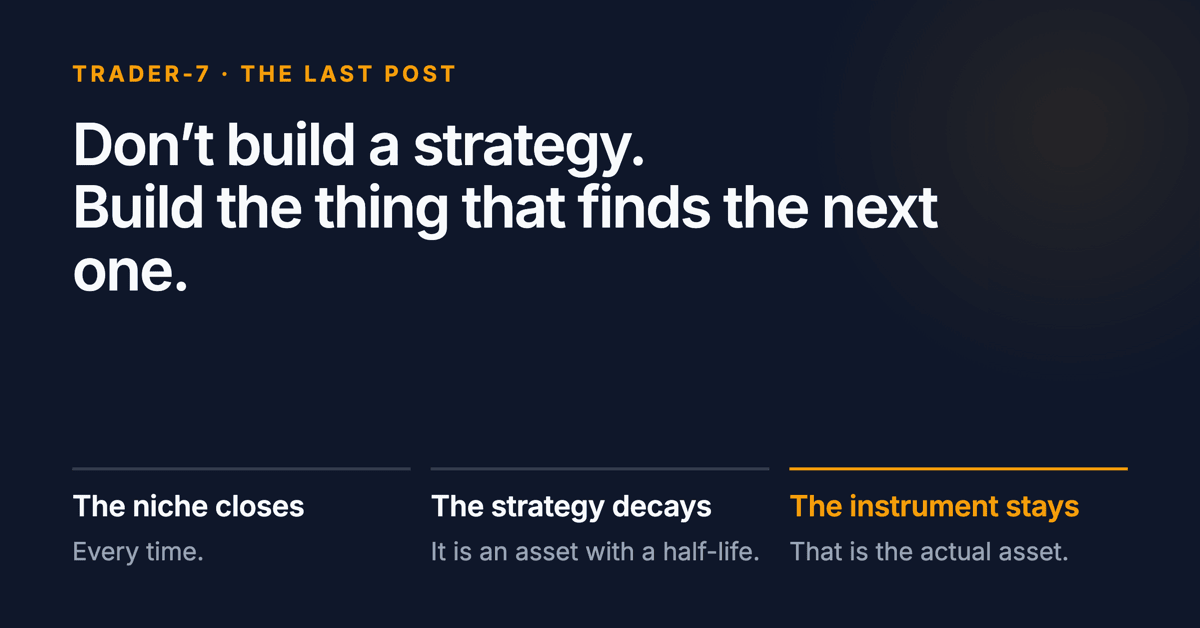
The retail trader doesn't have that mass. What they have, if they choose to develop it, is the instrument that reads the mutation as it happens. That instrument is the actual asset. Not any individual strategy. Not any individual trade. The thing that keeps finding shallows as the old ones fill in.
This is a very different posture from find a niche and defend it. The niche will close. The David posture is not flag-planting. It's the practice of staying alert, watching the mutation, finding where the next thin water is forming, playing there until it isn't, and moving on. Over and over again.
That's why the instrument matters more than any specific edge it surfaces. The edges will come and go. The instrument is what's left when they do.
Don't swim in the shoal
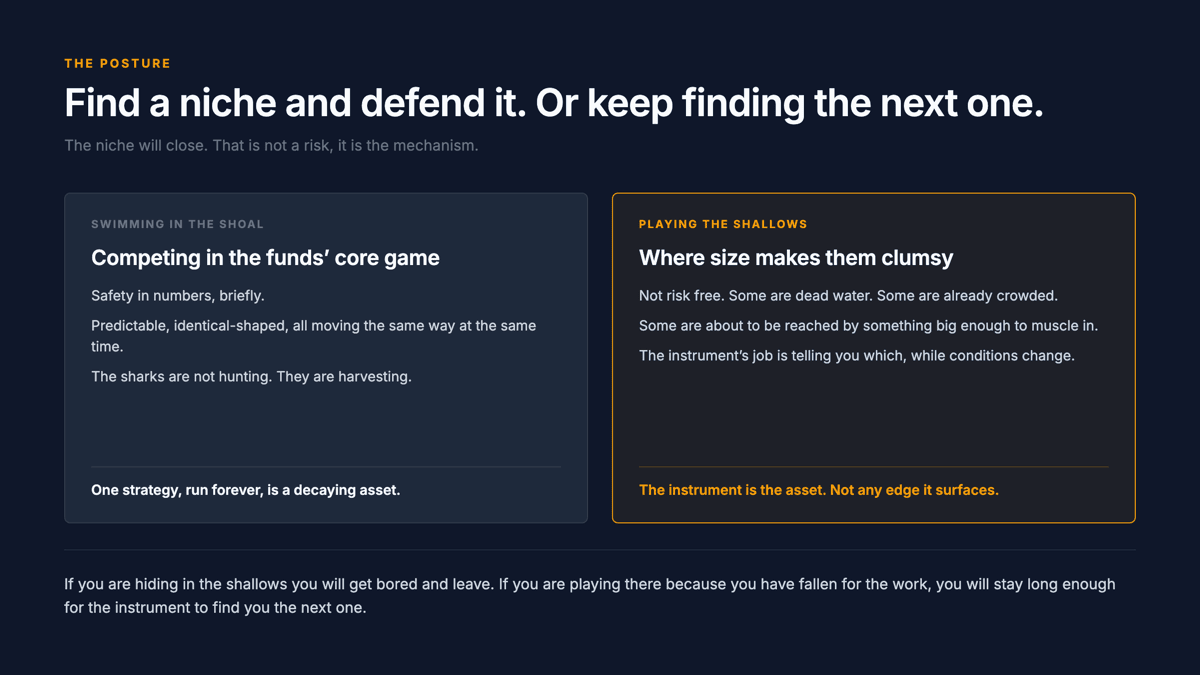
The metaphor I find myself returning to is fish.
The retail trader who tries to compete in the funds' core game is swimming in the shoal. There's safety in numbers, briefly, until the sharks show up. Then there's no safety at all, because the whole shoal is structured exactly the way the sharks need it to be: predictable, identical-shaped, all moving in the same direction at the same time. The sharks aren't even hunting. They're harvesting. The shoal is the meal.
The David move is to leave the shoal. Find the shallows the sharks can't enter. Not because the shallows are objectively better than the deep water. Because they're a place where you can play your own game, at your own size, with attention and flair, without being part of someone else's harvest.
The shallows aren't risk-free. Some of them are dead water. Some of them are full of competing small fish doing the same thing. Some of them are about to be reached by a shark big enough to muscle in. The instrument's job is to help you tell which is which, in real time, as conditions change.
But the deeper point is the one your relationship with the work has to absorb. You don't go to the shallows because they're a clever trade. You go because that's where you actually want to be: playing a game you find genuinely interesting, on a scale that lets you learn something every week, in spaces where attention and care are still the differentiator. The flair is the point. The love of the play is the point. If you're hiding in the shallows, you'll get bored and leave. If you're playing in the shallows because you've fallen for the work, you'll stay long enough for the instrument to develop into something useful, and the instrument will find you the next shallow when this one closes.
That's what loving the game looks like, in this specific operating frame. Not loving the markets in some romantic sense. Loving the practice of looking, of noticing, of staying with a question long enough that the question reshapes what you're capable of seeing.
The bigger frame
The trading-bot example is concrete because the feedback loop is short and the money is real. The same shift, from optimised performer of a fixed strategy to self-aware instrument that reads the mutation, applies almost everywhere a solo operator now competes alongside AI agents.
The institution will always have more compute, more capital, more headcount. Its structural advantages are also structural commitments. It is locked into the game it's good at. The solo operator who treats their AI stack as an instrument, and uses it to read the mutation rather than optimise a fixed strategy, has access to moves the institution structurally cannot make.
Trading is the version where the feedback is fastest. The logic generalises.
What this whole series has been about
Five posts. Four of subtraction.
Stop trying to win the funds' game. Refuse the engagement. Stop trusting your own confidence. Stop changing things before the data can speak. Each of those was a stop doing.
This last post is the one of addition. The thing you actually do, after all the stopping, is build an instrument. Not a strategy. Not a bot that prints money. An instrument that lets you find the next shallow when the current one fills in, that gives you enough operational discipline to play it well without lying to yourself about whether it's working, and that you actually enjoy operating well enough to stay with for years.
That's the David move. Don't swim in the shoal. Find the shallows the sharks can't enter. And learn to love the swim.
That's the work.
This is the fifth and final post in a series on retail crypto trading in the AI era. The four prior posts laid out the diagnosis (The House Always Wins), the reframe (But Retail Can Still Play), the operational reckoning (What Building a Trading Bot Taught Me About Building Trading Bots), and the discipline of staying still (Now the Real Data Starts). This post closes the arc by naming what the instrument is for. Future posts will move from theory to specific observations the instrument is starting to surface from the markets it's actually watching.
If this gave you something to think about, you can buy me a coffee.