The $380,000 AI job with no production code: measure before, measure after, tell the boss
Jamie Watters
Operational resilience and AI delivery practitioner.
I applied for a job at Anthropic called Technical Deployment Lead. On 1 September they turned me down. The advert is still up, and one line in it says something about where the money in AI work is going.
"You won't write production code," it says. The US version pays $275,000 to $380,000 a year. The London one, the job I went for, pays £165,000 to £230,000 (Anthropic, US advert; London advert).
So what is that much money paying for, if not code? Part of the answer is in one bullet point, and it's a skill most people who run projects at work could start learning this month.
Declared interest: I've applied for other jobs at Anthropic and am still waiting to hear on some. Nobody paid for this piece, and nobody at Anthropic saw it before it was published.
Why the AI firms need people
In May, OpenAI and Anthropic each set up a company to put AI inside other businesses. Anthropic's came first, on 4 May, with three investment firms including Goldman Sachs, to "rapidly bring Claude into their core business operations". The reason, from Anthropic's finance chief Krishna Rao: demand from enterprises for Claude is running ahead of any single way of delivering it (Goldman Sachs Asset Management release, 4 May 2026). OpenAI followed on 11 May with the OpenAI Deployment Company and "more than $4 billion of initial investment" (launch announcement as published by Advent, a founding investor, 11 May 2026).
Read those together and the problem is plain. The labs sell a general tool. Building and maintaining frontier AI systems, in the Goldman Sachs release's words, takes expertise that is "scarce even among the world's most sophisticated organizations". So the labs are building teams to do it for their customers. The advert below is for Anthropic's own teams, not the new firm: the US version sits on one called Claude Agentic Solutions, the London one on Forward Deployed Engineering.
That raises a question every customer will ask sooner or later: did it work?
Two jobs on one team
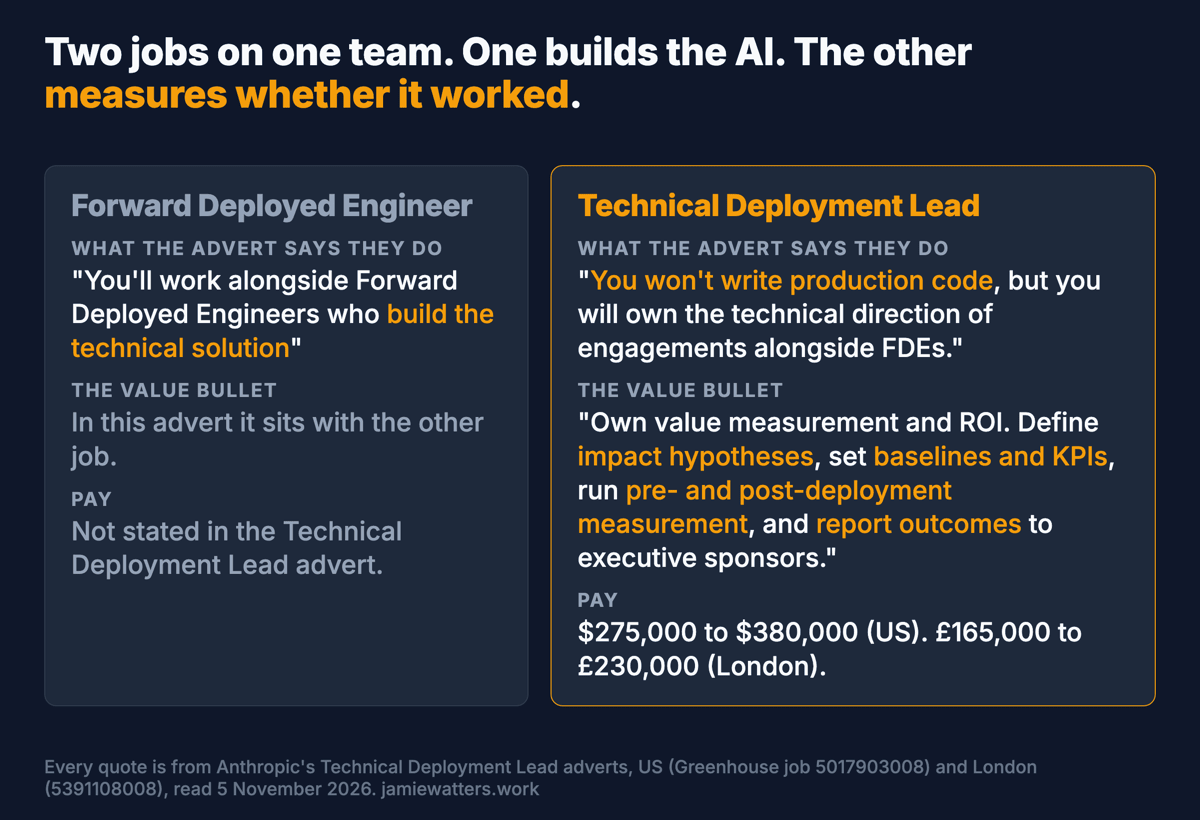
Anthropic splits the work in two. Forward deployed engineers, the people it sends into a customer's business, build the thing. I've written before about how forward deployed engineers work: they sit with the customer's staff, map how the work is really done, and build AI into it.
The Technical Deployment Lead sits beside them. In the advert's words: "You'll work alongside Forward Deployed Engineers who build the technical solution, while you own product scoping, stakeholder management, value measurement, and the organizational complexity that comes with deploying AI agents in enterprise environments." Further down, under the kind of person it wants, is the line that caught me: "You won't write production code, but you will own the technical direction of engagements alongside FDEs." FDEs are those forward deployed engineers.
Most of the list is what you'd expect from someone running a big project for a client. The plan, the scope and the customer relationship. Getting through security, legal, procurement and compliance. One bullet is different. Here it is in full:
"Own value measurement and ROI. Define impact hypotheses, set baselines and KPIs, run pre- and post-deployment measurement, and report outcomes to executive sponsors."
Another bullet asks for the statement of work, the scoping document signed with the customer, to carry "success criteria, and value hypotheses" from the start.
In plain words: before the AI goes in, write down what it should change. Measure that thing now. Measure it again afterwards, the same way. Tell the person paying what happened.
That is the skill. It is old. Finance teams, auditors and anyone who has run a trial know it. What's new is that an AI company has written it into a job description, with the pay range above attached.
What I don't want to overstate
This is not a job for anyone who has used ChatGPT. The same advert asks for people who "have delivered AI, ML, or LLM-based agentic solutions into production" and are technical enough "to hold architecture conversations with engineering stakeholders". They turned me down, and I've spent years in banking resilience and built AI tools of my own. It's a senior job with a high bar.
And an advert is a wish list. It shows what Anthropic wants, not what happens on the ground.
For a research note on how firms put AI into businesses, I compared the published methods of consultancies, AI labs, software vendors and in-house teams. In that set, one provider document gave anyone the job of taking a baseline: this advert. That's a count of what the note covered, not of every firm, and the note isn't published. But in what I read, measuring was the part of the job most often left out, and it's the part that travels.
And notice whose side that person is on. The Technical Deployment Lead works for the firm selling the AI. The person measuring whether it worked is paid by the seller. That isn't a scandal: someone has to do it, and it's better than nobody. But a vendor's number is a claim until someone on the customer's side, outside the team that delivered the change, checks it and signs it off. In a well-run firm that's a benefit owner with finance behind them. The sheet below is for that person.
Whether companies will pay an outsider to do it is untested. Inside a company, though, the person who can say "here's what it changed, here's how I know" has the answer the budget conversation needs.
I've sat on the other side of this. I sat on a bank's US committee approving AI and cloud deployments, and the committee assessed each initiative's business value as well as its risks. Value is the harder of the two to judge when nobody wrote down what the thing was meant to change.
The one-page value sheet
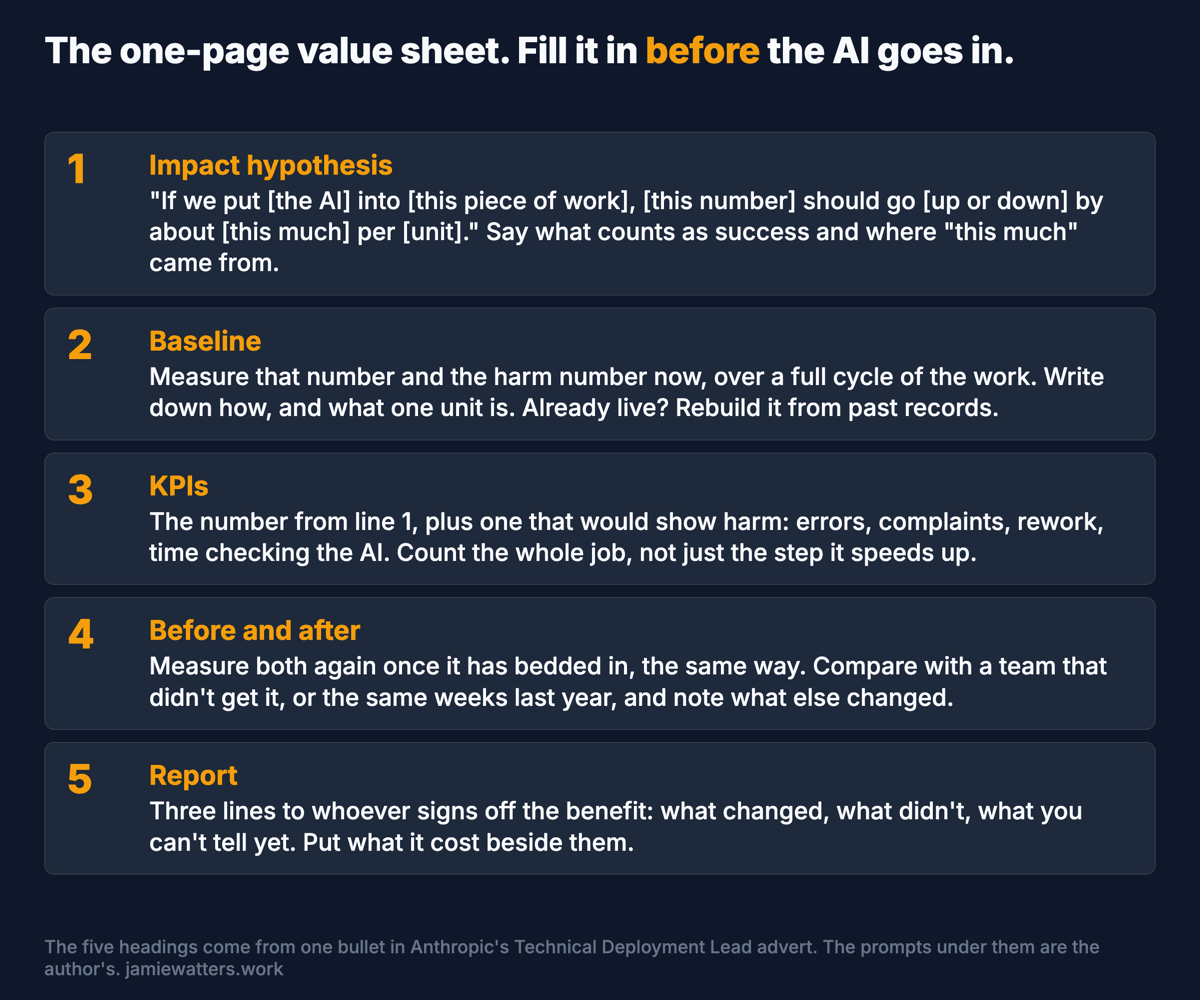
Here is the advert's bullet turned into something you can fill in for most AI changes at work, from a chatbot on the help desk to a tool that drafts reports. The five headings come from Anthropic's bullet, in plain words. The prompts under them are mine.
1. Impact hypothesis. "If we put [the AI] into [this piece of work], [this number] should go [up or down] by about [this much] per [ticket, report, case]." Write down what result would count as success, and where "this much" came from: the business case, the vendor's claim, or a guess you'll call a guess. If you can't write the sentence, you don't yet know what you're buying.
2. Baseline. Measure that number and the harm number from line 3 now, before anything changes, over a full cycle of the work, such as a month-end. Write down how you measured and what counted as one unit of work, so the after can be done the same way. If the AI is already in, rebuild the baseline from past records and say that's what you did.
3. KPIs. The one number from line 1, plus one that would show harm: errors, complaints, rework, time spent checking the AI's output. Count the whole job, not just the step the AI speeds up. If drafting gets faster and checking gets slower, both belong in the number.
4. Before and after. Measure both numbers again once the AI has bedded in, the same way as the baseline. Compare with a team or a period that didn't get it, so you aren't crediting the AI with a quiet month. If there's no such team, use the same weeks last year, note anything else that changed in between, and say so in the report.
5. Report. Three lines to whoever signs off the benefit, with what it cost beside them. For a help desk it might read: "Handling time per ticket fell from [before] to [after]; reopened tickets didn't move. We can't yet tell whether second-line support is picking up the slack. The tool costs [licences plus the hours spent setting it up and checking it], which is [more or less] than the time saved is worth at current volumes."
Line 4 is where it's easiest to fool yourself. A count of how many people used the tool is activity, not a result. Time saved is a similar trap. A Danish study surveyed about 25,000 workers in 11 jobs heavily exposed to AI. Two years after ChatGPT launched, chatbot users' earnings hadn't risen against comparable non-users', and the study ruled out an average gain above 2% (Humlum and Vestergaard, March 2026). That's workers' pay, not a firm's return, but it's a warning that saved time doesn't turn into money by itself. I wrote about where that time goes in an earlier piece.
Anthropic's US advert offers up to $380,000, and owning that measurement is one bullet of the job. They turned me down for the London version. The sheet is free.