AI follows your process as written, not as done. How to find the steps it will miss
Jamie Watters
Operational resilience and AI delivery practitioner.
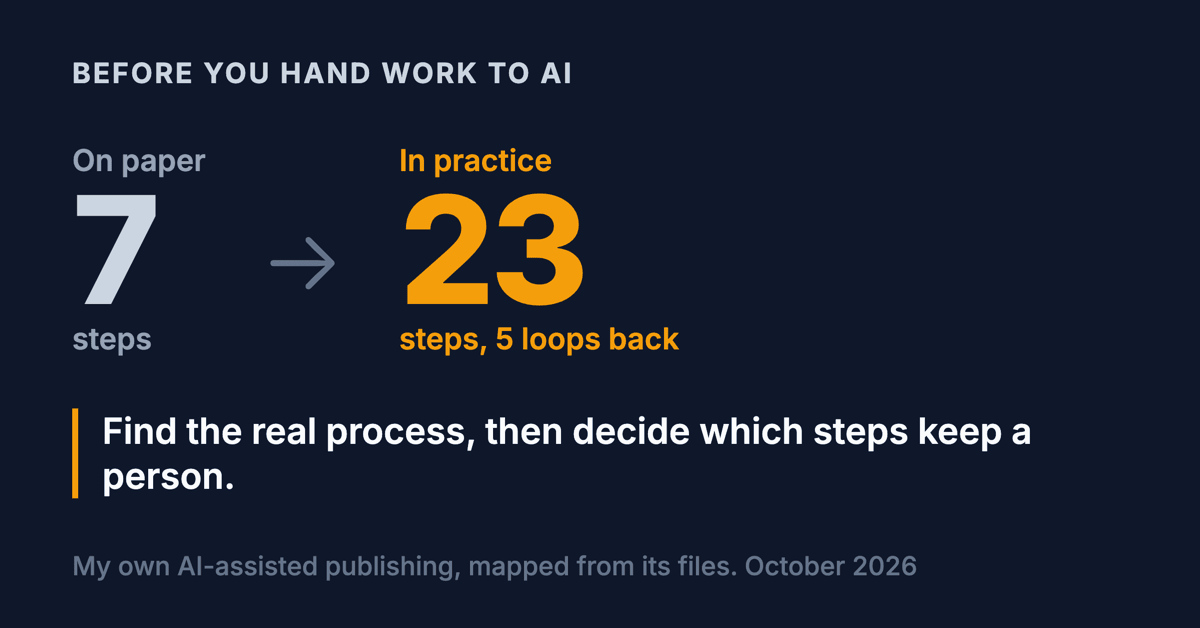
The instructions my AI tools follow say an article of mine goes through seven steps. When I mapped what actually happened to one piece on 7 October, from the files it left behind, it took 23 steps, with five loops that send the work back to an earlier step.
Nothing was broken. Most of the steps are written down somewhere, spread across several instruction files. But the summary of the process has seven, and nothing showed the whole thing in one place with its loops. An AI built from the summary would run a process I don't follow.
Someone who puts AI into companies for a living says this is normal. Vasuman Moza runs Varick Agents, which builds AI agents inside firms. In an interview on Greg Isenberg's YouTube channel he described a software company whose quote process ran in a neat line on paper, from building the quote to signing it. Its sales system's records, Moza says, showed 20 steps and seven loops. An accounting firm another practitioner told him about said it had six steps, and had 14.
So the work that makes AI pay comes before any AI: find the process people really follow, and decide which steps keep a person. The people firms send in to do this, and then build, are called forward deployed engineers. Here is Moza's method, and my own process run through it.
Declared interest: I'm talking to firms in this market about work. Nobody paid for this piece or saw it before it was published.
The method in four moves
Find the real process, from three places. First the people who do the work. Ask why they do it that way, who really decides, which step is for show, and how often the odd case turns up. Then the records in their systems: what comes in, what gets corrected, what goes back. Moza describes watching a client's sales system for three to four weeks. Documents come last, because they're often out of date.
Sort every step into one of four piles. Cut it, because it shouldn't exist any more. A plain rule: if this, then that, no judgement. An AI agent: it needs judgement, and there's enough history to learn from. Or a person: approval, negotiation, signing, paying money. Moza keeps a person on payments because an agent working alone can be fooled into paying a fake invoice.
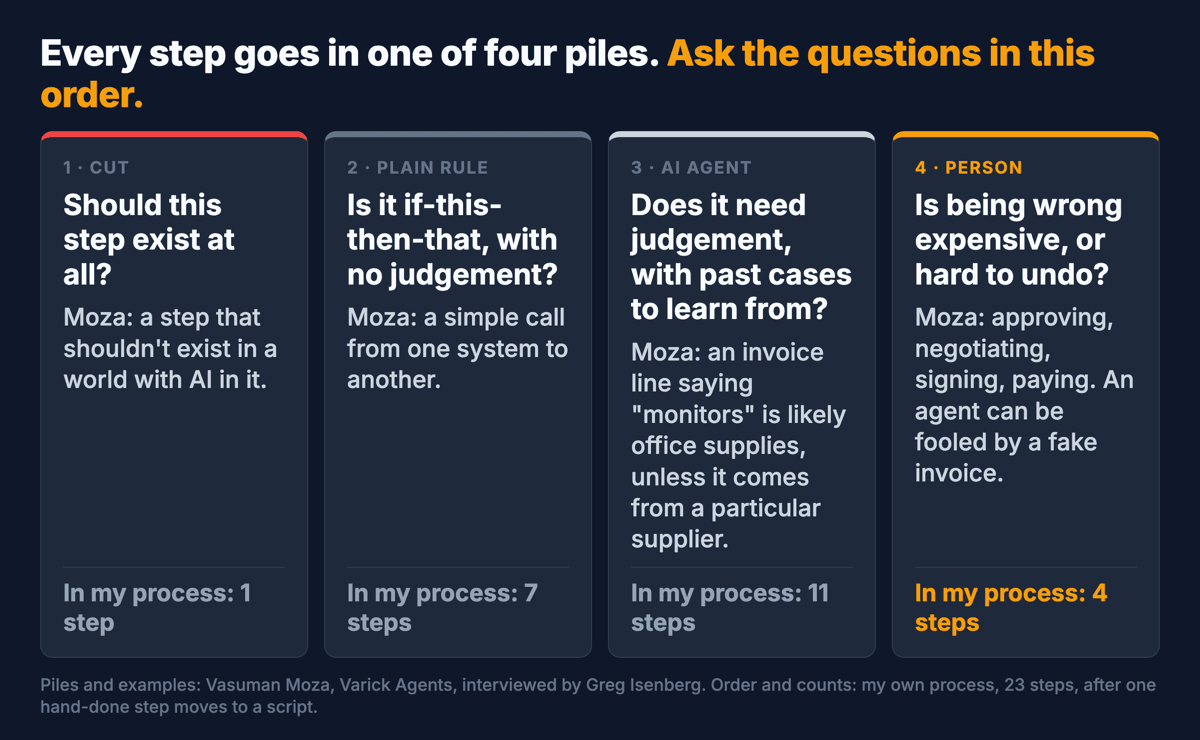
Ask the four questions of every step. The order and the counts are mine; the examples are Moza's.
Build inside the systems people already use. His agents work inside the client's existing sales or finance software, and a person approves with a message in their chat tool. Pitch a move to a new system, he says, and "you've lost them".
Measure before you build, then prove it. His shape: four weeks to map and measure, four weeks to build, then a before-and-after at three and six months. He gives one anonymised client whose invoices going through with no exception handling rose from 18% to 87% (Moza, Isenberg interview). He calls that process re-engineering, and says it wasn't all down to the agents. It's his figure, and I can't check it.
My Robodebt piece showed a slow human check cut for speed when it was the step asking whether the data was right. My AI roll-up piece set out five checks that would prove AI made a bought firm more profitable. The four moves come before both.
The fair objection: this is a vendor selling an audit. Moza sells the four-week map, and every example is his own and unchecked. Plenty of AI at work is also a person with a chat assistant going a bit faster, which needs no map. Both true. The map matters when an AI takes whole steps on its own, because that's when a step nobody wrote down gets skipped without anyone deciding to. A manager might add that the people you interview have reasons to leave things out. Moza's answer is not to trust one account: one person "might tell you the wrong story", so he interviews several and checks them against the system records.
My own process, mapped
I used the same three places. The person was me. The records were the files a piece leaves in its folder: source copies, review notes, every round of titles, the social posts. The documents were the instruction files my AI tools work from. One of those says write, check, publish for review, peer review, apply the changes, republish, social posts. Another says three steps: write, stage, publish.
The piece was my article on where the time AI saves at work goes, on 7 October. When I tested the idea for this piece on two fresh AIs reading it cold, both asked the same thing: show me the hidden steps and what caused each loop. Here they are.
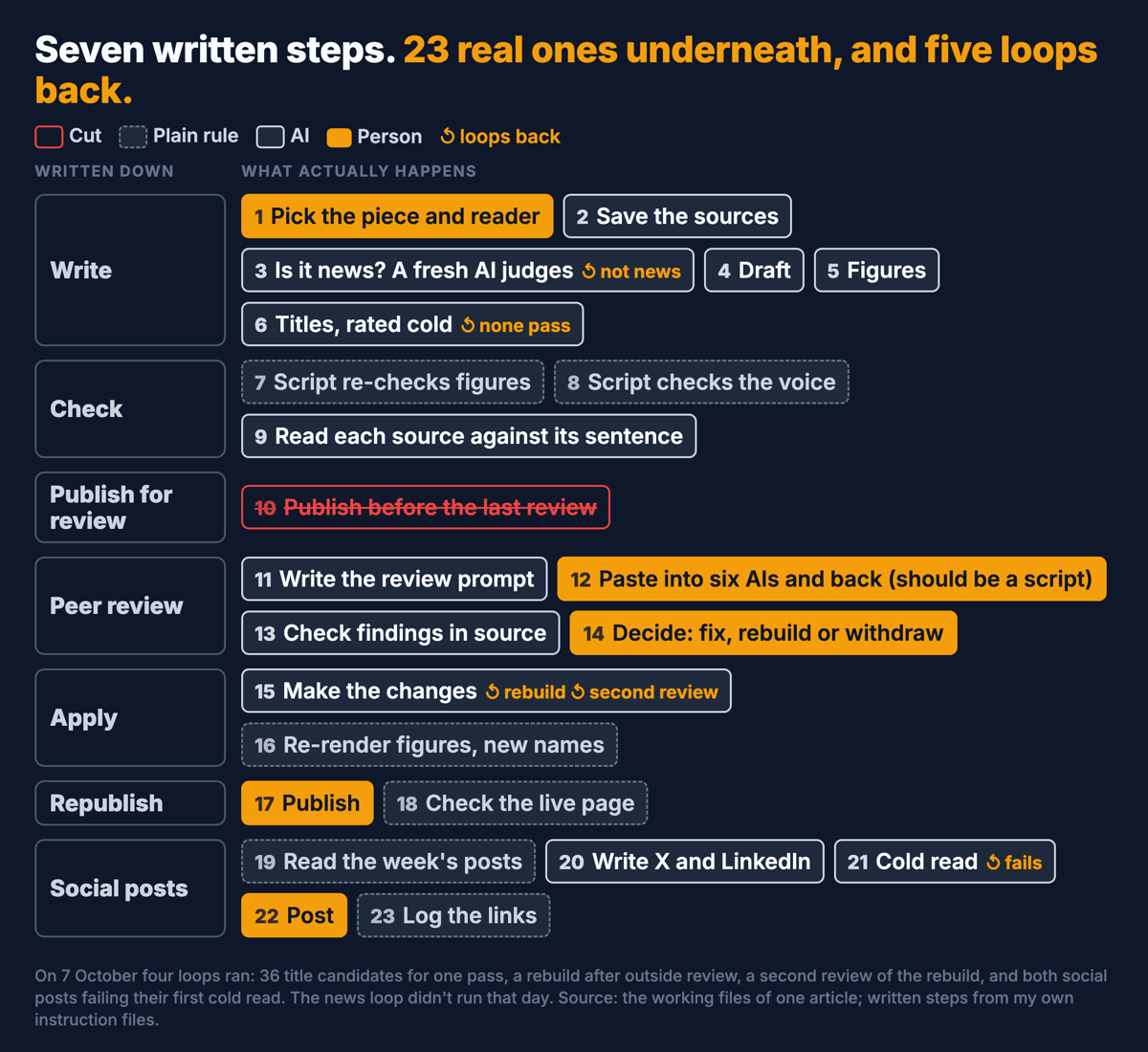
The seven written steps, and the 23 under them. From the files of the 7 October piece.
Four of the five loops ran that day (my review notes for the piece). Six outside AI reviews of the first draft produced 13 corrections that held up in the sources, and a rebuild. I'd read a study's summary, which said workers "report" putting saved time into other work, when its survey question asked what they "expect to" do. The rebuild went to six more reviews. It took 36 title candidates to find one a fresh AI would click. Both social posts failed their first cold read on the same question: what's in it for me?
Here is the map, sorted. Copy it and swap in your own steps.
HOW ONE OF MY ARTICLES REALLY GETS PUBLISHED
Mapped from the files of the 7 October piece.

Start: I pick a source and a reader.
End:   the article and two social posts are live
       and their links are logged.
Rule:  every step gets exactly one label.
  CUT     it shouldn't exist
  RULE    a script: if this, then that
  AI      judgement, with past cases to learn from
  PERSON  my name goes on it, or it can't be undone

WRITTEN       REAL STEP                          LABEL
Write          1 Pick the piece and the reader   PERSON
               2 Save the sources                AI
               3 Say the surprise in 30 words;   AI
                 a fresh AI judges if it's news
                 (loop: not news, back to 1)
               4 Draft in my voice               AI
               5 Build the figures, look at each AI
               6 Write 10+ titles; a fresh AI    AI
                 rates each (loop: none pass)
Check          7 Script re-checks every figure   RULE
               8 Script checks banned words,     RULE
                 dashes, unsourced figures
               9 Read each source against its    AI
                 sentence; answer the best
                 objection
Publish for   10 Publish before the last review  CUT
review
Peer review   11 Write the review prompt         AI
              12 Paste it into six AI models,    PERSON
                 paste the replies back          (RULE)
              13 Check every finding in source   AI
              14 Decide: fix, rewrite part,      PERSON
                 rebuild or withdraw
Apply         15 Make the changes                AI
                 (loop: rebuild, back to 4)
                 (loop: second review, to 11)
              16 Re-render changed figures       RULE
                 under new filenames
Republish     17 Publish                         PERSON
              18 Check the live page             RULE
Social posts  19 Read the week's posts; a        RULE
                 script refuses a repeated
                 lead figure
              20 Write the X and LinkedIn posts  AI
              21 A fresh AI reads each cold      AI
                 (loop: fails, rewrite)
              22 Post them                       PERSON
              23 Log the links                   RULE

Count: 23 steps, 5 loops.
CUT 1 · RULE 6 · AI 11 · PERSON 5
Step 12 moves to RULE: then RULE 7 · PERSON 4.
Four steps keep me. Picking what goes out under my name, and for whom (1). Deciding whether a claim stands, narrows or comes down (14): the reviewers are AIs and so is the checker, so somebody has to own the call. And the two publishes (17 and 22). A blog post can be fixed and republished. A social post is seen and copied the moment it lands. That's my version of Moza's rule on payments.
Step 12 is a person only because I haven't wired it up. I copy a prompt into six AI models and paste their replies back, which is a script's job.
Step 10 is the one to cut, and that's my reading, not a rule anyone wrote. The piece went live between the two review rounds. Both rounds were sent the full text, and the second prompt told the reviewers they didn't need the page. So publishing early did nothing for the review. It put a version I was about to change in front of readers.
Measure first
That gives me a before. From 7 October: 13 corrections found by outside review, 36 titles for one pass, both posts failing their first read, and one rebuild.
Moza cites Michael Hammer's work on re-engineering for the point that speeding up each step can leave a process no faster, because the time goes in the gaps between steps. In my map the extra work sat in the loops. The rebuild's cause is now part of step 9: when a figure comes from a survey, open the question and quote its tense. That doesn't make any step faster. It catches at step 9 what step 13 caught.
Most of my career has been business continuity. Its basic tool is the business impact analysis: a structured analysis of a business to identify its processes and resources and assess how critical each one is. I've done several hundred across banking. The first move of this method is close to that job. Sorting each step into a pile is the new part.
Four of my 23 steps need me. None of them is pasting text between AI models.
Sources
- Vasuman Moza, Varick Agents, interviewed by Greg Isenberg on forward deployed engineering, YouTube: https://youtu.be/1a5HxU52vCQ. Every client example and figure is his own, anonymised, and unchecked here.
- My own working files for the 7 October piece (its source copies, review notes, title rounds and social posts), and the instruction files for my writing and review process.