If AI saves you time, why aren't you being paid more for it?
Jamie Watters
Operational resilience and AI delivery practitioner.
We're all told AI saves time at work. The best evidence on where that time goes comes from Denmark, where researchers surveyed 25,000 workers in jobs highly exposed to chatbots and linked their answers to official pay records. Asked what they expect to do when a chatbot saves them time on a task, 85% of those saving time picked other work tasks. Under one in ten picked more breaks, and under one in ten picked more leisure (Humlum and Vestergaard, March 2026).
Then the records. They run to December 2024, two years after ChatGPT launched. By then, the users' earnings and hours had not pulled ahead of comparable non-users' by more than 2% on average (Humlum and Vestergaard, 2026, p. 3).
So workers plan to put saved time back into the job, and so far it hasn't put them ahead on pay. What it becomes is decided by whoever holds the decision rights and keeps the profit. That's the bet behind the companies now buying accounting and IT firms to run them with AI. Declared interest: I'm talking to firms in this market about work. Nobody paid for this piece or saw it before it was published.
Where workers expect the saved time to go
The study is by Anders Humlum of Chicago Booth and Emilie Vestergaard of the University of Copenhagen. It covers 11 jobs, among them accountants, legal professionals, software developers and teachers. The newest version, from March 2026, is titled "Still Waters, Rapid Currents". It hasn't been peer-reviewed.
The saving is smaller than the headlines. On average, users said chatbots saved them about 3% of their working hours. For accountants it was 1.6%. That's what workers report, not what anyone timed (Humlum and Vestergaard, 2026, Online Appendix Table E.3).
The question about saved time asked what people expect: "If AI chatbots save time on a task, do you expect to..." People could tick more than one of four answers. Among users who said they saved time, 85% picked more time on other tasks and 29% more of the same tasks. More breaks got 7%, and more leisure 6% (Humlum and Vestergaard, 2026, Online Appendix Table E.3 and questionnaire item 15). These are plans, not a diary.
The AI also makes work of its own. Even where employers do nothing to push the tools, about 8% of users said chatbots had given them entirely new tasks. Where employers actively back the tools, it's roughly 17%. The new tasks include drafting with AI, checking what it produced for quality and compliance, and writing the rules for using it (Humlum and Vestergaard, 2026, p. 2).
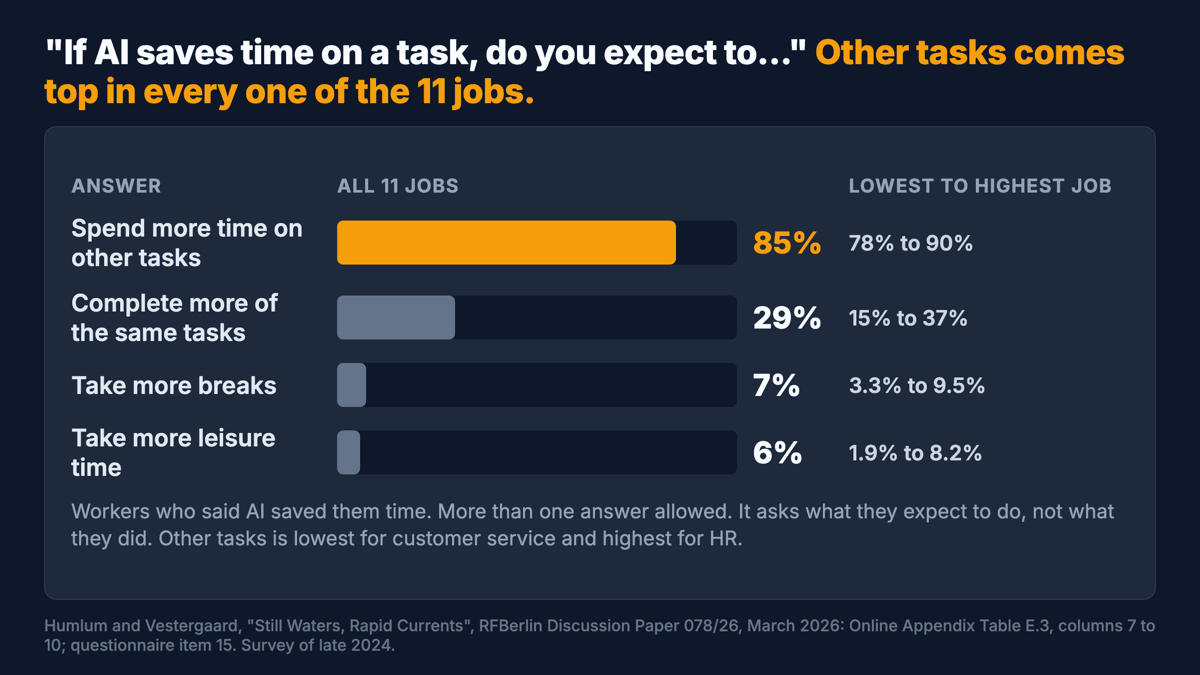
Other tasks comes top in every one of the 11 jobs. The question asked what people expect to do, not what they did.
What the pay records can see, and what they can't
The researchers compared chatbot users with non-users whose employers hadn't encouraged the tools, before and after ChatGPT arrived. Users already earned more: about 9% more where employers encouraged the tools, and 4% more where they didn't. Those gaps were there before ChatGPT, and they didn't widen after it. The estimates for earnings, recorded hours and hourly wages all centre on zero. The confidence intervals rule out average effects larger than 2% (Humlum and Vestergaard, 2026, pp. 3 and 23).
That held for daily users, for people who reported big productivity gains, and for workplaces that pushed the tools hardest. Those workplaces showed no differential change in headcount or wage bill either. The paper also finds the fall in early-career jobs reported in the US, and shows adopting firms aren't driving it (Humlum and Vestergaard, 2026, pp. 3 and 4).
The authors name the design's blind spot: the "missing intercept". Comparing users with non-users only shows a gap between them. If chatbots had raised or cut pay for everyone in these jobs, users and non-users alike, the comparison would miss it. Their check is to ask people directly. Of users, 97.7% said AI hadn't affected their earnings, and of non-users, 99.5% (Humlum and Vestergaard, 2026, p. 32 and Online Appendix E.5).
Firms tell a similar story. The paper cites firm surveys by Yotzov and colleagues (2026), which found generative AI widely adopted but limited perceived effects on employment or revenue productivity (Humlum and Vestergaard, 2026, p. 6). So the extra money may not exist yet. It isn't only a question of someone else keeping it.
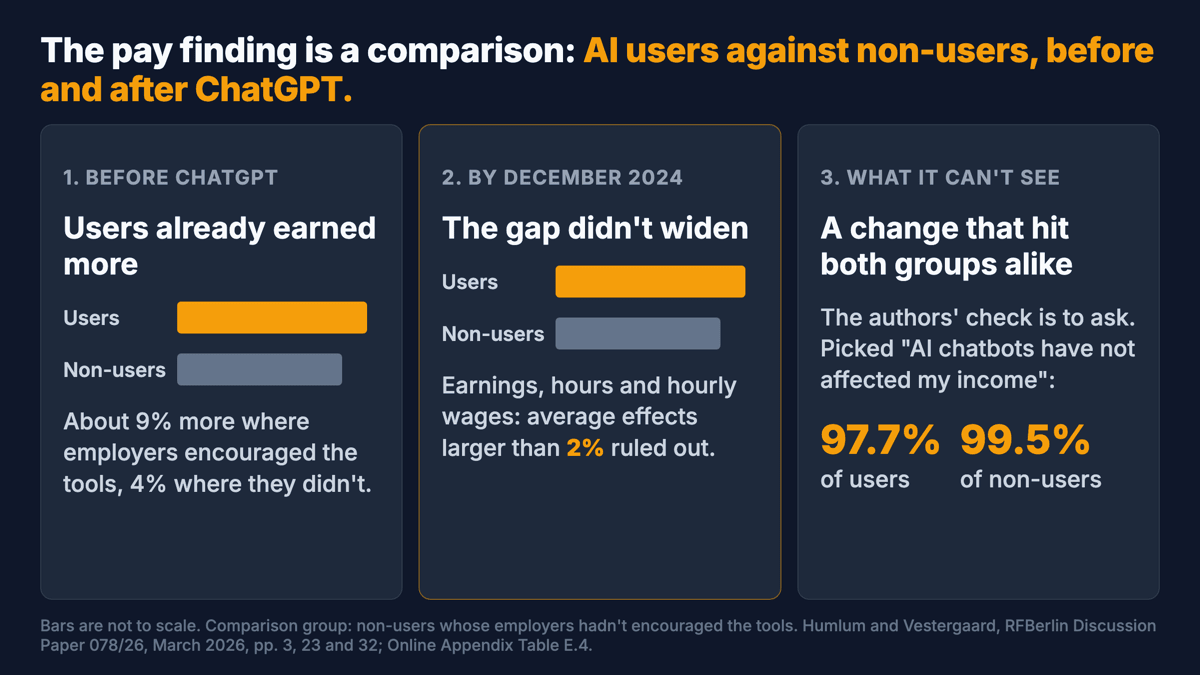
"Didn't pull ahead" is a comparison, so the third panel is the authors' check on what it can't see.
Other reasons users' pay hasn't pulled ahead
The saving is small. About 3% of hours is roughly a quarter of an hour in an eight-hour day. That's small next to the productivity gains "often exceeding 15%" that controlled experiments found on tasks from some of these jobs, as the 2025 version of the same paper notes (Humlum and Vestergaard, September 2025, p. 56). A small saving leaves little to pass on, and the records can't rule out a rise under 2%.
Workers may overestimate the saving. The authors raise this themselves. Their answer is that inflated self-reports are unlikely to be the full explanation, because the same workers say AI hasn't changed what they earn (Humlum and Vestergaard, 2026, p. 26).
Pay may be too rigid to move. The authors tested this and rejected it as the explanation. Most of these workers negotiate pay every year, and the null holds from teachers on central collective agreements to software developers and marketers who negotiate their own (Humlum and Vestergaard, 2026, pp. 7 and 26).
It's early. The records stop at December 2024, and the authors compare the moment to the early computer age, when productivity took years to show in the statistics. One thing did move: users were more likely to change occupation. Those who did saw earnings grow 12 percentage points faster than other Danish workers employed in both November 2022 and December 2024, partly by moving into better-paid occupations. That compares switchers with everyone else, not users with non-users, so it isn't a measure of what AI did to pay. They were also too few to move the average (Humlum and Vestergaard, 2026, pp. 4, 6 and 29).
Some of the time may have gone where pay can't see it. Of users, 53% said chatbots improved the quality of their work (Humlum and Vestergaard, 2026, Online Appendix Table E.3). Better work doesn't show up in an hours record.
None of these says the time vanished. Each is a reason it might not have reached the pay records yet.
Who decides what saved time becomes
Saved time can turn into money in four ways that matter commercially. They aren't the only outcomes. Better work is another.
- More work, same pay. The Danish expectation. If the extra work earns the firm more, the firm keeps it. The study didn't measure profit, so it can't say whether it did.
- More clients. OpenAI and Thrive Holdings, an OpenAI-backed company that owns accounting firms, describe a senior accountant whose tax preparation fell from 180 hours one year to 15 the next. She spent part of the time calling every client to walk them through their returns, and the rest taking on new clients and new services. That's the company's own account, and an outlier: the same write-up says the tool saves practitioners "about a third of their time" on tax preparation (OpenAI, 27 May 2026).
- Fewer people paid. Fura is an AI company that buys small freight brokers. At one of them, Pinwheel Logistics, staff went from 26 to 8 while gross merchandise value grew from $12m to $30m and the business swung from a $150,000 loss to $1m profit. Every figure comes from Fura's chief executive in interviews, and Caritas, which collected them, notes the headcount cuts "did meaningful work alongside the AI" (Caritas Venture Co.).
- Lower fees for the client. KPMG International is the UK-based umbrella organisation for KPMG's firms around the world. According to people familiar with the matter, it told its auditor, Grant Thornton UK, to pass on the savings from AI and threatened to find another auditor. It also argued its books were not especially complicated. Accounts at Companies House show the fee fell from $416,000 for the 2024 audit to $357,000 for 2025. That's 14% in dollar terms, though it would have been paid in sterling. KPMG International's own statement: AI "can create efficiencies", but "developing and operating AI systems can generate additional costs" (Financial Times, via The Irish Times, 6 February 2026).
Notice who chooses between them: whoever holds the decision rights and keeps the profit, the person who sets prices, staffing and which clients to take on. An employee may get to choose how a freed hour is filled. Turning it into a new client, a smaller team or a lower fee is usually someone else's call.
The bet on more clients and fewer staff
AI roll-ups are companies that buy ordinary service firms, such as accountants and IT support businesses, and run them with AI. On 6 October I set out what proof that their AI works would look like, and found that none of the new buyers had published it (what would prove an AI buyer's AI works).
The roll-ups own the firms, so they hold the decision rights most of the Danish workers don't. Thrive's write-up says its tool lifts throughput "by about 50%" (OpenAI, 27 May 2026). Throughput only becomes profit if there are new clients to fill it or fewer people to pay. The Danish evidence is the risk in that bet: wide use of AI, and so far no measurable change in headcount or pay bills at the firms pushing it hardest. And the client can claim the saving first. The Financial Times wrote that KPMG's argument "could embolden companies to press their accountants for similar reductions" (Financial Times, via The Irish Times).
Track where your own saved time goes
This log gives you your own numbers before anyone decides where your saved hours go. It takes about twenty minutes on a Friday. Copy it.
WHERE MY AI-SAVED TIME WENT
Four weeks. About twenty minutes each Friday.

Start, week 1: list the tasks you use AI on. Time one
  run of each without AI. If you can't, time week 1 as
  it is and count later weeks as change from week 1.

Weeks 2 to 4, each Friday, for each task:
  Saved = (minutes per run before - minutes per run now)
          x times you did it this week
  Time spent checking or fixing the AI counts as "now".
  Split the saved minutes across these labels:
    SAME    more of the same work
    OTHER   other or new work, including work AI created
    BETTER  the same work, done more carefully
    REST    a break, leaving on time
    PAID    new clients or paid work (only if you sell
            your own time)
    ?       you can't yet show where it went

End: the fourth Friday. Add up the minutes per label.
  Mostly SAME or OTHER: the saving went back into the
    job. Take it to the questions below.
  Mostly BETTER: quality is a result too. Ask how it
    counts at your review.
  Mostly REST: the time is coming back to you. Keep
    logging.
  Mostly PAID: saved time is becoming income. Check it
    against what you charge.
  Mostly ?: you can't show a saving yet. Log four more
    weeks before you raise it.

Before you show anyone, decide what you hand over.
  A record of spare hours can also be read as room for
  a bigger target.

Questions for your manager:
  1. Here are the hours AI saved me. Has my workload
     gone up to fill them?
  2. Have my targets changed since I started using AI?
  3. What is freed-up time meant to be used for here?
  4. How will it show at my review?
Do the timed run in week one, before anyone asks how much time AI saves you. A "before" you remember is the easiest number to argue with.
Sources
- Humlum, A. and Vestergaard, E., "Still Waters, Rapid Currents", RFBerlin Discussion Paper 078/26, 13 March 2026, not peer-reviewed. The main source for this piece, including its Online Appendix (Tables E.3 and E.4) and survey questionnaire: https://www.rfberlin.com/wp-content/uploads/2026/03/26078.pdf
- Humlum, A. and Vestergaard, E., the earlier version of the same study under its first title, University of Chicago Becker Friedman Institute working paper 2025-56, updated 22 September 2025 (cited for p. 56 only): https://bfi.uchicago.edu/wp-content/uploads/2025/04/BFI_WP_2025-56-4.pdf
- OpenAI, "Building self-improving tax agents with Codex", by engineers from Thrive Holdings and OpenAI, 27 May 2026: https://openai.com/index/building-self-improving-tax-agents-with-codex/
- Caritas Venture Co., AI Rollup Market Map, updated 23 September 2026 (Fura entry; figures are CEO-reported): https://caritas.ventures/ai-rollup-market-map/
- Financial Times, "KPMG pressed its auditor to pass on AI cost savings", republished by The Irish Times, 6 February 2026: https://www.irishtimes.com/business/2026/02/06/kpmg-pressed-its-auditor-to-pass-on-ai-cost-savings/