Is the $5 trillion AI roll-up opportunity real? McKinsey's number is a ceiling for firms that could sell, not a forecast that they will
Jamie Watters
Operational resilience and AI delivery practitioner.
Who this is for: anyone who has been pitched "buy a small business and run it with AI" on the strength of a huge McKinsey number, and anyone following the AI roll-up trend who wants to know what that number actually counts. By the end you'll know the answer, where its words changed, and have one accurate sentence to say back.
Skip it if you already know the McKinsey figure is a model of enterprise value, not a count of sales.
On the length: about ten minutes, most of it the trail of quotes.
"~$5 trillion worth of American businesses will change hands by 2035, according to McKinsey." That's the second paragraph of Greg Isenberg's X article "$5T opportunity: AI Roll Ups". It went up on 26 September and showed 1.9 million views on 22 October (Isenberg, 2026). His video on the same subject opens the same way. The pitch underneath is simple: owners are retiring, so buy the firm and, in his words, "use AI agents to 3x EBITDA".
The McKinsey sentence the number comes from reads: "More than one million firms are viable candidates for sale, representing up to $5 trillion in enterprise value" (McKinsey, 2026).
Same number. Different sentence. "Up to" has gone. "Viable candidates for sale" has become "will change hands". A ceiling on what could sell has become a forecast of what will (McKinsey, 2026; Isenberg, 2026). This is the same trip I took for "80% of AI projects fail", which turned out to be a paraphrase of unnamed opinion surveys quoted in a magazine profile (the earlier piece). The $5 trillion has a better pedigree: a real report, with a method. The drift is in what happened to its words on the way to your feed.
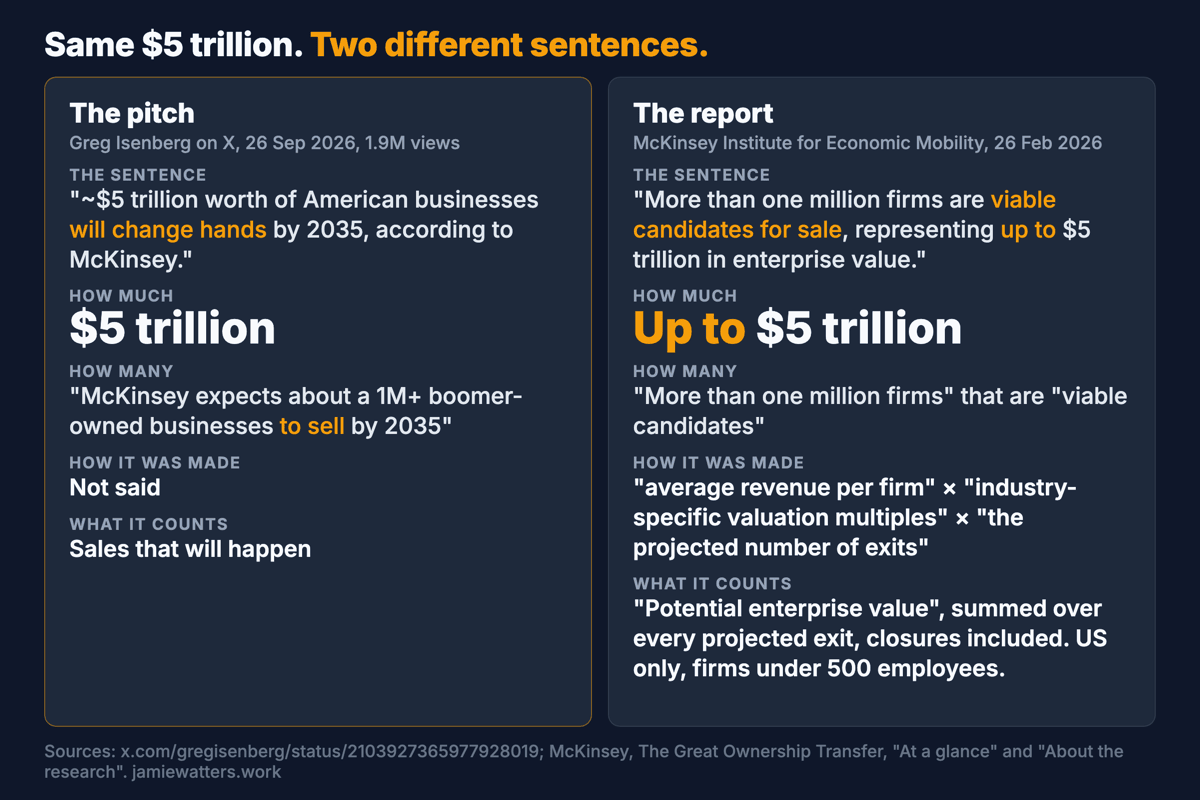
The pitch's sentence and the report's, side by side. Sources: Isenberg's X article, 26 September 2026; McKinsey Institute for Economic Mobility, The Great Ownership Transfer, 26 February 2026.
What McKinsey counted
The report is The Great Ownership Transfer, from the McKinsey Institute for Economic Mobility, dated 26 February 2026. It covers the United States, and firms "with fewer than 500 employees". Its headline: "By 2035, about six million small and medium-size businesses (SMBs) will face ownership transitions as baby boomers retire. More than one million firms are viable candidates for sale, representing up to $5 trillion in enterprise value" (McKinsey, 2026).
Enterprise value is what a business is worth as a going concern, before its debts are paid off. It isn't what the owner takes home.
How was the $5 trillion made? The report's own research note says. McKinsey "estimated the typical enterprise value of an SMB in each industry by using US Census Bureau data on average revenue per firm and applying industry-specific valuation multiples to translate revenue into enterprise value". Those per-firm estimates "were then multiplied by the projected number of exits across industries and years and summed". The figures "reflect the potential enterprise value tied to businesses changing hands, transferring within families, or closing". Not, the note adds, the result of any actual deal (McKinsey, 2026).
So: average revenue, times an industry multiple, times a projected number of exits. No business was valued. No sale was counted in the $5 trillion. It is a model of what the firms might be worth, and the report says so (McKinsey, 2026).
Read the note once more and it says something the headline doesn't. The total is "the total enterprise value associated with businesses expected to change hands or exit between 2026 and 2035", and it is multiplied across "the projected number of exits", closures included (McKinsey, 2026). The headline pins it on the million viable candidates. The method spreads it across every exit.
The six million rests on a model too. Footnote 2 says "Retirement rates are not directly measured in any official US statistical database", so McKinsey "estimated that 7 to 12 percent of baby boomers retire each year" and modelled the exits from that (McKinsey, 2026).
That isn't a criticism of the report. The criticism is of what happened next.
The number the pitch leaves out
The report splits exits by route for one year. "In 2022 alone, we estimate that 510,000 SMBs exited the market. Ninety-two percent of those exits occurred through closure, 5 percent were completed as sales, and 3 percent transferred to new owners (often intergenerationally to family members)" (McKinsey, 2026).
Five in a hundred. Of the businesses that exited in the one year McKinsey breaks down this way, about one in twenty was sold.
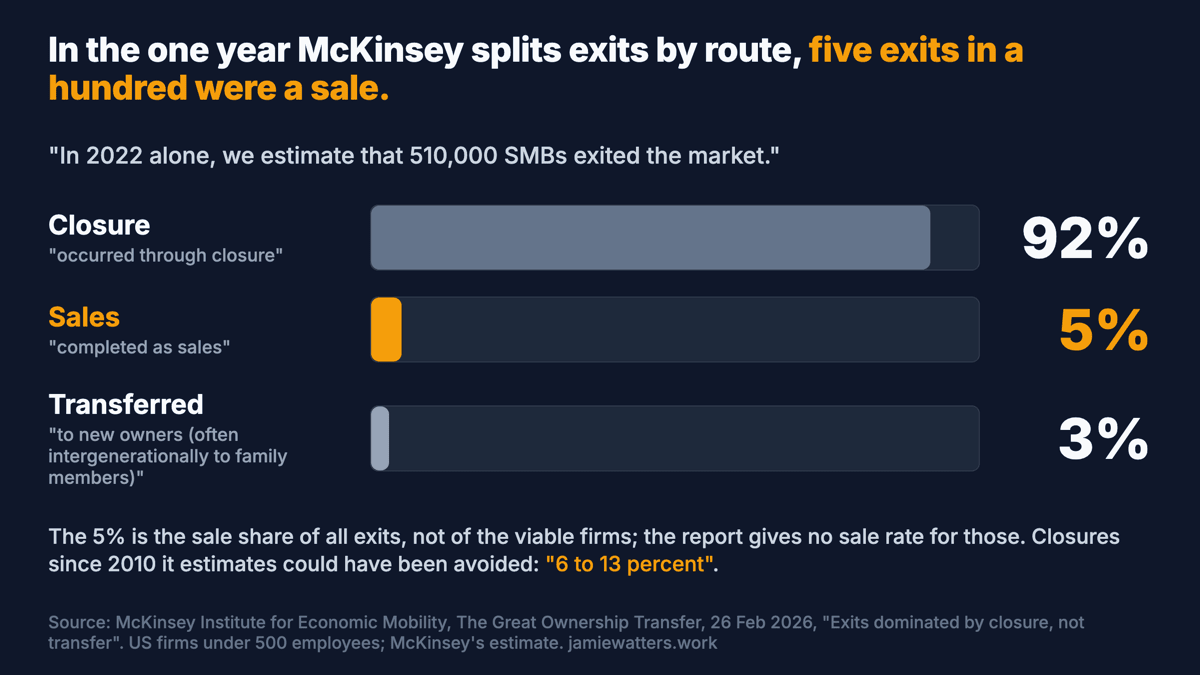
The base rate. Source: McKinsey, The Great Ownership Transfer, 26 February 2026, the "Exits dominated by closure, not transfer" section.
The report is not saying this will continue. Its whole argument is that it shouldn't: "most exits end in closure rather than transfer, not because the businesses lack value, but because pathways to succession are limited, opaque, or costly". It also estimates, of the firms that have closed each year since 2010, that "6 to 13 percent of these closures could have been avoided" (McKinsey, 2026).
Put the two halves together and you have the honest version of the number. A million firms might be worth up to $5 trillion if they sold. In 2022, one in twenty exits was a sale (McKinsey, 2026). Those are different groups: the 5% is the share of all 510,000 exits, and the report counts only about one in six of the coming exits as a viable candidate. The report gives no sale rate for the viable million on their own. The gap between "might be worth" and "one in twenty" is the question anyone buying has to answer, and the pitch answers it with the words "will change hands".
Where the words fell off
You'd expect the drift to be at the end of the chain, in the viral post. It starts on McKinsey's own page.
The page uses both forms. The summary says "up to $5 trillion". A few paragraphs down, the introduction says the six million "will be on the market". Then: "More than one million of these firms are viable candidates for sale or employee ownership, representing $5 trillion in enterprise value". The pull quote beside it repeats "will be on the market" and drops "up to" too (McKinsey, 2026). "Face ownership transitions" has become "on the market" before you've left McKinsey's website.
The press made the big move on day one. Forbes, on 26 February, the afternoon the report came out: "about 1 million of them expected to be sold in transactions cumulatively worth $5 trillion" (Forbes, 2026). Candidates became "expected to be sold". Enterprise value became "transactions". Its headline on the page reads "Millions Of Small Businesses Soon Changing Hands".
Two later outlets took that sentence from Forbes rather than from the report. Black Enterprise on 4 March, "Forbes reports": "one million businesses owned by them are expected to be sold, with an estimated value of $5 trillion" (Black Enterprise, 2026). A trade newsletter in May, sharing the Forbes article: "Roughly 1 million of those businesses are expected to change hands through transactions worth a combined $5 trillion" (AICC Now, 2026).
It wasn't universal. Fortune, the same day as Forbes, kept "up to $5 trillion in enterprise value" and said of the 2022 split that "the report does not link this percentage to the total $5 trillion valuation" (Fortune, 2026). A cleaning-industry magazine in March kept "up to US$5 trillion" as well (CMM Online, 2026). Copying the report was possible. It just wasn't what travelled.
Then McKinsey's own podcast, on 14 May, in a transcript the page says was "edited for clarity and length". Senior partner Shelley Stewart: "around one million of those businesses are viable candidates for sale. That represents close to $5 trillion in potential business value." He kept "candidates" and "potential". "Up to" became "close to", a ceiling turned into an estimate (McKinsey Podcast, 2026).
By 26 September the sentence was ready for Isenberg: "~$5 trillion worth of American businesses will change hands by 2035, according to McKinsey." Further down: "McKinsey expects about a 1M+ boomer-owned businesses to sell by 2035". The solo founder, he says, "gets the other 999,000 businesses" (Isenberg, 2026). In the video: "they expect about a million of those businesses to actually sell by 2035" (Isenberg, 2026, video transcript).
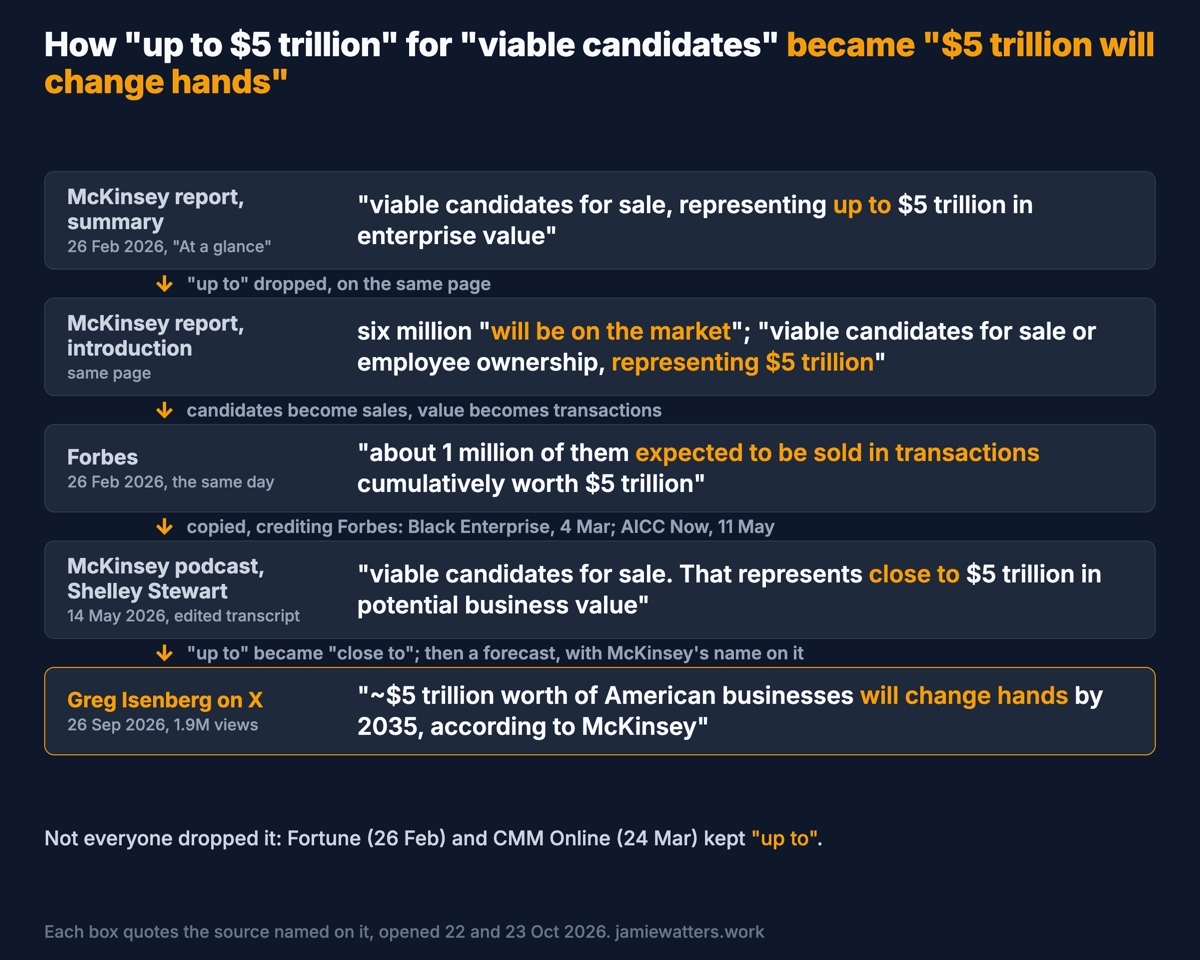
How "up to $5 trillion" for "viable candidates" became "$5 trillion will change hands". Each box quotes the source named on it (McKinsey, 2026; Forbes, 2026; Black Enterprise, 2026; AICC Now, 2026; Fortune, 2026; CMM Online, 2026; McKinsey Podcast, 2026; Isenberg, 2026).
No one in those steps invented a figure; it is the same $5 trillion in every box (McKinsey, 2026; Isenberg, 2026). Each step dropped or swapped a qualifier, and each swap made the sentence tidier and the claim bigger.
Two loose ends I couldn't tie off. The same podcast has Stewart's colleague Ken Yearwood saying "at a minimum, something like $5 trillion". But his sentence is about the value lost if viable firms close, not about sales, so it isn't on the chain. He also calls something a forecast: "up to 92 percent of viable businesses potentially closing". The cleaning magazine says 92% of firms under $5 million "will close rather than be sold" if current trends continue (McKinsey Podcast, 2026; CMM Online, 2026). The 92% on McKinsey's web page describes 2022. Neither the forecast nor the $5 million definition is on that page. They may be in the report's PDF, which I didn't open.
What this does and doesn't show
It doesn't show the roll-up idea is wrong. The retirements are real: McKinsey says "more than half of all small-business owners in the United States are over the age of 55" and "One in four small-business owners is 65 or older" (McKinsey, 2026). A buyer could read the 5 per cent the other way, as proof that sellers outnumber buyers. McKinsey makes that argument too, on other grounds: "For the first time, the country faces an oversupply of businesses for sale rather than a shortage" (McKinsey, 2026). That is a reasonable argument for buying. It is a different sentence from "$5 trillion will change hands".
Isenberg knows the failure mode. The last item in his own list of what breaks is "Believing the headline numbers. Most published results in this space are self-reported by young companies that are raising money... Underwrite your deal on your own numbers" (Isenberg, 2026). He applied that to the companies. He didn't apply it to the market number at the top of the page.
And it's American. The report covers US firms under 500 employees (McKinsey, 2026). If you're reading this in Britain, nothing in it measures the UK (the series ledger has what I found there).
The sentence you can repeat
If the number comes up, here is a version that passes on nothing the source didn't say:
McKinsey expects about six million US small firms to face an ownership change by 2035. It calls more than a million of them viable candidates for sale and models up to $5 trillion of enterprise value. That's a ceiling for what could sell, not a forecast of what will. In 2022, the one year it splits exits by route, its estimate is that 5% of small-business exits were sales. (McKinsey, 2026)
Three words to look for in any market-size claim, because they are the three that fell off this one: up to, candidates, enterprise value. A forecast with all three is a model of what might be for sale. A forecast with none of them is selling you a sale that hasn't happened.
How this was put together: the tracing was done with AI research tools on 22 and 23 October 2026. Each page was opened and its text saved, and every quote above was checked against the saved text. The McKinsey quotes are from the web version of the report, its "About the research" note and its footnotes; the 36-page PDF was not opened. Earlier in this series: what the AI roll-ups actually file, what they would have to prove, and the ledger of claims checked.
Sources
- McKinsey Institute for Economic Mobility, The Great Ownership Transfer: A new era of business stewardship, 26 February 2026, web version with the "About the research" sidebar and footnotes: https://www.mckinsey.com/institute-for-economic-mobility/our-insights/the-great-ownership-transfer-a-new-era-of-business-stewardship
- The McKinsey Podcast, "Sell, close, or continue? The transfer of US businesses is at a crossroads", 14 May 2026, edited transcript: https://www.mckinsey.com/institute-for-economic-mobility/our-insights/sell-close-or-continue-the-transfer-of-us-businesses-is-at-a-crossroads
- Greg Isenberg, "$5T opportunity: AI Roll Ups", X article, 26 September 2026: https://x.com/gregisenberg/status/2103927365977928019
- Greg Isenberg, "$5T opportunity: AI Roll Ups", YouTube video, auto-caption transcript: https://youtu.be/ZT4mpjx0JnE
- Martina Di Licosa, Forbes, "Millions Of Small Businesses Soon Changing Hands As Baby Boomers Retire In 'Great Ownership Transfer,' Report Says", 26 February 2026: https://www.forbes.com/sites/martinadilicosa/2026/02/26/millions-of-small-businesses-soon-changing-hands-as-baby-boomers-retire-in-great-ownership-transfer-report-says/
- Nick Lichtenberg, Fortune, "The great (small business) wealth transfer: McKinsey sees $5 trillion of baby boomer companies coming up for sale over the next decade", 26 February 2026: https://fortune.com/2026/02/26/great-small-business-wealth-transfer-mckinsey-5-trillion-baby-boomer-businesses-sale/
- Black Enterprise, "As Baby Boomers Start To Retire, $5T Worth Of Businesses Will Be Sold, Here's Why", 4 March 2026: https://www.blackenterprise.com/baby-boomer-businesses-worth-5t-could-be-sold-soon/
- CMM Online, "6M Small Business Owners to Reach Retirement by 2035", 24 March 2026: https://cmmonline.com/news/6m-small-business-owners-to-reach-retirement-by-2035
- AICC Now, "The Next Chapter May Be Closer Than You Think", 11 May 2026: https://now.aiccbox.org/?p=6355