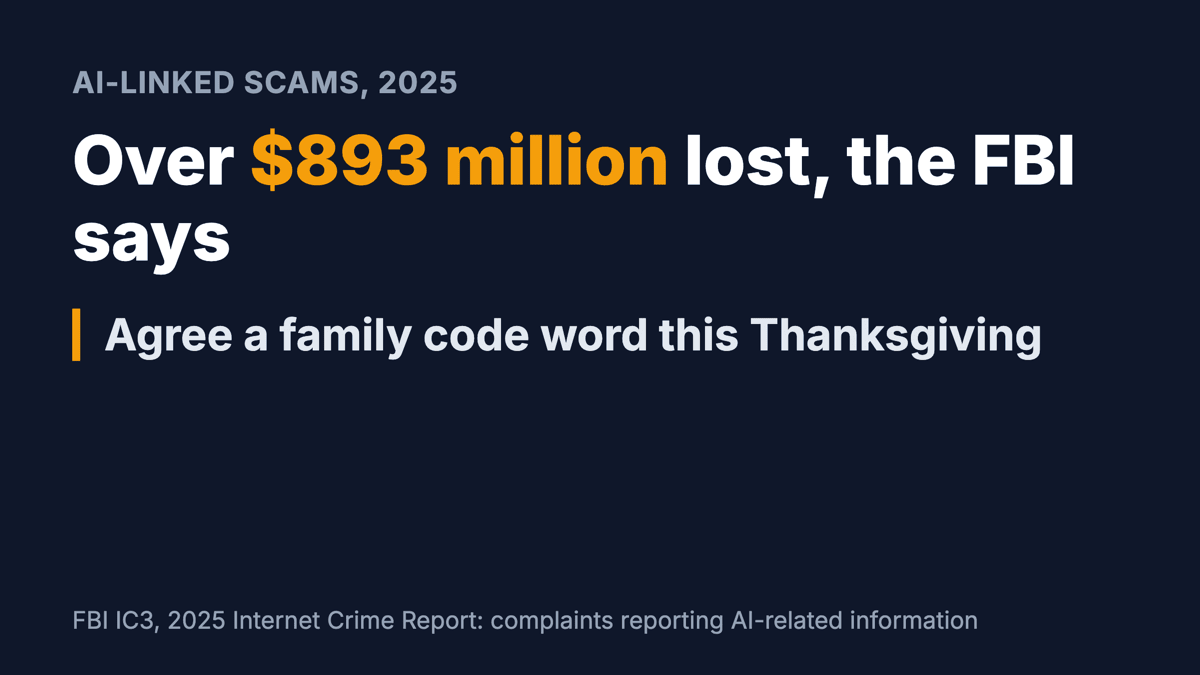
AI-linked scams cost over $893m in 2025, the FBI says. Agree a family code word this Thanksgiving
Jamie Watters
Ex-banker, founder at 58, building with AI.
Last month I told a friend that rioters in France had stripped an elderly couple in the street. I said it as fact. The photo I'd seen was made or edited with AI. It had flaws I didn't spot. The story had made me angry, and I didn't look closely.
It cost me an awkward conversation and some pride. Nobody asked me for money.
Now picture the same moment with one change. The face or the voice belongs to someone you love, or someone you work for. And it needs money now. That's not a thought experiment. It's a line in the FBI's annual crime report. And the idea that would have caught my mistake is the one that protects you there: confirm it with the source yourself, instead of trying to spot the fake.
What the FBI counted
The FBI's yearly crime report has a section on AI. In 2025 it logged 22,364 complaints that reported AI-related information, with more than $893 million in reported losses (FBI, 2025 Internet Crime Report).
One kind is aimed straight at families. In "distress" scams, the FBI says, "voice cloning technology is used to mimic the sound of a loved one in distress" (FBI, 2025 Internet Crime Report).
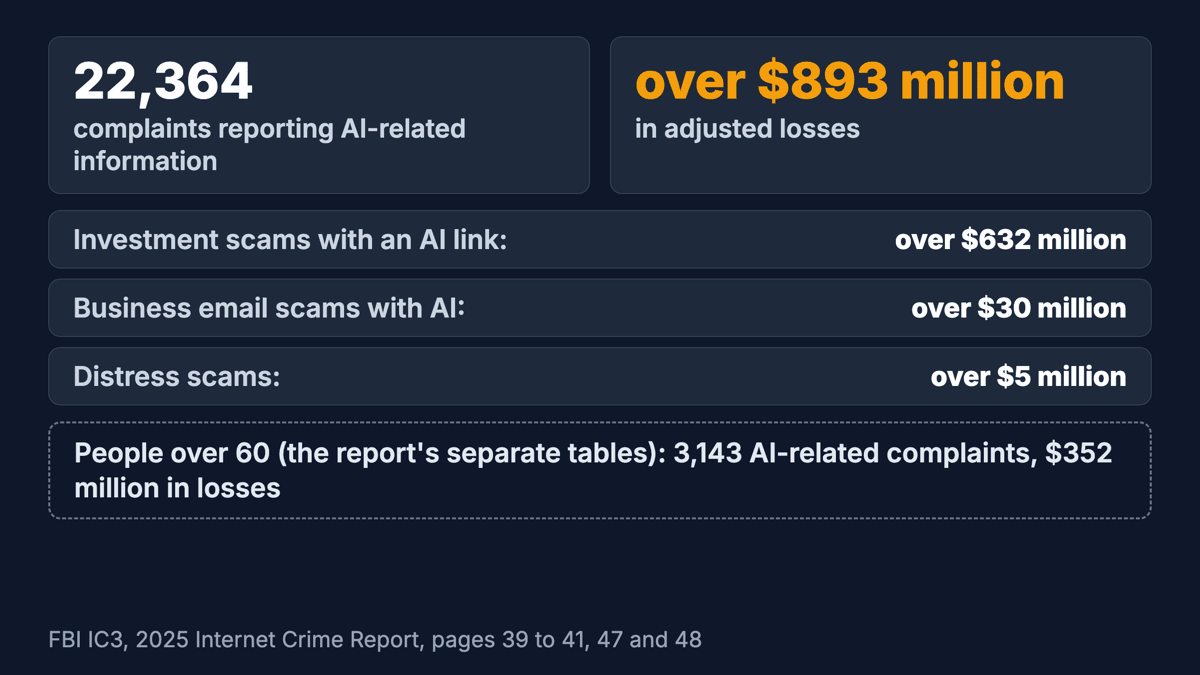
What the FBI counted for 2025. Source: FBI IC3, 2025 Internet Crime Report.
And those are only the complaints that mentioned AI. The FBI says itself that many victims don't realise how far AI was involved (FBI, 2025 Internet Crime Report). A victim who didn't know the voice was cloned can't report that it was.
Why looking harder won't save you
When the fact-checkers looked at the couple's photo, the flaws were there: the woman's left hand has four fingers, and one of the masked figures has two heads (franceinfo, 20 October 2026). I'd seen that photo and noticed neither.
That isn't just me. In a study published in PNAS, people shown faces and asked which were real and which were made by AI were right 48.2% of the time, slightly worse than tossing a coin. Taught the tells and given feedback after each answer, they reached 59.0% (Nightingale and Farid, 2022). Those were still photos of faces, with time to look. A scam gives you a voice, a hurry and a reason not to think.
The FBI says it plainly in its report: AI-made content "is becoming increasingly difficult to detect and easier to make" (FBI, 2025 Internet Crime Report). In fake kidnappings, it warns, the altered "proof of life" photo sometimes comes on a timed message, so you can't study it (FBI public service announcement I-120525-PSA, 5 December 2025).
The FBI does list tells worth a glance: distorted hands, odd teeth or eyes, lag, a voice that doesn't match (FBI public service announcement I-120324-PSA, 3 December 2024). Use them one way only. A flaw is a reason to stop. No flaw is not a reason to trust.
The doubt that was right
A finance worker in the Hong Kong office of Arup, the British engineering firm, got an email asking for a secret transfer. He suspected it was a scam. Then he joined a video call with what looked and sounded like the finance chief and colleagues he knew. Hong Kong police say every one of them was a deepfake. He sent about $25.6 million (CNN, 16 May 2024).
His first instinct was right. The video is what talked him out of it.
Same failure as mine: a picture overruled a reason to doubt. The fix isn't a sharper eye. It's taking the decision off the channel the scammer controls.
The check
Here's the check I'll run. Every step works without spotting anything.
Before a voice, a video or a photo gets your money
Start: someone you know, or someone official, asks for money, a code, a password or secrecy, by phone, message or video call, and it's urgent.
- Treat the hurry as the warning. "Scammers portray a false sense of urgency" (FBI). Say "I'll call you straight back".
- Don't judge it by sight or sound. A flaw is a reason to stop. Looking or sounding right proves nothing.
- Hang up and call back on a number you already had. For a bank, use the number on your card or statement. Never a number from the message, your screen or a search result. "Lost my phone" or "can't talk" means you call another relative, on a number you already had.
- Ask for the family code word. The FBI's advice is to "create a secret word or phrase with your family". Agree yours face to face, before any call. Never post it, text it or say it first.
- At work, confirm the request and the bank details on a second channel you start. Ring the person on the number in your own directory. A video call the requester set up is the same channel, however many faces are on it.
Pass rule: if you haven't confirmed it on a channel you started, no money moves.
Can't reach them? Call the police. Don't pay.
Done when: you've reached the real person yourself and they've confirmed the request, or you've paid nothing.
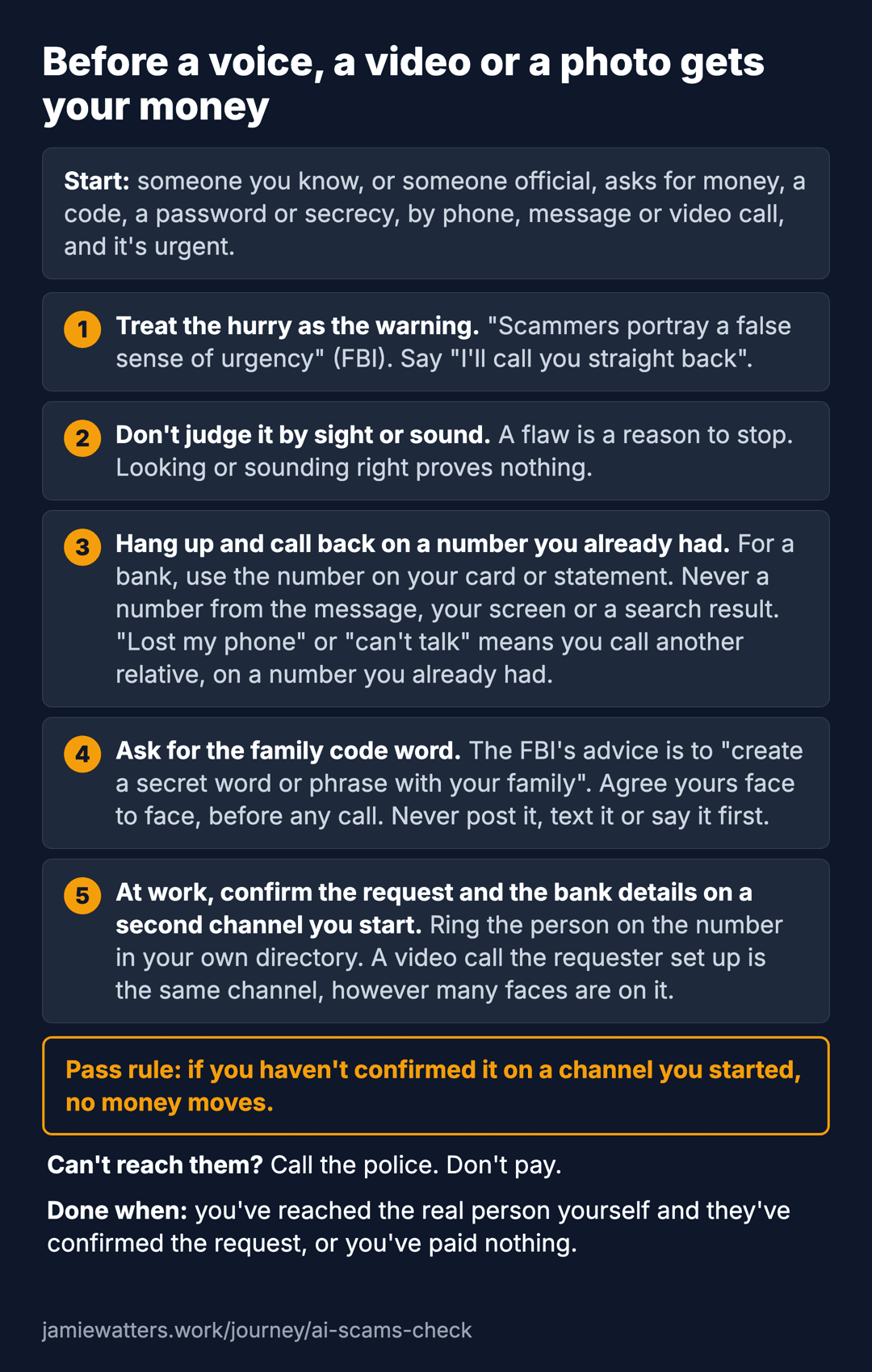
The check as a card, to save or send to your family.
The obvious objection
Come off it, you might say. If my granddaughter rings in tears, I'm not hanging up on her.
You're not hanging up on her. You're ringing her back. If it's really her, it costs one phone call. If it isn't, the person on the line has just lost their best tool, which was your hurry. And if you can't reach her or anyone with her, that's the moment for the police, not for a payment.
The code word is the step that only works in advance. Once the call has started, it's too late to agree one. If your family is together for Thanksgiving next week, that's the moment. Agree it face to face, with the people whose voices someone could copy.
Sources
- FBI IC3, 2025 Internet Crime Report (section "Artificial Intelligence (AI) Used in Cybercrime", pages 39 to 41; over-60 tables, pages 47 and 48): https://www.ic3.gov/AnnualReport/Reports/2025_IC3Report.pdf
- FBI public service announcement I-120324-PSA, "Criminals Use Generative Artificial Intelligence to Facilitate Financial Fraud", 3 December 2024: https://www.ic3.gov/PSA/2024/PSA241203
- FBI public service announcement I-120525-PSA, "Criminals Using Altered Proof-of-Life Media to Extort Victims in Virtual Kidnapping for Ransom Scams", 5 December 2025: https://www.ic3.gov/PSA/2025/PSA251205
- CNN, "Arup revealed as victim of $25 million deepfake scam involving Hong Kong employee", 16 May 2024: https://edition.cnn.com/2024/05/16/tech/arup-deepfake-scam-loss-hong-kong-intl-hnk
- Nightingale and Farid (2022), "AI-synthesized faces are indistinguishable from real faces and more trustworthy", PNAS: https://europepmc.org/article/PMC/PMC8872790
- franceinfo, 20 October 2026, on the French protest photo: https://www.franceinfo.fr/vrai-ou-fake/vrai-ou-faux-un-couple-d-octogenaires-a-t-il-ete-depouille-et-denude-en-marge-des-manifestations-du-17-octobre_8243974.html
- My earlier piece on that photo, how it was made and the check I built from it: https://jamiewatters.work/journey/i-repeated-it