Were an old French couple really stripped by rioters? The photos were AI fakes, and I repeated them
Jamie Watters
Operational resilience and AI delivery practitioner.
Who this is for: anyone who has passed on a shocking story they saw online and wondered afterwards whether it was true. By the end you'll have a six-step check to run before you repeat the next one. It's a ten-minute read.
Skip it if you already check where a photo came from and who confirmed a story before you pass it on.
In the week after the French protests, I told a friend that rioters had stripped an old couple in the street. I didn't say "I saw a post claiming". I said it as something that happened.
The photos I was basing it on were made or edited with AI. And the fallback I reached for when I found out, "well, there was a police report", turned out to be an unconfirmed tip passed on by the media.
It wasn't other people spreading lies. It was me.
That stings, because everything I publish goes through a check: every figure traced to its source before it goes out under my name. None of that ran. I wasn't publishing. I was talking, and the story had made me angry.
So here's what was actually there, why it got past me, and the check I'll run next time. It's short enough to copy.
What was actually there
The protests were real. On Saturday 17 October 2026 there were protests against the cost of living across France, with destruction, looting and clashes in several cities (AFP Factuel, 20 October 2026).
Dominique Rizet is a police and justice consultant on the French news channel BFMTV. At about 8.50 that evening he said on air that an 80-year-old couple had been attacked at Place de la République and "left practically naked", news he said was "coming from police sources" (Lead Stories' transcript, 20 October 2026). He did not say he had seen it. Le Parisien's live blog had carried the same claim around 8pm, citing a police source, and later deleted it (Les Surligneurs, 22 October 2026). franceinfo could not confirm the tip with any other source (franceinfo, 20 October 2026).
At around 10pm the same night, an account on X posted a montage that included a photo of an elderly couple in their underwear, surrounded by masked figures. Under that post was a "Made with AI" mention, and it got about 500 views. The next day a cropped copy, posted by an account located in Israel, reached six million views (AFP Factuel, 20 October 2026). A French police officers' union shared the photo, calling the attack alleged and not officially confirmed (Lead Stories), and the post was later deleted (franceinfo, citing Libération's CheckNews). Some posts named a culprit: Full Fact found captions accusing "far left and migrant rioters".
Then the fact-checkers looked. Google's SynthID detector flagged the photo as made or edited with AI (AFP Factuel; franceinfo; Full Fact). Look closely and the woman's left hand has four fingers, and one of the masked figures has two heads (franceinfo, 20 October 2026). Full Fact's verdict: "This image isn't real and was made using artificial intelligence."
On 20 October the Paris prosecutor's office urged "the greatest caution about these images" and said no complaint matching the story had been identified (AFP Factuel, 20 October 2026, my translation).
So did anything happen to a couple at République? In the latest report I have, updated on 22 October, no authority had confirmed it or ruled it out (Les Surligneurs, 22 October 2026). I said rioters stripped them. That went past both.
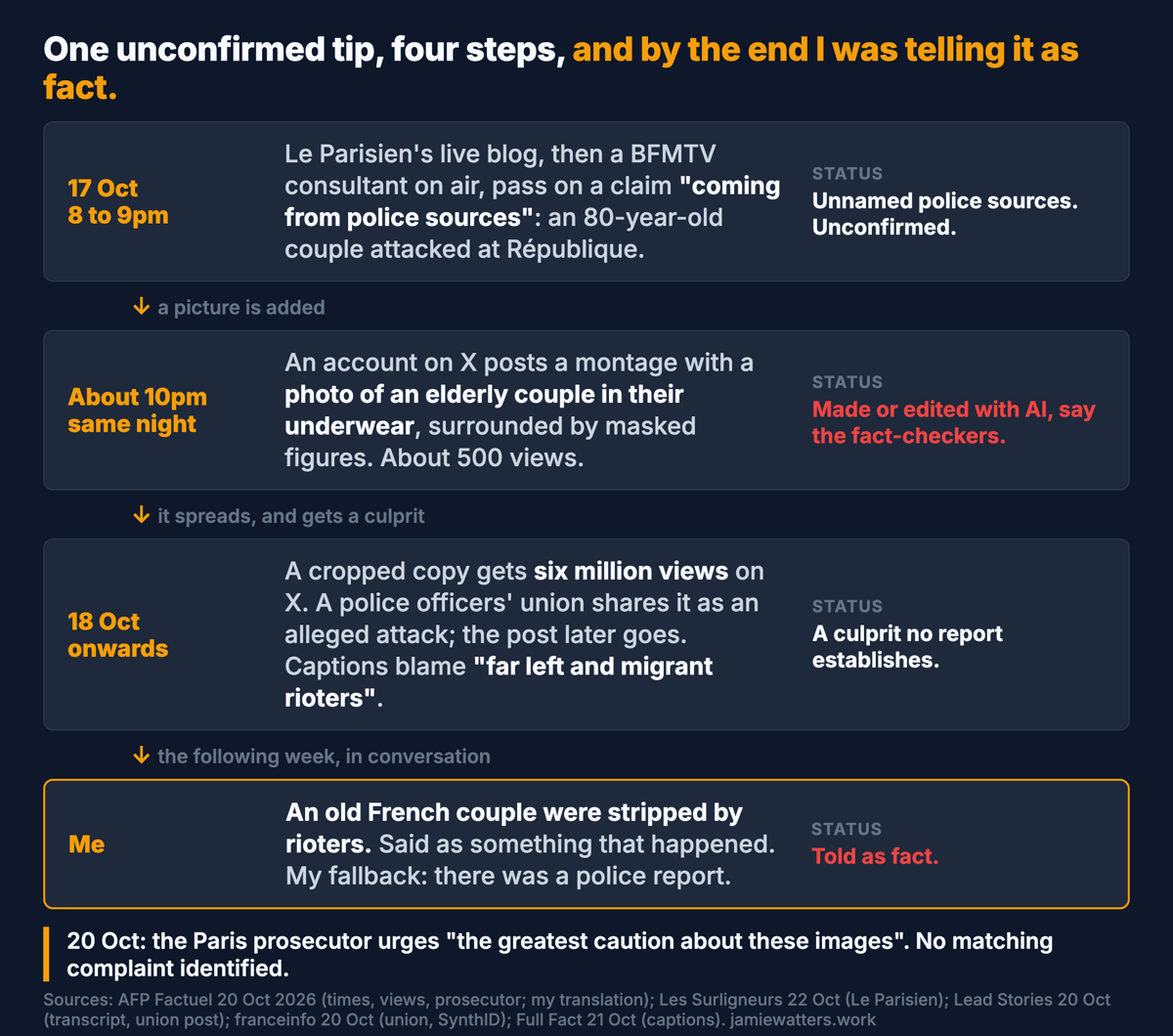
How one unconfirmed tip became something I said as fact. Sources: AFP Factuel, Les Surligneurs, Lead Stories, franceinfo, Full Fact.
The fallback was weaker than the photo
Then someone mentioned that a lot of the images from the protests were fake. My first thought was that this was dangerous, because it would make people distrust the real ones too. My second was that I should check the ones I'd seen. I asked Grok about the photo of the couple. It said the images were AI fakes, and it named the fact-checkers who had shown it. Grok was the pointer. The fact-checkers' work is what showed the photos were fake.
So the photos were fake. My next thought was that the core of the story still stood. There was a police report.
There wasn't. There was a claim from unnamed police sources, on a newspaper's live blog and read out live on TV, and in the reports I have nobody has confirmed it on the record since. That's the second lesson inside the first, and it's the one that bothers me more.
The photo had flaws I didn't spot. The fallback I could have checked with one search. I didn't check it. I treated it as the solid part.
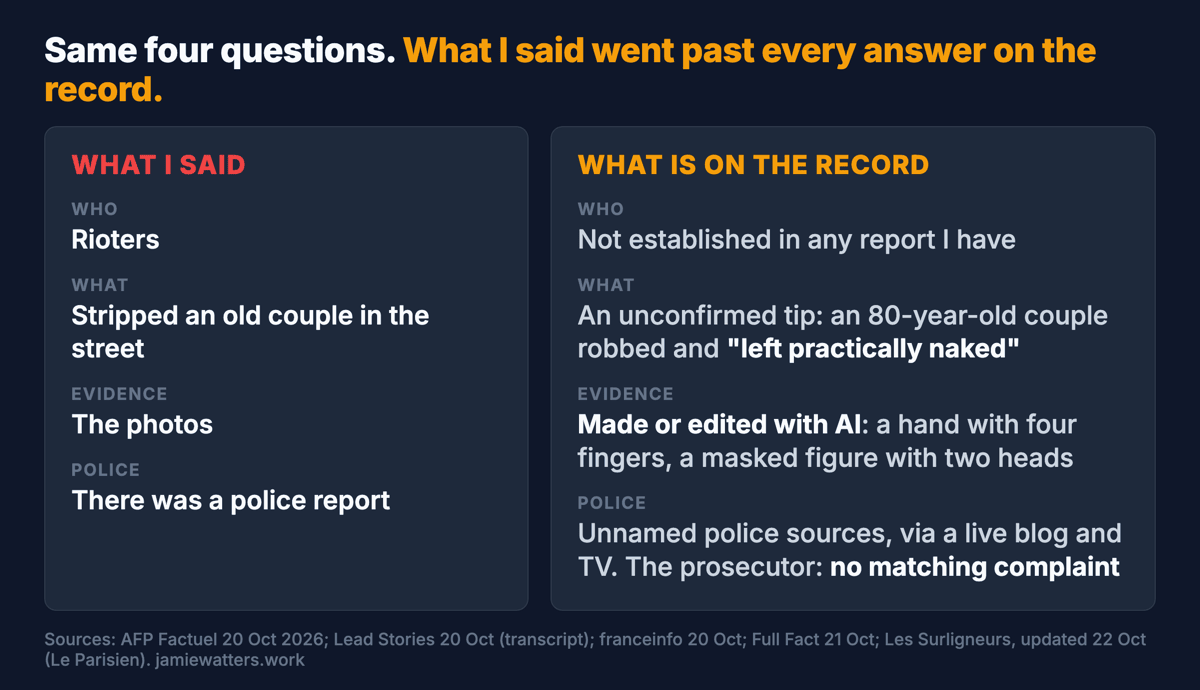
Same four questions, two answers. Sources: AFP Factuel, Lead Stories, franceinfo, Full Fact, Les Surligneurs.
Why it got past me
I'd like to say it was a one-off. The research says it's how minds work, mine included.
Outrage travels. A meta-analysis of 27 studies found that each extra moral-emotional word in a post went with 13% more expected shares (Brady and colleagues, 2025). That's a link, not proof the words caused the sharing, and in the same paper's new data, posts about the killing of George Floyd went the other way. This story came with the outrage built in, and a group to blame.
A picture makes a claim feel truer even when it proves nothing. In four experiments, a photo that carried no evidence either way made people more likely to judge an unfamiliar claim true. A few words did the same (Newman and colleagues, 2012). Those were real photos that proved nothing. Mine claimed to show the event itself.
Your eye won't save you. People sorting real faces from AI-made ones got it right 48.2% of the time, close to the 50% you'd get by guessing. A second group, given training and feedback, managed 59.0%. A third group rated the AI faces as slightly more trustworthy than the real ones (Nightingale and Farid, 2022). That study used faces, not street scenes, so the numbers won't carry over exactly. This photo did have tells. I didn't spot them.
Repetition adds to it. Repeated statements feel truer, and in one set of experiments that happened "even when participants knew better" (Fazio and colleagues, 2015). The biggest jump comes the second time you hear something (Hassan and Barber, 2021). So when I told the story, I may have been somebody's second hearing.
And most of us mean well. Pennycook and colleagues found that most people say it's important to share only accurate news. Yet whether a headline was true made little difference to whether they would share it. Their explanation is that people's "attention is focused on factors other than accuracy" (Pennycook and colleagues, 2021). That's me. My value was fine. My attention was on the outrage.
Outrage impersonates evidence. A vivid picture that makes you angry feels like proof. It isn't.
The check
Here's what I'll run before I repeat a story like that again.
Before you repeat a shocking story
Start: a story has made you angry, scared or disgusted, and you want to tell someone.
- Notice if it's made you angry. That's your cue to check, not a sign it's true.
- Ask one question: is it true? Not "is it shocking" or "does it fit what I think".
- Don't judge the picture by looking at it. Run an image search on it (on a phone, Google Lens) to find where it first appeared and who posted it. Can't find the origin? Treat it as unknown.
- Leave the page. Search the claim with the words "fact check". No fact-check yet means unconfirmed, not cleared.
- Find who confirmed it on the record: the police or the prosecutor, in their own statement. "Police sources told a TV channel" is not "the police said". Two outlets can share one source, and a police union isn't the police.
- Say it at the strength you found, and say who claimed it: "confirmed by...", "claimed by... but not confirmed", or nothing.
Pass rule: if you can't name who confirmed it on the record, you say "unconfirmed" or you don't say it.
Done when: you've passed it on with its source and its strength, or you've kept it to yourself.
Step 1 is my cue to start, not a tested fix. Step 2 is what researchers call an accuracy prompt. Across 20 experiments run by the researchers' own group, nudging people to think about accuracy cut their intention to share false headlines by 10% compared with a control group (Pennycook and Rand, 2022). That's small, it was measured as what people said they'd share rather than what they did, and it won't make anyone immune. The six steps haven't been tested together as one check.
Step 3 is there because my eye failed. Step 4 is what professional fact-checkers do. Wineburg and McGrew watched 10 fact-checkers, 10 historians with PhDs and 25 Stanford students judge websites. The fact-checkers left the site after a quick scan and opened new tabs to see what others said about it. They "arrived at more warranted conclusions in a fraction of the time" (Wineburg and McGrew, 2019). It's a small study, 45 people, but the habit is easy to copy.
Step 5 would have caught my fallback, and on the night itself, before any fact-check existed, it's the step that does the work. Step 6 is the gap between honest and accurate. I wasn't lying. I believed it. That isn't the same as it being true.
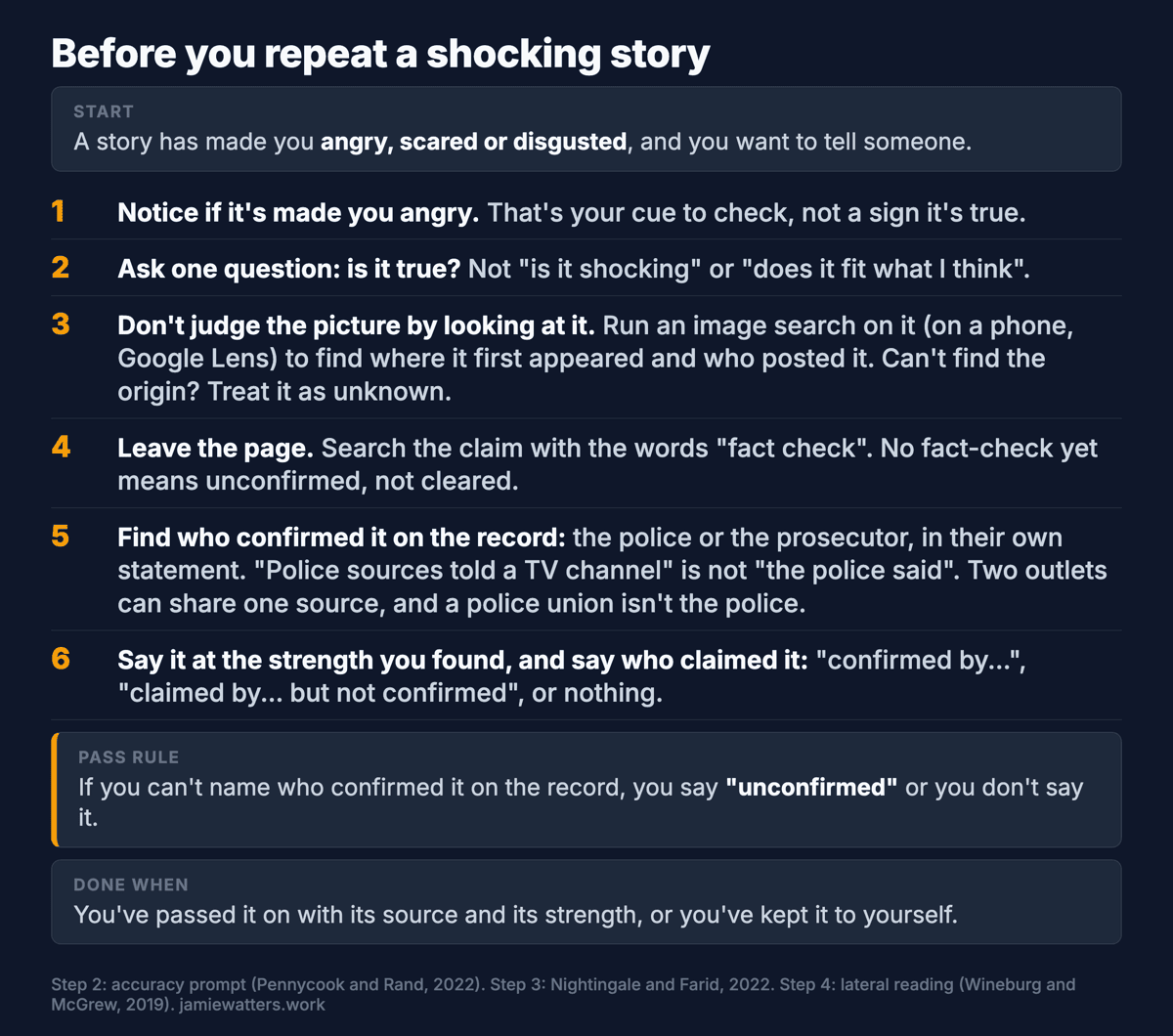
The check as a card, to save or screenshot.
The obvious objection
Come off it, you might say. It was a conversation, not a newspaper. Nobody checks everything they say over a coffee, and there was a police source, so maybe it happened. Teach people to doubt everything and they'll believe nothing, which is worse.
Some of that is right. You can't check everything. The check is for the stories that make you angry and hand you someone to blame, because those are the ones that travel.
The doubt-everything risk is real. It was my first worry when I heard about the fakes, and in one study it showed up. Four student teams replicated a study of a well-known game that trains people to spot fake news. Playing it cut belief in false tweets. It also cut belief in true tweets "to the same or almost the same extent" (Graham and colleagues, 2023). A check that ends in "believe nothing" has failed. That's why step 6 isn't "disbelieve it". It's "say it at the strength it has".
And yes, maybe something did happen at République. I can't rule it out. But the honest version was still worth telling. A newspaper and a TV consultant passed on an unconfirmed police tip. Photos made or edited with AI turned up the same night. A police union shared one as an alleged attack, and the prosecutor has no matching complaint. That's a true story about how a fake gets made. The one I told wasn't.
I went back to my friend and told them I'd been wrong.
Sources
- AFP Factuel, 20 October 2026, via Yahoo Actualités: https://fr.news.yahoo.com/photo-dun-couple-doctog%C3%A9naires-d%C3%A9pouill%C3%A9s-115101517.html
- Lead Stories, updated 20 October 2026, via Yahoo News: https://www.yahoo.com/news/world/articles/fact-check-fake-image-elderly-053447137.html
- franceinfo, 20 October 2026: https://www.franceinfo.fr/vrai-ou-fake/vrai-ou-faux-un-couple-d-octogenaires-a-t-il-ete-depouille-et-denude-en-marge-des-manifestations-du-17-octobre_8243974.html
- Clubic, 19 October 2026: https://www.clubic.com/actualite-634735-pancartes-truffees-de-fautes-panthere-rose-personnes-agees-denudees-l-ia-s-invite-dans-les-images-des-manifestations-d-octobre.html
- Full Fact, 21 October 2026: https://fullfact.org/world/photo-elderly-french-couple-stripped-ai/
- Les Surligneurs, updated 22 October 2026: https://lessurligneurs.eu/rumeur-doctogenaires-depouilles-le-17-octobre-les-images-qui-circulent-ont-ete-generees-par-ia/
- Brady and colleagues (2025), PNAS Nexus: https://europepmc.org/article/PMC/PMC12578369
- Newman and colleagues (2012), Psychonomic Bulletin and Review: https://doi.org/10.3758/s13423-012-0292-0
- Nightingale and Farid (2022), PNAS: https://europepmc.org/article/PMC/PMC8872790
- Fazio and colleagues (2015), Journal of Experimental Psychology: General: https://doi.org/10.1037/xge0000098
- Hassan and Barber (2021), Cognitive Research: Principles and Implications: https://europepmc.org/article/PMC/PMC8116821
- Pennycook and colleagues (2021), Nature: https://doi.org/10.1038/s41586-021-03344-2
- Pennycook and Rand (2022), Nature Communications: https://europepmc.org/article/PMC/PMC9051116
- Wineburg and McGrew (2019), Teachers College Record: https://doi.org/10.1177/016146811912101102
- Graham and colleagues (2023), Journal of Cognition: https://doi.org/10.5334/joc.324