Codie Sanchez said her AI bot made "damn near $2,000". It’s not a scam, and the upside isn’t what you think.
Jamie Watters
Ex-banker, founder at 58, building with AI.
"This is $100, and in 10 days, I'm going to turn it into $1,000." That's the first line of a video Codie Sanchez posted on 11 November.
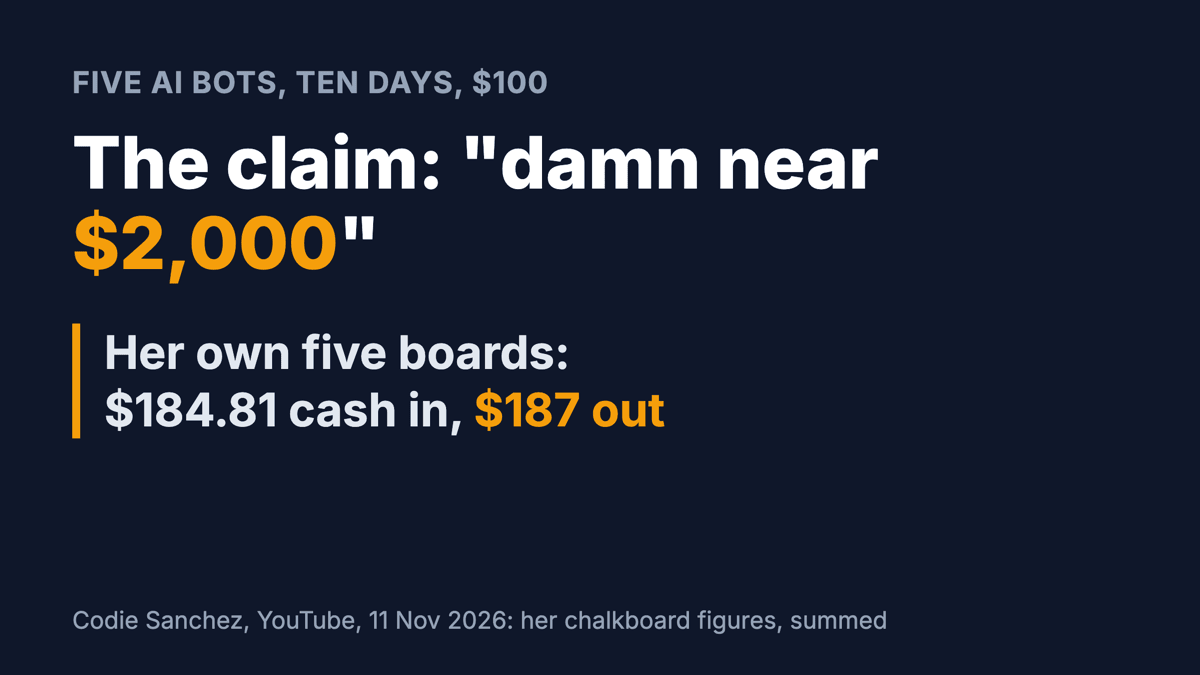
Ten days and five AI bots later, she gives the last bot five stars for "damn near $2,000 in revenue". In its first ten days, the video was watched more than 780,000 times.
If you've been wondering whether these bots could make you money, or whether it's all a scam, this is a good one to take apart. She doesn't hide the numbers. She writes them on a chalkboard, bot by bot. So you can add them up.
In cash, they come to $184.81 in and $187 out (her five boards, in the video), and $187 is the cost figure she gives at the end. Across ten days and five bots, about $2 down.
The three rules she set herself
Before the first bot starts, she sets the rules on camera (at the start). One: once the bots are set up, she can't do the work. Two: "I can't spend more than $100." Three: "the money only counts if it's cold hard cash or saves real money in my business."
Rule three is the one to keep in mind, because she sets it herself. It's a good rule, and it's the rule the ending breaks.
Five bots, five chalkboards
The bots run on Grok Bot. The video description says it "starts at $30 with an X Premium subscription", and tags the video #GrokPartner.
The trading bot read Reddit, X and the news and traded on the buzz through Robinhood. Trading lost 67 cents and the bot cost $15 to run: down $15.67 (day ten, in the last chapter). She fires it, and draws the right lesson: "if you point a bot at a bad process, you just lose money fast."
The flipping bots found free items listed online, booked a courier when the sums worked and relisted them on Facebook Marketplace. The first pickup was a bowling ball, in her hands 31 minutes after the bots found it. The bots also sold some stools and other things lying round her office. Revenue $130, costs $41.98, profit $88.02 (flipping section). That's the best real result in the video.
The clipping bot tried to sell video clips to strangers. The one prospect it found went quiet, and it ended down $31.76 (clipping section). The email bot wrote to 3,000 people who'd come to her book launch and not bought, sold two books in two hours, and made $14.48 (email section).
Then the star. The cold-lead bot looked for local business owners to fill a workshop her company was running in Austin. It checked her sales system first, so it didn't email anyone her team was already talking to. It checked each address before sending, and passed every reply to her human sales team. It cost $57.26. By day ten, about 10 owners had said they were interested and two had booked a call. Cash taken: none reported (day ten, in the last chapter).
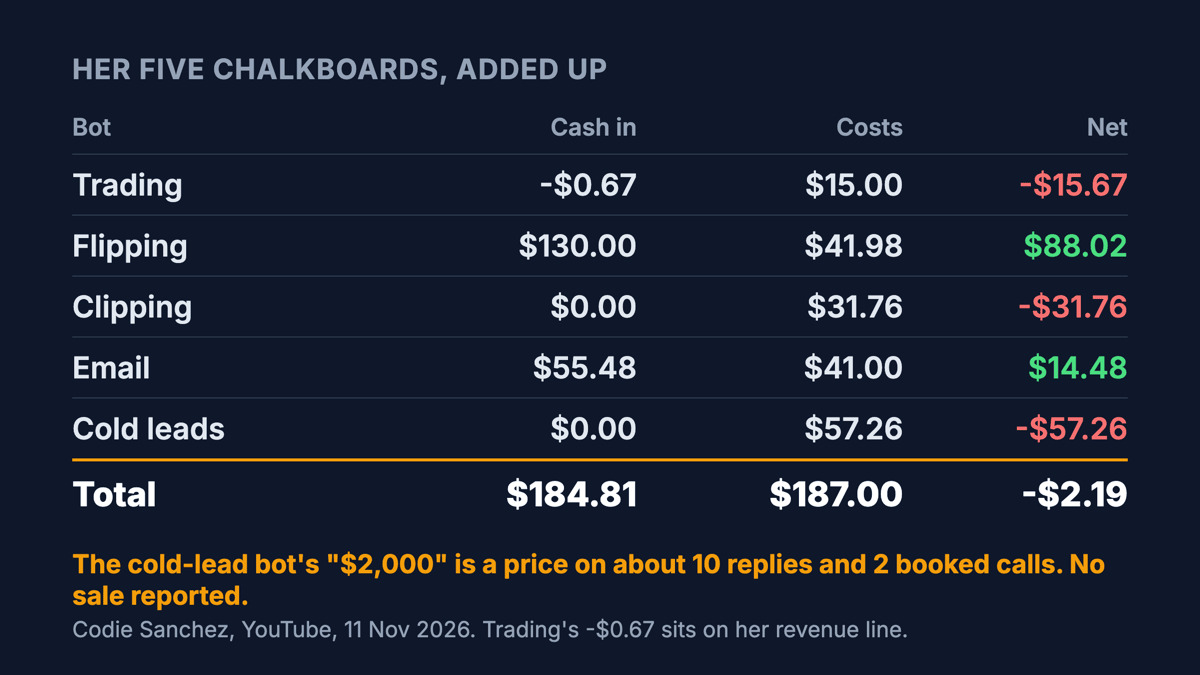
Her five boards, added up. Source: Codie Sanchez, YouTube, 11 November 2026.
Where the $2,000 came from
Before the cold-lead bot started, she gave each step a price (cold-lead section). A reply is worth $100 to her business. A booked call is worth $500. On day ten she adds, of the calls: "That's how much we pay for them on meta." She counts 10 replies, so $1,000. Two calls make another $1,000. The board says $2,000. If the two who booked are among the 10 who replied, and the video doesn't say they aren't, they're priced twice: $100 as a reply and $500 as a call.
No ticket sale is reported. The $2,000 is a price she put on replies and calls: what she says they cost her to get. For the calls, that's what she pays for one through Meta's adverts on Facebook and Instagram (the board). The clipping bot's "600 bucks a month" saved on editing is worked out the same way, from one video a week at $150 saved on each (clipping section), not from invoices.
The best case for her number
Here's the strongest argument on her side, and it's a real one. Rule three counts money saved, not just money made. If she would otherwise have paid Meta $500 to get a booked call, a bot that gets one for less has saved her money (her prices). And two booked calls from a cold list are worth a lot to a business that closes them.
But it only saves real money, her rule's words, if her Meta bill goes down, and the video doesn't say it did. A booked call is worth what it turns into, and by day ten no ticket sale is reported. Until one is, it isn't cold hard cash, and it isn't real savings yet.
What actually worked
This isn't a scam video, and calling it one would be its own exaggeration. Strip out the imputed value and something useful is left.
The bots that made real money did dull jobs with a clear limit. Flip a free item only if the delivery costs less than the profit. Email people who already know you, because, as she puts it, "the cheapest customer you'll ever get is the one you already have." Check before you contact anyone twice. Her own rule for using them in a business is the right one: the bot does the research and the first draft, and "A human approves anything that requires spending money or signs a contract".
Notice what both winners leaned on: things she already had. The email bot sold her own book to 3,000 people already on her list (email section), and some of the flipping money came from things in her office. If you don't have a book, a list or a sales team, the video doesn't show a bot building one for you.
That's the honest result. Small real money, $88.02 and $14.48 (her boards), from boring work, with a limit set in advance. Not $100 into $2,000.
Four questions for the next "AI made me $X" video
- Is it cash? Money in the bank, or a value someone put on replies, leads or time saved?
- Is it after costs? Subscriptions, usage fees, couriers, the premium plan.
- Did it happen in the time they said? Or is it a rate from two hours stretched across a week?
- Does it pass their own rules? If they set the rules at the start, check the ending against them.
This one fails the first and the fourth. The bots took $184.81 in cash and cost $187, against a $100 cap she doesn't say counted money earned back (her boards), and the five-star cold-lead bot reported no sale.