AI winners and losers: so far it's big firms up, young workers in exposed jobs down, most pay flat
Jamie Watters
Ex-banker, founder at 58, building with AI.
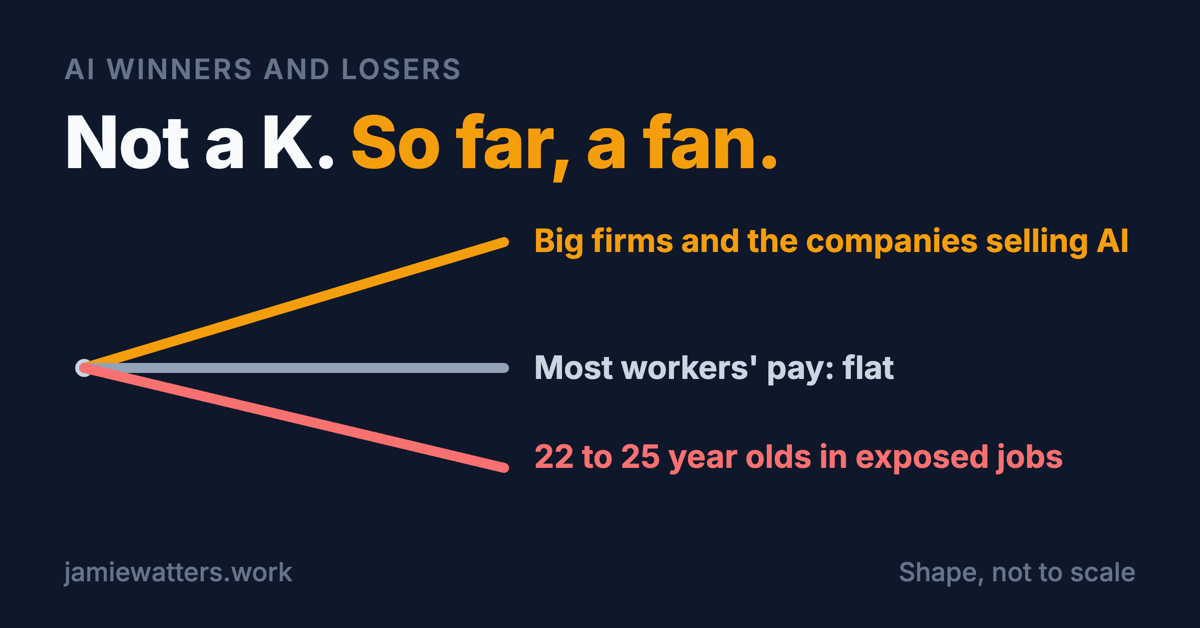
You've heard it. AI is splitting the economy into winners and losers. Economists have a letter for it, a K: one arm going up, the other going down. Which arm are you on?
I wanted a straight answer, so I opened the original documents behind the claim: filings, national statistics, payroll data and controlled trials. Ten of them. Not the news stories about them.
The split is real in two places. For most other workers, it hasn't shown up yet. And where the trials can see who gains and who loses, they point to two habits you can start this week.
The top arm is real, and it starts with the firms selling AI
The clearest winners are the companies selling it. Nvidia's data centre sales were up 117% on a year in its latest quarter (Nvidia). Anthropic, which makes Claude, took 14 times as much revenue in the first half of this year as a year before (its filing to list its shares). That revenue is real, though the same filing shows a loss of $80.7 billion over those six months. And it's only your side of the K if you own their shares.
Then your employer. In the EU, a firm with 250 or more staff is more than three times as likely to use AI as one with 10 to 49 (Eurostat). The difference between them has grown every year since 2023, from 24 percentage points to 38. In the US, AI use has been rising at firms with 20 or more staff and standing still at smaller ones.
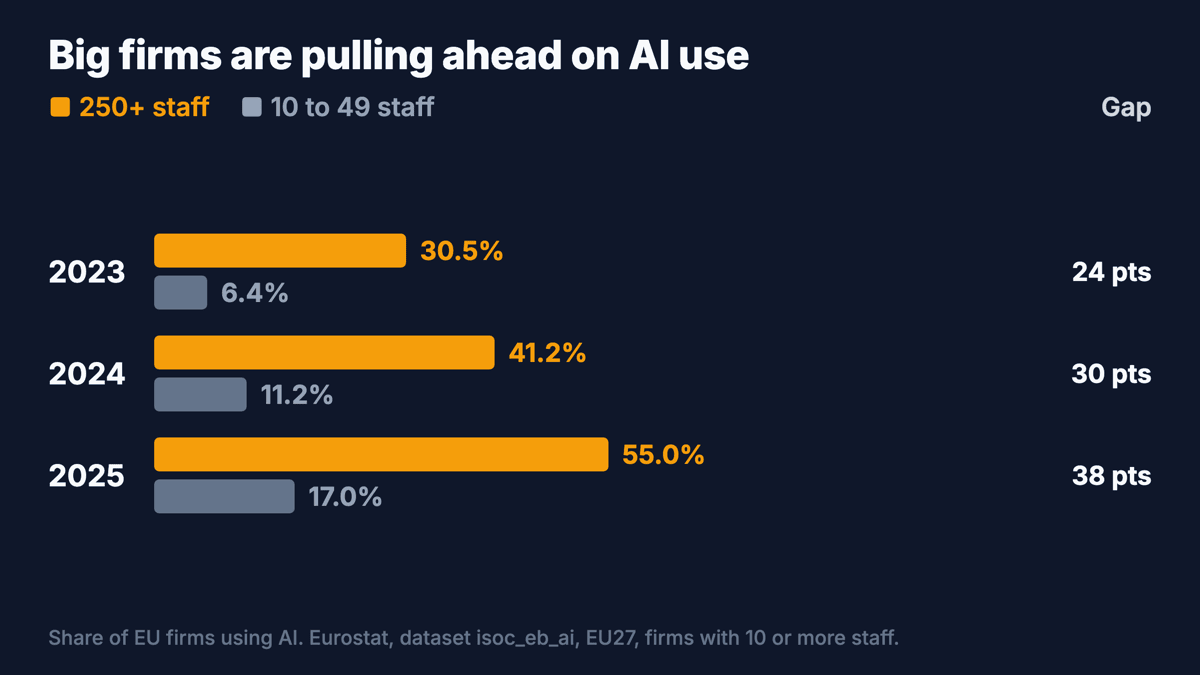
So if you work for a large company, your employer is probably on the upper arm. Whether that reaches you is a different question.
The one group falling
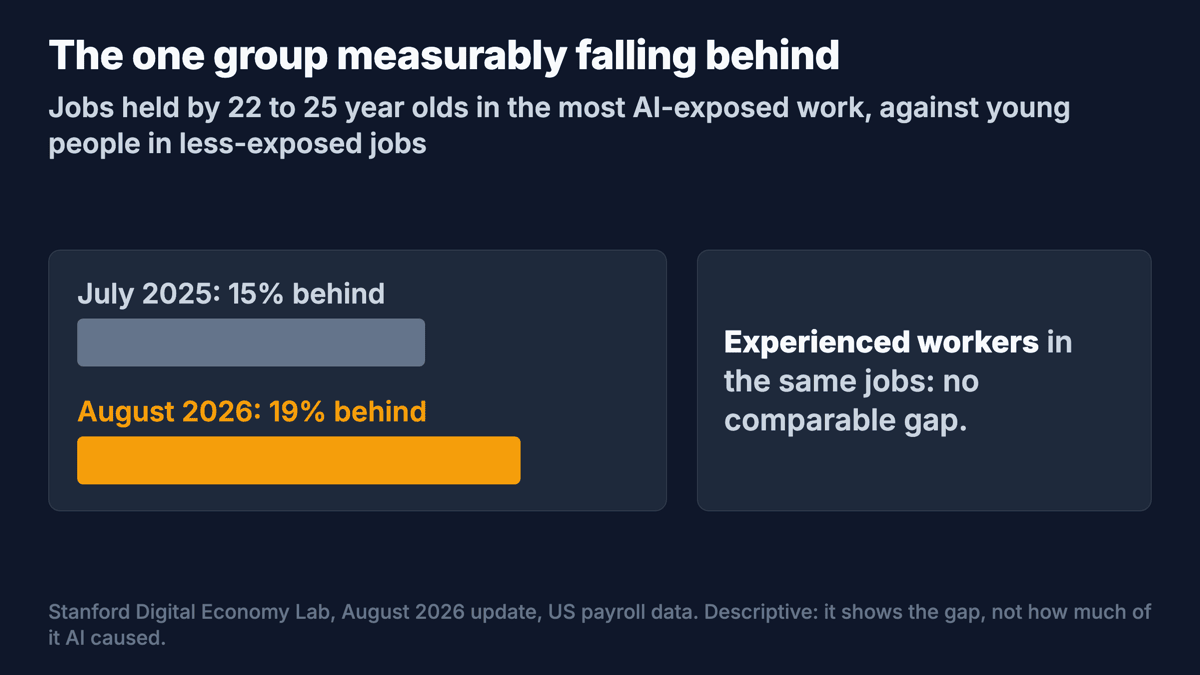
Now the workers. Stanford's Digital Economy Lab tracks US payroll data by age and by how exposed each job is to AI. Its August 2026 update looked at workers aged 22 to 25 in the most AI-exposed jobs. Their employment "stands about 19% below where it would be" if it had kept pace with young people in less-exposed jobs (Stanford Digital Economy Lab). A year earlier, on the same measure, the gap was 15%. It is getting wider.
The authors say the data show the gap, not how much of it AI caused. In one author's draft slides, a similar comparison that allows for other differences between the jobs, such as how easily they can be done from home, puts it at 9%. Either way, this is the one group measurably falling behind. For experienced workers, they found "no comparable gap."
Everyone else: flat, so far
If you're past your first job, the best evidence so far says AI hasn't moved your pay either way.
Denmark can check this properly, because it can match what workers say about AI to their tax records. Two economists did that for 25,000 people in jobs highly exposed to chatbots, from accountants to software developers. Most of their employers had brought in chatbots. Two years after ChatGPT launched, AI had not moved their average pay or hours by more than 2% either way (Humlum and Vestergaard, 2026).
Stanford's headline on its own young-worker finding says something similar about jobs in the wider economy: "No Widespread Displacement".
So for most working adults the K has no lower arm yet. It looks more like a fan: a steep line for big firms and the companies selling AI, a flat line for most workers, and one line going down, for young people trying to get into exposed jobs.
Inside the job, AI helps the weakest most
This is the part the winners-and-losers story gets backwards.
When researchers watch people do a specific task with and without AI, the people who start furthest behind usually gain the most. A study of 5,179 customer support agents found AI raised issues resolved per hour by 14% on average. That included "a 34% improvement for novice and low-skilled workers" and "minimal impact on experienced and highly skilled workers" (Brynjolfsson, Li and Raymond, NBER working paper).
Consultants at Boston Consulting Group got faster and better with AI on tasks it was good at. But a trial with 758 of them also found the trap. On a task picked to be just outside what AI could do well, those using AI were "19% less likely to produce correct solutions" than those without it (Dell'Acqua and others, Harvard Business School).
So the first skill is knowing which kind of task is in front of you.
Where the gap opens
The second skill comes from a trial I find more useful than any survey.
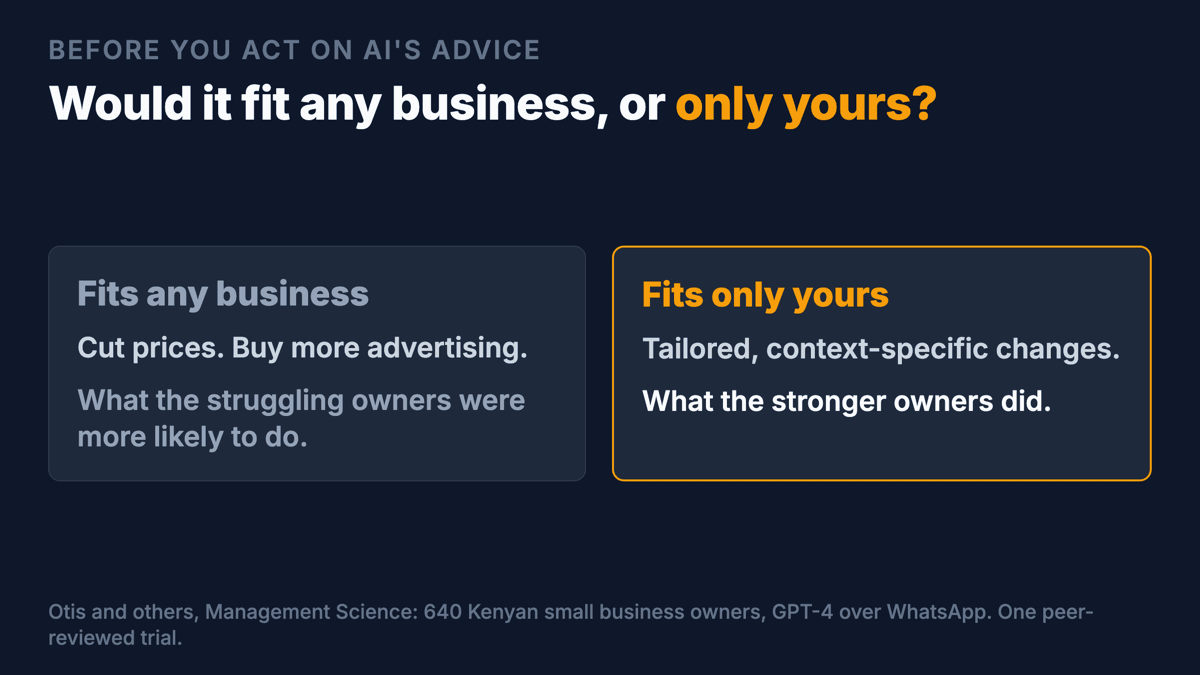
Researchers split 640 small business owners in Kenya into two groups. Half got an AI business mentor (GPT-4, over WhatsApp). The other half got business training guides. On average the AI made no difference. Underneath the average, it split (Otis and others, Management Science). Owners who were already doing well may have done better with it. Owners who were struggling did "nearly 10% worse due to the AI assistant", in the paper's own words.
The strong and the struggling owners asked similar questions and got similar advice. The difference was what they did with it. The stronger owners picked out the suggestions that fitted their business and made "tailored, context-specific changes." The weaker owners "disproportionately adopted generic strategies, such as lowering prices and increasing advertising", which may have cost them money.
It's one peer-reviewed trial, in one country, and the task studies found novices gaining most. Both can be true. On a task AI can do, it lifts you. On a decision, it hands you advice, and the advice is only as good as your judgement about it.
So which side are you on?
Three questions, from the evidence:
- Do you run or work for a large firm? Your employer is probably on the upper arm. Whether you are depends on the gains reaching your pay, and in Denmark they haven't yet.
- Are you 22 to 25 and in, or trying to get into, a job highly exposed to AI? You are in the one group where the data show a fall. Look for the parts of that work AI does badly and get good at those.
- Neither? There's no measured split for you yet. The trials point to two habits. Before you lean on AI, judge whether the task in front of you is one it does well. The consultants' trial shows that's hard to see, so try it first on something where you already know the right answer. And treat what it tells you as advice to sort through for your own situation, not as instructions.
The Kenya trial gives you a test for that. Before you act on what AI tells you, ask whether the advice would fit any business, or any job, or only yours. Cutting prices and buying more advertising would fit any business. That was the advice the struggling owners were more likely to take.