AI companies are spending billions buying firms. Here's which of their numbers anyone has checked
Jamie Watters
Operational resilience and AI delivery practitioner.
Who this is for. Anyone who keeps reading that AI companies are buying accountants, IT firms and lettings agents, and wants to know which of the numbers to believe. That includes owners who might get a call, staff and clients of firms already bought, and anyone putting money into these buyers. You'll leave with one dated table to check claims against.
Skip it if you want a verdict on whether these companies will succeed. Nobody outside them can give one yet, and this page says why. About eleven minutes; the table is in the second section, and the rest explains the money, the history and the case for the buyers.
Companies backed by billions are buying ordinary firms to run them with AI: accountants, IT support firms, lettings agents, a corporate travel company, an insurance broker. Most of what you'll read about them is a number. This page sorts every number I could check by who stands behind it: what the filings, audited accounts and research papers show; what the buyers and their backers say about themselves; and what nobody has measured. It's dated, because it will go out of date, and it ends with the events that would force me to rewrite it.
Declared interest: I'm talking to firms in this market about work. Nobody paid for this piece or saw it before it was published.
Who is buying what
Investors call these companies AI roll-ups. The idea is old: buy lots of small firms in a fragmented trade and run them as one group. The new part is the claim that AI, built once and rolled into every firm bought, makes each one cheaper to run.
Four deals show the shape of it. Long Lake calls itself "the World's First AI Holding Company". On 29 September 2026 it completed its purchase of American Express Global Business Travel, the corporate travel firm known as Amex GBT, in an all-cash deal valuing it at about $6.3bn (Amex GBT completion release).
Thrive Holdings, which TechCrunch describes as "akin to a private equity firm for AI", has focused on accounting and IT firms. It raised $2bn at a $12bn valuation in August (TechCrunch, 12 August 2026). Dwelly, in London, buys independent lettings agencies and raised a $170m Series B in July (Dwelly).
The fourth isn't closed yet. On 14 September Sequence Holdings and DFO Management, Michael Dell's investment office, agreed to buy a majority of The Baldwin Group, a US insurance broker. The price is $7.7bn in cash (Insurance Journal, 14 September 2026).
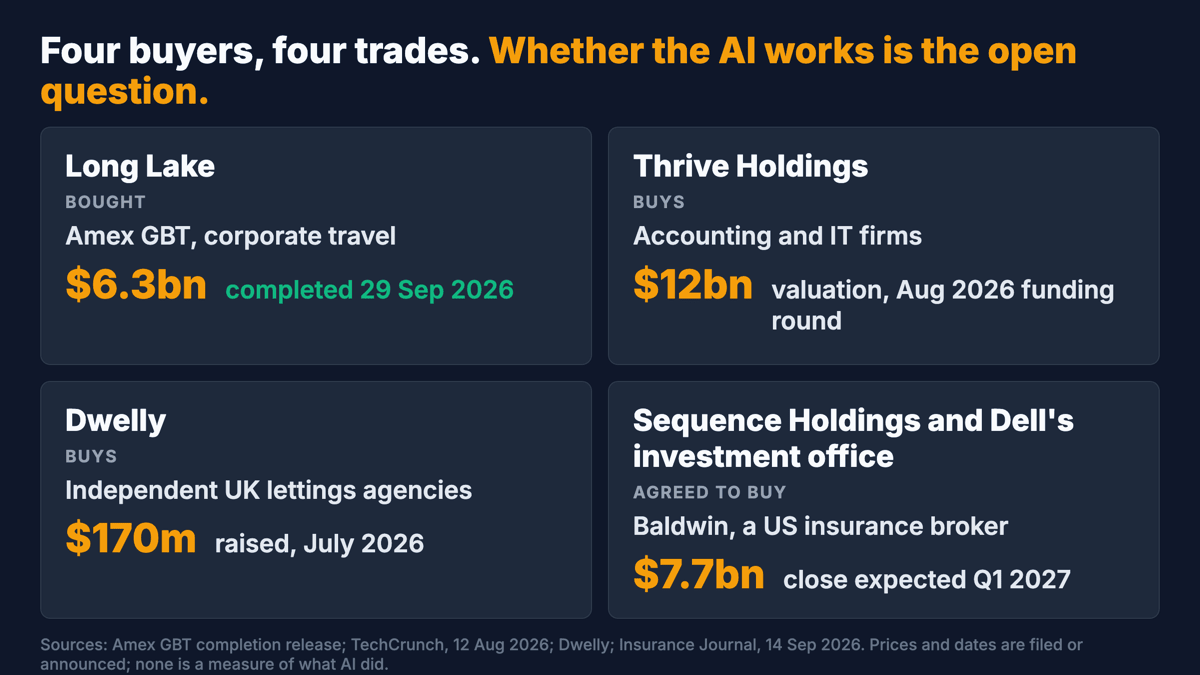
Four buyers, four trades. The prices and dates are from filings and announcements; whether the AI works is the open question.
Behind several of them sits General Catalyst, a venture firm that set aside $1.5bn for its Creation strategy in October 2024 (General Catalyst). Caritas Venture Co., a consultancy that maps this market, says General Catalyst coined the term "AI-enabled roll-up" and counts Long Lake and Dwelly among its co-creations (Caritas Venture Co., AI Rollup Market Map).
The ledger
Here is every number, in one place. Known means it's in a filing, audited accounts, a company register, a research paper or the announced terms of a deal. Claimed means the buyer, its investors or a forecaster says so and nobody outside has checked. I had to add a fourth line, reported: a figure someone else says is in a filing I haven't opened myself. Not measured means I looked and couldn't find it.
Last checked 12 October 2026. The sources were saved on 6 October; on 12 October I re-read the Caritas map, which still carries its 23 September update, and searched the news for anything that would move a row.
| What it says | Where it comes from | |
|---|---|---|
| Known | Long Lake paid $9.50 a share for Amex GBT, about $6.3bn, a 60.2% premium to the last close before the deal was announced | Amex GBT release, 4 May 2026 |
| Known | Part of the price was a $1.5bn first-lien bank loan, drawn in full on the day the deal closed, secured on "substantially all assets" of the borrowers and guarantors, Amex GBT among them | Amex GBT 8-K, 29 September 2026 |
| Known | Amex GBT's 2025 accounts, audited by KPMG: revenue of $2,718m and net income of $111m | Amex GBT annual report for 2025 |
| Known | The Baldwin price is made up of about $4.6bn of equity and about $3.1bn of net debt to be assumed or refinanced; the deal is expected to close in the first quarter of 2027 | Insurance Journal |
| Known | Dwelly's $170m is $95m of equity and a $75m debt facility led by Trinity Capital | Dwelly |
| Known | Prospire Technologies, the company Dwelly trades as, filed its accounts to 31 December 2025 in the audit-exempt category, which is lawful for companies that qualify | Companies House |
| Known | AI help raised issues resolved per hour by 14% on average among 5,179 support agents at one firm | Brynjolfsson, Li and Raymond |
| Known | Danish records rule out average effects of AI chatbots on users' earnings and hours larger than 2%, two years after ChatGPT's launch, compared with non-users. A working paper, not yet peer-reviewed | Humlum and Vestergaard, March 2026 |
| Claimed | Thrive Holdings is worth $12bn: the price investors paid in a private funding round, not a market price | TechCrunch |
| Claimed | Thrive's tax tool drafts returns "with up to 97% accuracy", a figure its write-up doesn't define; TechCrunch later carried "98% accuracy", attributed to Thrive | OpenAI, 27 May 2026; TechCrunch |
| Claimed | Dwelly's AI lets each agent handle "more than 300 units, up from around 100" | Dwelly |
| Claimed | General Catalyst's own essay reports "doubled EBITDA margins at Dwelly where deployed" | Caritas Venture Co. |
| Claimed | Long Lake has bought 35 businesses and raised over $3bn since it was founded, says its co-founder, with no split between equity and debt | Caritas Venture Co. |
| Claimed | "Up to $5 trillion": McKinsey's estimate of the value of more than one million US firms it calls viable candidates for sale as owners retire. It's a model of retirements, not of AI | McKinsey, 2026 |
| Reported | Long Lake issued $1.0bn of 7.625% senior secured notes in July 2026 to pay for Amex GBT | Caritas Venture Co., citing Gibson Dunn and the Wall Street Journal |
| Reported | The Baldwin price is about 20 times its trailing adjusted EBITDA and an 88% premium to its share price before the news | Caritas Venture Co., citing Baldwin's 8-K |
| Not measured | Audited figures from any of these buyers showing what AI did to the profit margin of a firm it bought. Caritas grades none of the 38 firms in its AI categories "third-party verified" | Caritas Venture Co. |
| Not measured | The interest rate and covenants on the $1.5bn Amex GBT loan (the 8-K calls the covenants "customary"), and the terms of Dwelly's debt | Amex GBT 8-K; Dwelly |
| Not measured | What happens to staff and clients after one of these buyers takes over a firm | Not found in my research searches to 6 October, or in a news search on 12 October |
| Not measured | A sale or stock-market listing of any of these buyers | Not found in my research searches to 6 October, or in a news search on 12 October |
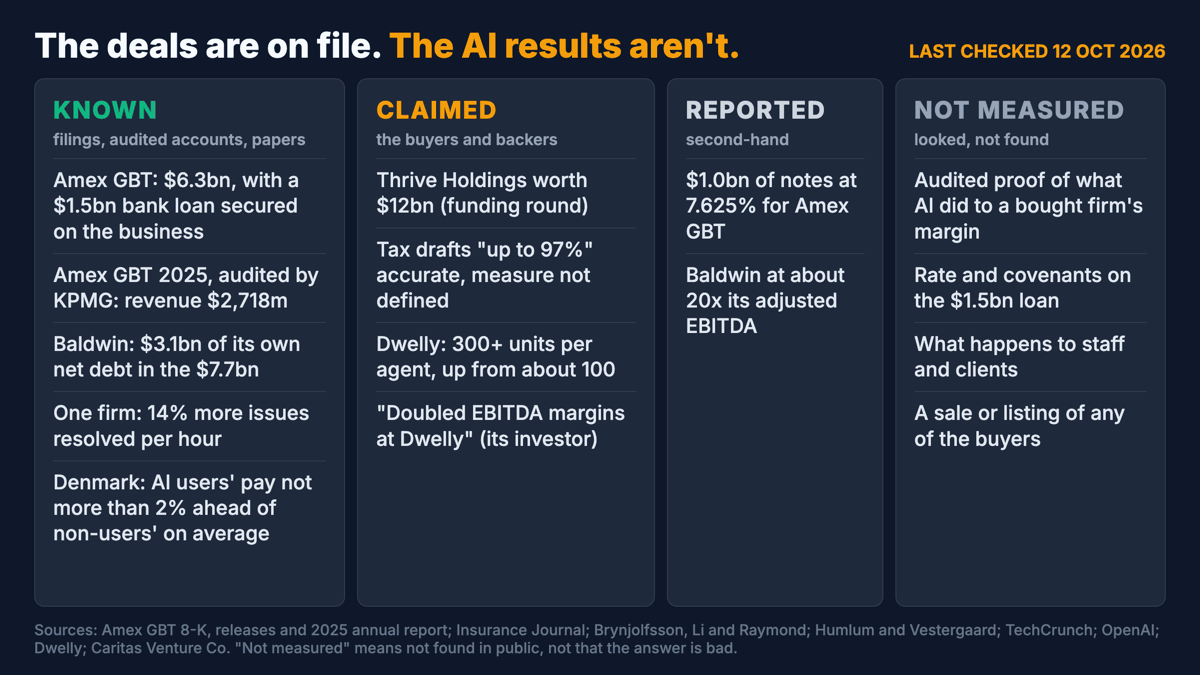
The ledger as a card to keep. Sources as in the table.
Two rows show why the columns matter. The accuracy figure started as "up to 97%" in a write-up by engineers from Thrive Holdings and OpenAI, which owns a stake in Thrive Holdings and doesn't say what the 97% measures. By August it had reached the press as "98% accuracy" (OpenAI; TechCrunch). And the 14% is real, but it's issues resolved per hour, in one call centre (Brynjolfsson, Li and Raymond). Time saved only becomes profit if a firm changes its prices or its headcount. I wrote about what the Danish pay records show in a piece on why AI-saved time hasn't raised pay.
The bottom rows aren't an accusation. These are young, private companies. Private companies don't have to publish what investors see, and audit exemption is a lawful filing category. "Not measured" means unknown, not bad.
Where the money comes from
The two biggest deals show who carries which risk.
The $1.5bn loan for Amex GBT is secured on the travel business. Before the takeover, Amex GBT already owed $1,486m of term loans after a January 2026 amendment, and at closing the company "repaid all loans and terminated all credit commitments" under that older agreement (Amex GBT 8-K; annual report for 2025). The new loan took the place of debt the business already had. The banks lent against a travel firm with audited accounts. The bet that AI makes it worth more sits with whoever put in the equity: Long Lake's existing investors and Koch Equity Development, according to the merger announcement (Amex GBT release, 4 May 2026).
Baldwin follows the same pattern. Of the $7.7bn, about $3.1bn is Baldwin's own net debt, to be assumed or refinanced (Insurance Journal).
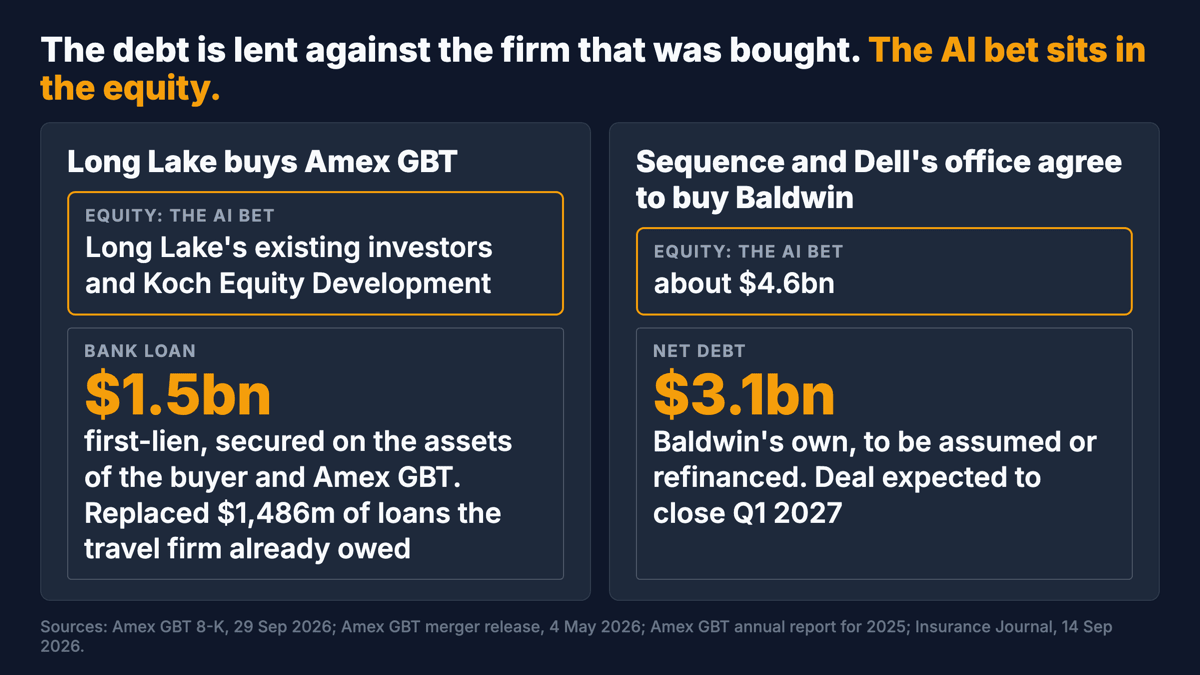
The lenders lend against the business that was bought. The AI upside belongs to the owners.
There is a regulator's warning about this structure, from a different industry. The FCA reviewed groups that buy financial advisers. It recognises "the potential benefits of debt funding", and it also found that "funding equity investments through debt (double leverage) can weaken the financial resilience of regulated entities within the group if they face pressure to upstream cash to service the external debt" (FCA, 31 October 2025). Travel and insurance broking aren't financial advice. The mechanism is the same: the debt is paid from the firm underneath.
What the last wave of roll-ups showed
This has been tried without AI. A study of roll-ups that floated on the stock market in the 1990s found their "operating performance mimics that of comparable firms but does not justify their high initial valuations" (Brown, Dittmar and Servaes, 2005). The firms ran about as well as their peers. The buyers paid too much. Results improved where the owners of the merged firms stayed on as shareholders and directors. I've read the abstract, not the full paper.
Bain looked at 44 buy-and-build deals made between 2010 and 2019. Those that relied on buying small firms and selling the bigger group at a higher price returned 1.4 times the money on average; those that also grew faster or lifted margins returned 2.2 times (Bain, Global Private Equity Report 2024). The AI is supposed to move a deal into the second group. Long Lake paid a 60.2% premium for Amex GBT (Amex GBT release). Price was what went wrong last time.
The strongest case for the buyers
Put it as an investor would. Public evidence is the wrong test for private deals. General Catalyst, Koch, Michael Dell's investment office and the banks lending $1.5bn didn't decide from press releases. They saw the figures for each firm under confidentiality agreements, in data rooms an outsider doesn't see. Private companies aren't required to publish what AI did to their margins, and investors in a private buyout don't expect them to. Judging these companies by what's public measures how much they disclose, not how well they run.
Most of that is right. "Not measured in public" is not "not measured", and I've said so in every row.
But the ledger isn't written for the people in the data room. It's for the people outside it. Caritas notes that buyers like Thrive Holdings and Long Lake "typically leave selling partners with meaningful equity" (Caritas Venture Co.). So the owner who sells takes part of the AI bet without seeing the data room. So does the member of staff, and the client. And the insiders' own behaviour says what they're sure of: the banks secured their loan on a travel business with audited accounts, and left the AI to the equity. In the 1990s study, the firms ran about as well as their peers and the price was what went wrong. The price is what's being set now.
If you're selling to one of these buyers, I set out the questions to ask in an earlier piece on what proof the AI works would look like. It has five checks for a firm the buyer already owns, and what to ask about your own deal.
What would change this page
I'll rewrite the ledger when any of these happens:
WHAT WOULD CHANGE THIS PAGE
Last checked: 12 October 2026

1. One of these buyers files audited accounts showing what
   happened to a bought firm's profit margin.
2. One of them is sold to a buyer it isn't connected to, or
   listed on a stock market.
3. A loan agreement for one of them is filed showing the
   interest rate and covenants.
4. An independent study measures what happens to staff or
   clients after one of them buys a firm.
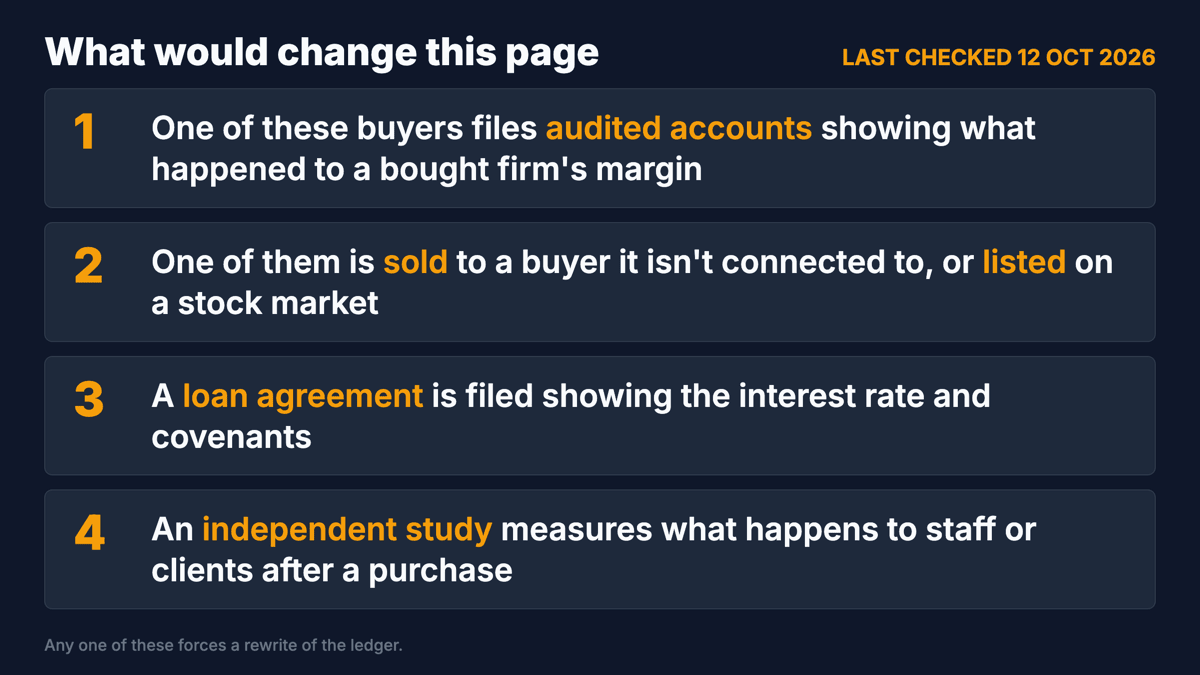
Any one of these forces a rewrite.
How this was put together: the research behind it was done with AI research tools in early October. The documents were saved on 6 October, and every figure above was checked against the saved filing, accounts, paper or page it comes from. Each row links to its source.
As of 12 October 2026, the banks in the biggest deal lent against a business with audited accounts. What the AI does to profit is still in the buyers' own words.
Sources
- Amex GBT (Global Business Travel Group): merger release, 4 May 2026; 8-K and completion release, 29 September 2026; annual report for 2025, audited by KPMG: https://www.sec.gov/Archives/edgar/data/1820872/000114036126037931/ef20082602_8k.htm
- Caritas Venture Co., AI Rollup Market Map, published 19 August 2026, updated 23 September 2026. Caritas works in this market and says so on the page: https://caritas.ventures/ai-rollup-market-map/
- TechCrunch, "OpenAI-backed Thrive Holdings raises $2B to bring AI to the enterprise", 12 August 2026: https://techcrunch.com/2026/08/12/openai-backed-thrive-holdings-raises-2b-to-bring-ai-to-the-enterprise/
- OpenAI, "Building self-improving tax agents with Codex", by engineers from Thrive Holdings and OpenAI, 27 May 2026: https://openai.com/index/building-self-improving-tax-agents-with-codex/
- Dwelly, "Dwelly raises $170M Series B", July 2026: https://www.dwelly.group/blog/dwelly-raises-170m-series-b
- Companies House, Prospire Technologies Ltd (company 14991567), filing history: https://find-and-update.company-information.service.gov.uk/company/14991567/filing-history
- Insurance Journal, "Baldwin Group to Go Private After $7.7B Investment Deal", 14 September 2026: https://www.insurancejournal.com/news/national/2026/09/14/baldwin-group-to-go-private-after-7-7b-investment-deal/
- General Catalyst, Fund XII announcement, October 2024: https://www.generalcatalyst.com/stories/fundxii
- Brynjolfsson, Li and Raymond, "Generative AI at Work", NBER working paper 31161, published in the Quarterly Journal of Economics: https://www.nber.org/papers/w31161
- Humlum and Vestergaard, "Still Waters, Rapid Currents", RFBerlin Discussion Paper 078/26, March 2026, not peer-reviewed: https://www.rfberlin.com/wp-content/uploads/2026/03/26078.pdf
- Brown, Dittmar and Servaes, "Corporate Governance, Incentives, and Industry Consolidations", Review of Financial Studies, 2005 (abstract read): https://ideas.repec.org/a/oup/rfinst/v18y2005i1p241-270.html
- Bain & Company, "Building a Stronger Buy-and-Build", Global Private Equity Report 2024: https://www.bain.com/insights/building-a-stronger-buy-and-build-global-private-equity-report-2024/
- FCA, multi-firm review of consolidation in financial advice and wealth management, 31 October 2025: https://www.fca.org.uk/publications/multi-firm-reviews/consolidation-financial-advice-and-wealth-management-sector
- McKinsey Institute for Economic Mobility, "The Great Ownership Transfer", 2026: https://www.mckinsey.com/institute-for-economic-mobility/our-insights/the-great-ownership-transfer-a-new-era-of-business-stewardship