An AI company wants to buy your firm? Ask it to prove the AI works first
Jamie Watters
Operational resilience and AI delivery practitioner.
Companies worth billions are buying ordinary firms to run them with AI: accountants, IT support firms, even a corporate travel company. A consultancy graded 46 firms in this market on what they can prove about their AI results. It gave its top grade to two, and neither is one of the new AI buyers (Caritas Venture Co., AI Rollup Market Map, updated 23 September 2026). Declared interest: I'm talking to firms in this market about work. Nobody paid for this piece or saw it before it was published.
The two are Apollo and Vista Equity Partners, traditional buyout firms that Caritas includes as a benchmark. The other 38 firms on its map are the new trade itself: AI buyers, consultancies doing the same work for a fee, and the funds behind them. Every one is graded B (results the company or its investors report) or C (a real plan and team, no checkable result yet). Thrive Holdings, the OpenAI-backed company valued at $12bn when it raised money in August (TechCrunch, 12 August 2026), is a B on the Caritas map.
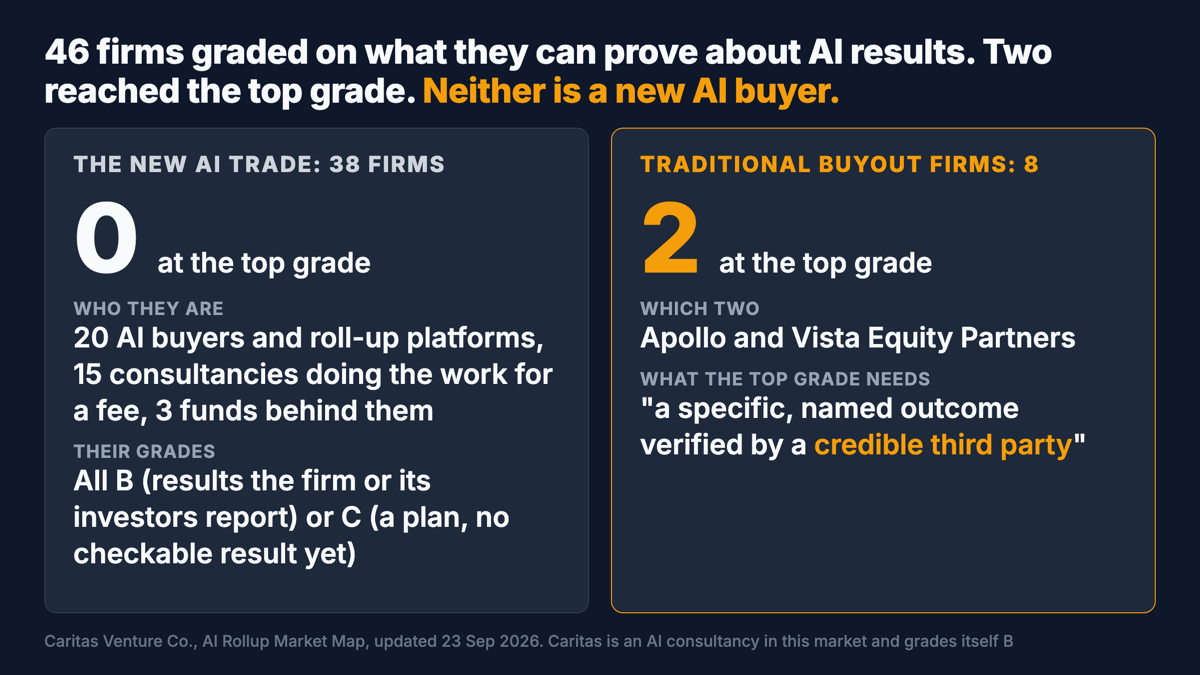
Caritas's top grade needs "a specific, named outcome verified by a credible third party". Two firms on its map have one.
That isn't proof the idea fails. It means the checking hasn't been done in public yet. And Caritas's top grade is a lower bar than the test below: one named result an outsider has checked, not two years of figures. Here is what would settle it, who has shown any of it, and what to ask if your firm, your job or your money is involved.
What the buyers are betting on
Investors call this an AI roll-up. Buy established service firms, keep the staff and the clients, move the paperwork onto AI, and the profit margin goes up. On 29 September Long Lake completed its purchase of American Express Global Business Travel, in an all-cash deal valuing the travel company at about $6.3bn. The completion release calls Long Lake "the World's First AI Holding Company" (Amex GBT completion release, 29 September 2026).
Buying lots of small firms and merging them is old. What's new is the claim about why it pays. Bain looked at 44 buy-and-build deals made between 2010 and 2019. Those that relied only on buying small firms cheaply and selling the bigger group at a higher price returned 1.4 times the money invested on average. Those whose plan drove faster growth from the firms they already owned, or better margins, returned 2.2 times (Bain, Global Private Equity Report 2024).
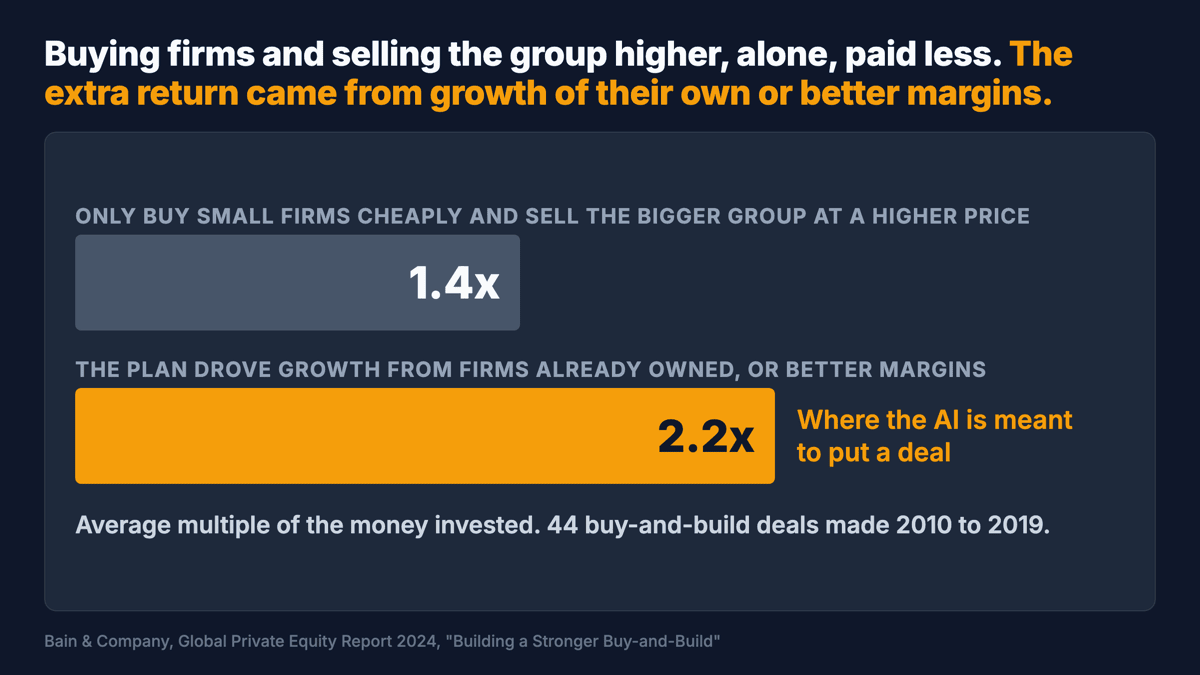
The AI is supposed to move a deal from the first bar to the second. That's the claim to test.
If the AI does that, the buyers are right. But price rises or staff cuts can get a deal there with no AI at all, so the test has to show which did the work.
What has been shown so far
The best-known result comes from Thrive's accounting business, Current. Engineers from Thrive Holdings and OpenAI wrote up a tax tool they built together, which processed 7,000 returns in a pilot in the 2026 tax season. Current's practitioners prepare tens of thousands a season. The write-up says the tool "saves practitioners about a third of their time on tax preparation, drafts returns with up to 97% accuracy". It doesn't say what the 97% measures. Its own measure is the share of returns that get 75%, 90% or 100% of their fields right (OpenAI, 27 May 2026).
That's the buyer and its shareholder describing their own product. Two of the four authors work for Thrive Holdings, and OpenAI took a stake in Thrive Holdings in December 2025 (TechCrunch, 12 August 2026). Caritas's note on Thrive puts it plainly: "OpenAI is a shareholder, so its case study is not independent validation."
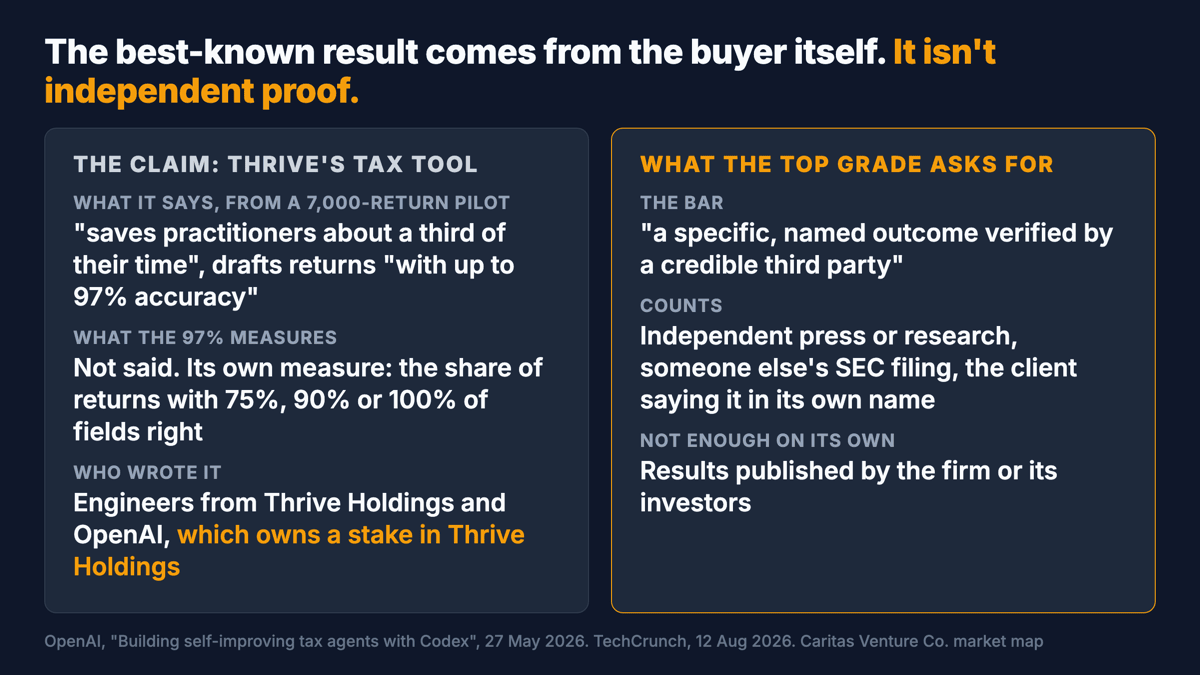
The claim on the left may well be true. The right-hand panel is what it would take for an outsider to know.
The strongest evidence on the buyers' side is Bending Spoons, the Milan owner of Evernote and Vimeo, listed in New York since July. Caritas reads its prospectus as crediting AI with being one cause of rising revenue per employee. It still grades it B, because the buy-and-rebuild playbook "predates the AI story" and "no result at any acquired business has been credited to AI by anyone outside the company". Its first quarter as a public company had revenue up 126%, "primarily driven by acquisitions", with 3% growth from the businesses it already owned (Caritas Venture Co.). I haven't read the prospectus myself; that is Caritas's reading.
Time saved also isn't money yet. The tax write-up's example is a senior accountant whose tax preparation went from 180 hours one year to 15 the next, and who used the time to call every client and take on new ones (OpenAI, 27 May 2026). Saved time becomes money only through more clients, fewer hours paid for or higher fees, and it has to show up in the accounts. Economists linked Danish workers' use of AI chatbots to official pay and hours records. Two years on, they ruled out an effect larger than 2% on pay or hours. That held for whole workplaces as well as workers, including "workplaces with substantial investments" (Humlum and Vestergaard, University of Chicago working paper, April 2025). It studied chatbots in ordinary jobs, not firms rebuilt around AI, so it doesn't settle this. It does show that, for pay and hours at least, saved time doesn't turn into money by itself.
The test
Here is what would settle it: five checks an owner can ask for. A small firm may never have had its accounts audited, so the start point is the buyer's quality-of-earnings work, the check of real profit a buyer does before it pays. Check 4 matters most, because price rises and staff cuts alone can pass the first three. Copy it.
WHAT WOULD PROVE AN AI BUYER'S AI WORKS
Five checks, for each bought firm. All five must pass.

Start point: the firm's figures as the buyer worked them out
             before it paid.
End point:   12 and 24 months after the purchase.

1. A BASELINE. The buyer's quality-of-earnings figures at
   purchase, owner's pay reset to a normal salary, tied back
   to tax filings or reviewed accounts.
2. SAME FIRM, SAME RULES. The firm's figures after purchase,
   under one stated rule for charging it the group's central
   costs. Firms bought later are left out.
3. MARGIN UP AND HELD, AFTER THE AI'S COST. Operating profit
   as a share of fees is above the start point at 12 months
   and still above it at 24, after charging the software, the
   engineers and the staff time spent checking the AI's work.
4. THE AI'S SHARE. A bridge showing how much of the gain came
   from the AI, and how much from price rises, fewer staff and
   central cost cuts, against firms in the group not yet on it.
5. CLIENTS AND FEES. Retention by fee value, and fee changes,
   so the profit did not come from dropping clients or
   raising prices.

Pass: all five. Anything less is a claim, not proof.
Not in the pass: a later, unconnected buyer paying more. That
shows the price went up, not that the AI worked.
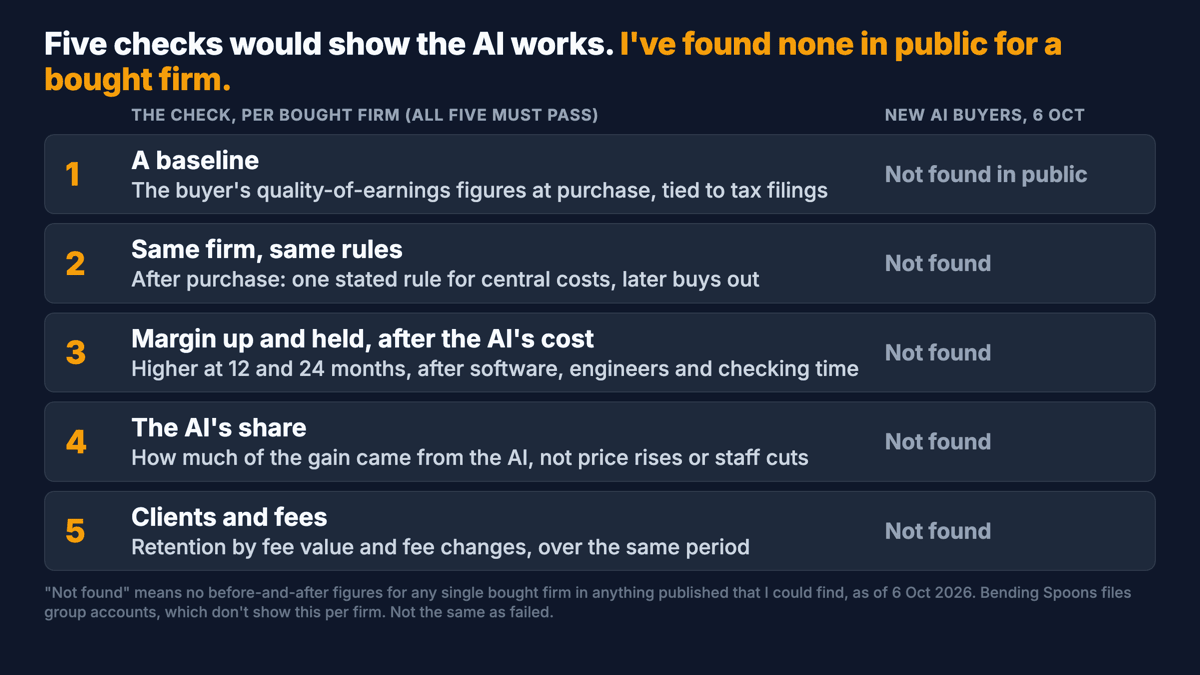
Where the public record stood on 6 October 2026, for each bought firm's before-and-after figures. Each "not found" is a gap in what has been published, not a finding that the result is bad.
If you don't read accounts, these questions get at the same evidence. Five of the owner questions are Caritas's, close to its wording; the rest are from my research notes.
IF YOU OWN A FIRM AND AN AI BUYER CALLS
- Show me audited or client-confirmed before-and-after numbers
  from two firms you already own.
- Let me speak to two owners who have already sold to you.
- What does your headline AI figure measure, and who checked it?
- How much of the price is cash on completion, how much is
  shares in your company, and how much is an earn-out?
- What are those shares worth, and when can I sell them?
- Which of your central costs can be charged against the
  profit my earn-out is measured on?
- What happens to my team, my brand and my clients in year one?
- If we part ways, who keeps the software and the data?

IF YOU INVEST IN OR LEND TO ONE
- What profit do you assume at purchase, with no AI gain at all?
- What evidence would make you stop buying?

IF YOU WORK AT A FIRM THAT HAS BEEN BOUGHT
- Who signs off the AI's drafts, and are they still checking?
- Where do the saved hours go: more clients, fewer people, or
  lower fees?

IF YOU ARE A CLIENT
- Have my fees or my named contact changed since the purchase?
A good answer names the firm, gives its figures at purchase and now, and says how central costs were charged. Quality-of-earnings figures tied back to tax returns are a fair substitute for audited accounts. A case study, or a percentage with no starting figure, is not.
Unknown is not the same as bad
The fair objection from the buyers is that the test asks for something that can't exist yet. That's only partly true. Thrive Holdings was set up in April 2025, but its accounting business is older. Current, first called the Crete Professionals Alliance, was founded in 2023, and Thrive Capital first invested in May 2024 (Caritas Venture Co.). Long Lake was founded in 2023 too (Amex GBT completion release). Any firm either of them bought before October 2024 is past the two-year mark, so the figures could exist now, in private. Private companies in the US don't have to publish accounts, and investors see the numbers under confidentiality agreements.
The buyers do publish results, all company-reported, which is why each firm sits at B. Multiplier Holdings says cash flow at Citrine, a tax firm with 12 people when it was bought, rose roughly 2.5 times within eight months. Beacon Software reported in June that operating earnings across the 30-plus software companies it then owned were up more than 50% on the year before. Fura's chief executive says a freight broker it bought went from a $150,000 loss to $1m profit, while its staff went from 26 to 8, so the AI wasn't doing all the work (all three via Caritas Venture Co.).
None of that is proof, and none of it is evidence against them. The right word for these firms is unknown, not bad. That's why the test is worth having now, while the prices are being set: $12bn for Thrive Holdings in a funding round, about $6.3bn in cash for the travel company. An owner, a lender or an investor can ask for all five checks across the table before signing. A firm that has the evidence can show it.
Two years isn't a harsh test either. At Abbey National I was part of the team that integrated the firms it bought, Cater Allen and Scottish Provident among them, largely on the data centre side. Each integration took years, and several overlapped. It's about the shortest time in which I'd expect a change to how a firm runs to show up as a settled result, rather than as the cost of making the change.
As of 6 October 2026, I haven't found a new AI buyer that has published, for any firm it bought, before-and-after figures showing the margin went up and stayed up after paying for the AI. The first to publish all five checks will have settled more than any funding round has.
Sources
- Caritas Venture Co., AI Rollup Market Map, published 19 August 2026, updated 23 September 2026. Caritas is an AI consultancy working in the same market and grades itself B on its own scale: https://caritas.ventures/ai-rollup-market-map/
- TechCrunch, "OpenAI-backed Thrive Holdings raises $2B to bring AI to the enterprise", 12 August 2026: https://techcrunch.com/2026/08/12/openai-backed-thrive-holdings-raises-2b-to-bring-ai-to-the-enterprise/
- OpenAI, "Building self-improving tax agents with Codex", by engineers from Thrive Holdings and OpenAI, 27 May 2026: https://openai.com/index/building-self-improving-tax-agents-with-codex/
- Bain & Company, "Building a Stronger Buy-and-Build", Global Private Equity Report 2024: https://www.bain.com/insights/building-a-stronger-buy-and-build-global-private-equity-report-2024/
- Humlum and Vestergaard, University of Chicago Becker Friedman Institute working paper, 15 April 2025, on AI chatbots and Danish pay and hours (abstract read): https://bfi.uchicago.edu/working-papers/large-language-models-small-labor-market-effects/
- Global Business Travel Group, completion release (exhibit 99.1 to its 8-K), 29 September 2026: https://www.sec.gov/Archives/edgar/data/1820872/000114036126037931/ef20082602_ex99-1.htm