AI companies are buying firms on borrowed billions. If it goes wrong, the firms pay
Jamie Watters
Ex-banker, founder at 58, building with AI.
Part of the series AI roll-ups

Who this is for. If an AI buyer has approached your company, whether you own it or work there, this is what happens after the sale: in the deals I checked, the business ends up carrying the buyer's debt. It's also for anyone watching the AI roll-up boom who wants to see how these deals are really put together, from the filings rather than the press releases. You'll leave with five deals side by side, and the three documents that show where the debt sits in the next one.
Skip it if you want a verdict on whether the AI works. The filings can't give one, and this page says why. The table is in the second section.
On 29 September 2026 a company called Long Lake finished buying American Express Global Business Travel, the corporate travel firm known as Amex GBT, in a deal the company valued at about $6.3bn. Long Lake is an AI roll-up: a firm that buys established service businesses and runs them with AI. The biggest single piece of the deal's debt is a $1.5bn loan recorded in a public filing (GBT 8-K, 29 September 2026).
So here is the question. The one public grading of these firms I found is a market map by Caritas Venture Co., which sells AI work to businesses and appears on its own map. Of the 38 firms in its three AI lanes, by my count, it rates none as having results checked by a third party (Caritas Ventures). Who would lend $1.5bn into that?
The filings answer it. The lenders' claim is on the business that was bought: in this deal and three others, it borrows the money, guarantees it or pledges its assets. Amex GBT already did that for its own loans before Long Lake arrived. What changed is how much debt there is, and how much of it you can see.
What the lenders lent against
The loan is a "senior secured first-lien term loan facility in an aggregate principal amount of $1,500,000,000", drawn in full at closing, with JPMorgan Chase Bank as agent. A further $250m revolving facility, a credit line to draw on as needed, was not drawn. The borrower is Gaia Purchaser, the company Long Lake used for the purchase, which now owns Amex GBT. The guarantors are "Holdings and certain subsidiaries of Parent (including, on the Closing Date, the Company and certain of its subsidiaries)": Gaia Purchaser's own parent, plus Amex GBT and some of its subsidiaries. The loan is "secured on a first-priority basis by substantially all assets of the borrowers and the guarantors", with some exclusions (GBT 8-K).
That isn't all the debt. In July Gaia Purchaser also offered $1bn of 7.625% senior secured notes due 2033, "part of the financing for Long Lake's proposed acquisition". That comes from the law firm that advised it, not a filing (Gibson Dunn, 13 July 2026). Who guarantees the notes, and what secures them, isn't in anything I could find.
Until the takeover, Amex GBT was listed in New York and audited by KPMG, which says it has been the auditor since 2014. Its audited 2025 figures show revenue of $2,718m and net income of $111m; its own adjusted EBITDA measure, which it defines and is not audited, was $532m (GBT annual report for 2025; GBT fourth-quarter results).
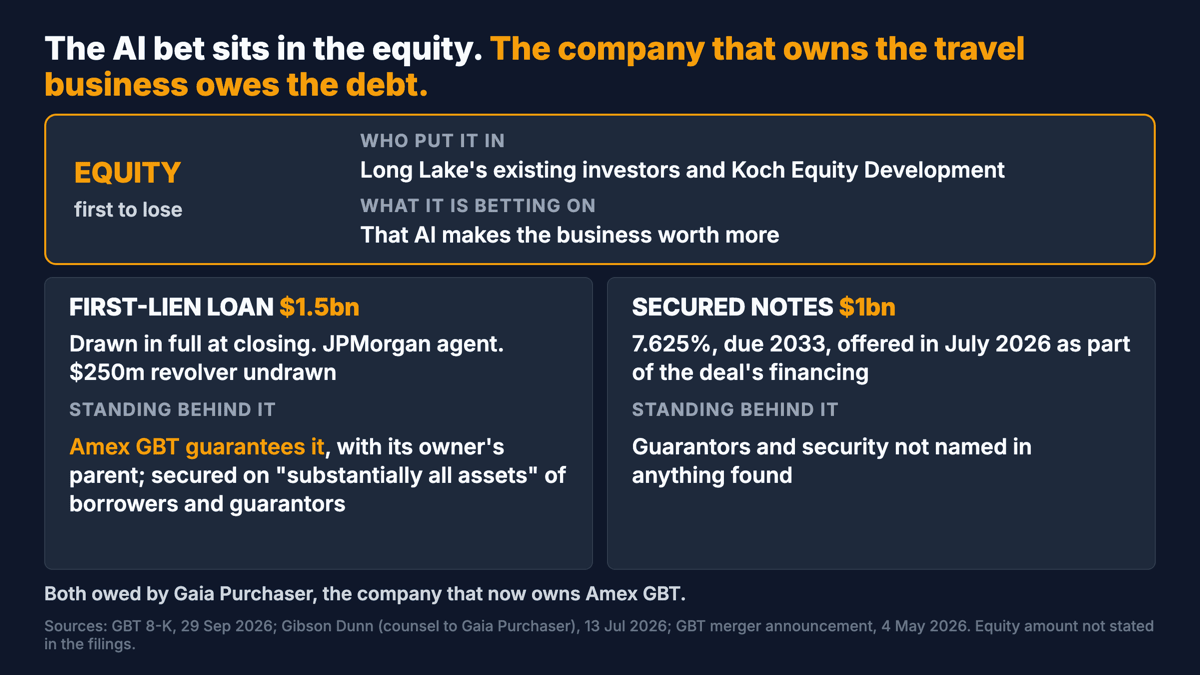
The AI bet sits in the equity. Gaia Purchaser owes the loan and the notes, and Amex GBT guarantees the loan. Sources: GBT 8-K; Gibson Dunn; merger announcement.
Amex GBT carried the same kind of debt before the takeover. Its term loans were $1,386m at the end of 2025 and $1,486m after an amendment in January 2026. They were senior secured first-lien loans. One of its subsidiaries borrowed them, Amex GBT and others in its group guaranteed them, and the lenders had "a first priority security interest in substantially all of the assets" of those companies. The annual report gave the price, 2.00% a year over the SOFR benchmark, on loans S&P rated BB- (GBT annual report for 2025). At closing the company "repaid all loans and terminated all credit commitments" under that agreement (8-K).
So the travel firm stood behind a secured loan before the AI buyer came, and stands behind one now. What changed is the amount, the borrower and what you can see. About $2.5bn of loans and notes was arranged for the deal (GBT 8-K; Gibson Dunn), against $1,486m of term loans before. Only the $1.5bn loan is known to carry Amex GBT's guarantee, about the size of the old one. The extra $1bn sits with the company that owns Amex GBT, at about $76m a year in interest, 7.625% on $1bn. The borrower moved up from one of Amex GBT's subsidiaries to its owner. These are amounts borrowed, not a balance sheet after closing, which no filing I opened gives.
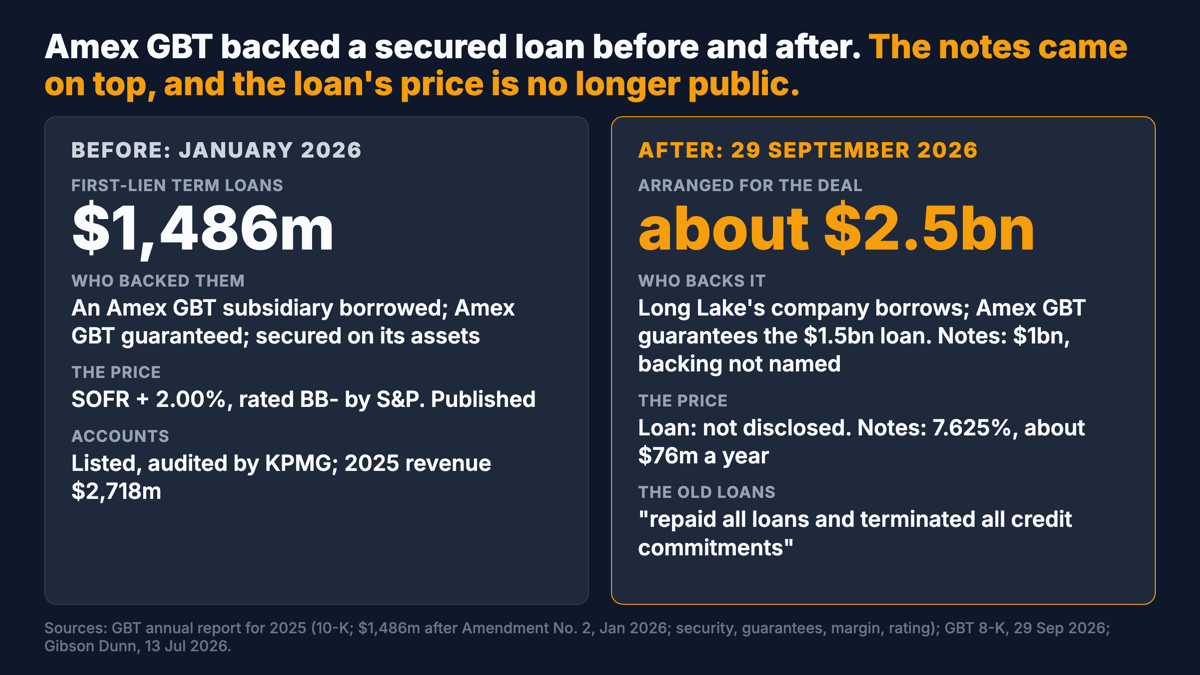
The same kind of guaranteed loan before and after, with the notes on top, and a price that's no longer public. Sources: GBT annual report for 2025; GBT 8-K, 29 September 2026; Gibson Dunn.
The old loan's price was in the annual report; the new one's isn't. The 8-K gives the loan's size, agent and security, and calls its covenants, the conditions the borrower must keep to, "customary for facilities of their respective types". It gives no rate and no covenant levels. Not disclosed isn't the same as unusual, but an outsider can no longer see what the loan costs.
That debt is owed whether the AI works or not. The upside, if it comes, belongs to whoever put in the equity: Long Lake's existing investors and Koch Equity Development (GBT release, 4 May 2026).
Three more deals where the bought firm stands behind the debt
Amex GBT isn't a one-off. I looked for other deals by AI buyers where a primary document shows who stands behind the debt, and found three completed ones.
The first is a fund manager. On 30 June 2026 Trian Fund Management and General Catalyst, a venture firm that Caritas says helped create Long Lake and Dwelly, completed their purchase of Janus Henderson. General Catalyst's chief executive said they would "enhance the Company's operations and customer value proposition with AI to drive growth and transform the business" (Janus Henderson announcement, 22 December 2025). They paid $52.00 a share in cash, about $6.5bn, to shareholders other than Trian, which already owned about a fifth (annual report for 2025). The money came from the investor group, preferred equity from MassMutual, and banks: a $2.9bn first-lien term loan drawn in full, beside a $500m revolving facility left undrawn. Here the borrower isn't the buyer. It is Janus Henderson's own US holding company, which merged with a borrowing company set up for the deal. The loans are secured on substantially all assets of the borrowers and guarantors, and Janus Henderson is one of them (Janus Henderson 8-K, 30 June 2026). Before the deal its only borrowing was $400m of notes, and the 8-K doesn't say what happened to them.
The second is a parking operator. In May 2024 Metropolis, which describes itself as "an artificial intelligence company whose computer vision platform enables checkout-free payment experiences", bought SP+ for $54.00 a share, about $1.07bn for the shares. It valued SP+ at about $1.5bn including debt, and paid with $1.05bn of preferred shares and $550m of term loans, plus a separate $175m revolving facility. Eldridge Industries led the financing, and its affiliate Maranon Capital co-arranged the loans (Metropolis release, 16 May 2024). A Metropolis company is the borrower, and SP+ guarantees both credit agreements. Part of the price came from "a draw on Parent's new revolving credit facility", amount not given (SP+ 8-K, 16 May 2024).
The third is a group of lettings agencies. Dwelly, in London, buys independent agencies. On 29 January 2026 ten Dwelly companies signed a "Security Agreement relating to term loan facilities to the Dwelly group of companies" with Trinity Capital, a US lender (charge registration). Eight of the ten, among them Number 1 Letting and HC Lettings, had other owners before a Dwelly company took control, the register shows. Each of the eight gave Trinity a fixed charge over its property and intellectual property, and a floating charge over everything else it owns (Companies House: Number 1 Letting). Whether they also guarantee the loans isn't in the register, and I haven't read the agreement's clauses in full.
Trinity's report to the SEC for the quarter to 30 June 2026 shows a secured loan to Prospire Technologies, the company Dwelly trades as, made on 29 January 2026 and due in February 2030. On 30 June, $13.8m was outstanding, at the Bank of England base rate plus 8.5 points with a floor of 12.2%, and a 2% payment due at the end. Trinity also holds warrants and preferred shares in Dwelly, about $0.6m at cost (Trinity Capital quarterly report). In July Dwelly announced a $75m debt facility led by Trinity (Dwelly). How that relates to the January loan isn't in anything I opened.
One more deal is agreed but not closed. On 14 September two buyers agreed to take a majority of The Baldwin Group, a US insurance broker. One is Sequence Holdings, which says it uses its own technology platform to rebuild the firms it buys. The other is DFO Management, Michael Dell's investment office. The deal values Baldwin at about $7.7bn, including about $3.1bn of net debt assumed or refinanced (Baldwin announcement, 14 September 2026). Nothing is borrowed yet. Lenders have committed up to $2.75bn of term loans, $415m more to draw later and a $500m revolving facility, to repay Baldwin's existing loans and pay part of the price. The commitment is to a company set up for the deal, which merges into Baldwin's operating company at closing. That company, its parent and some of its subsidiaries would pledge substantially all their assets (Baldwin preliminary proxy, 15 October 2026).
Here they are side by side.
| Deal | The new debt | Who borrows | How the bought firm backs it | Not disclosed |
|---|---|---|---|---|
| Long Lake bought Amex GBT, 29 Sep 2026 | $1.5bn loan, drawn; $250m credit line, not drawn; $1bn of notes | Gaia Purchaser, which owns Amex GBT | Guarantees the loan and pledges its assets, as it did before the deal | The loan's rate and covenant levels; who backs the notes |
| Trian and General Catalyst bought Janus Henderson, 30 Jun 2026 | $2.9bn loan, drawn; $500m credit line, not drawn | Janus Henderson's own US holding company | Its own company borrows; its assets secure the loans | The rate and covenant levels; what happened to the $400m of notes |
| Metropolis bought SP+, 16 May 2024 | $550m of term loans; $175m credit line, partly drawn | A Metropolis company | Guarantees both credit agreements | The rate, covenants, any security, how much was drawn |
| Dwelly and the agencies it bought, security signed 29 Jan 2026 | Trinity's loans: $13.8m outstanding on 30 Jun 2026 | Prospire Technologies, the company Dwelly trades as | Eight bought agencies give fixed and floating charges over their assets | Whether they also guarantee; covenants; how the $75m facility fits |
| Sequence and DFO agreed to buy Baldwin, not closed | Commitments only: up to $2.75bn, $415m to draw later, $500m credit line | A deal company that merges into Baldwin's operating company | The operating company and some of its group would pledge their assets | The spread over the benchmark rate, "to-be-agreed"; whether Baldwin's notes are paid off |
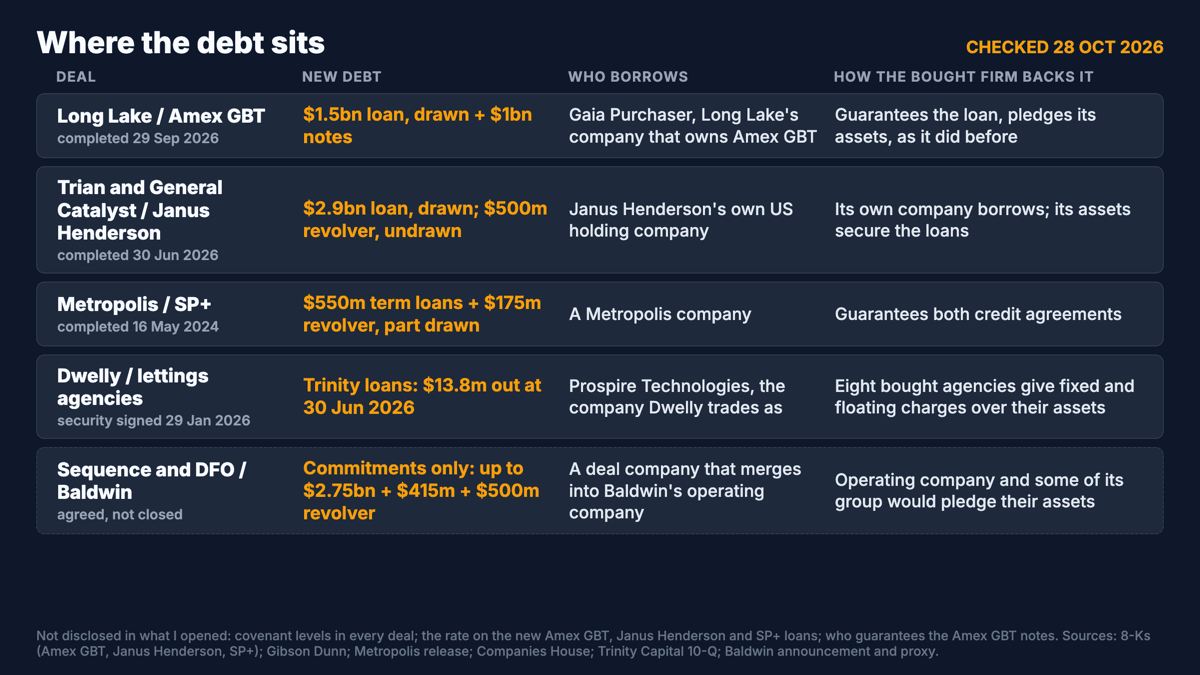
Where the debt sits, deal by deal. Sources as linked above.
To check the next deal, three documents answer most of it. For a US company, the 8-K filed on closing day: item 1.01 names the borrower and the guarantors, and usually what secures the loan. For a UK company, its charges page on Companies House. For a lender listed in the US, its quarterly schedule of investments: the loan, the rate and the dates.
Nothing in this is special to AI. It's how a leveraged buyout works: the loan is borrowed by the buyer's deal company or by the bought group itself, and the bought business guarantees it, pledges its assets, or both. The debt doesn't tell you what the lenders think of the AI. It tells you who they can turn to if the loans aren't paid: the travel firm, the fund manager, the parking operator and the lettings agencies.
If you want the claims these buyers make about the AI itself, sorted into what's known, what's only claimed and what hasn't been measured in public, that's on the ledger page.
The strongest case for the AI buyers
Put the other side as a backer would. The task-level gains are real. Among 5,172 customer support agents, AI help raised issues resolved per hour by 15% on average. That result is published in the Quarterly Journal of Economics, not a press release (Brynjolfsson, Li and Raymond, 2025). Secured debt on the bought firm is normal in any buyout, so it says nothing bad about AI in particular. A lender would add that it lends on the cash a business already makes, and Amex GBT's was audited.
All of that holds. Two things in the record still argue for care.
The first is the debt itself. In Bain's look at 44 buy-and-build deals from 2010 to 2019, those relying on buying small and selling big returned 1.4 times the money, against 2.2 times for those that also grew or improved margins (Bain, 2024). The AI is meant to put a deal in the second group. Until it does, the interest comes out of the business as it runs today, and the group that owns Amex GBT owes about $1bn more than Amex GBT did.
The second is a warning from the FCA, about groups that buy financial advisers. It recognises "the potential benefits of debt funding", but says an arrangement "can cause us particular concern where debt is guaranteed by, or secured on the assets of, the regulated entities within the group". That can move the lender's risk onto those firms and put clients behind the lender if the debt goes bad. The FCA draws a line: where lenders held only a charge over an advice firm's shares, it found that "did not expose the regulated firms to significant credit risk" (FCA, 31 October 2025). Travel, parking and lettings aren't financial advice. But a bought firm guaranteeing the debt or pledging its own assets, the arrangement the FCA worries about, is what the filings show in every completed deal on this page.
What would change this page
This page is dated because it will go out of date. I will rewrite it when any of these happens:
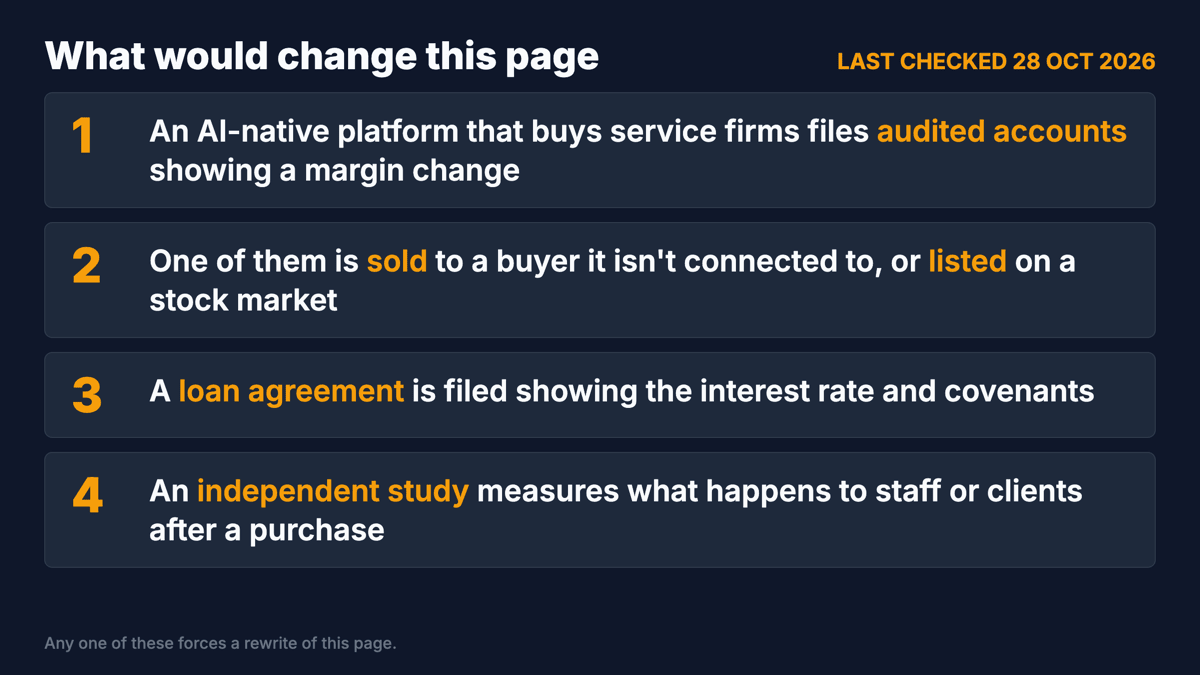
Four events that would force a rewrite.
- An AI-native platform that buys service firms files audited accounts showing a margin change.
- One of them is sold to a buyer it isn't connected to, or listed on a stock market.
- A loan agreement for one of them is filed showing the interest rate and covenants.
- An independent study measures what happens to staff or clients after one of them buys a firm.
How this was put together: the research was done with AI research tools in early October. I checked every figure against the saved filings and registers, most recently on 28 October, and each source is linked where it's used. Next in this series: why time saved by AI isn't the same as profit, and where the "up to $5 trillion" quoted for this market comes from (McKinsey, 2026).
So who would lend billions to these buyers, when the one public grading finds none with checked results? The filings show what the lenders lent against, and it wasn't the AI. It was a travel firm with audited accounts that had already backed a secured loan of about the same size. In all four completed deals, the business that was bought borrows the money, guarantees it or pledges its assets. If the AI flops, that's still where the debt sits.