An AI company wants to buy your firm. Its own job adverts show what it would do, and most of it you can do yourself
Jamie Watters
Operational resilience and AI delivery practitioner.
Who this is for. You own a small accountancy practice, lettings agency or IT support firm, and a company backed by AI investors has written to say it wants to buy it. By the end you'll know, from the buyer's own job adverts, what it would do in the first months, which of those steps you could pay for without selling, and the one question to ask before you reply. About ten minutes.
Skip it if nobody is trying to buy your firm. The adverts are the point here, and they are about what happens to a firm after a sale.
On the length. The argument is the first half: the adverts, the investor's plan, and the ten steps sorted. The second half is what you can check in the public file and what to ask. If you only want the steps, stop after the sorted list.
If a company backed by AI investors wants to buy your accountancy practice, lettings agency or IT support firm, you can read what it plans to do to it. It's in the job adverts. Dwelly buys lettings agencies in the UK and says it runs them on AI. It is hiring a Launch Manager to run each purchase, and the advert calls that function "the primary engine that translates each acquisition into revenue growth" (Dwelly, Launch Manager (Post-M&A), Greenhouse).
The engine, in the advert's own words, runs "from client onboarding and data migration to office and lease consolidations". The manager leads "the data transfer, process migration, and onboarding communications for new clients". Then "accounting consolidation, office and car lease terminations". Then "preserving morale and engagement", on site for "2-3 months at a time (typically a few days a week)" (same advert).
That list is an integration, not an AI project. The AI, in Dwelly's own description, is "the AI operating system for residential lettings" that your records get moved onto (same advert). The duties are the move, and most of them are work an owner could commission without selling the firm.
Declared interest: I've applied for a role at one firm in this market, and I'm about to start offering the mapping part of this work to owners myself. I wasn't paid for this piece and no company saw it before it was published.
What the buyer's advert says it will do
Dwelly's adverts are the most detailed public description of the job I've found from any AI buyer. The Launch Manager will "manage multiple integration projects simultaneously". They will "monitor KPIs and health metrics of acquired businesses". They will "help local teams build confidence in new systems and processes" (Dwelly, Launch Manager).
A second role, Associate Launcher, fills in the rest. It will "assist with acquisition onboarding, data migration, and process transitions onto the Dwelly platform". It keeps the "integration playbooks" current and makes sure "integration checklists are fully completed across all functional areas". And it will "support off-boarding processes where required in a respectful, structured manner" (Dwelly, Associate Launcher (Post-M&A), Greenhouse).
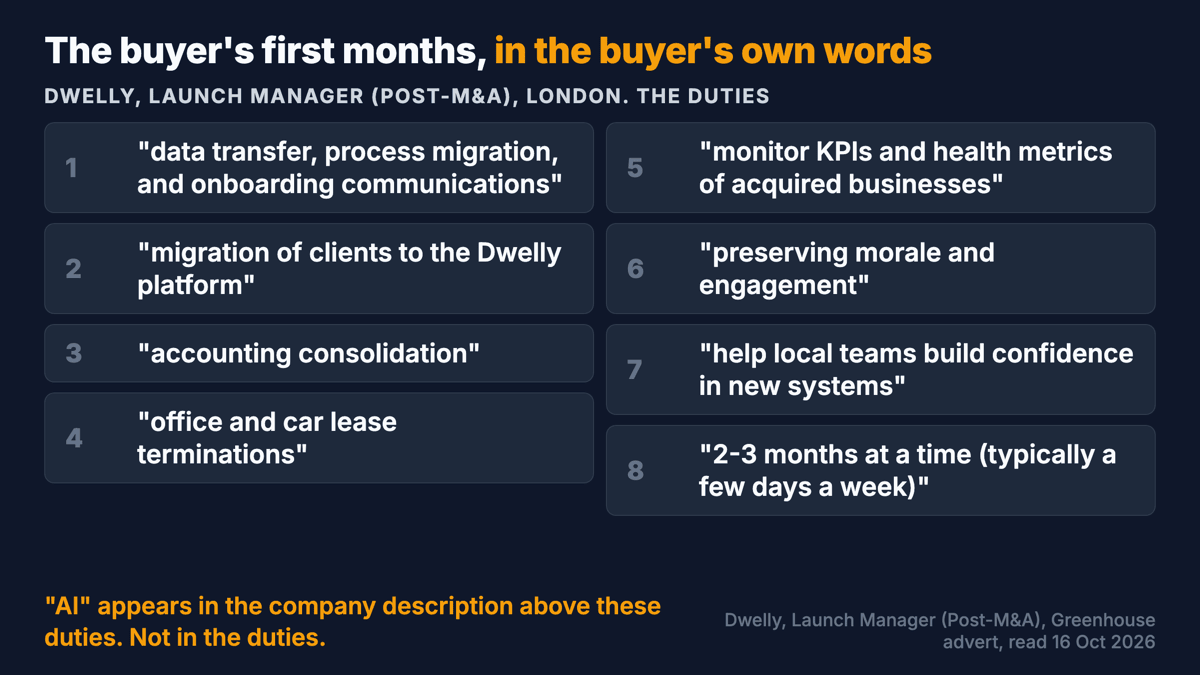
The buyer's first months, in the buyer's own words. Source: Dwelly's Launch Manager advert.
Read that as the owner. Someone moves your records onto their system. Someone consolidates your accounts and ends your office lease. Someone sits with your staff, a few days a week, for two or three months. Someone runs the offboarding "where required".
Dwelly's founder and chief executive, Ilia Drozdov, describes the same event more gently. "Other than improving the processes and introducing our technology, we pretty much leave them alone" (The Negotiator, interview, 20 August 2025). The interview is what the owner hears. The advert is what the staff get.
How the investor describes the plan
General Catalyst is the venture firm the Companies House register lists as a person with significant control of Dwelly's parent company, and it backs Long Lake, another of these buyers (Companies House, Prospire Technologies Ltd, filing history). Marc Bhargava of General Catalyst set out the AI part on a podcast in August 2025. The team goes in "shadowing the customer and understanding all the workflows in their business". Then "we map out the hours at a company". Then they "look at where could AI automate some of these workflows". The target he names is "30% of hours worked" (The Cognitive Revolution, 2 August 2025).
Three more lines from the same interview matter to an owner. On the workflow: "We wanna keep a lot of the same workflows." On the price: "we're gonna charge you around the same we do today, but we can do a lot more with AI." On staff: "it's less about letting people go", and "We're automating tasks". The aim, as he puts it for an accounting firm, is to "do 2 or 3 times as much work" on "a similar cost basis" (same interview).
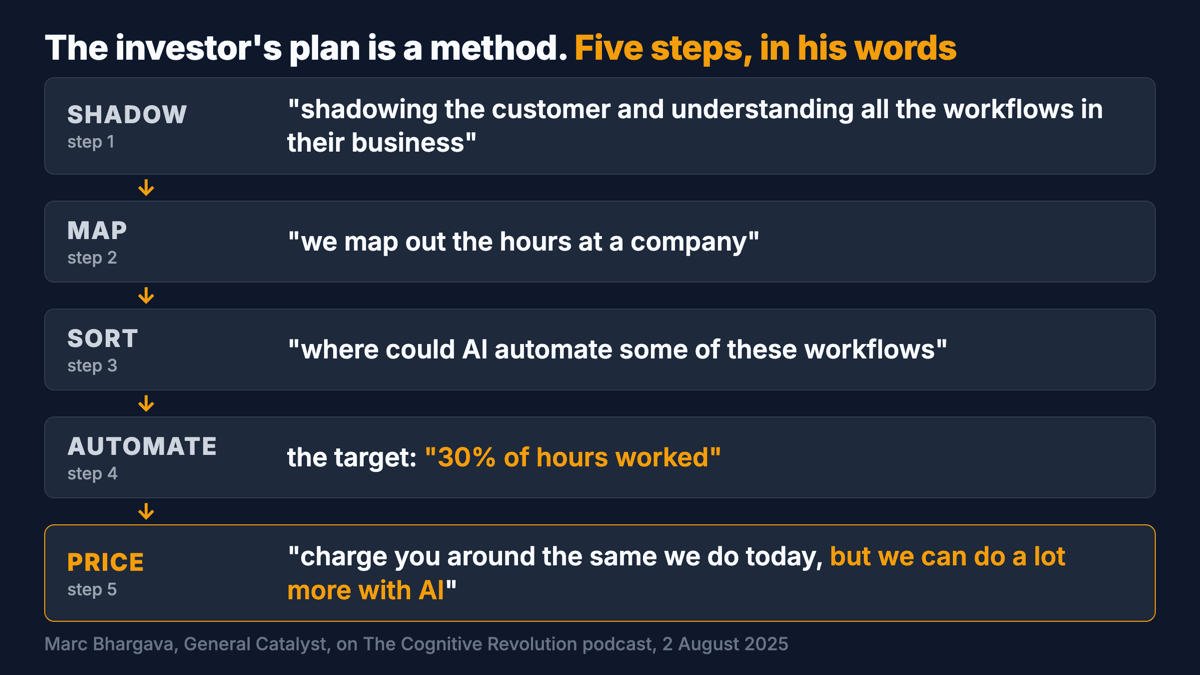
The investor's plan, in his words. Source: Marc Bhargava, The Cognitive Revolution, 2 August 2025.
The engineers' adverts say what the method looks like on the ground. Long Lake says it "acquires service business and transforms how they operate through a shared AI platform, forward-deployed engineers, and a world-class M&A / operations team". It wants an engineer for "writing the integration between a modern agent and a legacy industry ERP with no clean API" who "can point to a specific business metric (throughput, cycle time, error rate) that moved because of work you led", at $200K to $300K with equity (Long Lake, Technology, its own job board). Multiplier, a Singapore-based buyer of tax and accounting firms whose first purchase was a UK tax boutique (Dealroom, 7 August 2026), told its engineers in an advert since taken down: "you'll sit with tax pros and accountants to watch real work firsthand" (Multiplier Holdings, Product Engineer, Built In, removed 21 September 2026).
Which steps you can take without selling
Put the adverts and the interview together and the buyer's first year has about ten steps. The list is mine, built from their words, not a plan they have published. I've sorted each step by whether a firm of ten to fifty people could do it with an outside adviser, do part of it, or not do it at all.
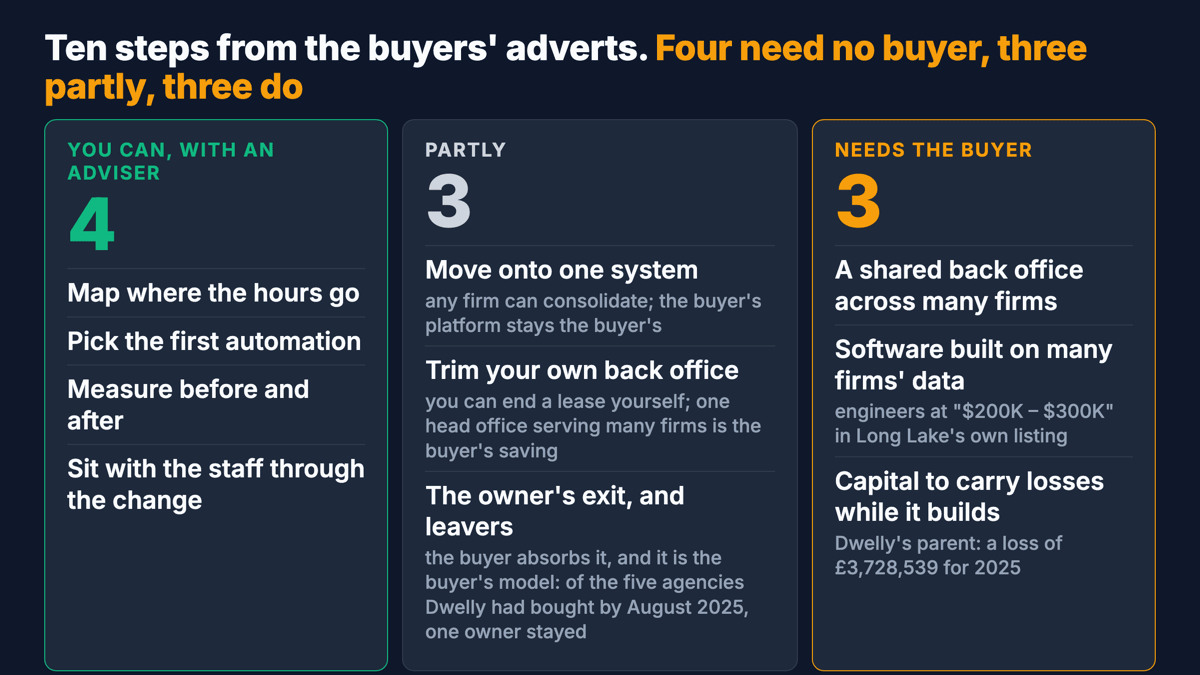
The buyer's steps, sorted. Source: the adverts and interview above; the sorting is mine.
You can do these, with an adviser.
- Shadow the work and map where the hours go. The map is a spreadsheet: who does each step, how long it takes, how often, and where it waits for someone else.
- Pick the first thing to automate. In the adverts and interviews that is maintenance triage, onboarding, tax preparation and client questions.
- Measure before and after. Days from instruction to let, or from documents received to draft accounts. Errors found at review. Jobs per person per week.
- Sit with the staff while the systems change. The Dwelly advert gives this more time than any other duty. It is hard, and it needs no buyer.
You can do part of these.
- Move onto one system. Any firm can consolidate onto one practice or property system. The buyer's platform stays the buyer's.
- Trim your own back office. You can end a lease and outsource payroll yourself. The buyer's saving is a different thing: one head office serving many firms.
- The owner's exit, and the leavers. The buyer absorbs this, and it is the buyer's model: in August 2025 The Negotiator reported that of the five agencies Dwelly had bought, one owner stayed and the rest had retired (The Negotiator, 20 August 2025). If you are selling because you want out, that is the real service, and no adviser replaces it.
You cannot do these.
- A shared back office across many firms.
- Software built on many firms' data, by engineers at the pay in Long Lake's listing. A single firm buys software. It does not build it on other firms' work.
- Capital to carry losses while the software gets built. Which is where the public file comes in.
The three that need the buyer are what make its thesis a thesis. The rest is work you can buy.
What you can check, and what you can't
The buyers describe results. The Negotiator reported Dwelly's claim that its technology cuts "time to let" by a third and maintenance resolution time by 40% (The Negotiator, 20 August 2025). Bhargava's target is 30% of hours. These are the companies' own figures, given to a trade paper and a podcast.
What you cannot do is check them in the accounts. Dwelly's parent company is Prospire Technologies Ltd. Its accounts are signed by Drozdov, its subsidiaries are lettings agencies, and General Catalyst is on the register as its controlling shareholder (Companies House, Prospire Technologies Ltd, filing history). Its accounts for 2025, filed on 30 September 2026, are its first group accounts, and they are unaudited. The filing says "the consolidated income statement has not been delivered" (the accounts to 31 December 2025, same filing history). So turnover and margin are not on the public file.
What is on the file: an average of 104 staff across the group in 2025, up from 17; assets of £32,573,268; and a loss for the year of £3,728,539, after £520,260 the year before, in the statement of changes in equity (same filing). Part of that loss is the cost of buying. The accounts write goodwill off over ten years, and they do not say how much of the loss that is. There is also a charge registered on 29 January 2026 in favour of Trinity Capital Inc., which means a lender holds security over the company (Companies House, Prospire Technologies Ltd, charges).
A note for the accountants. Those staff and asset numbers are above the limits for a small company, and the filing does not state the size test it relies on. The Companies Act lets a company that qualified as small the year before keep the regime for one year over the limits, and the previous year's accounts were filed as a standalone small company. So the unaudited, filleted filing is explained. The margin is still not in it.
Caritas Venture Co., a consultancy in this market, graded 46 firms on what they can prove, and its top mark went to two traditional buyout firms, not to the AI buyers (Caritas, AI Rollup Market Map). I wrote about what proof would look like and keep a ledger of which of the buyers' numbers anyone has checked.
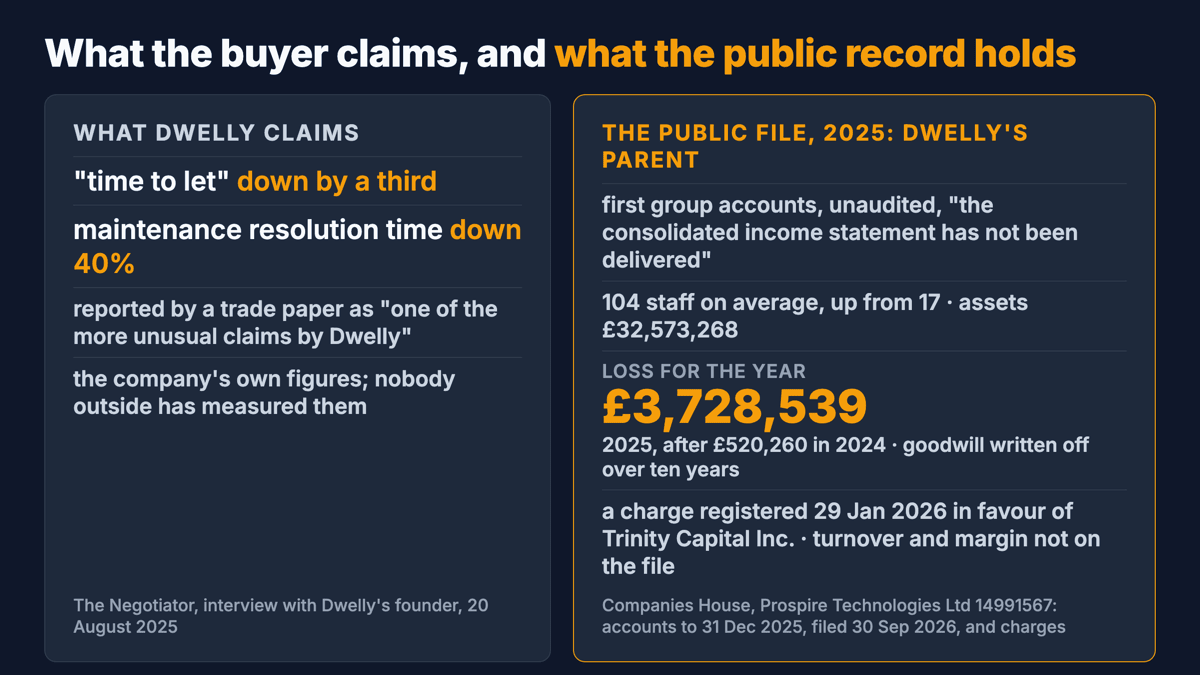
The claim and the record. Sources: The Negotiator, 20 August 2025; Companies House, Prospire Technologies Ltd, accounts to 31 December 2025 and filing history.
What to do with this
If a buyer has written to you, ask it four things.
- Which of our systems will be migrated, onto what, and how many days will your launch team spend on site with our staff?
- What happens to our office and our back-office roles once "accounting consolidation" is done?
- What will our clients pay in year one and year two? The investor says "around the same". Ask for the schedule, not the phrase.
- What am I paid in, when, and who ranks ahead of me? Bhargava describes sellers "rolling over 30% of their equity" (The Cognitive Revolution, 2 August 2025). Shares in a parent with unaudited accounts, a registered charge and the loss above are not cash, and a deferred payment is an unsecured debt that a secured lender is paid before. Take independent legal and financial advice before you answer the letter.
Then ask yourself which of the ten steps you actually want someone else to do. If the answer is the exit, that is what a buyer is for, and the price is the conversation. If the answer is the mapping and the automation, that is work you can buy, and I've written up how the mapping is done.
At Abbey National I was part of the team that integrated the firms it bought, Cater Allen and Scottish Provident among them, largely on the data centre side. Each integration took years, and several overlapped. Nothing in these adverts surprised me. Migration, consolidation, leases and morale are the work of a purchase, whoever owns the software.
The buyer's own advert calls that work "the primary engine that translates each acquisition into revenue growth". Its own file holds a loss and no margin. Decide which of those you are selling for.