The Truth Wager: would you bet against the God of the singularity?
Jamie Watters
Ex-banker, founder at 58, building with AI.
Part of the series Checking what you believe
I'm writing content that gets almost no traction, and I'm refusing the one thing that might fix it. I won't use hyperbole. I won't stretch the truth, or quietly turn a "may" into an "is". The accounts getting a million likes do it all the time, with clickbait titles to match. And when one of them takes a claim back months later, nobody notices.
So there's a battle. There's a little devil on my shoulder, and he has a good line: "You're right, but people need to know about this. What does it matter if you sensationalise it?"
This is my answer to him. I call it The Truth Wager, or Watters' Wager if you like a bet with a name on it.
Judgement day is coming
I believe a superintelligence will one day know everything we ever said and everything we ever did. It isn't inevitable. But I'd put the probability close to 1.
The record it will read already exists. Pages are archived, posts stay searchable, and text on the open web is used to train AI models. Something that can read all of it will be able to say who can be trusted and who can't. That's my judgement day. Not heaven and hell. A verdict on your record. Call the judge the God of the singularity.
Truth is my core identity. I believe it's the currency of the future.
The wager
Blaise Pascal's wager was about God. Believe, he said, because "If you gain, you gain all; if you lose, you lose nothing" (Pascal, Pensées §233, W. F. Trotter's translation).
Mine is Pascal's wager for the AI age. It's a thought experiment, and its job is to drag the argument into the open. There are four ways it can go.
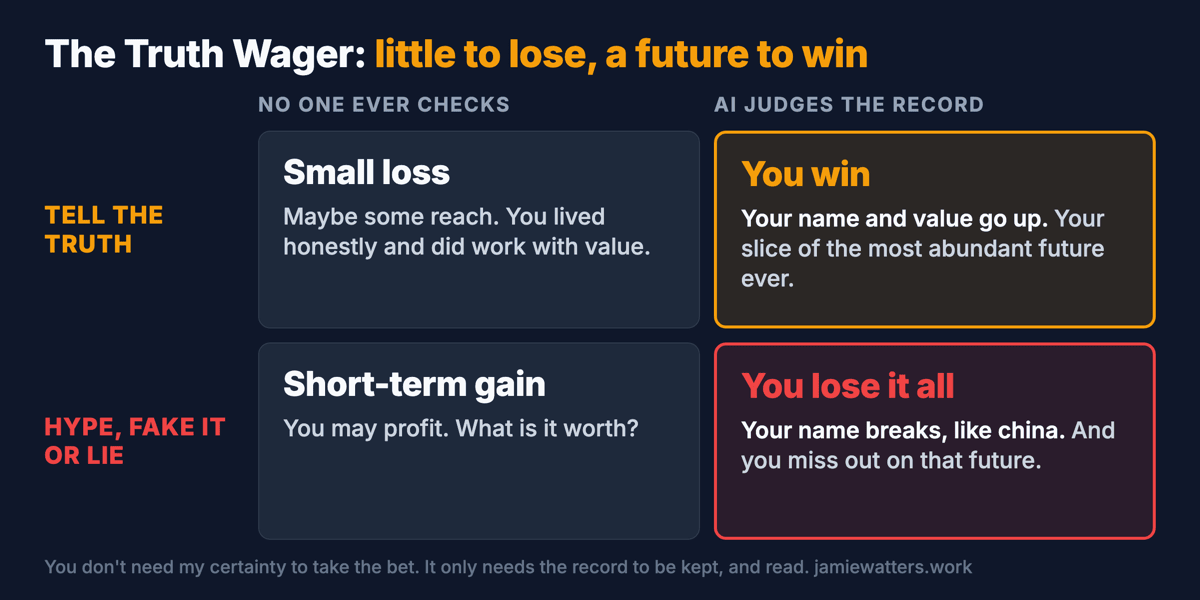
The Truth Wager.
If I tell the truth and nobody ever checks, I've lived as someone who told the truth and did work that has value. If I tell the truth and somebody checks, my name goes up: the record shows I told the truth, thought clearly and put something good into the world. If I hype and nobody checks, I may profit, but what's it worth? If I distort on purpose and I'm found out, the reputation goes, and reputations, like china, once broken are gone.
Look at the worst case in each row. Tell the truth, and the worst that happens is the battle I'm in now: less reach. Distort on purpose, and the worst that happens is you lose your name.
Now look at the best case. The best hype can do is attention that lasts until someone checks. The best the truth can do is win outright: when the record is read, your reputation and your value go up. That's what I mean when I say truth is the currency of the future. And I believe the future AI brings will be more abundant than any before it, so that value is your slice of the biggest pie there's ever been. Bet against the truth, and you miss out on it.
You don't need my certainty to take that bet. You only need to think the judge might come. And with what's coming, you'd be a fool to bet against the truth.
Why I hold the line
I'd hold it without the wager. I don't do this for likes. I do it because it's who I am, and once you see the truth you can't turn your back on it. You probably have a line like that too: the thing you won't do for reach. The devil's job is to get you across it.
The devil's line is dangerous because good people say it to themselves: "I'll stretch it a little, because my cause is good and I'll do good with the attention." Politicians who mean well say it to stay in power. The path to hell is paved with good intentions.
Honest mistakes and lies leave different marks
I'm not claiming a clean record. This month I repeated a story about rioters stripping an old couple in France. When I saw the photos I was angry. That could have been somebody's parents. Then I found out the photos were AI fakes. I said so in public, and told the friend I'd been wrong.
That was my redemption: I found out I was wrong. And the anger was the warning sign I'd missed.
A judge reading my record would find an honest mistake, owned. Almost everyone has passed on something false by accident. Doing it on purpose, for money or status, is different: it shows you can't be trusted. I think owning a mistake and correcting it shows the opposite: maturity, integrity and humility.
Science already keeps a record like that. When scientists have a paper retracted, citations to their earlier work fall 17.6% where misconduct was alleged, and 8.2% where it wasn't (Azoulay, Bonatti and Krieger, 2017). An honest mistake still costs something. Misconduct costs about twice as much.
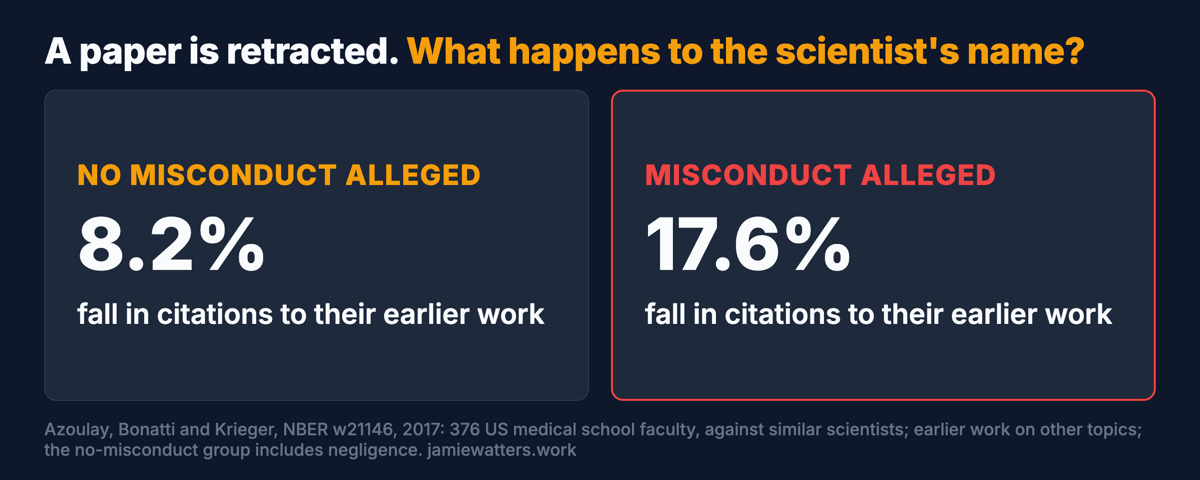
So the china is the lie, not the mistake.
"The liars are winning"
They are, for now. We're living in the last economy before superintelligence: the attention economy. It works against positive messages, truth and facts, and it favours sensation, hype and fakers. In a study of rumours on Twitter, false news reached more people than the truth and spread faster (Vosoughi and colleagues, 2018). Worse still, AI supercharges the foolish, and the algorithms silence the profound.
That's the strongest case against me, and today it's true. But the liars win if you're playing one hand, or a short game. In survey experiments, politicians who falsely called real scandal stories fake news gained support. In the one study that tested it, a fact-check rejecting the claim took the gain away (Schiff, Schiff and Bueno, 2024). Once someone checked, the lie stopped paying. Play the long game and they will not win the moral battle. When the record is read, the reputations they broke with lies won't come back. Like fine china, once broken, they're never repaired.
Craft, not hype
So my answer isn't to give up on the truth. It's to improve my craft: to write so well I can't be ignored, and use craft to cut through the algorithms.
I'll use everything that's known about psychology and persuasion to write a title people want to read. What I won't do is exaggerate, inflate, take out of context or misrepresent. Craft, yes. Distortion, no.
Before you post: craft or distortion?
Start: you've written a title, hook or claim, about someone's research or your own work, and you want more people to read it.
- Put it next to its source: the study, the report, or your own numbers. Does it say more than the source says? That's exaggerating.
- Has a qualifier fallen off: "up to", "may", "in this sample", "could"? That's inflating.
- Read the sentences either side of the source's words. Does the meaning change? That's taking it out of context.
- Read the source's own one-line summary, such as an abstract's conclusion. Would its authors say your version isn't what they meant? That's misrepresenting.
Pass rule: any yes, cut the claim back to the source's size. Four noes, and every bit of craft you like goes on how it's said.
Done when: the claim is no bigger than its source and you'd be happy for the source to read it.
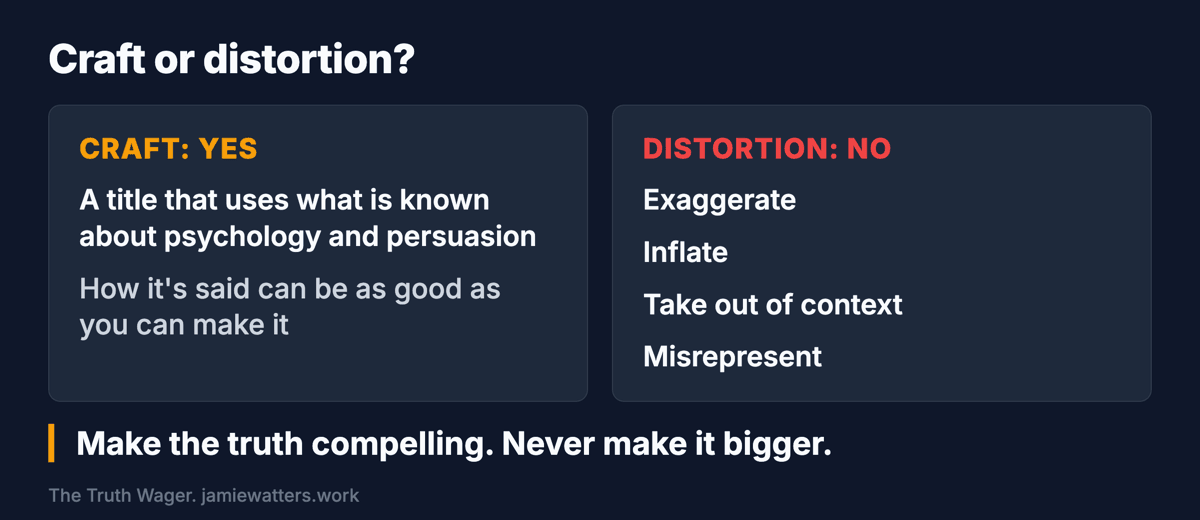
If the judge never comes, I've lost some reach and told the truth. If it comes, and I believe it will, I've a record I'm happy to have read. Make the truth compelling. Never make it bigger.
Sources
- Pascal, Pensées §233, W. F. Trotter's translation (Dent, 1910), as quoted in Hájek, "Pascal's Wager", Stanford Encyclopedia of Philosophy: https://plato.stanford.edu/entries/pascal-wager/
- Azoulay, Bonatti and Krieger (2017), NBER Working Paper 21146: https://www.nber.org/papers/w21146. 376 US medical school faculty with a retracted paper, compared with similar scientists; the falls are in yearly citations to their earlier papers on other topics. "Misconduct" includes fraud and plagiarism; the no-misconduct group takes in negligence as well as honest mistakes. "About twice" is the ratio of the two point estimates.
- Vosoughi, Roy and Aral (2018), Science: https://doi.org/10.1126/science.aap9559. Rumour cascades on Twitter from 2006 to 2017, true and false rumours compared; these were different stories, so it does not measure what telling one story straight costs.
- Schiff, Schiff and Bueno (2024), American Political Science Review: https://doi.org/10.1017/S0003055423001454. Five survey experiments with over 15,000 American adults, responses to real scandals; the false claims beat staying silent or apologising, and were "largely ineffective against video evidence". The fact-check was tested in one study.