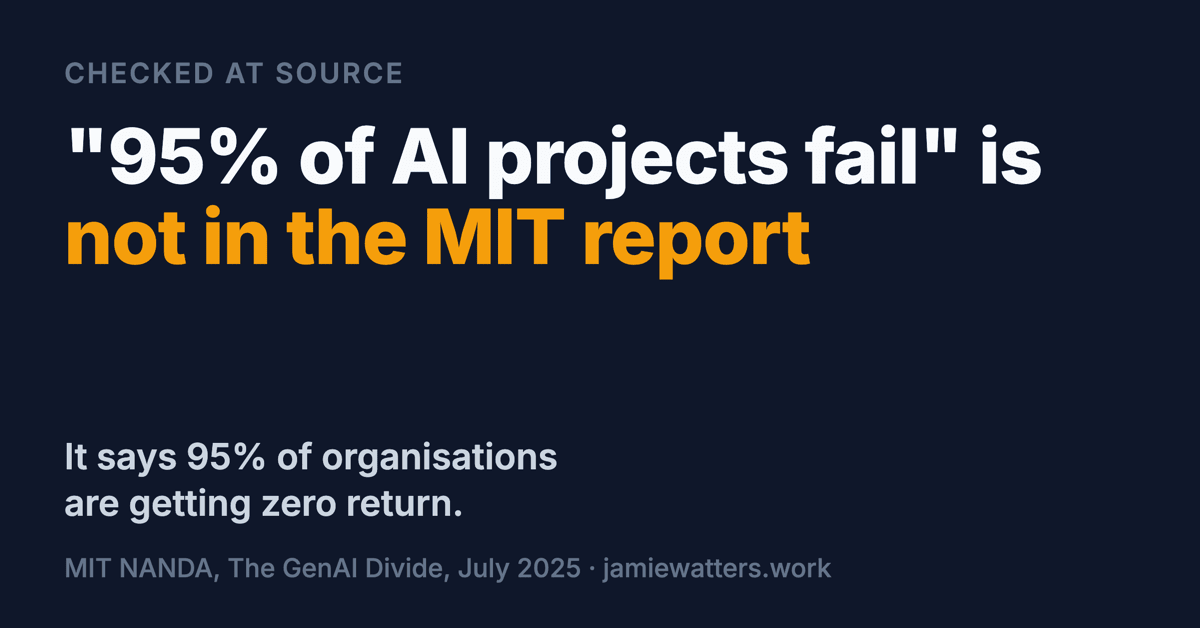
"95% of AI projects fail" isn't in the MIT report. Here's what is
Jamie Watters
Ex-banker, founder at 58, building with AI.
On 20 August 2025, Fortune reported a tech selloff. Its story named an MIT study: "Nvidia dropped 3.5% and Palantir nearly 10% after an MIT study claimed 95% of companies see no returns from generative AI". The same sentence goes on to Sam Altman of OpenAI, who had warned of a possible bubble. Fortune said the selloff "appeared to be sparked in part" by the report (Fortune, 20 August 2025).
In part, and alongside Altman. But the number has kept travelling. This May it was in the title of a guide to making money from AI consulting. You may have heard it in a budget meeting, in this form: "95% of AI projects fail, MIT found."
So I opened MIT's report and searched its full text for "95" and for "AI projects". The report is 26 pages, marked v0.1 and dated July 2025 (MIT NANDA, The GenAI Divide, 2025).
The sentence isn't there.
The number 95 appears twice, and the two sentences it sits in don't say the same thing.
What MIT wrote
Page 3, in the executive summary: "Despite $30–40 billion in enterprise investment into GenAI, this report uncovers a surprising result in that 95% of organizations are getting zero return" (MIT NANDA, 2025).
Page 7: "The 95% failure rate for enterprise AI solutions represents the clearest manifestation of the GenAI Divide" (MIT NANDA, 2025).
The first counts organisations. The second calls it a failure rate for "solutions". Neither says projects, and neither shows how 95 was calculated.
The report also changes its own noun. Two lines after the page 3 sentence: "Just 5% of integrated AI pilots are extracting millions in value" (MIT NANDA, 2025). Organisations, pilots, solutions, all inside the report, with no calculation shown.
How the words changed
The retellings kept changing words, and by May 2026 the noun was projects. The order below shows when each version appeared, not who copied whom.
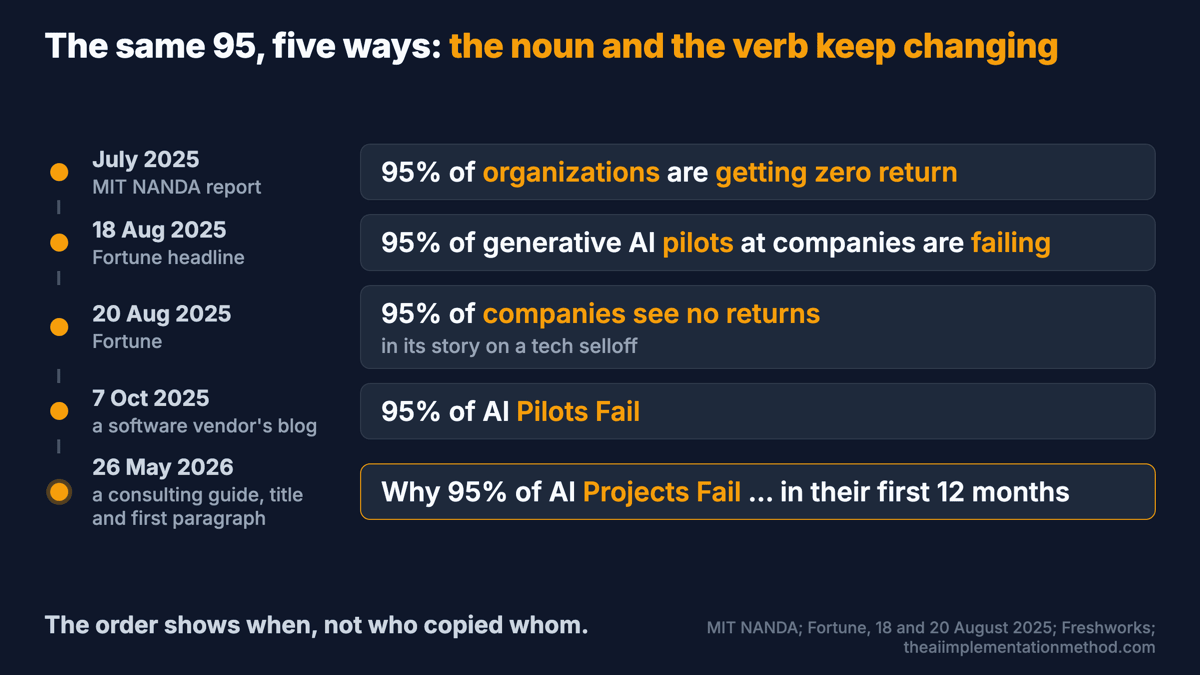
The same 95, five ways, in date order. Sources: MIT NANDA; Fortune, 18 and 20 August 2025; Freshworks; theaiimplementationmethod.com.
The consulting guide's first paragraph also says pilots fail "in their first 12 months" (theaiimplementationmethod.com, 26 May 2026). The report's success test looked six months after a pilot (MIT NANDA, 2025).
Each change sounds small. Between the report and the May 2026 guide, "95% of organizations are getting zero return" became "Why 95% of AI Projects Fail".
What the number rests on
The report defines success twice. On page 7, it's something users or executives "have remarked as causing a marked and sustained productivity and/or P&L impact". In the appendix on page 24, it's "deployment beyond pilot phase with measurable KPIs", with ROI "measured 6 months post-pilot" (MIT NANDA, 2025). The same appendix says six months "may be insufficient" to assess deployment for complex enterprise systems, and could understate success.
The base includes interviews with 52 organisations, 153 survey responses from senior leaders at four conferences, and a review of more than 300 public AI initiatives. Beside its pilot-to-production chart, the report calls those figures "directionally accurate based on individual interviews rather than official company reporting". It calls itself "Preliminary Findings" (MIT NANDA, 2025).
That doesn't make it worthless. It makes it a preliminary study with a strong headline, which is a different thing from a measured failure rate.
Check the next number yourself
The next number someone quotes at you may have the same problem, and you can find out in about five minutes. Three steps, on any statistic, AI or not:
- Open the source's own document, not an article about it. Search it for the number and copy the sentence it sits in.
- Compare what the source counts (organisations, pilots, projects) with what the version you heard counts.
- Find how success was defined, over what window, and how many were asked.
If the version uses a different noun, verb or window from the source, quote the source's sentence, not the version. And if the source's own sentence has no calculation beside it, say that too.
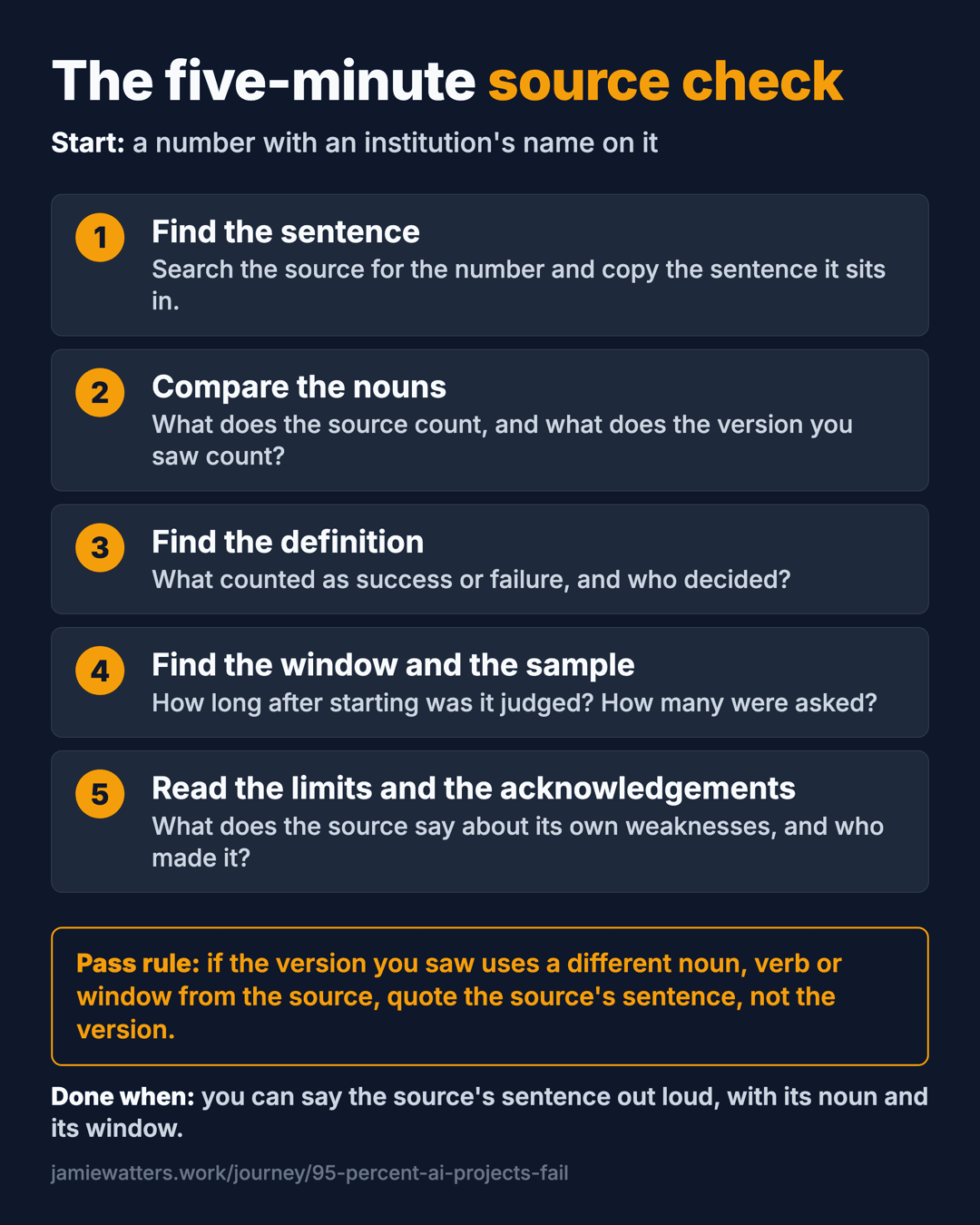
The full five steps as a card. Save it for the next number.
What the report did: MIT's NANDA project interviewed 52 organisations, surveyed 153 leaders, and wrote that 95% of organisations were getting zero return. Its appendix measures success six months after a pilot and says that may be too short.
Sources
- MIT NANDA (Challapally, Pease, Raskar, Chari), The GenAI Divide: State of AI in Business 2025, v0.1, July 2025 (executive summary page 3; research note page 7; methodology and limitations page 24). Read from the copy held in my research archive, 26 pages
- Fortune, Sheryl Estrada, "MIT report: 95% of generative AI pilots at companies are failing", CFO Daily, 18 August 2025: https://fortune.com/2025/08/18/mit-report-95-percent-generative-ai-pilots-at-companies-failing-cfo/
- Fortune, Beatrice Nolan, "U.S. tech stocks slide after Altman warns of 'bubble' in AI and MIT study doubts the hype", 20 August 2025: https://fortune.com/2025/08/20/us-tech-stocks-slide-altman-bubble-ai-mit-study/
- Freshworks, "95% of AI pilots fail. Here's a 3-stage path forward", 7 October 2025: https://www.freshworks.com/theworks/ai-assisted-service/ai-pilots-path-forward/
- theaiimplementationmethod.com, "AI Implementation Failures in 2026: Why 95% of AI Projects Fail and How Corporate Professionals Can Profit From Fixing Them", 26 May 2026: https://theaiimplementationmethod.com/2026/05/26/ai-implementation-failures/
- My paper on 19 AI failure statistics, traced to source: https://jamiewatters.work/journey/why-ai-projects-fail
- My four questions for any AI failure statistic: https://jamiewatters.work/journey/four-questions-ai-statistic