I left a bank at 58 to start my own firm. It needs one skill I've never had: selling
Jamie Watters
Ex-banker, founder at 58, building with AI.
Part of the series Can an old dog learn new tricks?
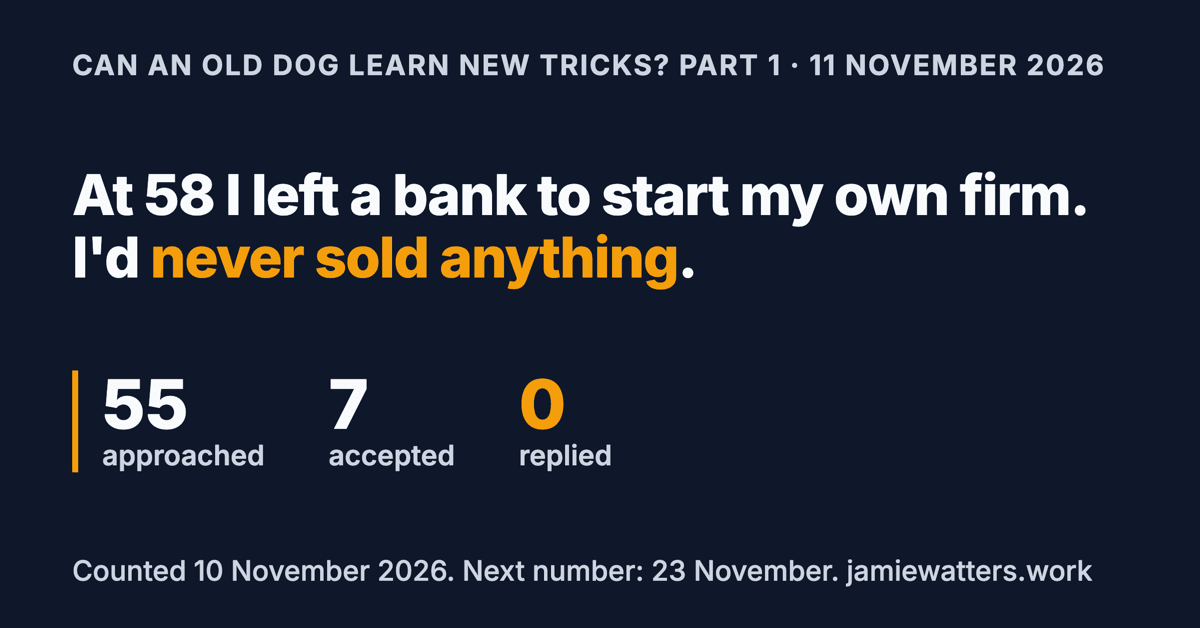
Fifty-five. That's how many people I've approached on LinkedIn since starting my firm, each with a request to connect and a short note. Fifty of them went out since Saturday. Seven accepted. None of them has replied yet.
I'm 58. I've been an employee since 1985, when I started as a computer operator at 17. Now I've given up a bank's pay cheque, the pension and the health insurance. The share scheme went too, and so did somewhere to go every morning. All of it for a firm that lives on one skill. Selling. I have never sold anything.
I'm writing this as it happens, before I know whether it works, with the real numbers each time. This is the first one.
Why I left
This year my son died. There are no words to express the pain, and I only hope you never have to go through it. The paradox is that on one level you can't think, and on another nothing matters. At the same time, everything matters. Life is too precious to let it slip through your fingers doing things that don't matter.
Then a restructure was on the cards at the bank, and I decided to take the chance to rethink my life and choose life over a slow death.
The restructure wasn't the only push. I'd long since lost any say over what I did, how I did it or how I ran my team. Most of my week went on ticking boxes, proving that meaningless things had been done, for people who treated them as life and death. And I wasn't learning what I'd need to stay useful in a world that AI is remaking.
So I left. My first plan was the safe one: a job or a contract in AI, because I'd been building apps with it since April 2025. That didn't come off. It's hard for an employer to take a leap of faith on someone whose last job title doesn't match the next job. The contracts didn't open up either. That left one option: start on my own.
The other side of the desk
At the bank I was the one doing the checking. I sat on a committee that approved AI and cloud initiatives, and I checked whether the bank's critical suppliers could keep running through a crisis. Now I'm on the other side of that desk. My firm, Beforehand, helps suppliers like the ones I used to check get ready for the bank's questions.
I know what the bank asks. What I don't know is how to get a stranger to pay me for knowing it. Most of the people I see starting firms like mine have decades of commercial experience, much of it in sales, marketing or customer service. I have thirty or forty books on selling, marketing and strategy, read over the years, and no practice at all.
The sum my first plan got wrong
The first draft of my sales plan assumed that half the firms that replied would book a call. On that assumption it forecast about 22 calls by the end of February.
The figures published by companies that sell LinkedIn outreach tools tell a different story. One booked call takes somewhere between 500 and 750 connection requests. My plan assumed one reply in two would become a call. Their figure is about one in 14.
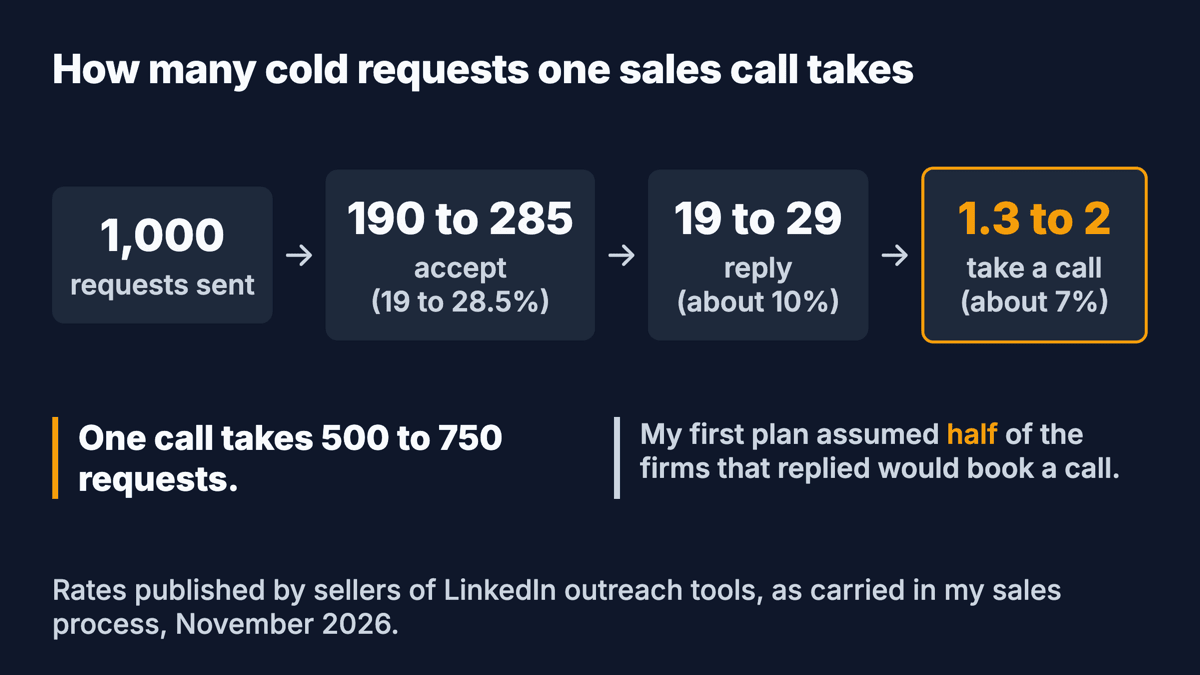
Run my own week through it. On those figures, seven accepts should bring less than one reply. So my silence isn't a verdict yet. It's what the figures predict.
The sellers have every reason to make those figures look good, so the real number may be worse. Either way, cold requests on their own won't get me 22 calls by February.
What I'm trying next
I can't buy decades of sales experience, and I won't pretend to have it. What I do have is years on the other side of the desk, and they give me a guess. A firm needs me when a bank's questionnaire has just landed on its desk, not when my message lands. So the next approaches go to the people who see those questionnaires arrive: small security firms who already work with these suppliers and could send them my way. Those conversations start on 16 November. It's a guess, and the next pieces will show whether it's right.
I've done this before on a small scale. When an app I built missed its numbers, I shut it down; the last one went in August. The plan here is the same, only with my savings on it. Try something, keep what works and change what doesn't. Then do it again, a few times, before the money runs out. Along the way I'll find out whether a 58-year-old mind can still turn quickly.
That's the belief I'm staking my savings on. I don't need to be a genius, because the market is the genius, and it talks in feedback. My job is to ask it, and listen.
Run the sum before you leave
I did this sum after I'd left the bank. Do it before you leave your job. Here it is with my numbers beside each line.
1. How many people can you reach in a week? Mine so far: about 50.
2. How many do you have to ask to get one answer? Search for your channel's reply rate and use the gloomiest figure you find, not a hope. Mine, cold on LinkedIn: about 40.
3. How many answers does it take to get one call? If you can't find a figure, start with mine: about 14.
4. Multiply line 2 by line 3, then divide by line 1. That's how many weeks one call takes. Mine: 40 × 14 is 560 asks. At 50 a week, that's about eleven weeks for one call.
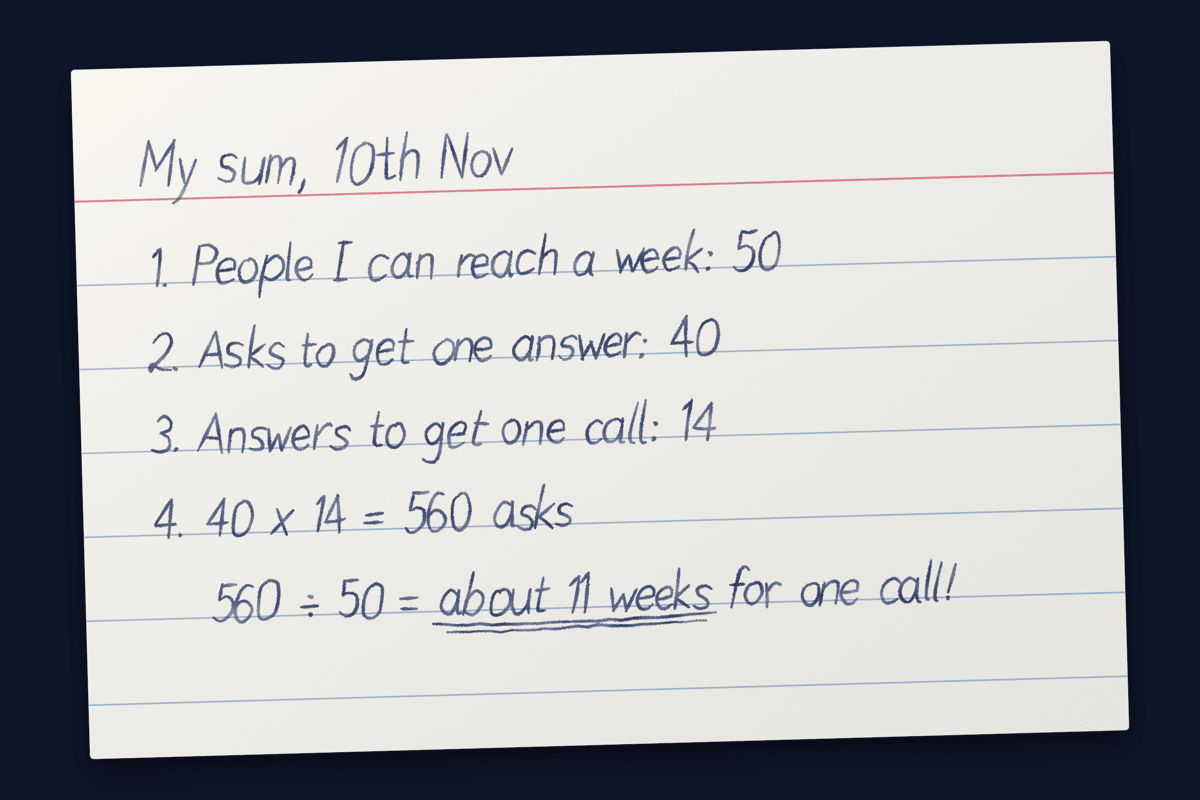
My sum on 10 November. Copy the card and put your own numbers in.
A call isn't a client, so set those weeks against how long your money lasts, and leave room for calls that don't turn into work. If the answer frightens you, find a warmer way in: people who'll introduce you, not a bigger list. That's what I'm trying next, and I'll tell you if it works.
My test has a date on it. If two of the firms I've approached take a call by 23 November, it passes. I'll publish the number either way, in the next piece.
Fifty-five approached. Seven accepted. No replies yet. The next number comes on 23 November.
Sources
- LinkedIn outreach rates: published by sellers of LinkedIn outreach tools (vendor data), as carried in my sales process, November 2026. Accepted 19 to 28.5%, replied about 10%, took a call about 7% of those who replied.
- My own numbers: my contact records, read on 10 November 2026.
- Beforehand Advisory: https://beforehandadvisory.com/