Jev, the AI that can't write: where it saves money and where it's hype
Jamie Watters
Operational resilience and AI delivery practitioner.
Who this is for. You've seen the noise about Jev and want to know if it would cut what you pay for AI, or what it's actually good for. No technical knowledge needed. By the end you'll know what it is, where the claims are wrong, and five questions to decide if it's worth trying. About twelve minutes.
Skip it if you already run Jev in production. You'll know most of this.
On the length. The answer is in the first three sections. The five questions are at the very end, if that's all you want. The middle is the evidence behind them.
Jev answers questions but cannot write a sentence. That one fact explains almost everything about it: why it is so cheap, why it is fast, what it is good for, and why most of the excitement around it is aimed at the wrong things.
TypeSafe AI released Jev on 15 September 2026 (TypeSafe). By 8 October there is enough independent evidence to separate what it does from what people said it does. This is the plain version, for anyone deciding whether it belongs in their work.
I applied for a role at TypeSafe in September. Nothing here was shown to them, and the sources are linked so you can check the figures yourself.
What Jev is
You give Jev a piece of text and a question, plus the only answers it is allowed to give. It picks one and tells you how likely it thinks each answer is.
"Here is a customer email. Which team should handle it: billing, shipping or returns?" Jev comes back with "billing", plus a probability for each of the three teams. It can also answer yes or no as a probability, or place something on a scale you describe, such as calm, frustrated, very angry (TypeSafe docs).
That is all it does. It can't draft an email, summarise a report or hold a conversation. Think of it as a Magic 8 Ball that actually reads your question, where you write the answers, and it tells you how sure it is.
It costs $0.042 per million tokens (chunks of words) sent in, and nothing for the answer (TypeSafe models page). Google's cheapest current Gemini 3 text model, Gemini 3.1 Flash-Lite, charges $0.25 per million in and $1.50 out, or half that through its Batch API (Google pricing, read 8 October 2026).
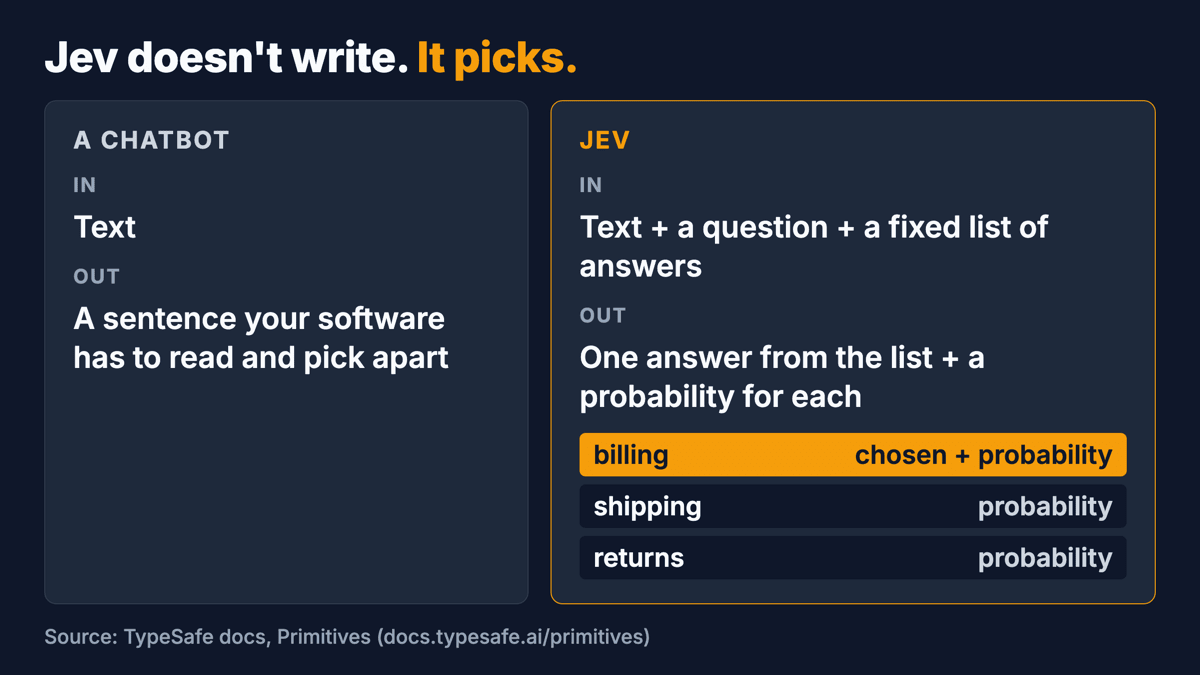
What goes in and what comes out. Sources: TypeSafe docs.
Is it an LLM?
TypeSafe says no. Its launch post calls Jev "neither small nor an LLM". Beyond that it says only that Jev is transformer-based and does not write its answer one word at a time, the way ChatGPT or Claude does (launch post; The Batch). Its own training explainer presents its method as a third way of adapting a pretrained language model (TypeSafe primer).
Outside observers suspect an open-weight LLM underneath (TechCrunch, 18 September). Archer Hume probed Jev with about 10,000 calls and found its token counting matched no public tokeniser he tested, which he says rules out an off-the-shelf tokeniser, not a public base model (Jev's Architecture Unmasked, 17 September).
TypeSafe has not said which model it started from, how big it is, or what it was trained on, beyond its founder telling TechCrunch the data is entirely synthetic, made in-house. The likeliest description, not a confirmed one: it starts from a language model's understanding of text and has been retrained to stop talking and start choosing.
So "is it an LLM" is the wrong question for anyone deciding whether to use it. It reads like one and answers like a classifier. What matters is whether its answers and its probabilities hold up on your work.
Why "calibrated" is the selling point
Ask ChatGPT how sure it is and it will tell you, in words. Those words are generated like any other text. A model can say it is almost certain and be right far less often than that suggests.
TypeSafe's claim is that Jev's probabilities are trained against outcomes. Of all the answers it gives at 0.8, about 80% should be right (TypeSafe primer). That is what "calibrated" means, and it is the most useful thing about Jev, because it lets your software act on the confident answers and send the rest to a person or a bigger model.
Is it true? Mostly, with exceptions you need to know about.
- An independent paper ran Jev on 37 public datasets, 346,009 requests in total, for under $10. It found the probabilities on multiple-choice answers well calibrated. The yes-or-no probabilities ranked well but sat in the wrong place relative to a 0.5 cut-off (Deußer, Sparrenberg and Sifa, arXiv 2609.37647).
- A second paper, on 18 social-science labelling tasks, found Jev's confidence better than the stated confidence of 16 of 19 LLMs, though not the three frontier Claude models, Sonnet 5 among them. On judging empathy in support conversations, Jev was highly confident and close to chance. And it was less accurate than the best language model for each task on 14 of the 15 tasks scored that way, by a median of 11.6 points on the paper's main score, macro-F1 (Ibrahim and Zaki, arXiv 2609.24574).
- Filing 75 of my notes, I let Jev keep any answer it scored at 0.80 or more on its confidence measure. 11.9% of the kept answers were wrong, against the 5% limit I set before running it. That tests a threshold more than calibration: the kept answers averaged 0.94 confidence and 88% were right. Those errors came from six notes, wrong in every run, so they can't settle whether the fault is the model or my folder labels (Jev filed my notes). In an earlier fact-checking test it called one wrong claim right at 0.98 or 0.99 confidence in every run, and all four models I tested got that claim wrong too (six mistakes I made testing Jev).
Calibration is a property of many answers taken together. It never promises that this particular answer is right, and TypeSafe says so itself. It has to be checked on your own work before you rely on a threshold.
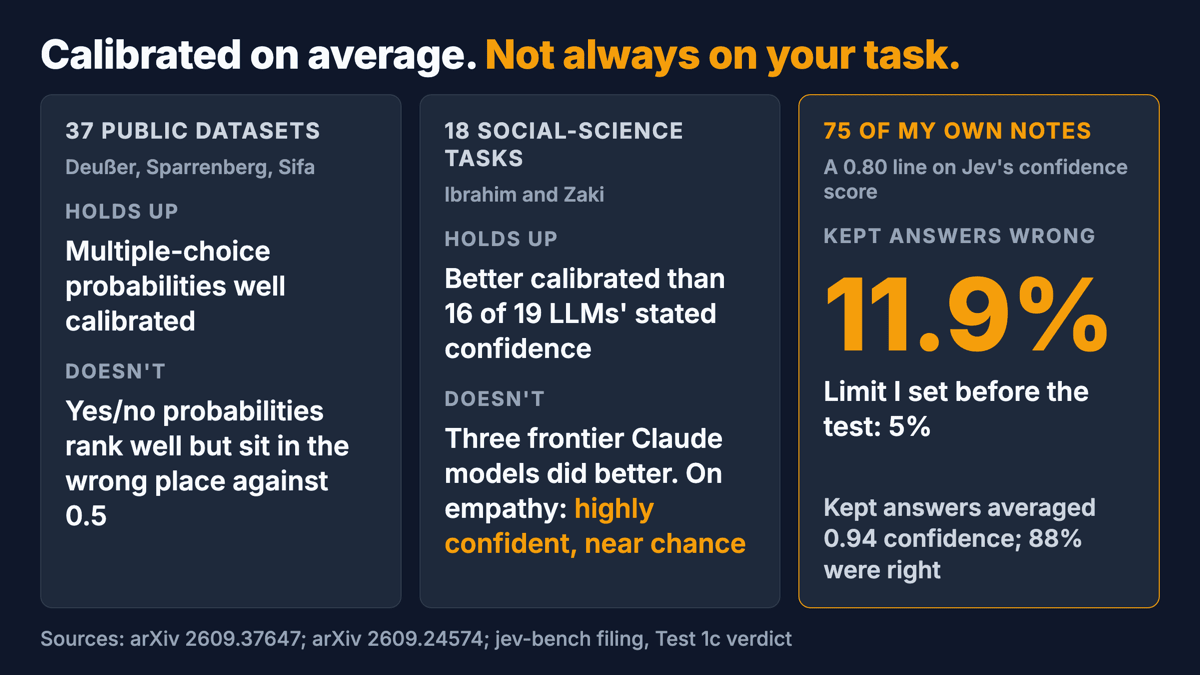
Calibrated on average is not calibrated on your task. Sources as linked.
Hype against reality
"193.6 times faster, 444.6 times cheaper." Those figures come from TypeSafe's own workflow tests, against expensive frontier models. TypeSafe's own small print says its team wrote the workflows, that the reference answers are an average of two competitor models, and that the numbers are "on the higher end of real world gains" (launch post). The launch post makes the big claims in its main text and hedges them in its own footnotes; most coverage kept the claims and dropped the footnotes. Against a cheap model the gap is far smaller: on input price alone, Gemini 3.1 Flash-Lite costs about six times what Jev does at standard price and about three times at batch price (Google pricing).
"It can't hallucinate." It can't give you an answer that isn't on your list. It can still pick the wrong one from the list. TypeSafe's own note under its hallucination chart says its 0% figure "is not empirical": an answer from your list is guaranteed by the design, so it was not measured (launch post).
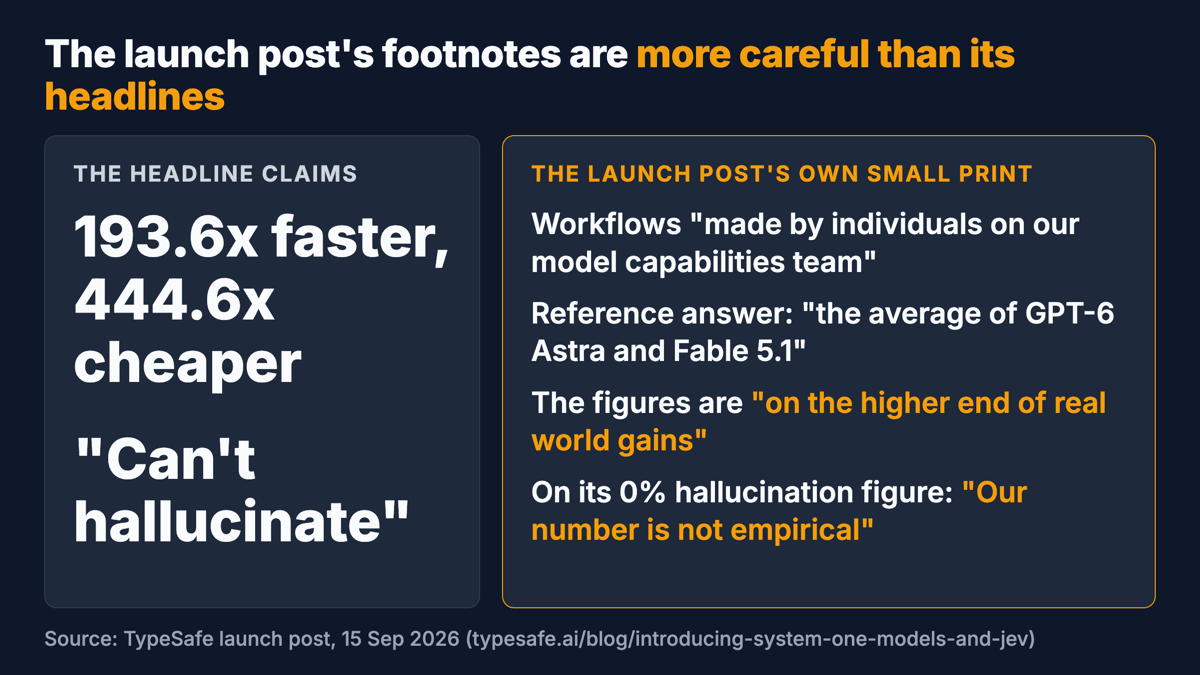
The headline claims against the launch post's own small print. Source: TypeSafe launch post.
What TypeSafe has not published: a paper on its training method, which it calls RLCD; the model's size; its base model; its training data beyond "synthetic"; and the weights. You can only use Jev through its own service, or through platforms such as Vercel and Cloudflare that added support for it (The Batch).
What it admits. TypeSafe lists nine of Jev's weak spots (Jev 1.13 jaggedness, last reviewed 2 October). Among them: it reads instructions literally, can't do arithmetic or count reliably, reads dates as text, can be steered by hostile text, in some cases leans towards the first option in a list, and gets worse with long text full of detail the question doesn't need. That page is more useful than any of the launch numbers.
What it is genuinely good for
The pattern is the same every time: a small judgement, repeated thousands of times, where the rule is in the text you send.
- Routing. Which team gets this ticket, which model gets this request. Vercel's Pranit Sharma said that swapping the OpenAI model it had been using to review commands for Jev got results five to 18 times faster, and more accurate. In the same report, Bryo AI's CTO found Gemini slightly more accurate than Jev at sorting business emails, at 10 to 20 times the cost (TechCrunch).
- Scoring. Rate this complaint's urgency, this review's tone, this lead's fit, on a scale you define.
- Checking an agent's actions. Before an AI agent runs a command, ask: does this delete anything, does it send anything outside the company? Cheap enough to ask on every step. TypeSafe's founder pitches exactly this use.
- Sitting in front of a bigger model. Jev answers everything; the answers it is unsure of go to Claude or GPT. On my notes that gave the same result as Claude alone, 65 of 75 filed correctly, for 63% less (Jev filed my notes). On the social-science tasks, the same pattern matched or beat the LLM alone at a quarter to half of its cost (Ibrahim and Zaki).
Be clear about what that buys. In the same test Jev alone got 64 of 75 (Jev filed my notes), so the hand-off added one note at about 29 times Jev's cost per note. It added no check: on the six notes Jev got confidently wrong, Claude usually chose the same wrong folder, and most of my notes were filed by a Claude session, so agreement with Claude is partly built in. If you already pay a big model to make a judgement, the hand-off is where I would start: it cut my bill without changing the answers. It is not a safety net.
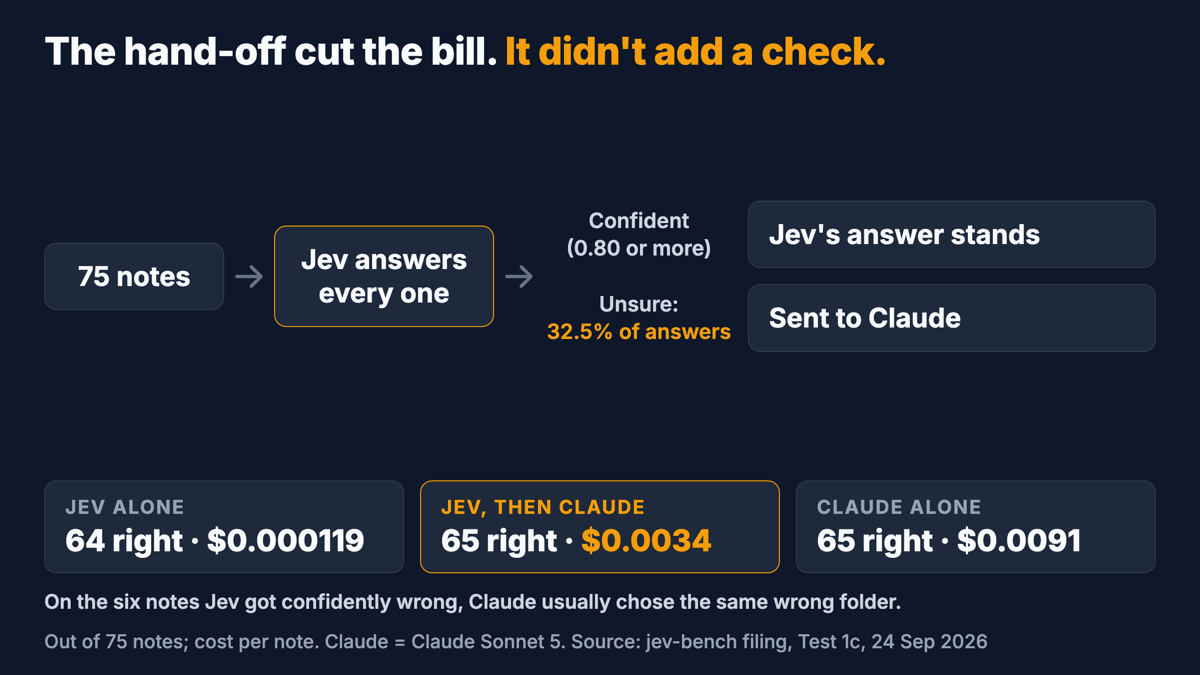
What the hand-off did on my notes. Source: Test 1c, jev-bench filing folder.
Where the money is, and where it isn't
The saving is real per decision and tiny per decision. Whether it matters depends on what each decision costs you now, and how many you make.
The costs below come from my filing test, where each note went in with ten similar notes as examples. That made about 2,833 tokens a note, worked out from Jev's price (Jev filed my notes; Google pricing). If your inputs are a tenth of that size, Jev's and Gemini's costs are a tenth too. The Gemini rows count input only and were not tested on my notes.
| Cost a month, at my notes' size | 1,000 decisions | 1,000,000 decisions |
|---|---|---|
| Jev alone | $0.12 | $119 |
| Gemini 3.1 Flash-Lite, batch price | $0.35 | $354 |
| Gemini 3.1 Flash-Lite, standard price | $0.71 | $708 |
| Jev, unsure answers to Claude | $3.40 | $3,400 |
| Claude Sonnet 5 alone | $9.09 | $9,090 |
Against Claude alone, the hand-off I recommend saves $5,690 a month at a million decisions. Jev alone would save $8,971, but on my notes it failed the 5% limit I set, so I don't let it file on its own (Jev filed my notes).
Against a cheap model the case shrinks. At a million decisions, Jev alone undercuts Gemini 3.1 Flash-Lite by about $235 a month at batch price and $589 at standard price, on input alone. A team with labelled examples has another option: a small open model fine-tuned on them. Kev's README reports one going from 80.4% to 90.4% accuracy on consumer complaints after training on 5,219 labelled ones, while TypeSafe says Jev itself is not fine-tuned on customer data (Kev README; models page). Whether either beats Jev on your work, only your own test shows.
At a thousand decisions a month every saving here is a few dollars, paid for with a second supplier, a new integration and days of testing. My own tests ran from 20 to 24 September before I trusted any of the numbers. So the economic case is narrow: Jev pays where you already make a judgement at volume and pay a big model, or a person, to make it.
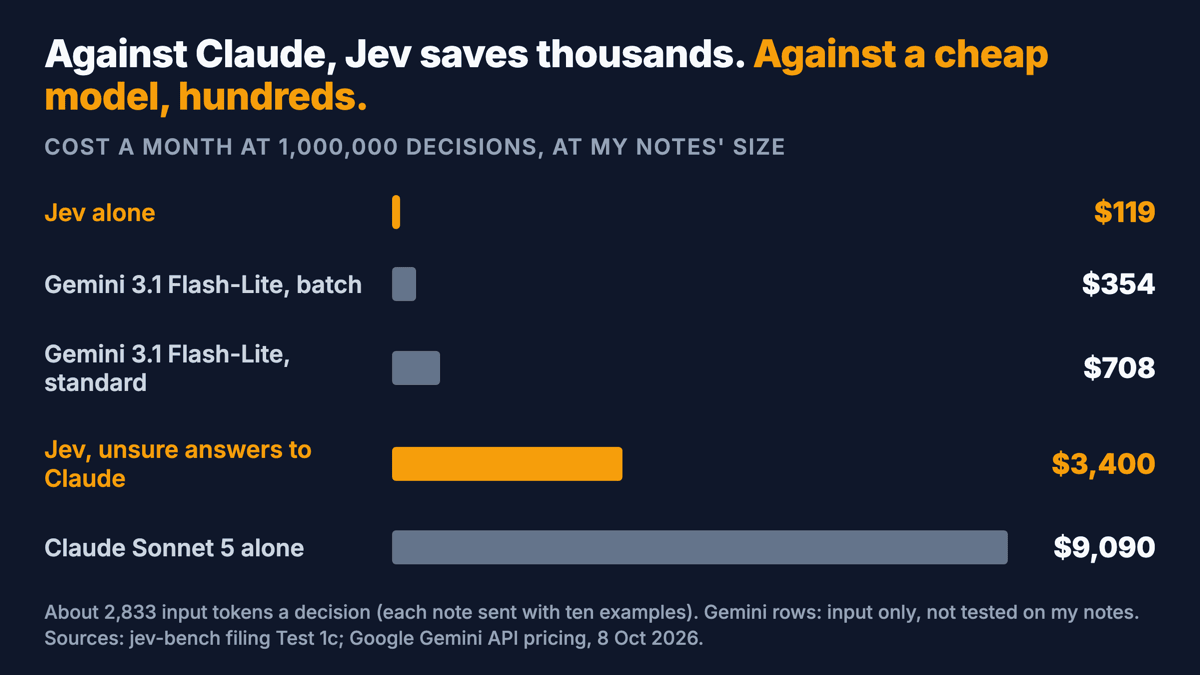
Per-note costs from Test 1c and Google's price list; the scaling is arithmetic.
Where the hype falls apart.
- Jev-only agents. An agent has to produce things: replies, code, the contents of an action. Jev can only choose from options you already wrote. TypeSafe's own docs say forcing it to generate text "will not work well and will be very slow".
- Anything with numbers or dates. Approving an invoice under a limit, checking a deadline. TypeSafe says keep the arithmetic in code.
- A security guard on its own. Its docs say Jev does not treat the text it reads as hostile by default. Use it as a cheap first filter, never the only lock on the door.
- Confidential data, by default. Zero data retention is offered to enterprise customers (models page). Check the terms in writing before client documents go anywhere near it.
The copies
Within a week, open-source projects copied the idea. None has Jev's weights. SemIf copies only how Jev is used; Kev also tries to rebuild the architecture Archer Hume described.
- Kev, by Jared Palmer (Apache 2.0): four sizes built on Alibaba's open Qwen models, the smallest small enough for a laptop. Its own tests put the largest, Kev-27B, at 85.1% against Jev's 85.7% on tasks it never trained on, which the README says is not a controlled comparison. It is candid about where it trails: on the harder knowledge benchmark MMLU-Pro it scores 67.5% to Jev's 84.0%. It says no Jev outputs were used in training (github.com/jaredpalmer/kev).
- SemIf, formerly OpenJev, by Theodore Lee (MIT licence): runs a 4-billion-parameter Qwen model at home or in a browser. It says outright that it copies the interface, not Jev's model. On 102 test items from TypeSafe's public tests it agreed with the reference 84.5% of the time, against Jev's published 88.3% (github.com/TheoLeeCJ/SemIf-OpenJev).
Every one of these numbers is the project's own. The Batch made the same point: without a shared public benchmark, they are hard to compare (The Batch). What they do settle is that the interface is easy to copy. The question is whether Jev's inside is.
Where this goes next
Three things will decide whether this is a new layer of software or a well-packaged classifier.
- Price. TypeSafe says it can't prove the price isn't subsidised (launch post), and its rate limits are marked as changing without notice.
- The copies. If Kev-style models close the last few points, anyone can run this on their own hardware.
- Independent results on real work. The two papers above are a start. Companies' own messy categories will matter more.
Five questions before you switch
WOULD JEV SAVE YOU MONEY?

1. Is it a choice from a list you can write down in advance?
   If the answer has to be written, it's the wrong tool.
   Add a "none of these" option if the list might miss.
   A question can offer at most 255 answers.
2. What does each decision cost you now, and how many a month?
   Multiply the saving per decision by the volume.
   If that won't pay for a second supplier and days
   of testing, stop here.
3. Is the rule in the text you'd send?
   If it lives in someone's head, give Jev examples,
   or expect it to lose. If you already have plenty of
   labelled examples, test a model you can train on them too.
4. Does it need maths, counting or dates?
   Do those in code. Give Jev only the judgement.
5. What happens when it's confidently wrong?
   Pin the model version, not "jev-latest".
   Decide which number you set the line on: Jev's
   confidence score is not the probability of its top
   answer, and yes-or-no answers don't have one.
   Test enough of your own items that it keeps at least
   59 answers; with none of them wrong, that is about
   the fewest that shows a 5% limit is met. Only then
   set the line, and send everything below it to a
   person or a bigger model.
Jev can't write, and that is the point. It is cheap enough to ask the same small question a million times. Whether that pays depends on what you pay for each answer now.