Thinking of buying a crypto trading bot? One year, 268 trades and $722 of profit say read this first
Jamie Watters
Operational resilience and AI delivery practitioner.
Who this is for. You've looked at a crypto trading bot, built one or been offered one, and you want to know whether a person on their own can make money with it. By the end you'll have the five numbers that decide that before the strategy does, and you'll know whether the country you live in lets you run one at all. About ten minutes.
Skip it if you trade for a living on a desk with institutional fees, or you're after a tip. There are no tips here, only a year of logged results and what they cost.
On the length. The argument is the first three sections: what the AI got wrong, why fees decide the sign, and where you can run one. The back half is the rule-based test, the five-number checklist, and two dates to watch.
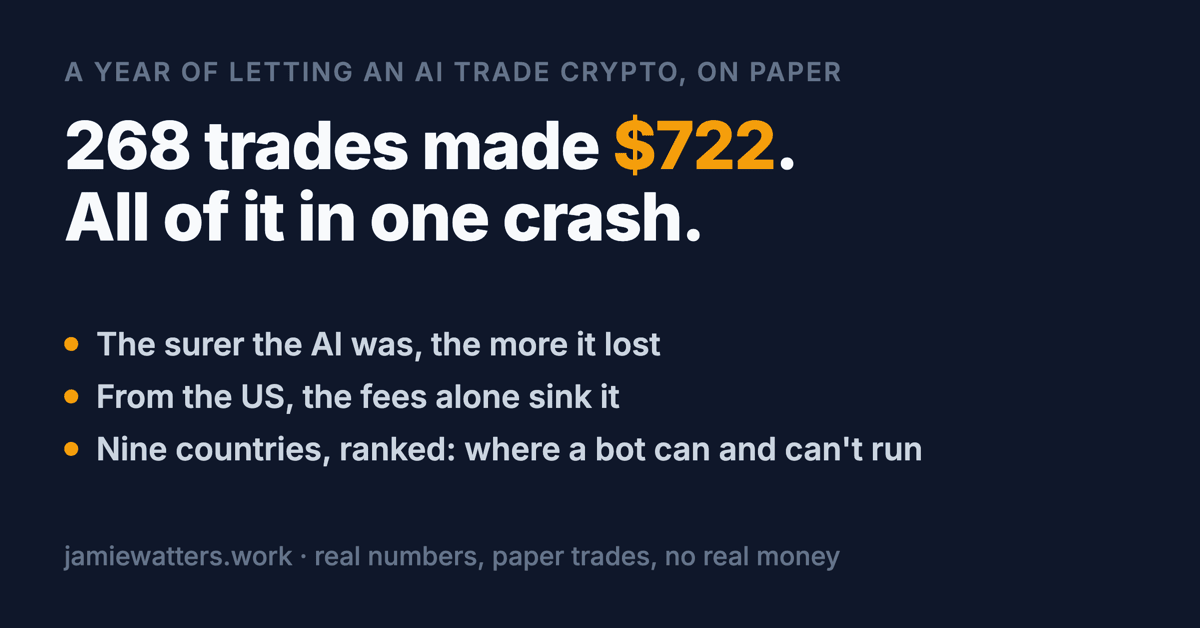
I let an AI pick my crypto trades for a year, in a system I call Trader-7. On paper, so nobody lost anything but time. It made 268 trades and finished $722 up before fees, and every dollar of that came from seven weeks in January and February when Bitcoin fell 10.8% one month and 15.7% the next and the system happened to be short. Across the other ten months it broke even or lost. The monthly result changed sign six times.
If you're thinking about building one of these, or paying for someone else's, here is what the year taught me, with the numbers. The short version: the strategy is the last thing that decides whether you make money. The first three are where you live, which exchange you can legally use from there, and how long you hold.
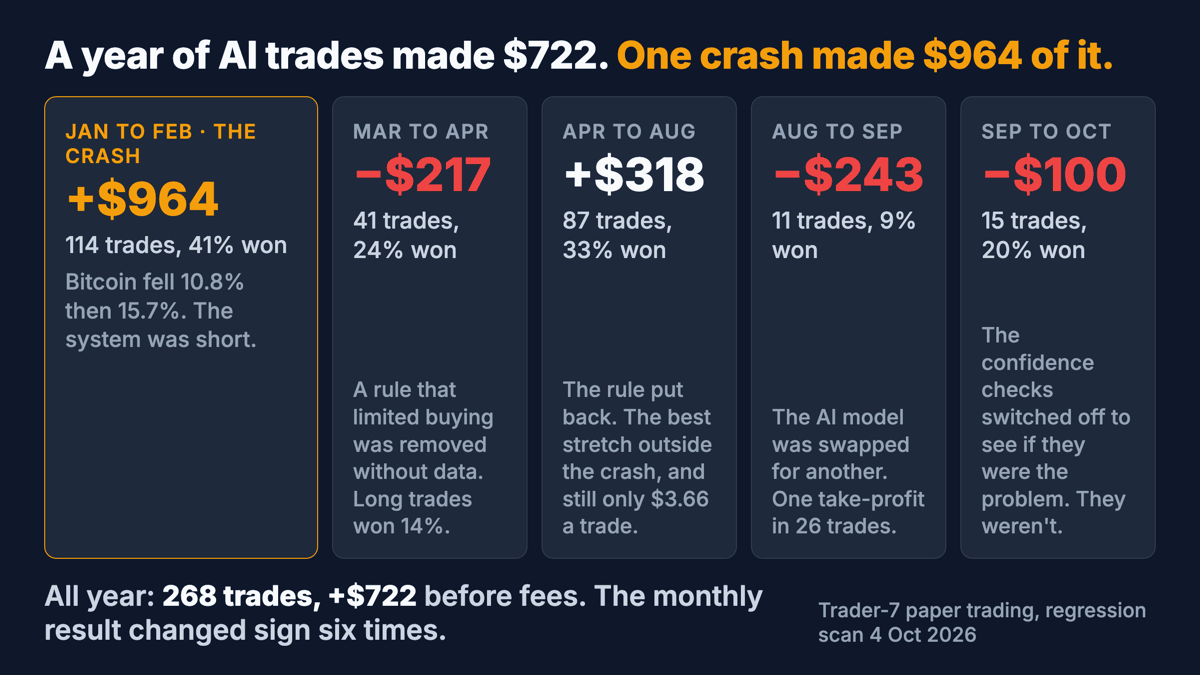
Where the year's $722 came from. Paper trades, before fees, from the Trader-7 regression scan of 4 October 2026.
What the AI was for, and what it was useless at
The system worked the way most of the ones you can buy work. Every hour a language model read the prices and the usual indicators for three coins and proposed a trade: entry, stop, target and a confidence score. A stack of checks downstream decided whether to take it. By October the stack in Trader-7 had grown to about 38 checks, each added by someone sure it was prudent.
The confidence score is the finding I'd put in front of anyone who thinks an AI can judge a trade. Over the months the main model ran in Trader-7, trades it rated under 60% confidence won 65% of the time. Trades it rated 72 to 80% won 17%. Trades it rated 80% and above won 7%. The surer it was, the more it lost, and the floor we had set at 72% confidence was quietly keeping the worst of them. When we swapped the model for a different one, the pattern held in the same direction.
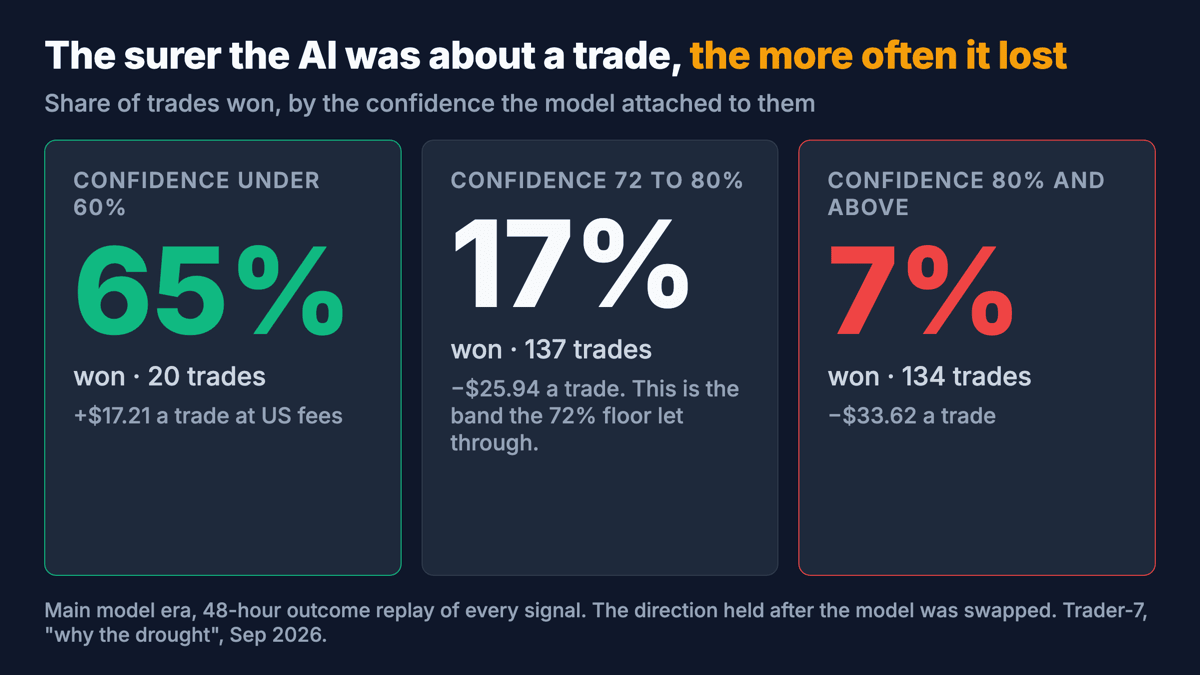
The surer the AI was, the more it lost. Win rate by stated confidence, main model era, from the Trader-7 drought analysis of September 2026.
It also recited numbers back at us. The Trader-7 prompt required a 2:1 reward-to-risk ratio, and 94.3% of the model's proposals cleared it, nearly all at exactly 2.0. The day we stopped stating the number in the prompt, 3.6% cleared it. Its honest estimate of reward to risk was about 1.05 to 1. It had been copying the pass mark out of the question.
And it changed under our feet. One swap of the signal model took the Trader-7 win rate from 33% over 87 trades to 15% over the next 26. A system whose edge lives inside a model has an edge that can vanish when the provider updates it, with no commit to show for it.
What the model was good at is reading: headlines, a scheduled event, an exchange incident. What it couldn't do was put a calibrated probability on a column of prices. The redesign I'm running now lets a model read the news and veto a trade on information the numbers can't see, and gives it no say in picking entries.
Fees decide the sign before the strategy does
My account is in the United States. From here, the one crypto futures venue a retail account can use is Coinbase's, and I had its fee rate wrong in the code by a factor of 3.33 for months. The real round trip, read off the Coinbase account's own fee tab, was 0.231% of the trade's value on Bitcoin, 0.298% on Ether and 0.235% on XRP. At the stop distances the system used, that's a quarter to a third of the risk on every trade paid to the venue before the market moves. The break-even win rate at the trades' real reward-to-risk and those fees was about 42%. The system's realised win rate over 94 trades was 30.9%.
The same trades on OKX, at 0.05% a side, or on Coinbase's own non-US perpetuals at 0.03%, would have paid the venue a tenth of that. The strategy didn't change. The country did.
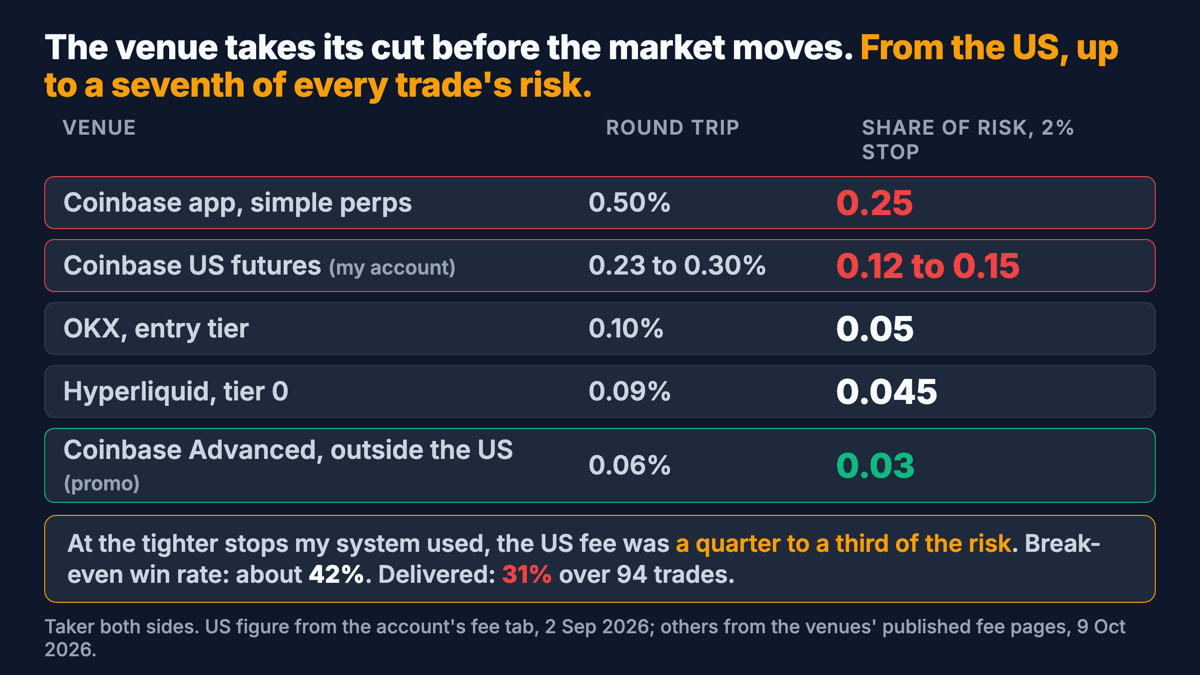
The fee as a share of the risk, at a 2% stop. The US figure is measured on my own Coinbase account; the others are the venues' published entry-tier rates on 9 October 2026.
The arithmetic is short. Your fee in risk units is the round trip divided by your stop distance. A 2% stop and a 0.06% round trip costs you 0.03 of your risk. The Coinbase app, at 0.25% a side, costs you a quarter of it. No strategy survives giving away a quarter of every trade.
There's a second cost I hadn't priced. Funding is the fee long positions pay to short ones every eight hours on a perpetual contract. When I later ran a rule-based system across six years of data, funding came to $6,061 against $896 in exchange fees, on the Trader-8 scorecard. Seven times the number I'd been optimising. The API bill for the AI version ran to $536 a year, 15.7% of the Trader-7 account, to pick trades at a frequency the fees could never support.
Where you live is the strategy
Because the venue decides the fee, and the country decides the venue, I checked nine countries for whether a person living there can use a cheap perpetuals exchange at all, and what the tax authority does to the gains. Official pages, October 2026: the venues' own restricted lists, the FCA, Numbeo for living costs. Ranked from worst to best.
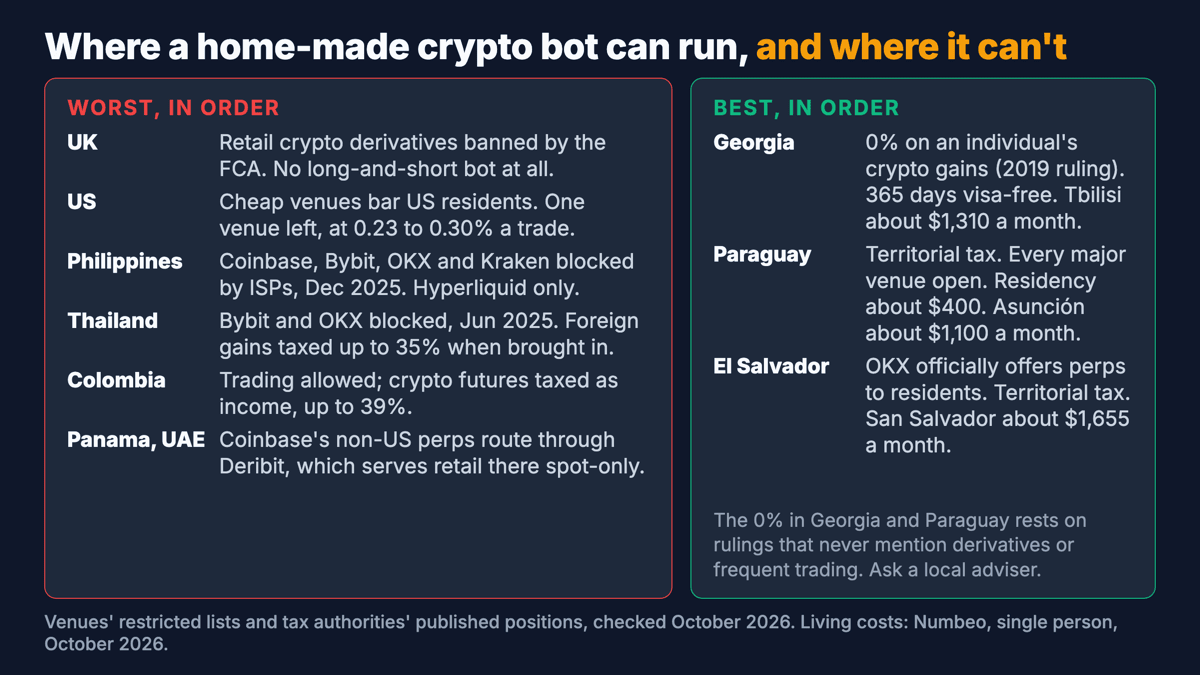
Nine countries, checked against the venues' restricted lists (OKX, Bybit, Kraken, Hyperliquid, Deribit) and the tax authorities' published positions, October 2026. The tax lines in Georgia and Paraguay rest on rulings, not statute.
The United Kingdom is the worst, and it isn't close: the FCA bans the sale of crypto derivatives to retail customers, so a UK resident cannot run a long-and-short bot on perpetuals anywhere. The United States is next. The cheap venues bar US residents, which leaves the one expensive one. The Philippines blocked Coinbase, Bybit, OKX and Kraken at the internet-provider level in December 2025. Thailand did the same to Bybit and OKX in June 2025 and taxes gains made on foreign venues at up to 35% when the money comes home; the tax break people quote applies only to Thai-licensed exchanges. Colombia lets you trade and taxes crypto futures as ordinary income at up to 39%. Panama and the UAE look fine until you find that Coinbase's non-US perpetuals now route through Deribit, which serves retail in both countries spot-only.
At the other end: El Salvador, where OKX officially offers perpetuals to residents and the tax system is territorial. Paraguay, territorial too, with every major venue open, residency for about $400, and Numbeo putting a single person in Asunción at about $1,100 a month. Georgia, with 0% on an individual's crypto gains under a 2019 ministry ruling, 365 days visa-free, and Tbilisi at about $1,310 a month on Numbeo. The catch in the last two is that the 0% rests on a ruling that doesn't mention derivatives or frequent trading, so get a local adviser before you believe it.
I'm not telling you to move. I'm saying that from London or New York the venue question is settled against you before you write a line of code.
The rule-based alternative, tested with the pass mark written first
So I replaced the AI with a rule and called the result Trader-8. Buy a breakout above the last 20, 40 or 60 days in the direction of the trend, sell one below it. Fifteen of the most liquid coins, 1% of the account at risk per trade, holds of days rather than hours. No model anywhere. Before running it on six years of data I wrote down what counted as a pass: a return-to-risk score above 0.6 on the years it hadn't been tuned on, most six-month windows positive, no drawdown worse than 35%.
It failed. The Trader-8 scorecard shows 0.32 over the whole period. It made 26% in 2021 and roughly nothing in any year since. That matches the published record: Gbadebo (2026), covering eight coins from 2020 to 2025, found a trend strategy making about 32% a year before costs with a 45% worst drawdown, nearly all of it before mid-2021.
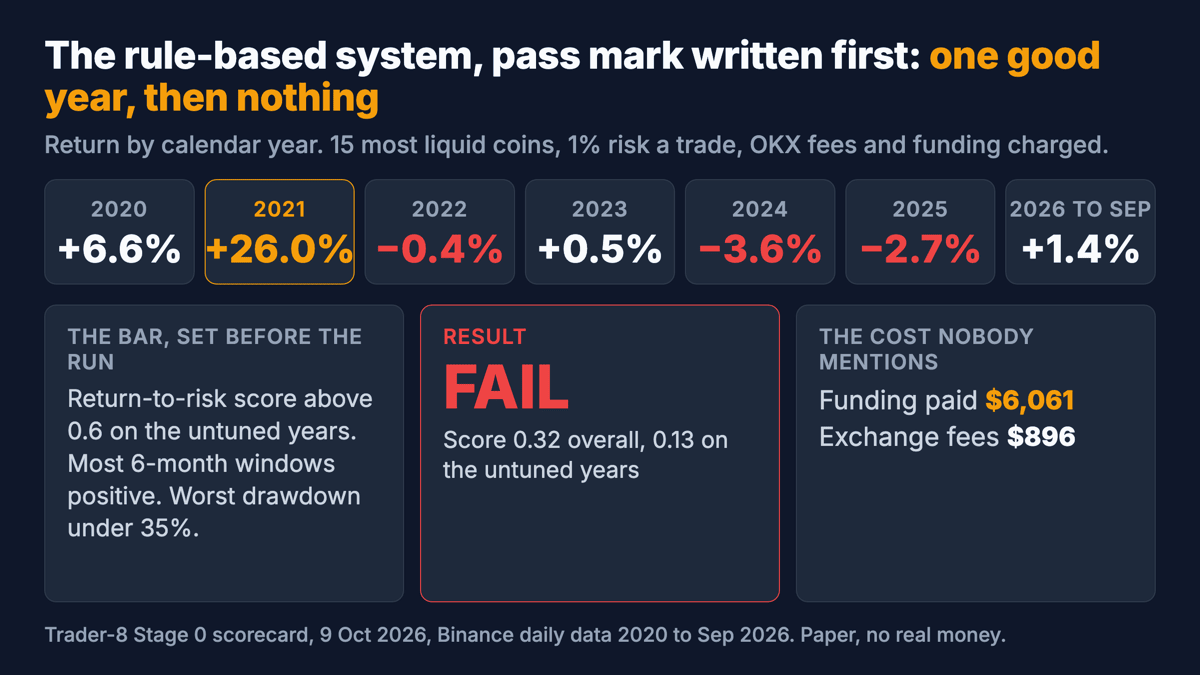
The rule-based system, 2020 to September 2026, 15 coins, OKX fees and funding modelled, from the Trader-8 scorecard. One good year.
Switching off every rule in turn showed two of them were costing most of the profit: a trailing stop that chased price and cut winners short, and no cap on how many same-direction bets could run at once. With those two changed, the same Trader-8 test scores 1.01 with a 12% worst drawdown. I don't trust that number, and neither should you, because I found those changes by looking at the answers. So the corrected version is running forward on live prices from 10 October, on paper, against a bar I wrote down before it started.
What a $5,000 account can honestly expect from this, if the forward run holds, is in the Trader-8 design note: at the score the test claims and a sensible risk setting, roughly $450 a year, with a plausible bad year of minus $1,500. That isn't income. It's a hobby with a kill rule, and the kill rule is the part most people building these never write.
Five numbers to get before you build or buy one
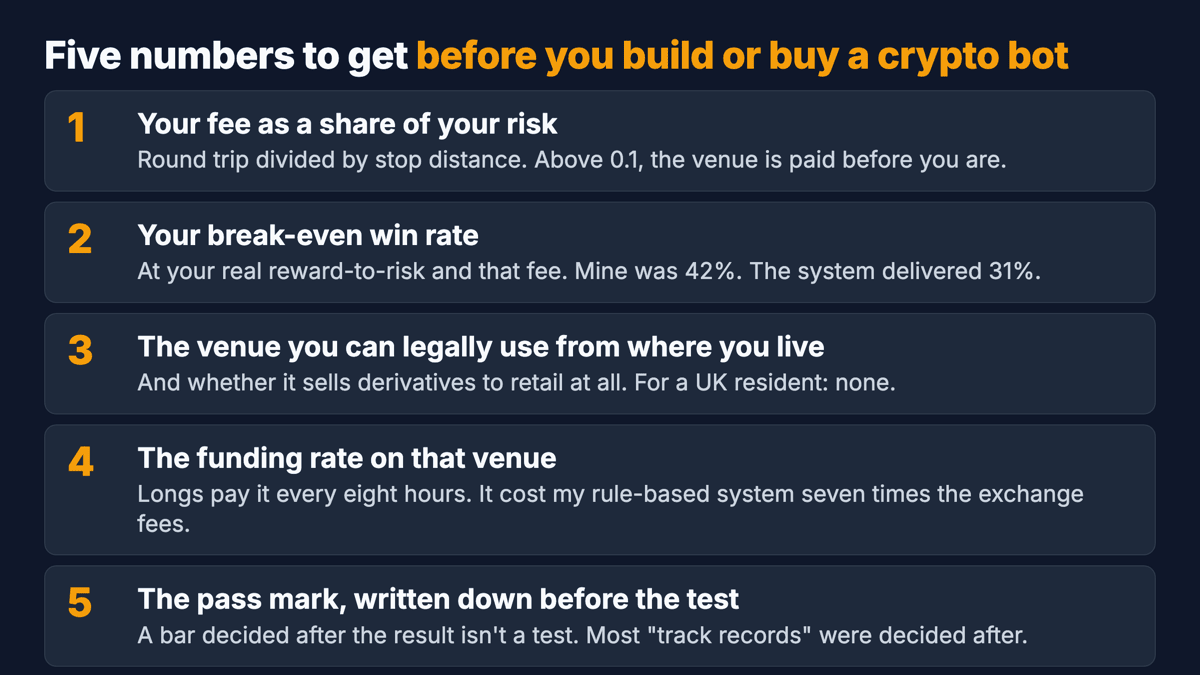
The five numbers. If a seller can't give you them for their bot, they don't know whether it makes money either.
- Your fee in risk units. The round trip, divided by your stop distance. Above 0.1 of your risk, the venue is being paid before you are.
- Your break-even win rate at your real reward-to-risk and that fee. On Trader-7 it was 42% and the system delivered 31%, and I didn't know either number for months.
- The venue you can legally use from where you live, and whether it will sell you derivatives at all. For a UK resident the answer is none.
- The funding rate on that venue. It cost the Trader-8 test seven times what the exchange fees did.
- The pass mark, written down before the test runs. If the bar is decided after the result, it wasn't a test, and most of what gets sold as a track record was decided after.
Two dates. On 30 November the Trader-7 AI system is judged: at 60 closed trades or on the day, whichever comes first, it's switched off unless it has made more than $7 a trade before fees. Outside the crash it hasn't come close: over the 98 trades from 19 April to 20 September it lost $1.14 a trade at a cheap venue's fees and $5.75 at the US venue's. On 31 January the Trader-8 forward run is judged against the bar it started with. I'll publish both results whichever way they fall.
The number to beat on 30 November is $7 a trade. The number to beat since April has been zero, and Trader-7 hasn't.
Sources
- Trader-7 regression scan, 4 October 2026, and the Trader-7 drought analysis, September 2026: working notes in the private Trader-7 repository (
insights/performance/regression-scan-2026-10-04.md,insights/strategy/why-the-drought-2026-09.md). The per-era figures, the confidence bands, the model-swap win rates and the 98-trade net per trade come from there. - Trader-7 cost structure note, 2 September 2026: the Coinbase US futures fee read from the account's fee tab, the 42% break-even and the 30.9% realised win rate.
- Trader-8 scorecard and design note, 9 October 2026:
trader8/results/stage0-2026-10-09/scorecard.md,trader8/results/stage0-v2-2026-10-09/scorecard.md,docs/ground-up-redesign-2026-10.md. - OKX fees: https://www.okx.com/fees · Hyperliquid fees: https://hyperliquid.gitbook.io/hyperliquid-docs/trading/fees · Coinbase Advanced perpetuals guide: https://docs.cdp.coinbase.com/coinbase-business/advanced-trade-apis/guides/perpetual · Coinbase app derivatives fees: https://help.coinbase.com/en/coinbase/derivatives/derivatives-fees
- Deribit restricted jurisdictions: https://support.deribit.com/hc/en-us/articles/25944487427741 · Coinbase Global Derivatives: https://help.coinbase.com/en/coinbase/derivatives/global-derivatives-get-started
- FCA ban on the sale of crypto derivatives to retail consumers (PS20/10, in force since January 2021): https://www.fca.org.uk/publications/policy-statements/ps20-10-prohibiting-sale-retail-clients-investment-products-reference-cryptoassets
- Philippines ISP block, December 2025: https://bitpinas.com/regulation/ntc-bsp-block/ · Thailand block, June 2025: https://www.coindesk.com/policy/2025/05/30/thailand-to-block-okx-bybit-and-others-citing-lack-of-license · Thailand exemption scope: https://www.forvismazars.com/th/en/insights/doing-business-in-thailand/tax/thailand-exempts-tax-on-digital-asset-gains · Colombia DIAN unified concept on crypto assets, 2023: https://www.dian.gov.co/normatividad/Documents/100202208-1621-Concepto-Unificado-Criptoactivos-17102023.pdf
- Georgia: https://ge.andersen.com/crypto-tax-georgia/ · Paraguay residency: https://migraciones.gov.py/residencia-temporal/ · El Salvador OKX products: https://www.okx.com/en-us/help/sv-products
- Numbeo cost of living, single person, October 2026: https://www.numbeo.com/cost-of-living/
- Gbadebo (2026), time-series momentum in cryptocurrencies, Vilnius University Press: https://www.journals.vu.lt/BATP/en/article/download/44540/42590/138419