Barclays is cutting about 5,000 jobs. Its boss calls AI "the icing on the cake". Check your own job the way a bank would
Jamie Watters
Ex-banker, founder at 58, building with AI.
On 22 October Barclays said it expects to have cut around 5,000 jobs by the end of 2026, about 5% of its staff (PA, via the Irish News). The headline on the Press Association story: "Barclays to cut 5,000 jobs this year as AI makes work more efficient".
Read on, though, and the bank's chief executive, CS Venkatakrishnan, tells a different story. The technology investment behind the cuts, he said, meant "modernising our platforms and harmonising our systems and having simpler and better processes", and "that is driving the bulk of the efficiency gains". AI, in his words, "is the icing on the cake", and "it's not the cake" (PA, via the Irish News, 22 Oct 2026).
So AI was the icing. The cake was the rebuild underneath: newer platforms, joined-up systems, simpler processes. And most of the reductions, PA reported, were in "operational and functional roles".
If you work in an office, that's the line worth reading twice. What changed first was the work: how it's done, on what systems, in how many steps. Which means the question "is my job safe?" can't be answered from your job title. Your task list tells you more: which part of your week is exposed, and which part the business needs you for.
Why this month's headlines can't answer it
Barclays wasn't alone. On 4 November Canva's chief executive, Melanie Perkins, wrote to staff. Some 1,271 people, 22% of the workforce, will lose their jobs, change roles or move to central hubs. She didn't say how many would go. She did say, Bloomberg reported, that there will be fewer niche specialisations (Bloomberg, via The Star, 5 Nov 2026).
You're not imagining the worry, either. When Pew surveyed 5,273 employed Americans in October 2024, about half (52%) said they were worried about the future impact of AI use in the workplace (Pew Research Center, 25 Feb 2025).
But a headline about a company tells you nothing about your Tuesday. Neither does a list of "the jobs AI will replace". Two people with the same job title can spend their weeks on completely different work. One of them is exposed. The other might not be.
I learned to ask the better question somewhere unglamorous.
The check a bank runs
For much of my career I worked in business continuity in banking: the people who plan for the day a building, a system or a supplier goes down. I've run several hundred Business Impact Analyses, across retail, wholesale and investment banking.
A Business Impact Analysis is a structured analysis of a business to identify its processes and resources and assess how critical each one is. In practice, you sit down with a team and ask three things about everything it does. What is the process? What does it depend on: people, systems, information, suppliers? And if it stopped, how long before it hurt, and who would feel it?
A BIA doesn't ask "is this department important?" That question has no useful answer. It breaks the department into pieces and scores each piece. The result is a ranked list, and the department's priorities are in the list, not in its name.
Put "job" where it says "department" and you have the question behind this month's headlines. The bank's answer is the same: score the pieces. And it turns out that's how the researchers measure AI's reach too.
Anthropic does the same sum on 800 jobs
Anthropic makes the Claude AI models. In March, two of its economists published a new way of measuring which jobs AI is reaching (Massenkoff and McCrory, 5 Mar 2026). They don't start from jobs. They start from tasks, using O*NET, a US database that lists the tasks of around 800 occupations. Their example: "AI can grade homework but not manage a classroom".
They score each task twice. First, could an AI model in theory make it at least twice as fast? Second, are people actually using Claude to do it at work? Then they add the tasks up for each job, weighted by how much of the working week each task takes.
The gap between the two scores is the part to notice. In Anthropic's study, AI could in theory speed up 94% of the tasks in computer and maths jobs, and 90% in office and admin jobs. In computer and maths, Claude's real use covered 33%. Computer programmers topped their list at 75%. At the other end, 30% of workers had no coverage at all in Claude's data: cooks, bartenders, lifeguards.
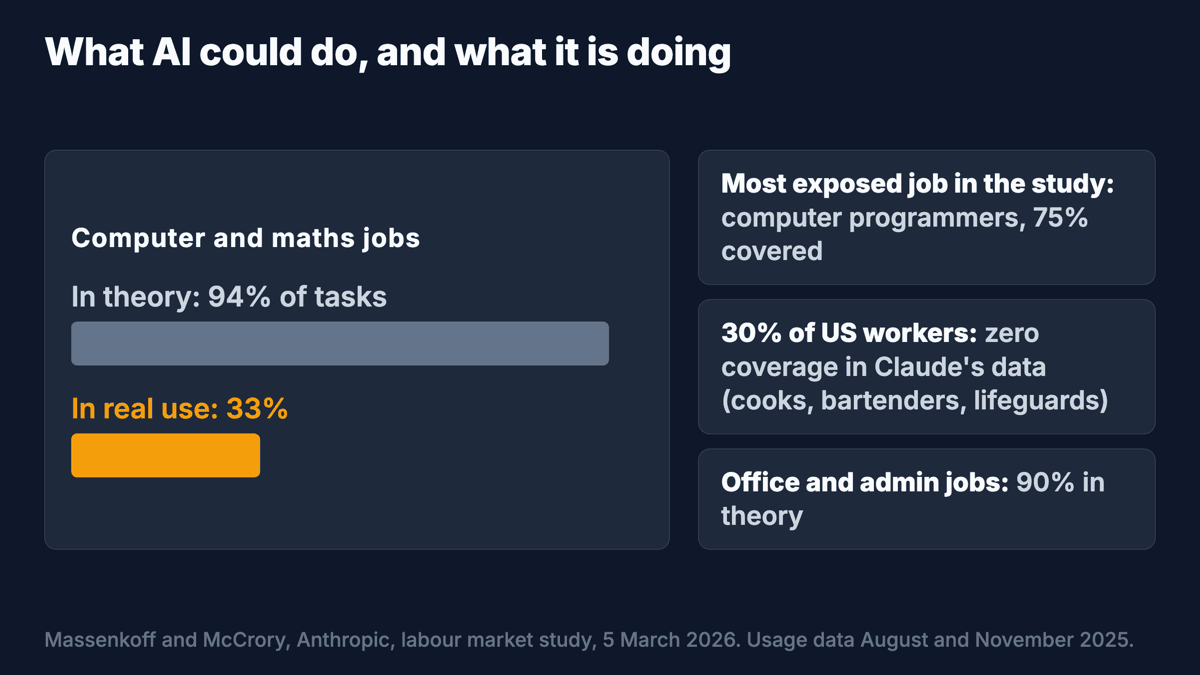
What AI could do against what it is doing, from Anthropic's own usage data. The gap is work AI could speed up but isn't yet doing.
And what has it done to jobs so far? Less than the headlines suggest. Anthropic's authors found "no systematic increase in unemployment for highly exposed workers since late 2022". The one warning sign is at the door: for 22 to 25 year olds, the rate of starting a job in highly exposed occupations fell 14% against 2022, a result the authors call "just barely statistically significant".
So far, in this data, the one warning sign is fewer young people starting jobs in exposed work, not more unemployment among the people already in it. That's a window, not a guarantee. Barclays shows the processes can be simplified out from under people already in post.
The job impact check
Here is the bank's check, turned on one job: yours. The three questions come from the BIA; weighting by time is how Anthropic's researchers add tasks up. The prompts, and the two numbers at the end, are mine.
1. List your tasks. Take a normal fortnight, not a quiet one. Write down every distinct thing you do: "reconcile supplier invoices", "answer queries from the regional team", "write the monthly risk report". Next to each, the rough share of your time it takes. Together the shares should cover the whole fortnight.
2. What does each task depend on? Systems, documents, other people. Then the part that matters most: what does it need from you that isn't written down anywhere? A judgement call you're trusted to make. A relationship someone outside the team values. A sign-off you're accountable for. Knowledge of why things are done the way they are. If a task is part routine, part judgement, split it in two.
3. How critical is it? If this task stopped for a week, who would notice, and what would it cost? Mark it critical if the answer is money, a customer or a broken rule. If a weekly task could stop for a month without anyone missing it, it won't be missed when it's automated either.
4. Could AI do it? Is it mostly reading, writing, summarising, sorting, looking things up, entering data or answering routine questions at a screen? Could you describe it in an email to a stranger and get it back done? If yes, mark it exposed, even if your workplace hasn't tried it yet.
5. Add it up. Total the time share of the tasks you marked exposed in step 4 that need nothing from you in step 2. That's your first number: the exposed share of your fortnight, weighted by time the way the researchers weighted theirs. Then total the share of tasks that are critical in step 3 and need you in step 2. That's your second number: critical work that, today, depends on you. Whatever is left over, exposed but needing you, is work AI is more likely to help with than take over.
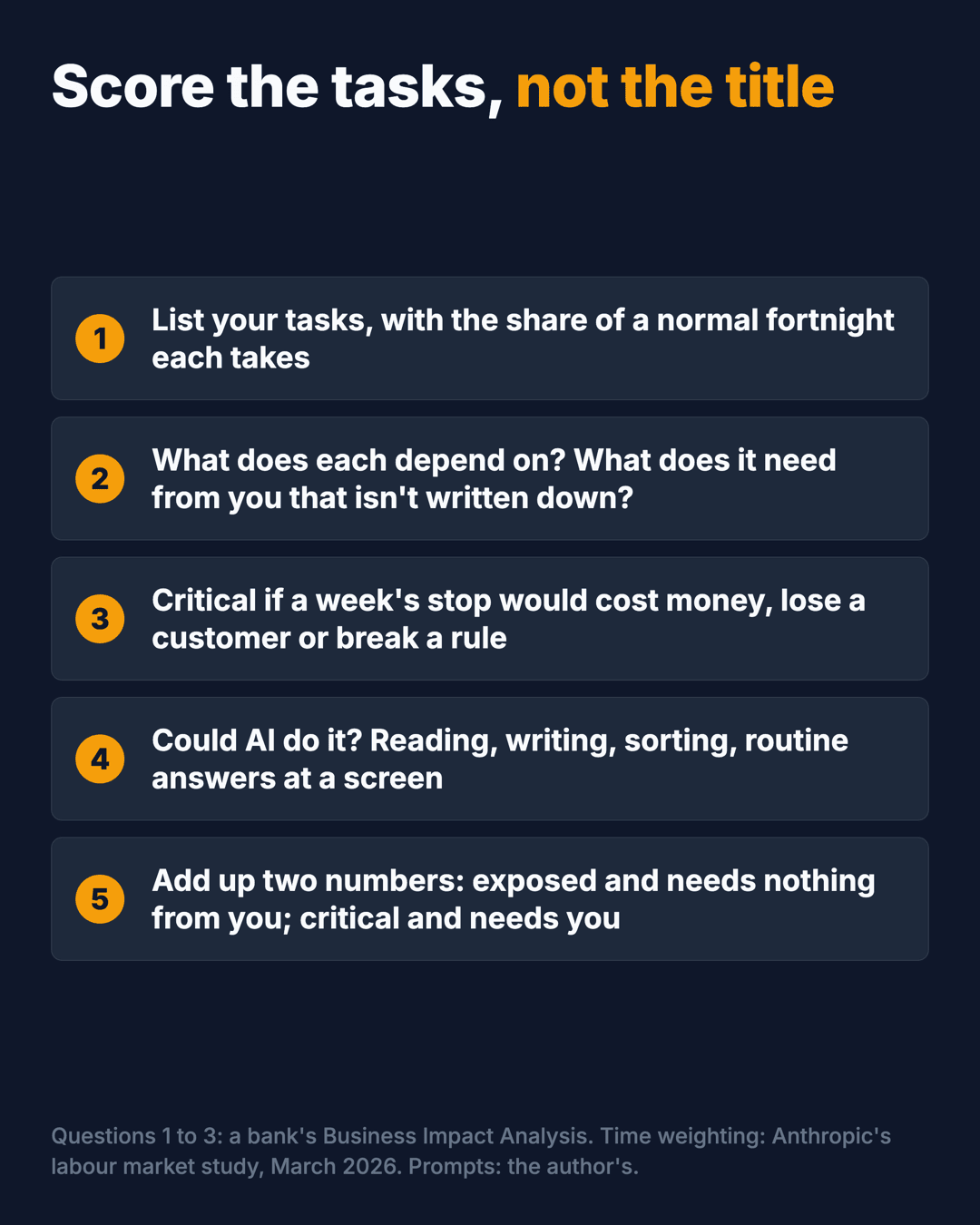
The check as a card, to keep or screenshot. Same five steps as the block above.
Reading what you find
To show the shape, here is an invented example: an accounts payable clerk. She spends half her week matching invoices to orders. A fifth goes on answering supplier queries, and another fifth on chasing approvals from managers who know her. The rest is fixing payments that went wrong.
Matching invoices is exposed and needs nothing from her: that's half her week on its own. Supplier queries are exposed too, unless the answers depend on knowing the supplier. Chasing approvals and fixing failed payments are the opposite. Both are critical if they stop, and both run on her judgement and her relationships. In this invented example, her first number is 50%, or 70% if supplier queries need nothing from her. Her second is 30%. Those two numbers say more about her job than any "jobs at risk" list.
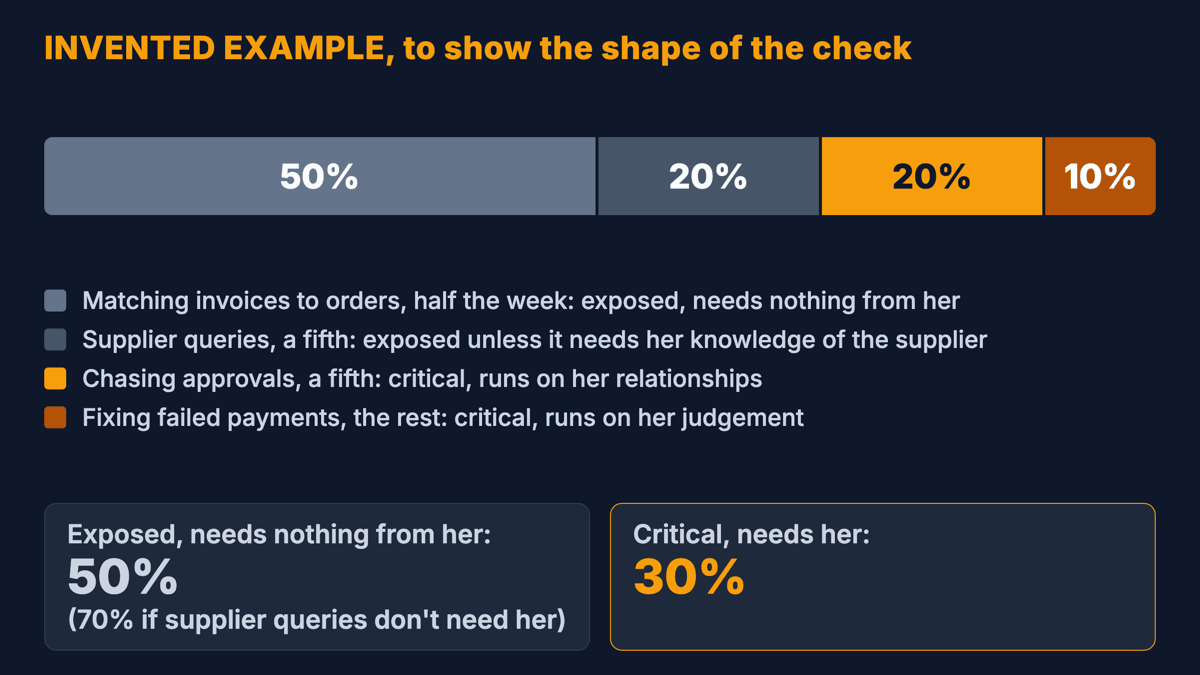
An invented example. Your own list will look different, and that's the point.
If your first number is high, it doesn't mean you're out. It means that part of your week is the part most exposed to change. Two things follow.
Move your time towards the second number. Those are the tasks a BIA marks as critical. Agree with your manager to take on more of them, and make sure the people who decide on roles can see you doing it.
And volunteer for the AI that comes for the first number. If your company brings AI into that work, someone has to set it up and show whether it worked, and the person who knows the task best is you. I wrote about what that skill is worth in a piece on an AI job paying up to $380,000 that writes no production code.
Barclays' chief executive called AI the icing, and the rebuilt platforms, systems and processes the cake. Your job is a set of processes too. Score them, and you'll know which part of your week is most exposed, and which part the business needs you for.