OpenAI's Texas data centre is built to barely use water. The power plants it runs on use 300 times more water than it does
Jamie Watters
Operational resilience and AI delivery practitioner.
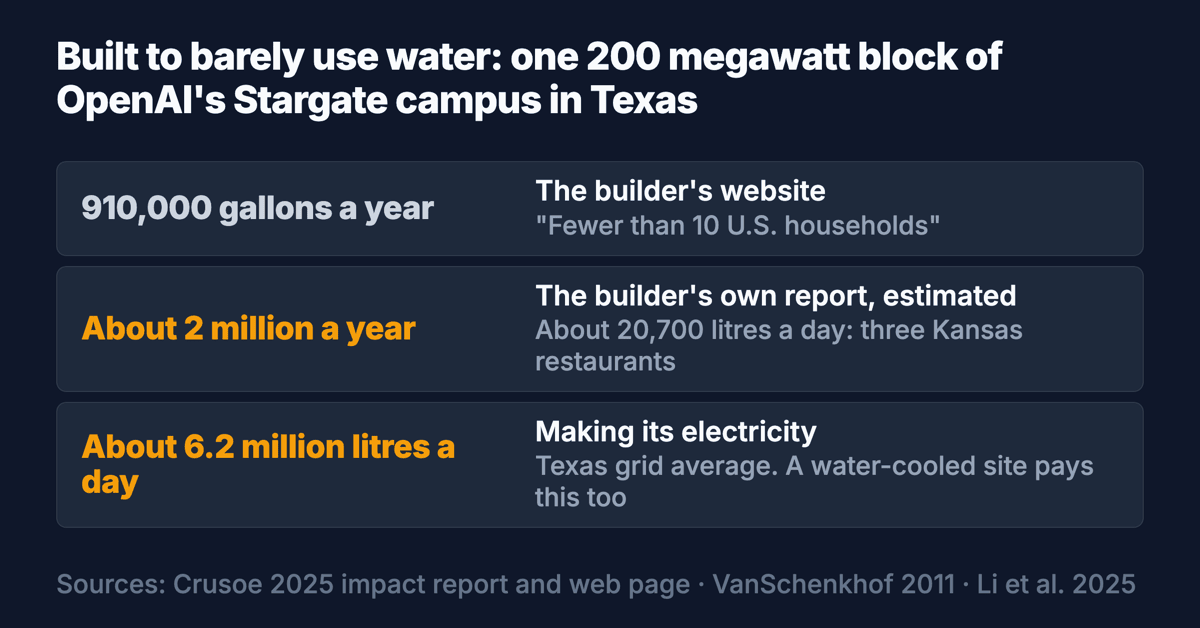
Crusoe builds the Stargate campus in Abilene, Texas, which Oracle runs for OpenAI (DCD). It says on its website that a 200 megawatt block uses about 910,000 gallons of water a year, "comparable to fewer than 10 U.S. households" (Crusoe, impact report web page). The full report that page links to says something else. "At a 200 MW facility, total annual water use ... is estimated to be approximately 2 million gallons per year, comparable to the annual water use of fewer than 20 U.S. households" (Crusoe 2025 Impact Report, p. 28).
Same company, same 200 megawatts, two numbers. One is more than twice the other.
The bigger one is still small. Two million gallons a year is about 20,700 litres a day. A casual-dining restaurant in Kansas gets through about 6,700 litres a day, on utility records for 221 of them (VanSchenkhof, 2011). So a 200 megawatt block of Stargate uses about as much water as three restaurants. The restaurant is my comparison, not Crusoe's. Crusoe compares itself to households, and to "any office or warehouse of similar size".
In the previous piece I traced the per-prompt water numbers back to where they came from. One was the bottle of water per 20 questions, which its own authors withdrew (AI water use: the bottle per 20 ChatGPT questions was withdrawn by its own authors). I also said what I believed about the buildings: that data centre cooling is mostly a closed system, and the water actually used up is small. This piece tests that. It's wrong for the fleet that exists and right for the newest designs. And the biggest water number isn't in the building at all.
The fleet that exists
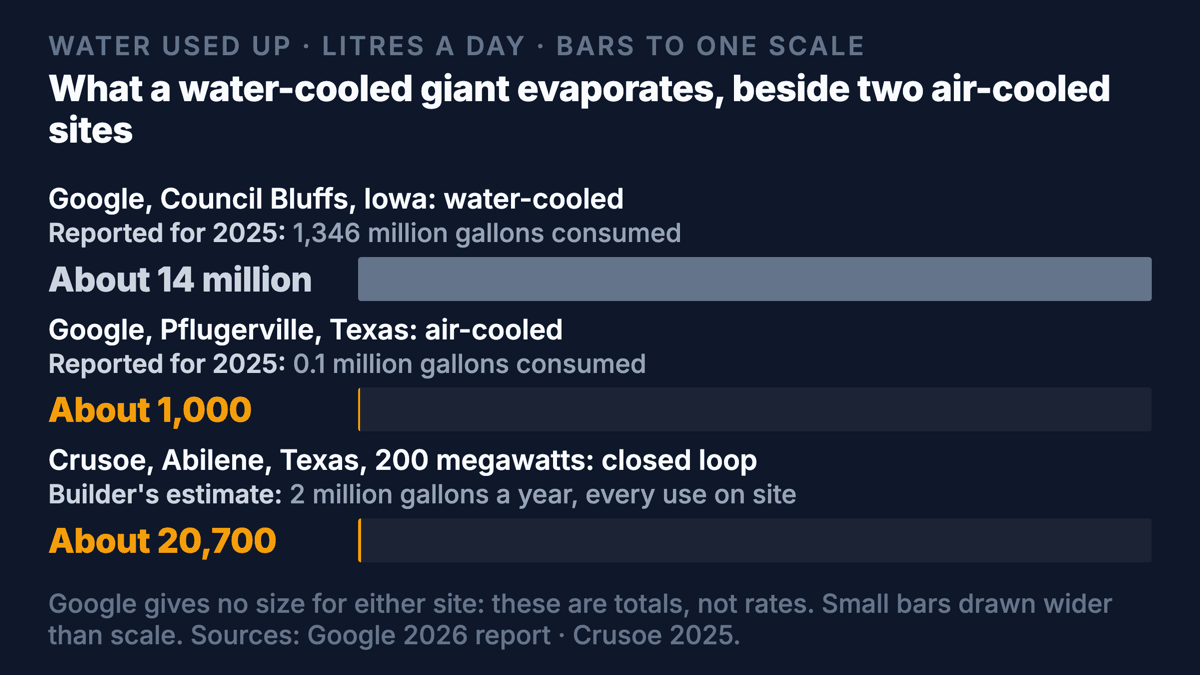
Google publishes water figures for each of its data centres, in a table at the back of its environmental report. Its Council Bluffs, Iowa site withdrew 1,746 million gallons in 2025 and consumed 1,346 million of them: evaporated, not returned (Google 2026 Environmental Report). That's about 14 million litres a day used up, at one site, reported for a year that has happened. The same table lists an air-cooled Google site in Pflugerville, Texas: 0.1 million gallons consumed in 2025, about 1,000 litres a day. Google doesn't give the size of either site, so the gap isn't all down to cooling. But it shows what a water-cooled giant evaporates. Google says water cooling "requires less energy than air-cooling technologies", and its freshwater consumption rose 37 per cent in 2025.
That's one company. For the whole country, Lawrence Berkeley National Laboratory puts the direct water consumption of US data centres at 66 billion litres in 2023, 84 per cent of it at hyperscale and colocation sites (LBNL, December 2024). Its modelling finds plenty of ways to save water, then says "the indispensable role of evaporative cooling in dissipating internal heat from IT devices remains evident, therefore contributing to significant water consumption" (p. 44). Its average for the whole fleet is just over 0.36 litres of water per kilowatt-hour of computing.
So "mostly a closed system" is wrong for the buildings running today. Many of the big ones evaporate water on purpose. LBNL says why: evaporative systems "are generally more energy efficient than an air-cooled chiller", and "while air-cooled chillers use no water, they use more energy" (p. 45). Evaporating water saves electricity.
The efficient ones
The newest designs are different, and Crusoe isn't alone. Microsoft says every data centre it has designed since August 2024 "consumes zero water for cooling", with the first sites coming online in late 2027 (Microsoft, December 2024). Its Fairwater site in Wisconsin runs over 90 per cent of its capacity on a closed loop that takes water "only once during construction"; the rest switches to water on the hottest days (Microsoft, September 2025). In June 2026 Satya Nadella said a new Microsoft data centre uses "roughly" what "a single restaurant would use" (PCMag via Yahoo Tech, June 2026).
Here's why that's possible. Cooling the chip doesn't use water up: the liquid goes round a sealed loop. The water question is where the heat leaves the building. A cooling tower gets rid of heat by evaporating water, about 80 per cent of what it takes in (Li and colleagues, 2025). An air-cooled chiller blows it away with fans, and evaporates nothing. That's Crusoe's design: "The heated liquid is then cooled by air-cooled chillers and recirculated. No water is evaporated" (Crusoe report, p. 29).
So where do Crusoe's 2 million gallons go? Its own breakdown, for 200 megawatts (p. 28):
- Cooling top-up: about 54,000 gallons a year. That's what the Kansas restaurant uses in about a month.
- Kitchens, restrooms and break areas: about 460,000 gallons.
- Equipment cleaning and facility upkeep: about 1.4 million gallons.
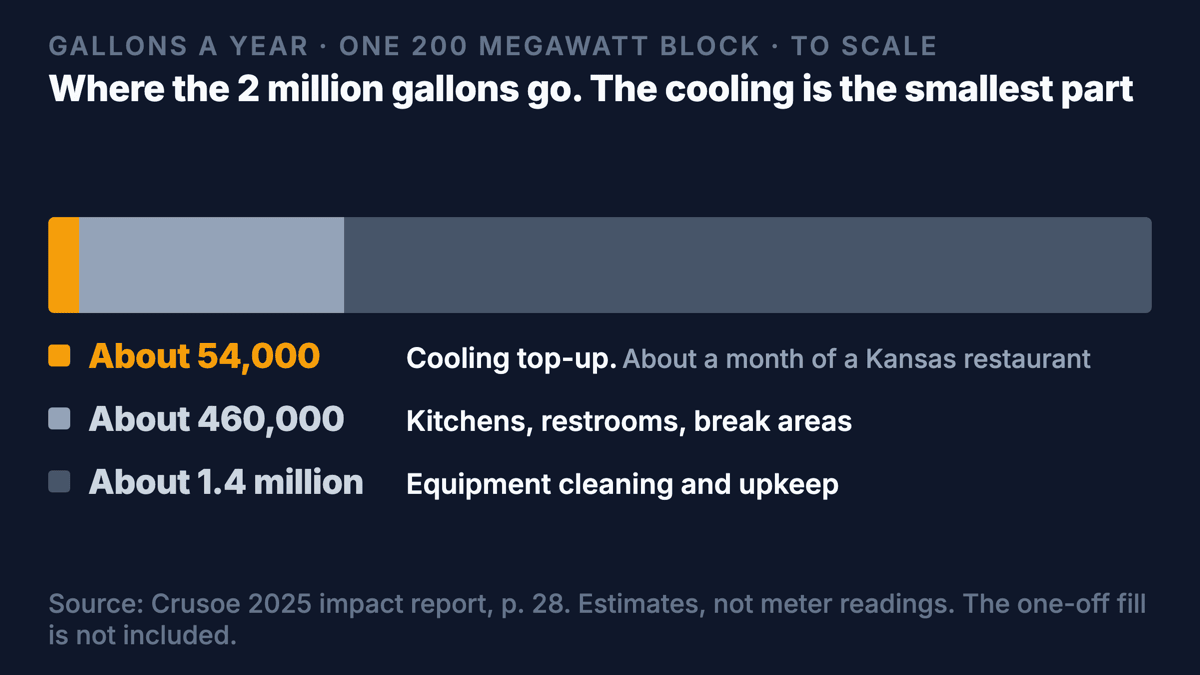
The cooling is the smallest part. Most of the water is people and cleaning.
Two labels to keep on these numbers. They're estimates: the report's words are "estimated" and "expected", and it gives no metered figure for any site. The first two Abilene buildings were handed to the tenant in mid-2025, and the report covers 2025, so a measured figure could exist. It isn't published. And none of them includes the one-off fill. Crusoe gives that three ways. Its 2025 site tour says one million gallons per building (Crusoe, August 2025). The report's text says 1.7 million for a whole 200 megawatt data centre. The same report's index says 1.7 million per building. Somewhere between 850,000 and 1.7 million gallons a building, spent once, then reused for up to 15 years.
The power plants
Electricity has water in it. Power plants that burn fuel need cooling, and hydroelectric reservoirs lose water to evaporation (LBNL, p. 56). LBNL's figure for the water consumed generating US data centres' electricity in 2023 is nearly 800 billion litres, twelve times the 66 billion they consumed on site (p. 57). It's a model, built on the average mix of each regional grid, not a measurement at any plant.
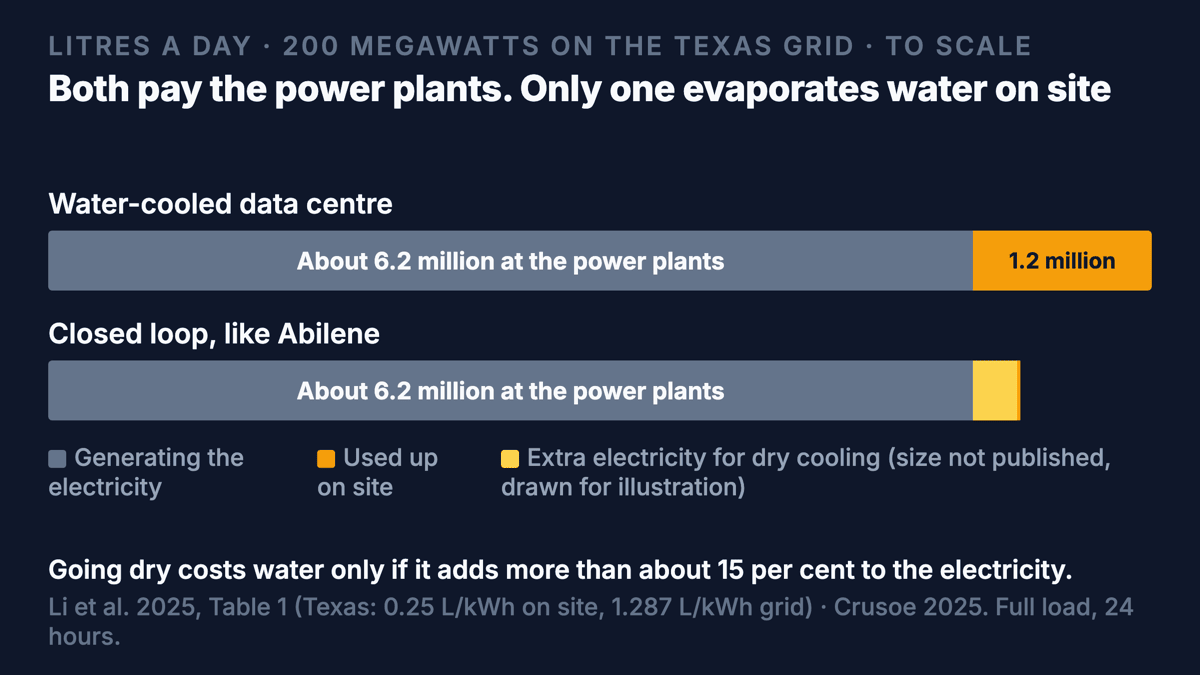
Do the same for one Abilene block. Run 200 megawatts flat out for a day and it draws 4.8 million kilowatt-hours. The Texas grid average is 1.287 litres of water consumed per kilowatt-hour: a World Resources Institute figure from 2020, used by Li and colleagues (2025 revision). That's about 6.2 million litres a day at the power plants. If the 200 megawatts is the computing load rather than the whole site, add Crusoe's design overhead of 1.2 to 1.4 and it's 7.4 to 8.6 million. That's 300 to 400 times what the block uses on site.
Two caveats. That's the grid average, not the plants that actually serve Abilene. And Abilene has its own 350 megawatt gas plant on site for backup (Crusoe report, p. 17), which the grid average doesn't see.
Now the part I got wrong in the first version of this piece. I wrote that a closed loop "moves the water bill from the site to the grid". It doesn't. A water-cooled data centre of the same size in Texas runs on the same grid and pays nearly the same 6 million litres. The power plants' water belongs to the electricity, not to the cooling. What the closed loop changes is two things: it stops evaporating water on site, and it uses a bit more electricity to do it.
So which is bigger? Li and colleagues give Microsoft's Texas data centres an on-site rate of 0.25 litres per kilowatt-hour. For a 200 megawatt water-cooled site that's about 1.2 million litres a day evaporated on site, against Crusoe's 20,700. Going dry costs water only if the extra electricity is more than about 15 per cent, my arithmetic on Li's Texas figures. Microsoft says its zero-water design costs "a nominal increase in our annual energy usage". On the numbers that exist, in Texas, the closed loop most likely cuts total water. Neither Crusoe's report nor Li's paper has a measured comparison, so I can't settle it.
The test, for the next data centre water number you hear
Start with a water figure for a data centre, from anyone: a company, a podcast, a headline.
- Measured, estimated or designed? Look for the word. Crusoe's say "estimated" and "expected". Google's table reports a year that has happened. A year in a table doesn't prove anyone measured it, so read the method note too.
- What does it count? Cooling only, or every tap? Does it include the one-off fill? Crusoe's 54,000 gallons is cooling. Its 2 million is everything on site. The fill is separate.
- Taken in, or used up? Withdrawal is water drawn from the supply. Consumption is the part that doesn't come back, mostly through evaporation. Council Bluffs withdrew 1,746 million gallons and consumed 1,346 million.
- Per what? A building, a 200 megawatt block, a whole campus? Two totals without sizes can't be compared, which is why Council Bluffs against Pflugerville proves less than it looks.
- Where does it stop? At the fence, or at the power plants? And if the power plants: how much would any data centre of that size pay, and how much is down to the cooling?
Pass: each label stated by a source you can name. Repeat the number with its labels. Fail: any one missing. Say "the company says", and say what's missing.
Run it on Crusoe's number. Estimated, not measured. Everything on site, but not the fill. The report doesn't split taken in from used up. Per 200 megawatt block, and the campus is 1.2 gigawatts. And it stops at the fence. Three of the five labels are in Crusoe's report. Its web page has two, and the smaller number.
Crusoe's website says 910,000 gallons. Its report says 2 million. Neither says what the power plants use, and that's the biggest number in this piece. It's also the one the closed loop changes least.
Corrected 2 October 2026. The first version used Crusoe's website figure of 910,000 gallons, not its report's 2 million. It credited Crusoe with a restaurant comparison that is mine, and quoted the wrong sentence from the LBNL report. It also said a closed loop moves the water bill to the grid, which this version explains is wrong. The title and the figures changed with it.
Sources
- Crusoe, 2025 Impact Report (PDF, report dated 15 September 2026): p. 17 Abilene panel (8 buildings, 206 MW commissioned, 350 MW on-site gas backup, ~54,000 gallons cooling maintenance per building per year); p. 28 water section (about 2 million gallons a year for 200 MW, "fewer than 20 U.S. households", breakdown 54,000 / 460,000 / 1.4 million, 1.7 million gallon initial fill); p. 29 case study ("No water is evaporated", "office or warehouse of similar size", 15 years); the GRI index (1.7 million gallons per building); delivery to the tenant in mid-2025; design PUE 1.2 to 1.4 with IT load as the denominator. https://cdn.prod.website-files.com/6855c1aa175582ee23e0aa19/6aa975443d2a8405e214f067_Crusoe_2025_Impact%20Report2_web_optimized.pdf
- Crusoe, "Crusoe's 2025 impact report" web page, dated 28 May 2026, updated 15 September 2026; 910,000 gallons and "fewer than 10 U.S. households". https://www.crusoe.ai/resources/blog/crusoes-2025-impact-report
- Crusoe, the Abilene site tour, 5 August 2025, updated 18 August 2026; one million gallon fill per building, air-cooled chillers. https://www.crusoe.ai/resources/blog/an-inside-look-at-the-abilene-ai-data-center
- Matthew VanSchenkhof, "An investigation of water usage in casual dining restaurants in Kansas", PhD dissertation, Kansas State University, 2011; 1,766 gallons a day per restaurant, utility records for 221 restaurants. https://krex.k-state.edu/items/9e85557f-1009-48d5-b610-2711a8237cad
- Google, 2026 Environmental Report (calendar 2025 data); the per-site water table (Council Bluffs; Pflugerville, Texas, marked air-cooled) and the narrative on water cooling and the 37 per cent rise in freshwater consumption. https://sustainability.google/files/google-2026-environmental-report.pdf
- Lawrence Berkeley National Laboratory, the 2024 United States data centre energy usage report, LBNL-2001637, December 2024; p. 44 to 45 cooling, p. 47 average site WUE, p. 56 to 57 indirect water and method. https://eta-publications.lbl.gov/sites/default/files/2024-12/lbnl-2024-united-states-data-center-energy-usage-report_1.pdf
- Pengfei Li, Jianyi Yang, Mohammad A. Islam, Shaolei Ren, "Making AI Less 'Thirsty'", arXiv 2304.03271 v5, 26 March 2025; section 2.2.1 on cooling and Table 1 (Texas: PUE 1.28, on-site WUE 0.25 L/kWh, grid factor 1.287 L/kWh, the grid factors taken from Reig and colleagues, World Resources Institute, 2020). https://arxiv.org/abs/2304.03271v5
- Microsoft, "Sustainable by design: next-generation datacenters consume zero water for cooling", 9 December 2024. https://www.microsoft.com/en-us/microsoft-cloud/blog/2024/12/09/sustainable-by-design-next-generation-datacenters-consume-zero-water-for-cooling/
- Microsoft, "Inside the world's most powerful AI datacenter", 18 September 2025. https://blogs.microsoft.com/blog/2025/09/18/inside-the-worlds-most-powerful-ai-datacenter/
- PCMag via Yahoo Tech, Satya Nadella at Microsoft Build 2026 on the single-restaurant comparison, updated 4 June 2026. https://tech.yahoo.com/ai/copilot/articles/microsoft-ceo-data-centers-same-164251795.html
- DatacenterDynamics, on Crusoe's Abilene campus going live for Oracle and OpenAI's Stargate. https://www.datacenterdynamics.com/en/news/crusoes-abilene-data-center-officially-live-serving-oracle-and-openais-stargate/
- Jamie Watters, "AI water use: the bottle of water per 20 ChatGPT questions was withdrawn by its own authors in 2023", the previous piece. https://jamiewatters.work/journey/ai-water-claims-checked