The AI you use gets through less water in a day than you do. So where did 'AI is draining the water supply' come from?
Jamie Watters
Operational resilience and AI delivery practitioner.
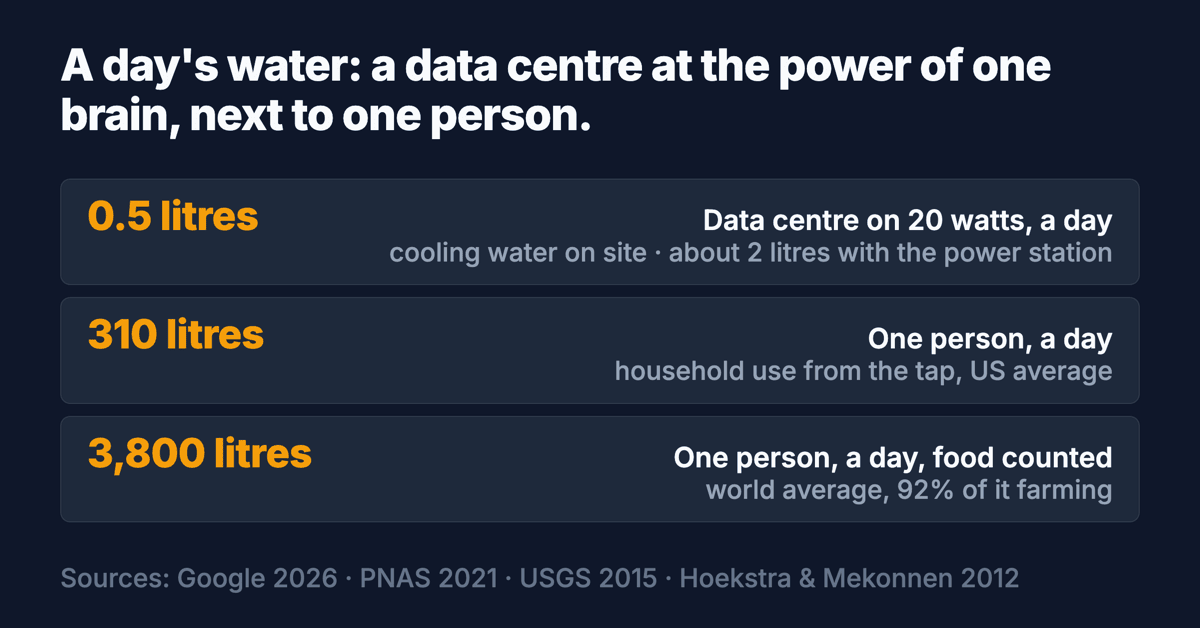
Run a data centre at the power of one human brain and it evaporates about half a litre of water a day. The person whose brain that is drinks, washes and eats their way through thousands of litres in the same day.
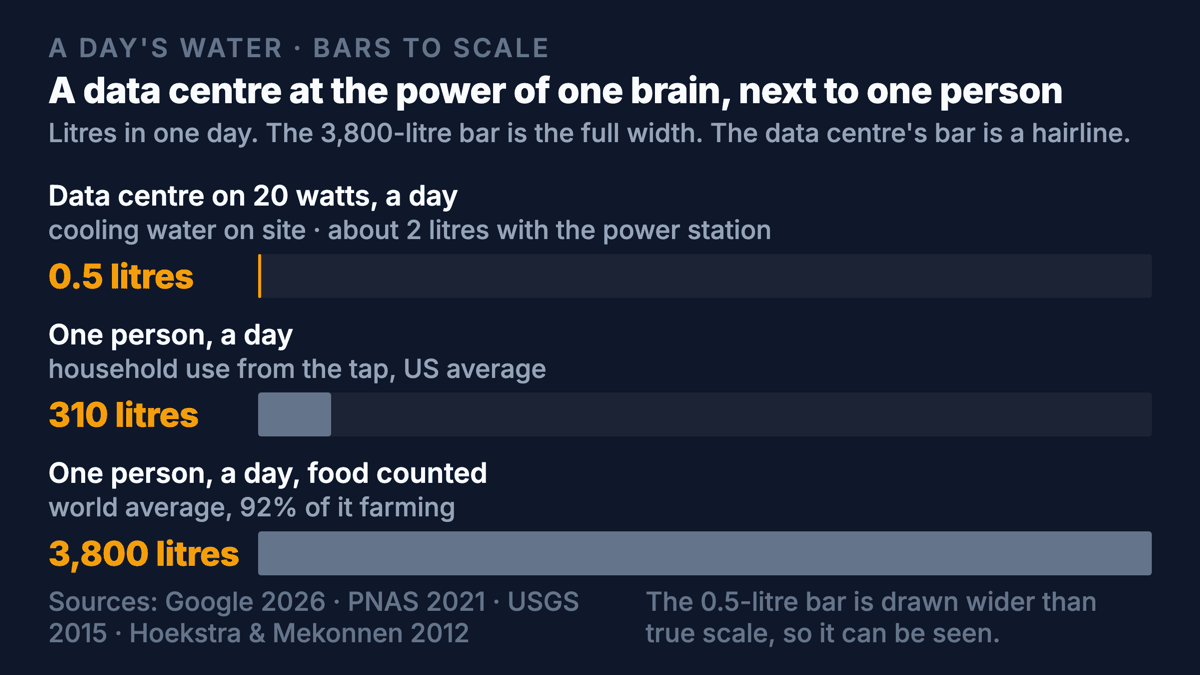
Every AI water number I'd heard came with no human standing next to it, so here's the arithmetic. Every input is somebody else's measurement. A brain runs on about 20 watts (Balasubramanian, PNAS, 2021). Over a day that's 480 watt-hours. Google says the median text prompt to its Gemini app uses 0.24 watt-hours of electricity and "consumes 0.26 milliliters (or about five drops) of water" (Google, August 2025). At that rate, 480 watt-hours of prompts evaporates about 520 millilitres. On the human side, the US Geological Survey puts American household use at 82 gallons a person a day in 2015, about 310 litres (USGS, 2018). Count the water behind a person's food as well and the world average is 1,385 cubic metres a year, about 3,800 litres a day, on 1996 to 2005 data (Hoekstra and Mekonnen, PNAS, 2012). Farming is 92 per cent of that. Or per person: 2,000 text prompts a day is that same half litre, against 310 litres from your tap. The AI you use gets through less water in a day than you do.
Two limits, stated up front. First, watts against watts is not thinking against thinking. A brain-day of electricity buys about 2,000 Gemini prompts at Google's figure, and no source I found puts a number on how many prompts equal a day of human thought. Until someone measures that, neither side can claim to do "the same work" as the other. Second, the half litre counts only the water used at the data centre. The power station feeding it uses water too. The UC Riverside paper that started the AI water argument puts that at about 3.1 litres per kilowatt-hour for average US electricity (Li, Yang, Islam and Ren, 2025 revision). On site it's roughly 1 litre per kilowatt-hour. Add it and the half litre becomes roughly two litres a day. That's still about 150 times less than the household tap, and about 1,800 times less than the person with their dinner counted. One more thing an average hides: where the water is drawn. Half a litre from a full reservoir and half a litre from a stressed aquifer are not the same half litre, and this piece is about the arithmetic, not the geography.
The rest is why you haven't seen that comparison: who was counting what.
What you're told, and what was measured
Four numbers do most of the travelling. Sam Altman wrote that an average ChatGPT query "uses about 0.000085 gallons of water; roughly one fifteenth of a teaspoon" (The Gentle Singularity, June 2025). That's 0.32 millilitres. A UC Riverside paper said in April 2023 that ChatGPT "needs to 'drink' a 500ml bottle of water for a simple conversation of roughly 20-50 questions and answers" (Li and colleagues, v1, 2023). A Morgan Stanley note said, as the newswires reported it, that AI data centres' water use "could reach around 1,068 billion litres by 2028, an 11-fold increase from 2024 levels" (Storyboard18, 8 September 2025). And a US Geological Survey statistic, as it's usually repeated: power generation takes 40 per cent of America's freshwater.
Now the measured ones. Google's data centres consumed 10,523 million gallons of water in 2025, about 39.8 billion litres, while using 42,415,800 megawatt-hours of electricity (Google 2026 Environmental Report). That's about 0.94 litres per kilowatt-hour, on site, by Google's own count. Microsoft reports 5,807 megalitres consumed across the whole company in its 2024 financial year (Microsoft, 2025); Meta reports 3,123 megalitres for calendar 2024 (Meta, 2025). Add the three together and you're under 50 billion litres a year, on site, from three of the largest operators. The trillion is a forecast for 2028 that also counts the power stations.
In units a person can feel: a year of Google's whole data-centre fleet evaporated about as much water as 29,000 people's full footprint, dinner included, at the world average (Hoekstra and Mekonnen, 2012).
Who said it, and where it came from
The wording most people met these numbers in is Hank Green's video "Why is Everyone So Wrong About AI Water Use??", uploaded 8 December 2025 (the video). It had 5,990,306 views when my claim-hunting script pulled its captions on 27 September. I read the captions, not the film; the quotes below are the captions, each with a timestamp link.
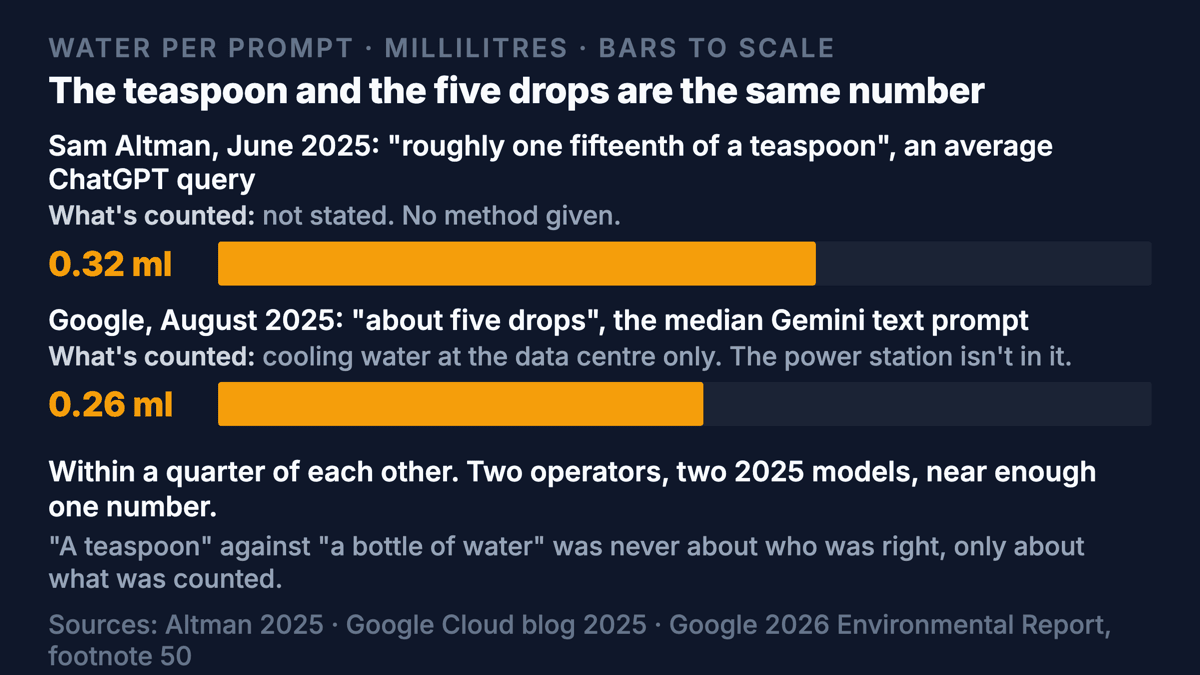
The teaspoon and the five drops are the same number. At 0:00 the video quotes Altman's fifteenth of a teaspoon. Altman's post gives no method and doesn't say what's counted (Altman, 2025). But put his 0.32 millilitres next to Google's 0.26 and they're within a quarter of each other. Google says what its figure counts: the cooling water at the data centre, estimated from energy per prompt and the fleet's average water use per unit of electricity, so the power station isn't in it (Google 2026 report, footnote 50). Two operators, two 2025 models, near enough one number. So the argument between "a teaspoon" and "a bottle of water" was never about who was right, only about what was counted.
The university changed its own number and I couldn't find anyone who reported it. The bottle-per-20-questions figure comes from the Riverside paper's first version, dated 6 April 2023: "ChatGPT needs to 'drink' a 500ml bottle of water for a simple conversation of roughly 20-50 questions and answers, depending on when and where ChatGPT is deployed" (v1). On 26 March 2025 the authors revised it to: "GPT-3 needs to 'drink' (i.e., consume) a 500ml bottle of water for roughly 10 – 50 medium-length responses, depending on when and where it is deployed" (v5). The model became GPT-3, an older one. The low end of the range halved, which doubles the worst-case water per response, from 25 millilitres to 50. And the figure counts the power station as well as the cooling, which the paper says and the headlines dropped.
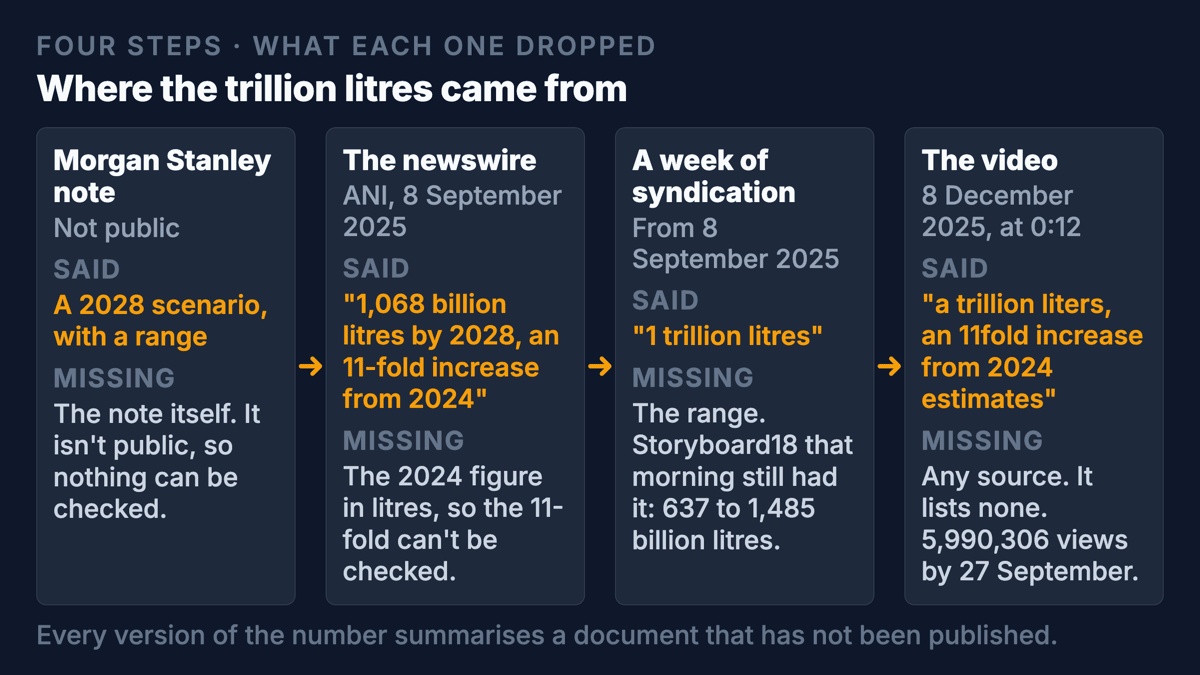
The trillion litres has not been published. At 0:12 the video says a Morgan Stanley projection "could reach around a,000 billion lers [1,000 billion litres] by 2028. That's a trillion liters, an 11fold increase from 2024 estimates." The trail behind that sentence: a Morgan Stanley note that isn't public. The ANI newswire's summary of it on 8 September 2025 (The Tribune, syndicating ANI). Storyboard18 the same morning, with the range still in: "between 637 billion litres and 1,485 billion litres" (Storyboard18). Then a week of syndication as "1 trillion litres", range gone. Every version of the number, including the viral one, is a newswire's summary of a document that has not been published. None of the outlets I read prints the 2024 starting point in litres either, so the "11-fold" can't be checked from any of them.
Why the numbers disagree: three mechanisms
Withdrawal or consumption. Withdrawal is water taken from a river or an aquifer. Consumption is the part that evaporates and doesn't go back. The USGS reports that US thermoelectric power stations withdrew 133 billion gallons a day in 2015 and consumed 3 per cent of it (USGS Circular 1441). In the Riverside paper's own 2027 projection, global AI withdraws 4.2 to 6.6 billion cubic metres and consumes 0.38 to 0.60, about eleven times less (Li and colleagues, 2025).
Forecast or fact. Google's 39.8 billion litres is a count of last year. Morgan Stanley's trillion is a scenario for 2028 with a range from 637 to 1,485 billion litres (Storyboard18). Quoting the middle of a range as "a trillion" is how a scenario turns into a fact.
Total water or freshwater. At 11:12 the video says: "according to the US Geological Survey, electricity generation accounts for, get this, 40% of all freshwater withdrawals in the United States." The USGS says thermoelectric power took 41 per cent of all withdrawals in 2015, seawater included, and 34 per cent of freshwater withdrawals (USGS Circular 1441). Ten years earlier the freshwater share was 41 per cent (USGS Circular 1344). So the 40 is either the total share with the wrong label or the 2005 figure repeated in 2025. I can't tell which from the video, which lists no sources. Either way, the current freshwater number is 34.
Three questions, next time you meet a number
First: withdrawal or consumption? If the source doesn't say, you don't have a number.
Second: where does the count stop? The cooling tower on site, the power station feeding it, or the factory that made the chips? Altman's teaspoon doesn't say. Google's five drops stop at the cooling tower. Riverside's bottle includes the power station.
Third: measured, or forecast, and what's the range? A 2015 measurement and a 2028 scenario don't carry the same weight. If a forecast has a range, quote the range.
Pass: the number you're about to repeat has an answer to all three, from the source, not from the person who told you about it. Fail: any one is missing. Then say "reportedly", or say nothing.
And now you have a number to put beside "AI is draining the water supply". At the power of one human brain, half a litre a day on site, about two with the power station. The person: 310 litres from the tap (USGS, 2018), about 3,800 with their dinner (Hoekstra and Mekonnen, 2012).
Sources
- Vijay Balasubramanian, "Brain power", PNAS 118(32), August 2021. https://europepmc.org/articles/PMC8364152
- Google, "Measuring the environmental impact of AI inference", Google Cloud blog, 21 August 2025. https://cloud.google.com/blog/products/infrastructure/measuring-the-environmental-impact-of-ai-inference
- Google, 2026 Environmental Report (calendar 2025 data), 30 June 2026; footnote 50 gives the per-prompt scope. https://sustainability.google/files/google-2026-environmental-report.pdf
- USGS, "Estimated Use of Water in the United States in 2015", Circular 1441 (2018) and Fact Sheet 2018-3035. https://pubs.usgs.gov/publication/cir1441 and https://pubs.usgs.gov/fs/2018/3035/fs20183035.pdf
- USGS, "Estimated Use of Water in the United States in 2005", Circular 1344. https://pubs.usgs.gov/circ/1344
- Arjen Hoekstra and Mesfin Mekonnen, "The water footprint of humanity", PNAS 109(9), 2012. https://www.pnas.org/doi/10.1073/pnas.1109936109
- Pengfei Li, Jianyi Yang, Mohammad A. Islam, Shaolei Ren, "Making AI Less 'Thirsty'", arXiv 2304.03271, v1 (6 April 2023) and v5 (26 March 2025). https://arxiv.org/abs/2304.03271v1 and https://arxiv.org/abs/2304.03271v5
- Sam Altman, "The Gentle Singularity", 10 June 2025. https://blog.samaltman.com/the-gentle-singularity
- Microsoft, 2025 Environmental Data Fact Sheet, Table 17. https://cdn-dynmedia-1.microsoft.com/is/content/microsoftcorp/microsoft/msc/documents/presentations/CSR/2025-Microsoft-Environmental-Data-Fact-Sheet-PDF.pdf
- Meta, 2025 Independent Accountants' Review Report, year ended 31 December 2024. https://sustainability.atmeta.com/asset/2025-independent-accountants-review-report/
- Morgan Stanley note on AI data-centre water, as reported 8 September 2025 by ANI (via The Tribune) and Storyboard18; the note is not public. https://www.tribuneindia.com/news/business/ai-data-centers-to-drive-11-fold-rise-in-water-consumption-by-2028-morgan-stanley/ and https://www.storyboard18.com/digital/ai-data-centres-to-drive-global-water-usage-11-fold-by-2028-morgan-stanley-80504.htm
- Hank Green, "Why is Everyone So Wrong About AI Water Use??", YouTube, 8 December 2025. Captions and view count from my claim-hunter target sheet of 27 September 2026. https://www.youtube.com/watch?v=H_c6MWk7PQc