Amazon's 30,000 job cuts weren't proof AI is taking jobs. What its boss says is coming is closer to it
Jamie Watters
Operational resilience and AI delivery practitioner.
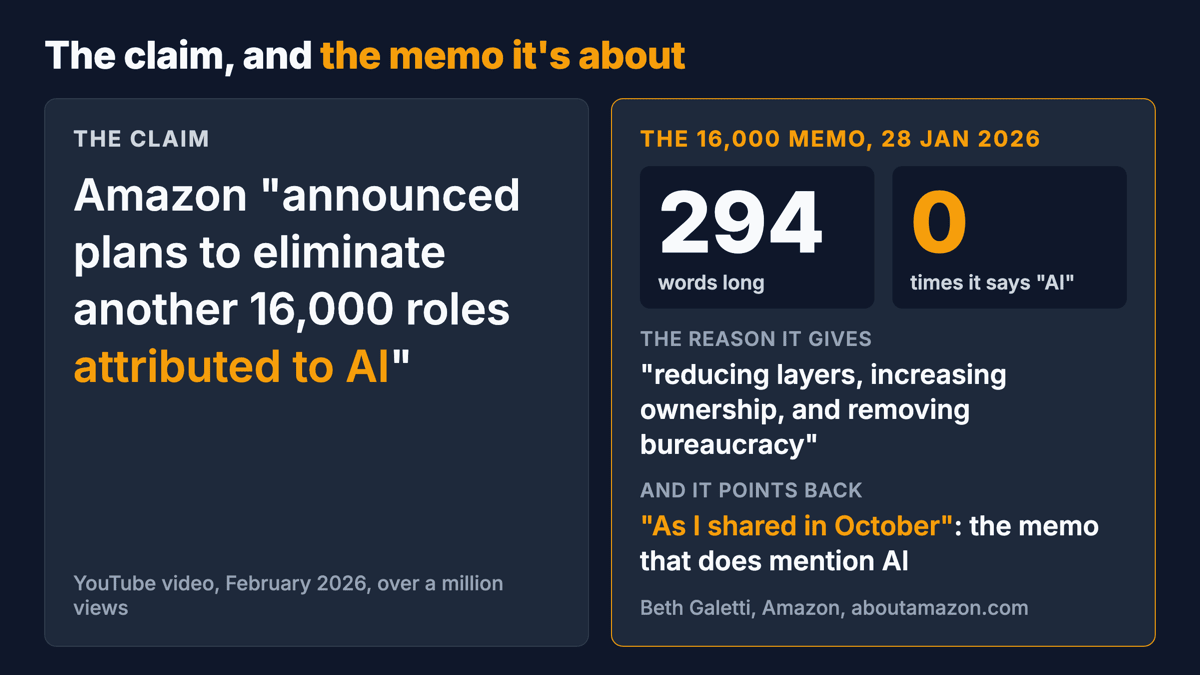
A video with more than a million views puts it plainly. Amazon, it says, "announced plans to eliminate another 16,000 roles attributed to AI with senior vice president Beth [Galetti] calling it the most transformative technology we've seen since the internet" (at 7:24).
Amazon's memo announcing the 16,000 is 294 words long. AI isn't one of them. But its reasoning opens with "As I shared in October", and the October memo does mention AI.
So both versions going round are wrong. Amazon didn't say AI did these jobs. It didn't keep AI out of it either. What it said is more useful to you if you use AI at work and wonder whether you're next, because it separates two things the headlines merge: AI as the reason your employer reorganises, and AI doing your job.
First, fairness to the video. Its argument isn't that AI is doing these jobs. It says AI has become "the most effective blanket justification for the mass replacement of American jobs" (at 7:16). And it says the push for AI has "far less to do with automating human workers, at least as of right now" (at 12:23). On Amazon's record that broader point has something to it. The line it quotes about the 16,000 doesn't.
The claim, and the memo it's about.
What Amazon said, in date order
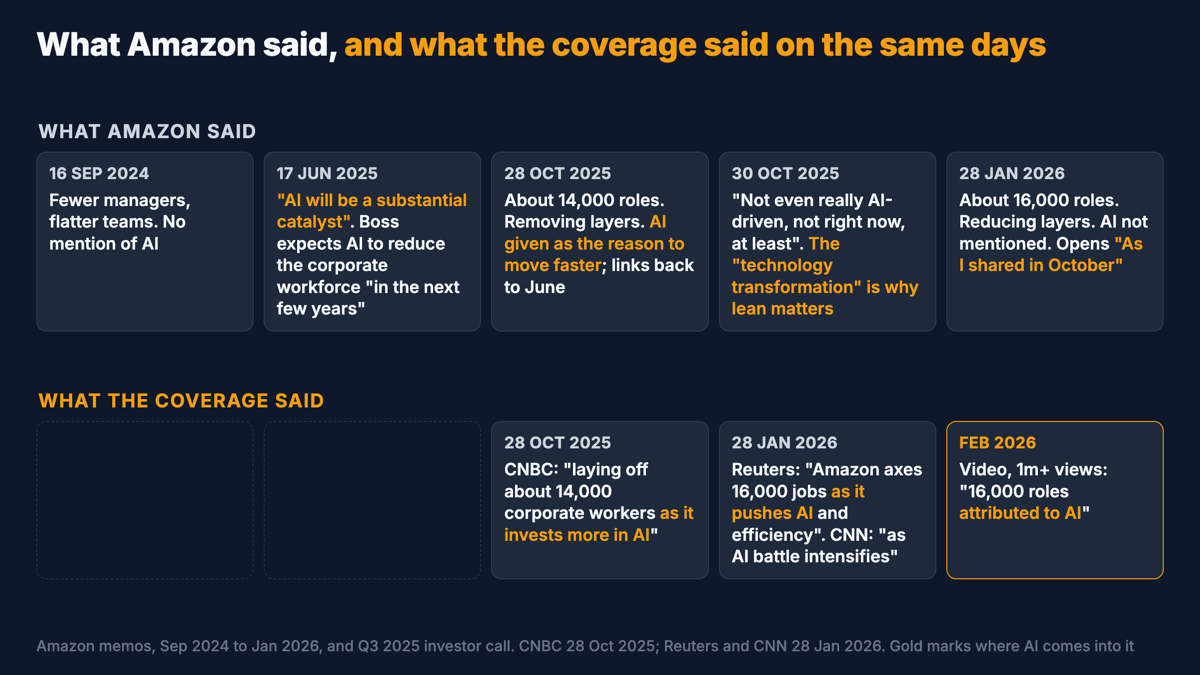
16 September 2024. Andy Jassy, Amazon's chief executive, asks every senior leadership team to raise its ratio of staff to managers "by at least 15% by the end of Q1 2025". His reason: "Having fewer managers will remove layers and flatten organizations". This memo doesn't mention AI. The cutting of layers starts here.
17 June 2025. Jassy writes to staff about generative AI. He says the leadership will keep taking steps to move faster and give people more ownership. Then: "AI will be a substantial catalyst here." Then the forecast: "We will need fewer people doing some of the jobs that are being done today, and more people doing other types of jobs. It's hard to know exactly where this nets out over time, but in the next few years, we expect that this will reduce our total corporate workforce as we get efficiency gains from using AI extensively across the company."
28 October 2025. Beth Galetti, Amazon's senior vice president of people experience and technology, announces "an overall reduction in our corporate workforce of approximately 14,000 roles". It's a net figure: the memo says it includes "reducing in some areas and hiring in others". The reason given is "further reducing bureaucracy, removing layers, and shifting resources to ensure we're investing in our biggest bets". The memo then asks why Amazon is reducing roles while it's performing well. Its answer is AI: "This generation of AI is the most transformative technology we've seen since the Internet, and it's enabling companies to innovate much faster than ever before." The next sentence says Amazon needs "fewer layers and more ownership, to move as quickly as possible for our customers and business." And a paragraph headed for 2026, "as Andy talked about earlier this year", promises more places to "remove layers, increase ownership" and find "efficiency gains". The words "earlier this year" link to the June AI memo.
30 October 2025. On the quarterly call with investors, an analyst asks whether AI is making Amazon efficient enough to keep headcount flat. Jassy says the October announcement "was not really financially driven and it's not even really AI-driven, not right now, at least." He calls it culture: fast growth left Amazon with "a lot more layers". Then he finishes the answer: "I don't know if there's ever been a time in the history of Amazon or maybe business in general with the technology transformation happening right now, where it's important to be lean, it's important to be flat, and it's important to move fast".
28 January 2026. Galetti again: "approximately 16,000 roles across Amazon". Its reasoning starts "As I shared in October", and the reason is the same: "reducing layers, increasing ownership, and removing bureaucracy." These were the teams that "did not complete that work until now". The memo doesn't mention AI. It points back to the one that does.
9 April 2026. Jassy's letter to shareholders says Amazon has "worked to flatten" itself over the past year. He also describes six engineers, building on Amazon's AI coding service Kiro, delivering in 76 days something that "might take a team of 40 people about a year". He tells it as a story about speed, not headcount.
What Amazon said, and what the coverage said on the same days.
Three things "AI" can mean in a job cut
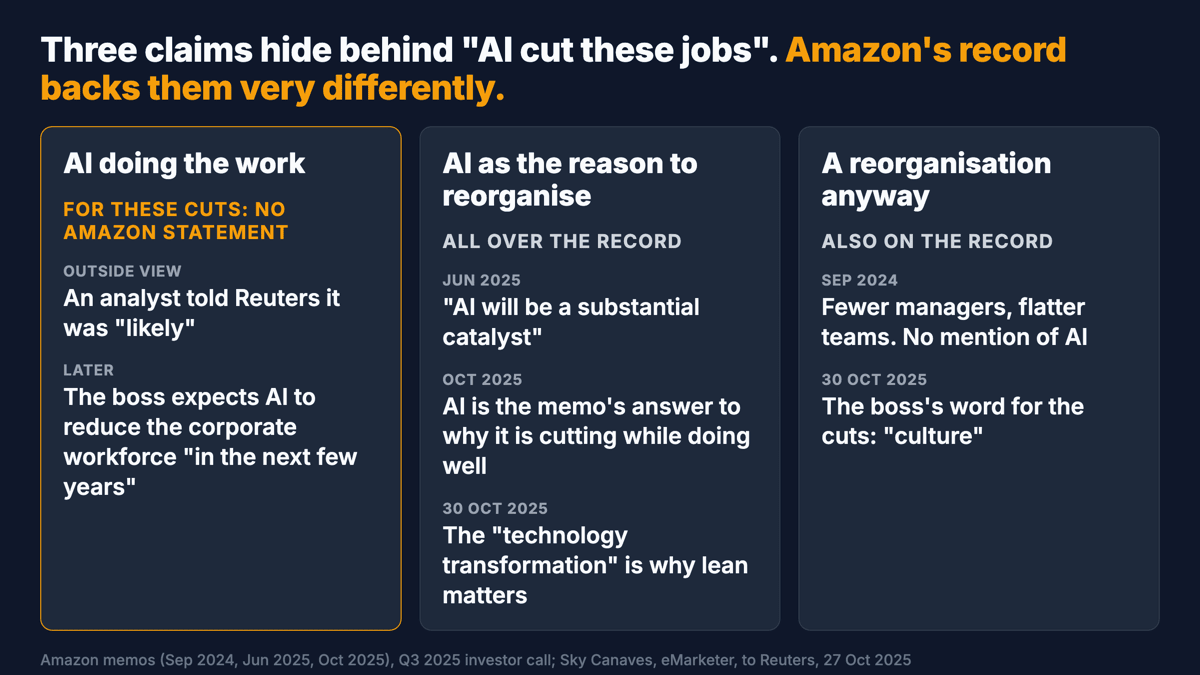
Put the record together and there are three different claims hiding behind "AI cut these jobs". They need different evidence, and Amazon's record supports them very differently.
AI doing the work. Software now does what the people who left used to do. Nothing Amazon has published says this about these cuts. The nearest thing is an analyst's reading. The day before the first round, Sky Canaves of eMarketer told Reuters that Amazon "is likely realizing enough AI-driven productivity gains within corporate teams to support a substantial reduction in force." That's an outside view, and it says "likely".
AI as the reason to reorganise. AI makes every company faster, so Amazon has to cut layers to keep up. This one is all over Amazon's record: the June "catalyst", the October memo's answer to "why now", and Jassy's "technology transformation" on the call. It's a fair reading of the October memo to say it blames AI, in this sense.
A reorganisation that would have happened anyway. The layer-cutting began with the September 2024 memo, nine months before the June AI memo, and that memo says nothing about AI. Jassy's own word for the cuts was "culture".
The first claim is what most people hear in "AI cut these jobs". On Amazon's record it's the one with no evidence, for these cuts. But "not right now, at least" points somewhere. The June memo says where: AI shrinking the corporate workforce "in the next few years". That's the first claim, as a forecast, from the person running the company.
Three claims behind "AI cut these jobs", and what Amazon's record says about each.
Whether culture was the whole story can't be checked from anything Amazon has published. Its memos don't say which roles went, or what now does their work, and that's the evidence that would settle the first claim. A company has reasons not to say "AI replaced these people", and reasons to sound like an AI company in front of investors. That's my reasoning, not something Amazon has said, and it cuts both ways. What anyone can check is who said what, and when.
How "AI is why we must move fast" became "attributed to AI"
Look at the coverage on the two days Amazon announced cuts.
On 28 October, CNBC's headline read "Amazon laying off about 14,000 corporate workers as it invests more in AI". The article said the company wrote that it was investing in "our biggest bets" including generative AI. The memo's "biggest bets" sentence doesn't name AI. AI is in the memo further down, as the reason to move fast.
On 28 January, the day of the 16,000, Reuters ran "Amazon axes 16,000 jobs as it pushes AI and efficiency". It said Amazon had cut 14,000 in October, "saying at the time that artificial intelligence and concerns over shifting corporate culture were to blame." CNN ran "Amazon is laying off 16,000 employees as AI battle intensifies".
None of these says AI did the jobs. Each puts AI and the cuts in one headline, joined by "as", and "as" is an easy word to read as "because". Three weeks later the video says "attributed to AI". I can't show which of these, if any, the video drew on. By then the pairing was the normal way to report the story.
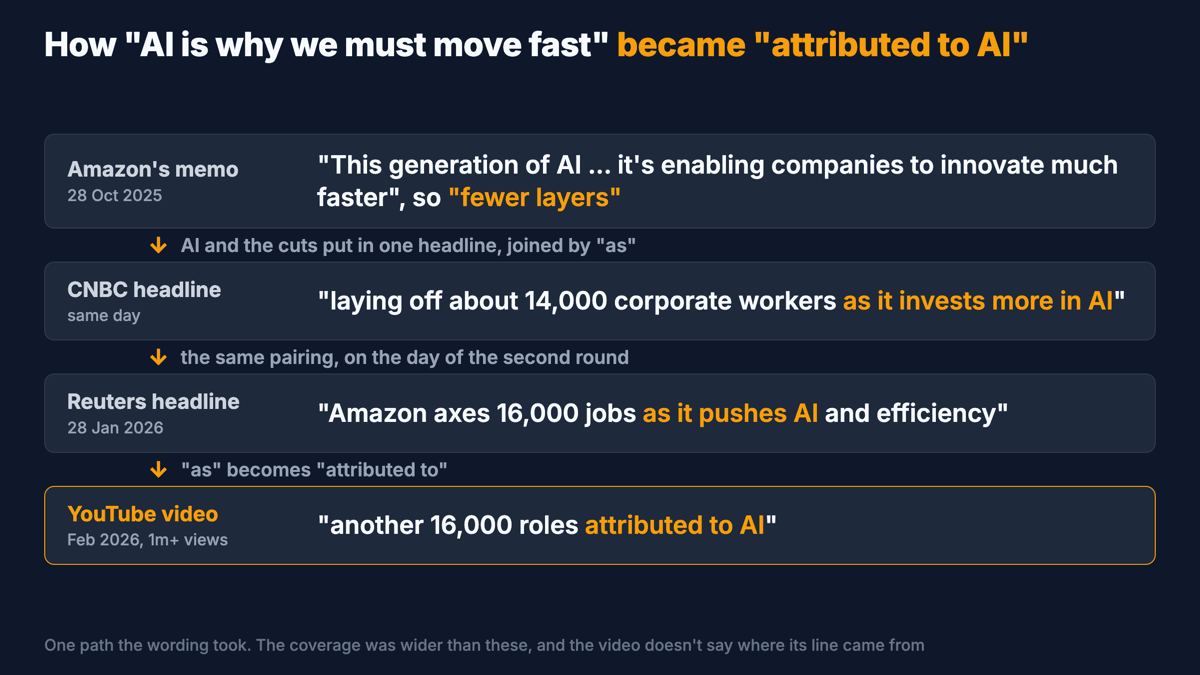
How the wording changed between Amazon and the video.
Three questions for the next "jobs cut because of AI" story
1. Who said AI, and about what? The company, in its own announcement or investor call, or a headline, video or post about the company? If the company says AI, is it the reason to change, or the thing doing the work?
2. What reason did the company's own document give? Read the paragraph around any AI sentence, not the sentence. Follow back-references like "As I shared in October" to the document they point to. A memo that never says AI can still lean on one that does.
3. Now or later? "We cut" is a fact: it tells you what happened. "We expect this will reduce" is a forecast: it tells you what to plan for.
Run Amazon through them:
- Who said AI? Amazon did, in June and October, as the reason to move faster. Not as the thing doing the work. The coverage put AI beside the cuts on both announcement days, and the video attributed the 16,000 to it.
- What reason? Fewer layers and more ownership, in both rounds. October gives AI as the reason speed matters. January points back to October.
- Now or later? Now, a reorganisation. Later, by the chief executive's own forecast, fewer corporate jobs as AI is used across the company.
Amazon hasn't said AI did the jobs it cut. Its chief executive has said, in writing, that he expects AI to reduce its corporate workforce "in the next few years". The second statement is the one to plan for.
Sources
- Amazon, "Message from CEO Andy Jassy: Strengthening our culture and teams", 16 September 2024: aboutamazon.com
- Amazon, "Message from CEO Andy Jassy: Some thoughts on Generative AI", 17 June 2025: aboutamazon.com
- Amazon, "Staying nimble and continuing to strengthen our organizations" (Beth Galetti), 28 October 2025: aboutamazon.com
- Amazon Q3 2025 earnings call, 30 October 2025, transcript published by The Motley Fool: fool.com
- Amazon, Beth Galetti's memo to staff, 28 January 2026: aboutamazon.com. The 294-word count runs from the memo's first sentence to its last, without the sign-off, and does not count dashes as words.
- Amazon, Andy Jassy's 2025 letter to shareholders, 9 April 2026: aboutamazon.com
- CNBC, "Amazon laying off about 14,000 corporate workers as it invests more in AI", 28 October 2025: cnbc.com
- Reuters, "Amazon targets as many as 30,000 corporate job cuts, sources tell Reuters", 27 October 2025, as syndicated by CP24: cp24.com
- Reuters, "Amazon axes 16,000 jobs as it pushes AI and efficiency", 28 January 2026, as syndicated by Yahoo Finance: finance.yahoo.com
- CNN, "Amazon is laying off 16,000 employees as AI battle intensifies", 28 January 2026: cnn.com
- The video: "Replacing Humans With AI Completely BACKFIRED", uploaded 18 February 2026, 1,125,438 views when checked on 30 September 2026: youtube.com. Quotes are from its auto-captions, which spell Galetti's name "Kleti".