Failed at meditation? Try this two-minute exercise for a busy mind instead
Jamie Watters
Operational resilience and AI delivery practitioner.
Who this is for: anyone who has tried meditation and given up because their head wouldn't go quiet, and anyone who has met the word Efformism in my book and wants to know what it means.
Skip it if you want the full argument against the philosophers. That's the paper's job, and it's linked at the end.
On the length: about ten minutes, but the two exercises come first.
The exercises below don't ask your thoughts to stop. In my book's words, they "treat thoughts as scenery rather than as the enemy" (The Way Within, Introduction). They ask you to notice what your mind adds all day, and to set it down for a minute.
Here are two, from the book's quick reference. The first takes the word off a feeling. The second is the one the book says "takes about two minutes" (The Way Within, Introduction and Appendix B).
Try it, part one: drop the word
- Pick one thing present right now: an ache, a sound, a pressure. Present, not remembered.
- Attend to its raw quality: the throb, the hum, the press.
- Notice the word stuck to it: "pain", "traffic", "tightness". Notice the word is not the thing.
- Drop the word. When it comes back, set it down again and return to the quality.
- Notice what happened to the thing without its label. Try two or three more things.
Try it, part two: look for the one who's looking
- Point at something across the room. Look at it: colour, shape, distance.
- Point at the floor. Then your foot. Your knee. Your chest. Notice each step is less object, more you.
- Turn your finger around, six inches from your nose, pointing at where your face should be.
- Look past the finger, at the place you are looking out from. Take your time.
- Notice what you find there. Not what the mirror says. What is actually there, in your first-person experience.
The first shows you can hold the ache without the word, so the word is something you can set down. The second is the pointing exercise from the Headless Way, developed by the English philosopher Douglas Harding (The Way Within, Introduction and Appendix A). It asks whether you can find anyone behind your eyes, or only more things being seen.
Nothing dramatic has to happen. If you looked and felt nothing special, that still counts. The book says "you cannot fail through lack of ability". "There is only looking, or not looking." And what it changed for me on an ordinary day: "I never stopped having negative thoughts and stupid ideas, and I still have them daily. What ended was being them." (The Way Within, Introduction.)
Both are the same move. I call the idea behind it Efformism, and in August I published it as a paper (Watters, 2026).
What Efformism says
Most of what's in your head was added. A name for every feeling. A story about what it means. A belief that there's a "you" somewhere behind your eyes, watching. Efformism is the habit of taking those additions away, one at a time, and seeing what's left.
"Effable" means anything that can be put into words. "Ineffable" means what can't. The paper defines Efformism as "the disciplined subtraction of the effable" until "only the ineffable remains: aware experiencing itself" (Watters, 2026, §2).
The ingredients aren't new, and the paper says so. Its contribution is "not the discovery that awareness is fundamental, a claim with a long history" (Watters, 2026, References). What it adds is the way it runs the subtraction, and how it keeps that apart from any bigger claim.
Descartes is the starting point. In his Meditations (1641) he doubted everything he could. One thing survived: "I am, I exist", true whenever he thought it (Watters, 2026, §4). Efformism says he stopped one step too soon. You can notice a thought, so a thought is something known. The paper's point is that the thing you know can't be the ground floor of the knowing (Watters, 2026, Abstract). The noticing comes first.
The paper's method has four steps, in order (Watters, 2026, §5):
- The label. Drop the word and "the quality remains, now unnamed".
- The world out there, held as a certainty. The paper calls it "a hypothesis, practical and possibly true, but not a datum": a good bet, not something you can check from where you sit. The perceiving remains.
- The watcher behind the eyes. This is Harding's experiment. "The experiencing remains, now without a centre."
- The one doing the subtracting. That turns out to be one more thing that appears, and the method "falls away".
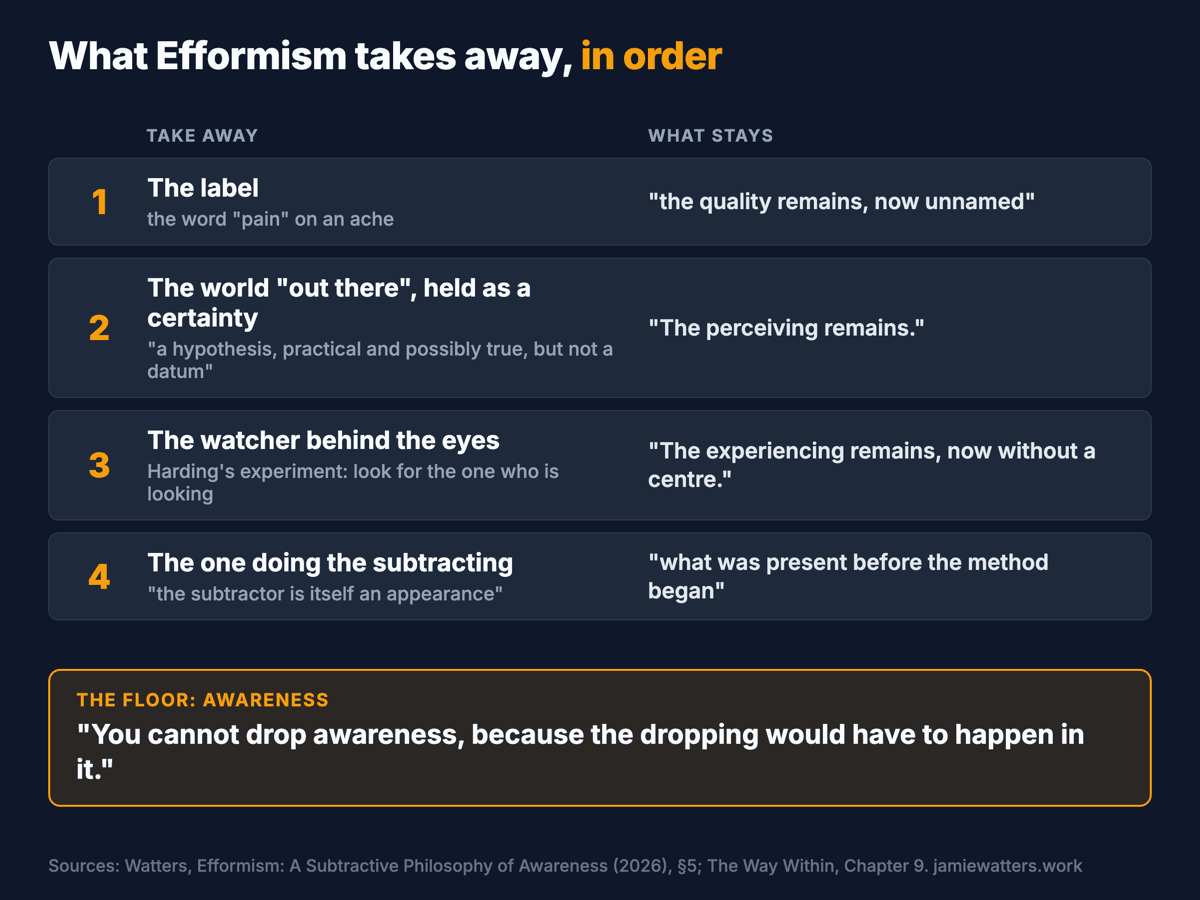
The four steps of the method, and what each one leaves behind. Source: Watters, Efformism: A Subtractive Philosophy of Awareness, 2026, §5.
So why stop at awareness? The paper's stopping rule: "Subtraction halts at whatever is presupposed by the act of subtracting" (Watters, 2026, §5). In the book's plainer words, you can drop any thought, because the dropping is one more event in awareness. "You cannot drop awareness, because the dropping would have to happen in it" (The Way Within, Chapter 9). The paper is careful about how little that gives you. It doesn't show that awareness is one thing, or that it lasts: "The floor is thin. It holds regardless." (Watters, 2026, §5).
What it doesn't claim
The paper's central rule is "the refusal to let a strong hypothesis wear the clothing of a certainty" (Watters, 2026, Abstract).
So it has two levels and keeps them apart (Watters, 2026, §8). The first is asserted: "everything known appears in awareness; awareness cannot be subtracted." The second is only proposed. It reads reality as "non-dual awareness appearing as world, body, mind, and self." The paper "rests its weight on the first."
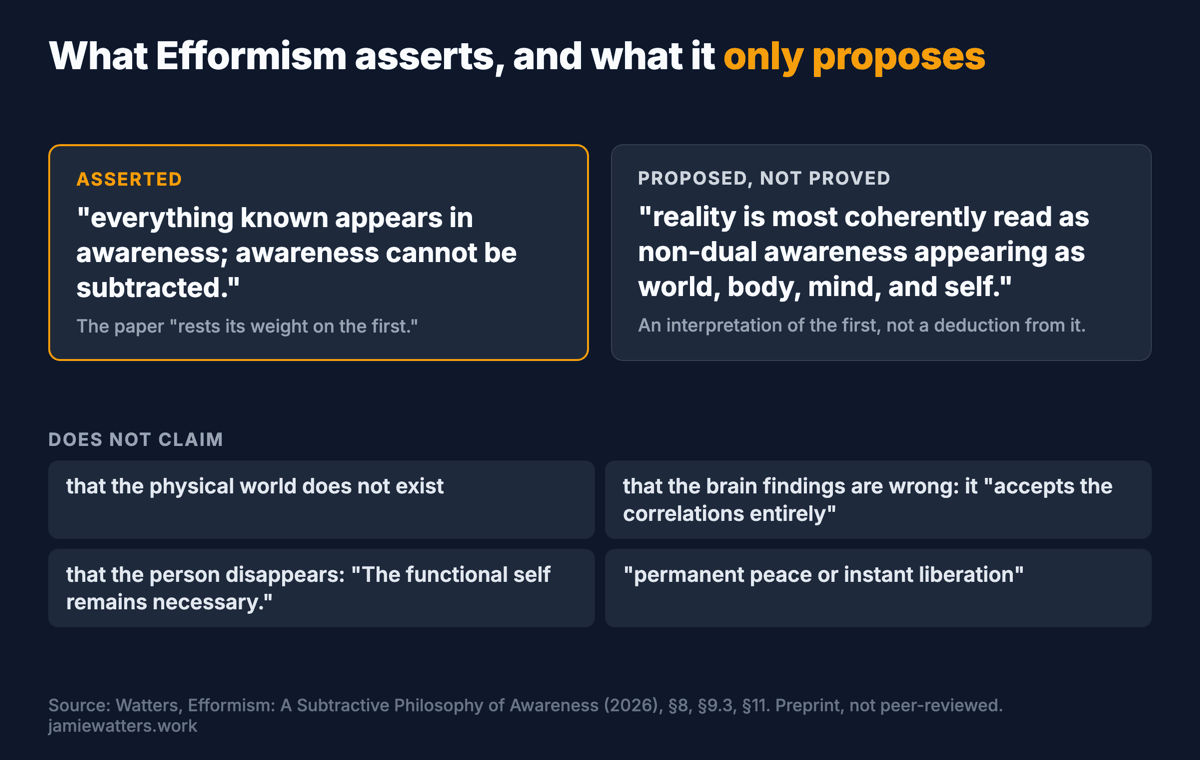
What the paper asserts, and what it only proposes. Source: Watters, 2026, §8, §9.3 and §11.
That keeps a lot out. In one sentence: it doesn't say the physical world is unreal, that the brain findings are wrong, that you disappear, or that you'll find permanent peace (Watters, 2026, §9.3 and §11). On the brain, it "accepts the correlations entirely" and disputes only the step from those to "the brain produces awareness". And "Efformism does not promise permanent peace or instant liberation."
The obvious objection is one the paper raises against itself: so what? Someone who thinks the world exists whether or not anyone sees it will happily agree that they only meet it through experience. The paper concedes this. The core is "fully compatible with realism", and "The core is true and modest. It does not secretly contain a metaphysics" (Watters, 2026, §8.1). It also admits the core "forbids no observation", so no experiment could prove it wrong (Watters, 2026, §11.1).
In plain words, a materialist can accept the core and lose nothing. The paper doesn't fight that. It still calls the core true, and it asks anyone who wants a theory to risk being wrong to read the core "as a claim about method rather than about the world" (Watters, 2026, §11.1). It does name what would sink it: a comparison of experience against a reality outside all experience. "Produce such a comparison and the core falls." (Watters, 2026, §11.1). The method is the part you can run, which is what the two exercises are for.
It doesn't claim the ache ever arrives with no concept attached, either. That objection, from the philosopher Wilfrid Sellars, gets its own section (Watters, 2026, §9.4).
There's one objection it doesn't win. Madhyamaka, a school of Buddhist philosophy, says nothing has a fixed nature of its own, awareness included. The paper agrees that far. They part on one point. Is the bare fact that experiencing is happening, here, empty too? Madhyamaka says yes: "conventional all the way down, with no floor at all". The paper calls this "a genuine and possibly undecidable difference" and does not claim to have refuted it (Watters, 2026, §9.5). It is also a preprint. Its status line reads "Preprint. Not peer-reviewed."
Where it came from
I first met Harding's Headless Way in his writing, and was blown away by it. But reading gave me more ideas, not a change. Around 2010 I went to a workshop in a house in Leamington Spa, where Richard Lang was sharing the Headless Way. Being walked through the exercises took me from insight to knowing (The Way Within, About the author).
I wrote The Way Within over the years that followed, and it came out in 2018 (The Way Within, About the author).
A later draft of that book gave the word one line. "Incidentally, I call my philosophy efformism," it says, because the approach works "by accepting what we can't know (the ineffable) and directing our attention to what we can know (the effable)" (second-edition manuscript).
That points attention at the things that can be named. The idea as it stands now does the opposite: let those go, and see what's left. It wasn't the only inversion. An earlier formulation called Efformism "the removal of the ineffable", and the paper says: "That was an inversion, and we discard it" (Watters, 2026, §2).
The name comes from the Latin efformare, "to form out of" (Watters, 2026, §2). It also carries the paper's bigger idea, which the paper only proposes. That idea is that everything you notice is formed out of awareness, "in the way a wave is formed out of water" (Watters, 2026, §2).
The paper was first drafted on 26 May 2026 (Watters, 2026, title block). I used AI models to draft versions of the argument and then to attack them. I'm the sole author: AI was a tool for articulation and stress-testing, not a named author (Efformism publication plan). Version 1.0 followed on 19 June. Version 1.1, on 2 August, added the section on what would make it wrong (Zenodo deposit notes). The same day it went on Zenodo, an open research archive, with a permanent DOI (Zenodo record).
Why I wrote the paper
I'd given the process a name, and its shape and form were clear to me, but it felt subjective. I wanted it to become more objective. I believed it needed to be formally described, and I wanted to see if it would stand up to scrutiny. A philosophical paper was the obvious way to do all of that.
It did a job for the book. A book of exercises can't stop to answer objections. The paper can, and the book's rewrite was corrected to match it (The Way Within restructure plan, v8). It also gave the idea a fixed public record: a Zenodo deposit is frozen, with a date and my name on it (Efformism publication plan).
How it sits under The Way Within
The book is the practice and the paper is the argument. The book names the word once, in the introduction. It calls efformism "the practice of subtracting what the mind adds", then drops the word and runs the exercises (The Way Within, Introduction).
The appendix says what that means: "Every exercise in this book is that one move wearing different clothes." The subtraction exercise removes a word. The pointing removes the face you assume is there. Another exercise removes the owner of a feeling (The Way Within, Appendix A).
The 2018 edition was a book of philosophy. This edition rewrites it as a book of practice, and leaves the philosophy to the paper (The Way Within, About the author).
The book is at jamiewatters.work/the-way-within, and the paper is at its DOI.
You can drop the word "pain" from an ache. You can't drop the noticing. That's Efformism.
Sources
- Watters, J. (2026). Efformism: A Subtractive Philosophy of Awareness, version 1.1. Zenodo. doi.org/10.5281/zenodo.21760952. Preprint, not peer-reviewed.
- Watters, J. The Way Within, current edition: Introduction, Chapter 9, Appendices A and B, About the author. jamiewatters.work/the-way-within.
- Unpublished working files: the second-edition manuscript of The Way Within, its restructure plan (v8), the Efformism publication plan and the Zenodo deposit notes.
- The paper's reference list closes with a debt it says is not a citation: contemporary non-dual teaching, and Rupert Spira's in particular.
- Harding, D. (1961). On Having No Head.
- Descartes, R. (1641). Meditations on First Philosophy; (1637) Discourse on Method.