Plan your day in 5 steps so a missed task stops feeling like failure
Jamie Watters
Ex-banker, founder at 58, building with AI.
Who this is for: anyone who meditates, or has had a glimpse of nondual ideas, and still has to plan a working day. Skip it if you want a new productivity system: this is about how to hold the one you have. About a 12-minute read.
Here's a trap I think a lot of people fall into after a spiritual awakening. They see that everything is already OK, just as it is. Then they stop making plans. Why set a goal if this moment is already fine? Life will happen anyway.
It sounds wise. In practice it means you stop steering. The work, the bills, the people who rely on you: none of it gets your effort, because effort starts to feel like the ego trying to grab the future.
Teachers get quoted as if they agreed. Douglas Harding is one of them. He was a British writer who taught a simple experiment: look back at the place you're looking out from. You can see other people's heads, but you can't see your own. From where you are, there's no head, just open space with the world in it. His best-known book is called On Having No Head.
Harding gets retold as telling you to stop planning and let life happen. He had a way of making decisions that he called No Choice, and some popular summaries go further still: they say a decision made this way can't be wrong.
I plan my days in time blocks. I can't hold a whole plan in my head, so mine is written down, and an agent reminds me through the day what's still to do and what's next. If the retellings are right, all of that is the ego running the show.
So I went back to what Harding actually wrote. He doesn't say stop planning. What he says lets you keep every goal you have. And at the end of this piece there's a five-step exercise you can try on tomorrow's plan.
What Harding actually wrote
Harding set out his path in eight stages. Stage 6, which he calls Working It Out, is about getting on with ordinary life after you've seen what he's pointing at. Part of it does sound like "stop planning": he talks about living like the lilies of the field, taking each step as it comes and not worrying about tomorrow. It's easy to see how the retellings got there.
But in the very next sentence he sees the trap coming. He says this way of living can be used as an excuse for dropping out. Lived, he says, it means dropping in: giving life everything you've got, "including whatever planning is necessary" (On Having No Head, stage 6).
So planning is in there, by name, and so is the trap. Seeing that you have no head doesn't mean you stop making plans.
Richard Lang, a teacher of Harding's work, wrote up an exercise in 1990 called Creating from Emptiness. You arrange a few objects into a pattern while noticing the open space you're looking out of. Then he adds planning: picture a pattern, let it go, picture another, choose one, and make it. His summary is one line: "Creating consciously from the Void does not exclude planning." By "the Void" he means that open space. (Richard Lang, Creating from Emptiness, first published in Share It, 1990)
No Choice, Harding's method for decisions, is on page 177 of his book Head Off Stress. It has four steps:
- See yourself as the open space the options appear in, with all their pros and cons. Let them arrange themselves, sleep on them, and don't push for an answer. If there's a deadline, it's one of the things on display.
- Let the decision come. It often turns up by itself, when you wake up or while you're doing a chore.
- Let the decision show its weak spots: your doubts, and the practical problems of carrying it out. You don't settle them by choosing. You stay with them until they sort themselves out.
- Carry it out.
Step 3 is the one that matters here. Harding says the decision, when it comes, feels so right you're left in no doubt. He still doesn't stop there. He puts it on display to show its weak spots before anything is done. And he says plainly what the method is not: "To live the choiceless life that we have been describing is not fatalism." (Head Off Stress, p. 177)
Fatalism is the belief that what will happen is already fixed, so nothing you do makes any difference. Harding says that isn't what he means. When you have a problem, he writes, you don't just sit back and wait for things to happen.
Life isn't a film you sit and watch
This is where I think the trap after an awakening comes from. You notice that everything comes out of that open space: thoughts, sounds, the next moment. From there it's easy to slide into treating life like a film. The film is already made. All you do is sit and watch it play.
I don't think that's right. The future does come out of the void, but it doesn't come out finished. It gets mixed with what you put into each moment: what you decide, what you say, the work you do. What you put in is your responsibility. That's what I understand by co-creation. You aren't writing the whole thing, and you aren't just the audience either.
That's my view, not a quote from Harding. It fits part of what he says about No Choice: the decision arrives by itself, and it still gets worked through and carried out. He goes further than me, though. On the same page he says it isn't the person who decides. The decision comes from the open space. As a separate person, he says, you're "powerless to make the slightest difference" (Head Off Stress, p. 177). Where I say co-creation, he'd say the whole thing comes from what you really are.
The three things you want
Harding has a passage in Head Off Stress about three kinds of wanting. He calls them the three areas of the will. "The will" here just means what you want and aim for.
- What you think you want: the goals you'd write down if someone asked.
- What you really want: this shows up in what you actually do, and it can be quite different.
- All the rest: what you're up against. He calls this what the Universe wants. In a 1997 interview he calls the same thing your deepest will, "the will of who you really are".
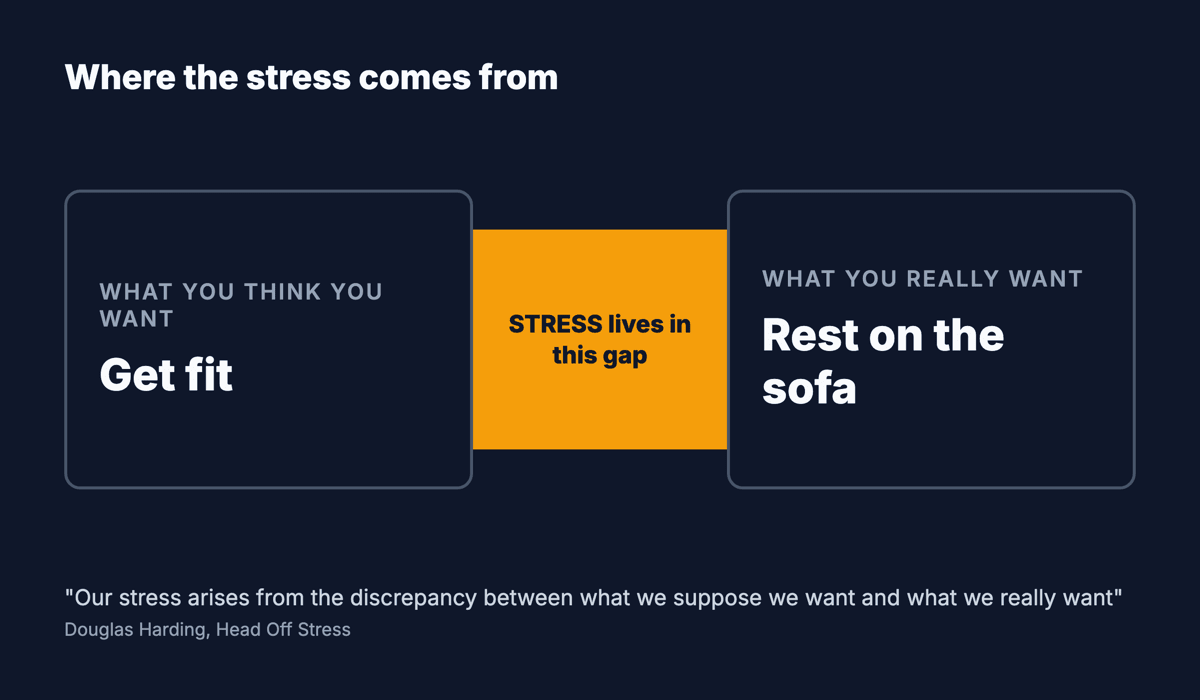
Say you tell everyone you want to get fit, and every evening you choose the sofa. What you think you want is fitness. What you really want, at least at 7pm, is rest.
Harding says that gap is where stress comes from: "Our stress arises from the discrepancy between what we suppose we want and what we really want" (Head Off Stress, p. 101). "Discrepancy" just means the difference between the two.
Here's the part that matters if you make plans. Harding doesn't tell you to throw away the first kind of wanting, the everyday goals. He draws the three as circles, one inside the next. What you think you want sits inside what you really want, and that sits inside everything else. The aim he names is to bring all three together into one whole, not to delete the inner ones. He even says your hidden wants aren't necessarily worse than your surface ones.
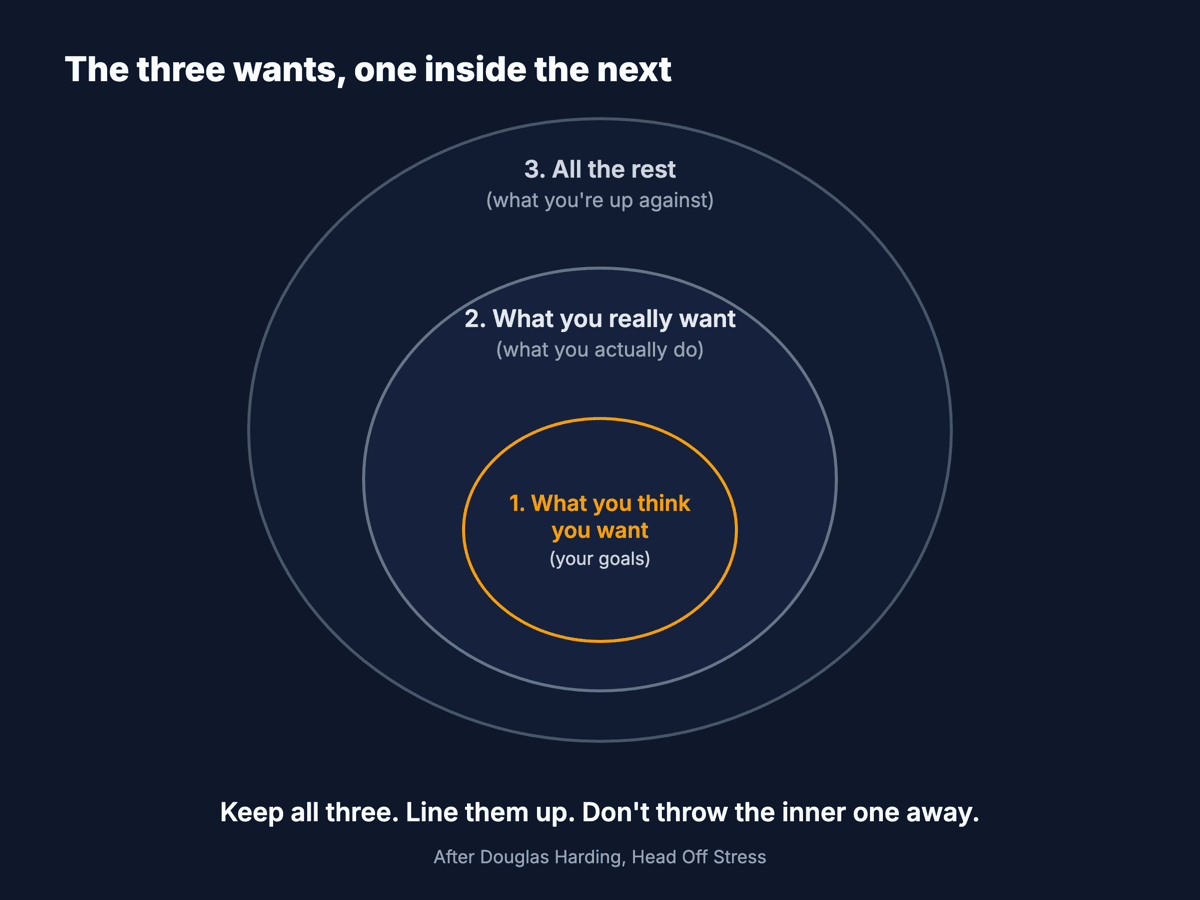
So you keep your goals. The work is to line them up with what you really want and with what's actually going on around you.
Where my own draft went wrong
I know how easy this is to get wrong, because I got it wrong. An earlier draft of my book The Way Within, from 2021, taught this passage. It credited Harding, and it got his point about stress right.
Then it told the reader to live from what they really want instead of what they think they want. Put simply: leave the everyday goals behind, they're the shallow ones. Harding didn't say that. He kept all three and joined them up.
The published edition dropped the passage, so it doesn't teach the mistake. But I wrote it, and it's the same mistake the popular retellings make. They keep the comforting part, that everything is fine as it is, and drop the part that makes it harder.
The harder part comes next.
The question Harding asked himself
Harding's answer to stress is this: if you could want everything to be exactly as it is, you'd be happy. Then he asks the question a sceptic would ask:
"Wouldn't your stress-free joy be bought at the expense of your honesty, your compassion, your natural revulsion against the world's dreadful injustices?" (Head Off Stress, p. 102)
Put simply: if I'm happy with everything just as it is, haven't I stopped caring about the people who are suffering?
He doesn't answer with an argument. He points to two people. One is his orderly during the war, who habitually said yes to whatever happened to him. The other is Richard Wurmbrand, a pastor who was imprisoned and tortured in Communist Romania for his faith. Neither of them had an easy life. What both did, Harding says, was become aware of all three kinds of wanting at once.
Two examples aren't proof. Two people coping well doesn't show that everyone can, or that you can say yes to everything and still stand up to injustice. Harding doesn't claim it does, and I won't either.
My own answer comes from co-creation. Saying yes to this moment includes saying yes to the part of it that is you, and that part may be working hard to change tomorrow. Accepting today and working to make tomorrow better aren't opposites. Again, that's my view, not Harding's.
The person plans. The open space holds the plan.
Harding's practice gives you two ways of seeing yourself. From the outside, you're a person: a face, a name, a calendar full of things to do. From the inside, looking out, there's no face. There's open space with this screen and your hands in it. His practice is noticing both at once. He called it two-way looking: "at once looking in at Nothing and out at everything" (On Having No Head, stage 5, Practising Headlessness).
"Nothing" there is the open space you look out from. "Everything" is the world you see in it.
That gives every plan two jobs. The person makes the plan, carefully, the ordinary way. The open space, which is what you really are, holds the plan without being judged by it. A plan that goes wrong is something that happened in view. It isn't a verdict on you.
Harding goes further in stage 8, the last of his stages. He asks you "actively to will (rather than passively to acquiesce in) whatever happens" (On Having No Head, stage 8). In plain words: don't just put up with what happens, like someone who has lost. Say yes to it, as if you'd chosen it. Stage 6 keeps planning in, so here's how I put the two together: give the plan your full effort, then say yes to however it turns out. That combination is my reading, not his words.
When you miss a goal, Harding gives you both sides at once. As the person, you're answerable for what you did. As the open space, there's nobody on trial: "Here I let poor old Douglas Harding off. Here I take responsibility for him..." (Head Off Stress, p. 214)
Another exercise from the same school, David Lang's Handling Problems, adds the practical side. You hold a problem out at arm's length and look at it there. Then you bring your attention back down your arm to where you're looking from, and see whether anyone is there holding it. And you keep working on it: "This observation doesn't make the problem go away, but it does place it where it belongs and where it can best be handled." (David Lang, Handling Problems)
Here's how that works on a day. The last two columns split out whose idea is whose. "Taken from" is the idea as Harding or Lang wrote it. "What I added" is how I've applied it, which they didn't write.
| The person does this | From the open space | Taken from | What I added | |
|---|---|---|---|---|
| Making the day's plan | Writes the time blocks | Sees the plan in the open space, chooses, starts; each reminder is a moment to look both ways | Lang's Creating from Emptiness; Harding's two-way looking | Doing it on a written plan, and using the day's reminders as the moments to look |
| When a task slips | Compares the plan with what happened, and fixes it | Holds the miss at arm's length; nobody there on trial | David Lang's Handling Problems; Harding, Head Off Stress p. 214 | Using it on a missed task in the day's plan |
There's one small study of this practice: 20 adults who had never tried it were guided through the exercises in interviews (Ramm, Lumma, Sparby and Weger, Mindfulness, 2024). It found the exercises can produce the experience Harding describes. It had no comparison group. In the research behind this piece I found no test of whether any of this helps with planning, stress or decisions. What's here is a practice to try, not a proven method.
Tomorrow morning
Here's Lang's exercise, changed for a plan you write down rather than one you hold in your head.
- Write tomorrow's plan as you normally would: the tasks, in order, with times.
- Point one finger at the page and another back at where your face is. Look at what the second finger points at. From where you are, is there a face there, or just open space with the page and your hand in it?
- Underneath, write a second version: change the order, or move or drop something. Look at both.
- Choose one.
- Start the first task, and let a timer, an app or an agent tell you what's next, so you don't have to carry the plan in your head. Each time one goes off, look both ways: out at the task, and back at the space it's in.
When a task slips, use David Lang's arm. Say the report you'd planned for 11 isn't done. Hold your hand out with the plan in it, the missed block at the end of your arm. Notice the feeling that comes with it. Then bring your attention back down your arm to where you're looking from. Is anyone there holding the problem? The miss stays out there, where it can be dealt with, so deal with it: move it, shorten it, or drop something else. Then carry on. A missed task is something to fix, not a verdict on you.
The pointing exercises behind two-way looking are in my book, The Way Within.
Sources
- Douglas Harding, On Having No Head, stages 5, 6 and 8 (quotes checked against the archive.org full text).
- Douglas Harding, Head Off Stress (1990 Arkana edition), pp. 100 to 103, 177 and 214. Page 177 is also extracted on headless.org as "Solving Problems".
- Douglas Harding, interview with Richard Lang, March 1997, headless.org.
- Richard Lang, Creating from Emptiness, first published in Share It, 1990; headless.org experiments.
- David Lang, Handling Problems, headless.org experiments.
- Richard Wurmbrand: Wikipedia; Christian History Institute, Tortured for Christ.
- Ramm, Lumma, Sparby and Weger (2024), Seeing the Void, Mindfulness 15, pages 958 to 976.
- The Way Within, second-edition manuscript draft (2021), and the published edition, checked for the three-areas passage.