Can a crypto trading bot pay your bills? Mine would need at least $1 million, and a bad year would take $300,000
Jamie Watters
Operational resilience and AI delivery practitioner.
My crypto trading bot is called Trader-8. Its design note says that if the bot passes its test, a $5,000 account can expect about $450 in a normal year. The same paragraph says a plausible bad year loses $1,500. That's plus 9% and minus 30%, written down side by side before a penny of real money goes in.
That isn't an income. So the obvious next thought, and I had it, is to add zeros.
This is not investment advice, just arithmetic. The first piece in this series, a year of letting an AI pick my crypto trades, covered fees and where you can legally run a bot.
Add zeros, and the bad year comes with them
Trader-8's design note works the numbers for $5,000 and says they scale ten times at $50,000. I've multiplied the same two percentages out to bigger accounts.
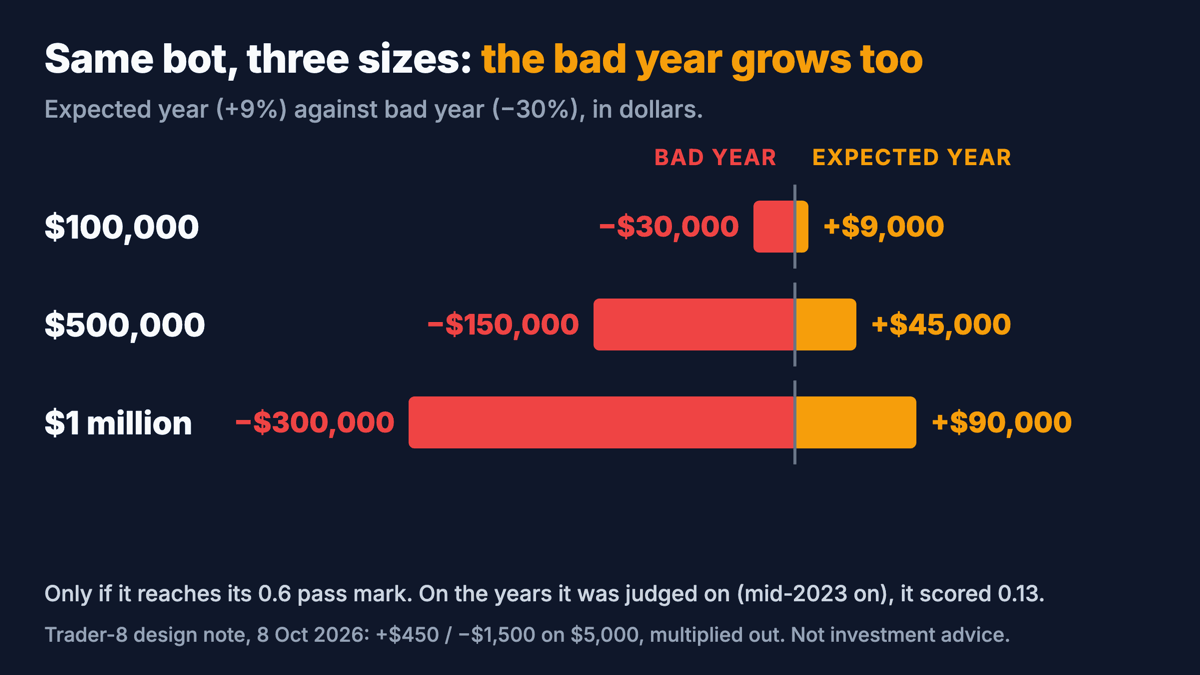
Trader-8's plus 9% and minus 30%, multiplied out by me. Both assume it passes its test.
Ninety thousand a year looks like a salary. But whatever the account, the bad year is more than three times the expected one, in the other direction. One bad year takes back more than three expected years earn. Size changes the dollars. On its own, it doesn't change the percentages.
It's worse if you're living off it. Take $90,000 from $1 million in a year that loses 30%, and the next year starts on $610,000. Climbing back from minus 30% takes a 43% gain, more than four of Trader-8's expected years.
Why plan for a year that bad? It's the price of following trends. Trader-8 buys a coin that closes above its recent range while the trend is up, and bets on a fall when one closes below its range in a downtrend. The note's reading of the research is that a well-run trend system on this many coins falls 30 to 45% from its high in bad years, and that 2022 and 2023 were bad years. Two in a row.
Trader-8 has brakes. Its risk halves after a 10% fall from its high, halves again at 20%, and at 25% it stops trading and pages me. The note still plans for minus 30%. And a stopped bot earns nothing while it's stopped.
What size does change
Fixed costs, like paying an AI to read the news, shrink as a share of a bigger account. That's the honest argument for scaling.
Fills can get worse. On a thin coin, a big order pushes the price against you as it fills. Trader-8 hasn't traded real money yet, so that cost has no number. The note won't scale anything until $1,000 to $2,000 of real money has run 20 trades inside the cost budget. Even that measures fills at $2,000, not at $1 million.
The 9% is a target, not a result
The 9% is what a return-to-risk score of 0.6, the pass mark, gives at the 15% risk level the note chose: 0.6 times 15%. I set that bar before testing the rule. On Trader-8's scorecard, for the years it was judged on, from mid-2023, the rule scored 0.13. By the same sum, my arithmetic, that's about 2% a year. It passed one of its four checks, keeping its worst fall to 22.3% against a 35% limit, and failed the other three.
A revised version scores far better, but two of its three changes were chosen with the test years in view, which is looking at the answers. So it's running forward on paper from 10 October and is judged on 31 January 2027 at the earliest. Its own spec says sixteen weeks is a weak test of profit and a fair test that it behaves as built. The 9% stays a target after January too.
The strongest objection
A financial planner would say I've framed this wrong. A sensible person doesn't put $1 million into one strategy. You size the slice so the bad year is one you can afford: put $100,000 of a $1 million pot into Trader-8, and minus 30% costs the whole pot 3%. Comparing a bad year with a salary is the wrong test.
That's right, and it's my point. Sized so the bad year is affordable, the slice's expected year, if Trader-8 passes, is $9,000. On these numbers you can have the income or the affordable bad year. You can't have both from the same bot.
The test, before you scale anything
Before you scale any bot, yours or one you're being sold:
- Get its expected year and its bad year as percentages of the account. For the bad year, ask for its worst twelve months and its biggest fall from a high, with dates, after fees.
- Ask whether each number comes from live trading, a backtest or a target. My expected year is a target.
- Multiply both by the money you'd put in. If you couldn't live through the second number, the first one isn't an income.
If the paper run passes, Trader-8's first real money is $1,000 to $2,000. That's the right size for a bot whose expected year is still a target.
Sources
- Trader-8 design note, 8 October 2026:
docs/ground-up-redesign-2026-10.mdin the private Trader-7 repository. The plus $450 and minus $1,500 at $5,000 on a 0.6 net Sharpe and a 15% annualised vol target, the tenfold scaling at $50,000, the 30 to 45% drawdowns in bad years on this many coins with 2022 to 2023 named as bad years, the entry rule (Donchian breakout in the direction of the trend, long or short), the drawdown ladder, and the $1,000 to $2,000 live stage over 20 trades. - Trader-8 Stage 0 scorecard, 9 October 2026:
trader8/results/stage0-2026-10-09/scorecard.md. Out-of-sample net Sharpe 0.13 against 0.6 (out-of-sample from July 2023), and the other three checks. - Trader-8 forward-run spec and revised scorecard:
trader8/SPEC-stage0-v2.md,trader8/results/stage0-v2-2026-10-09/scorecard.md. Two of three changes chosen with the out-of-sample half visible, the 10 October 2026 start, the 31 January 2027 judgement and what sixteen weeks can and cannot show.