Testing your own belief feels boring. Defending it feels great. The gap is the tell.
Jamie Watters
Operational resilience and AI delivery practitioner.
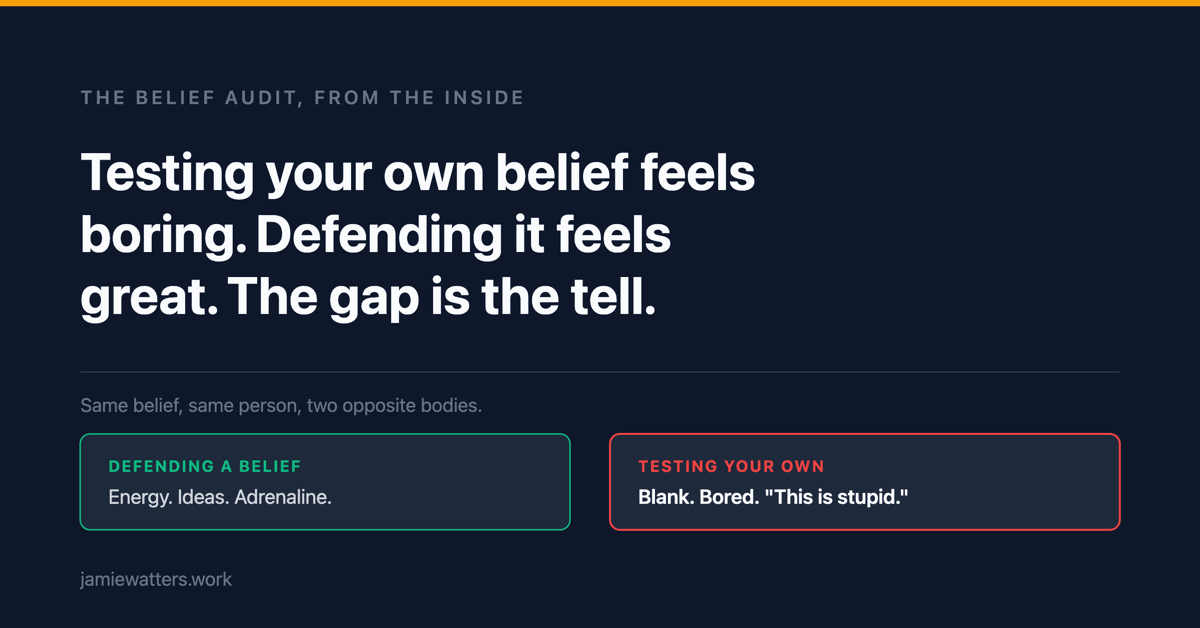
Who this is for. Anyone trying to check their own thinking rather than win with it. By the end you'll have one signal you can use the same day: testing your own belief feels flat, defending it feels good, and the gap between those two is the tell.
Skip it if you haven't hit this yet. The piece assumes you've tried to audit a belief you actually hold and noticed the pull to stop.
On the length. Thirteen minutes. The signal is in the first two sections. The rest is what else the feeling could be, which matters only if you want to be careful about the claim.
Last week I published the results of auditing three beliefs I hold, using the rule I apply to everything I write: never state a claim you have not seen the source for. Each belief turned out to be two claims in one sentence, a half a result could contradict and a half nothing could touch. That piece is about the method. This one is about something I left out of it, because I did not recognise it until the audit was over.
It is what the audit felt like from the inside. It did not feel like being challenged. It felt like being bored.
The moment the fuel went off
The audit runs as a conversation with an AI agent. It asks me to state a belief so that it could be wrong, then asks what would lower my confidence in it. When it reached the half of the belief that nothing could touch and pushed on it, something happened that I had not expected.
I could not frame a reply. Not because the question was hard. Because I had nothing to run on. The question felt stupid. The whole exercise felt boring and pointless, and I wanted to be somewhere else. If I had been alone with a notebook instead of in a session with an agent that kept asking, I would have stopped, and I would have told myself the task was dull.
Now put me on the other side of the same question. Somebody attacks a belief I hold, or I go after one of theirs. Adrenaline. Energy. Arguments arrive without being called, three at a time, and I have to choose which to use. I could do it for hours and enjoy it.
Same subject. Same person. Opposite body.
Boredom is a better disguise than anger
I had expected resistance to look like resistance: irritation, a defensive argument, a raised voice inside my head. That would have been easy to spot.
What arrived instead was a blank. And a blank does not read as a fact about me. It reads as a fact about the task. "This is boring" is a judgement about the work, and it is the kind of judgement I act on without examining, because why would you examine boredom? You just stop doing the boring thing.
If it is a defence, that is what would make it effective. Anger says "I am threatened". Boredom says "there is nothing here". The second one ends the audit without anyone noticing an audit was ended.
The psychology literature has a definition of boredom that half fits. Eastwood and colleagues define it as "the aversive experience of wanting, but being unable, to engage in satisfying activity" (Perspectives on Psychological Science, 2012). They add that the bored person blames the environment rather than themselves. Being unable to engage, and blaming the task: that was my afternoon. The wanting is what does not fit. Mine had less wanting in it than that, and by their definition it may not have been boredom at all. I take that as a clue. A blank with no wanting behind it looks less like boredom and more like avoidance.
There is a brain-imaging study I first read as pointing the same way, and it does not. Kaplan, Gimbel and Harris challenged the political and non-political beliefs of forty self-described liberals in a scanner and found more default-mode-network activity for the political challenges (Scientific Reports, 2016). They read it as a search through memory for counterarguments, because people took slightly longer over the political ones. That is my energised side, not my blank.
A preregistered replication published in January 2026 is closer. Forty-three people in Poland, the same design (Scientific Reports, 2026). The identity signal in the brain came back. The emotion link did not: how much people changed their non-political beliefs had no relationship with activity in the amygdala or the insula, with moderate evidence for no relationship at all. And after the challenges, people rated their political beliefs faster than their non-political ones, which the original study had also found. The authors offer, as one possible explanation among others, that under high identity relevance people "may disengage from analytic evaluation more quickly, defaulting instead to rapid dismissal heuristics rather than extended counterarguing". That is the closest peer-reviewed sentence I have found to my blank. A hook, not proof: it interprets a timing difference and measures no boredom. What it lends the "not with fear" part is thin: the one link between emotion regions and changing your mind that the original study reported did not come back, a null on one correlation, among left-leaning people.
Avoidance itself is well documented, and it scales with how much of you is in the belief. A meta-analysis of selective-exposure studies found a moderate preference for choosing information that agrees with you over information that challenges you, weaker for beliefs not tied to your values or not held with conviction (Hart and colleagues, Psychological Bulletin, 2009). It also found the preference reverses when the challenging information serves a goal you have right now, which is the condition an audit is trying to create. So people choose what agrees with them, more so when the belief matters to them, and an audit is an attempt to want the opposite.
Why this breaks the method
The audit protocol I wrote assumed the obstacle would be argument. Build the strongest opposing case, it says. Do not accept "that doesn't matter" as an answer. Both rules are aimed at a person who is fighting back. They are useless against a person who has gone flat, and the method fails silently: the person running it concludes the belief was fine and the exercise was dull.
So here is my hypothesis, and I want it read as one. The belief does not argue back. Something in me withdraws the fuel from the part that would test it, and lets me blame the task. My working name for it is that the ego uses the body against you: not with fear, which you would notice, but by removing the wish to look. I have not found that studied, and I have asked for the search. The test is below.
What else it could be
The plain rival is that it was nothing of the kind. Not willpower running out. Ego depletion, the idea that self-control is a tank that empties, came out close to zero in two large preregistered replications, one across 23 laboratories and one across 36 (Hagger and colleagues, Perspectives on Psychological Science, 2016; Vohs and colleagues, Psychological Science, 2021). The real rival is stronger. Motivational intensity theory says effort drops away when a task is judged impossible (reviewed by Richter, Gendolla and Wright, 2016). Being asked what would lower your confidence in a claim you have decided nothing can touch is a task you have judged impossible. The leading model of boredom says the same from the other side: boredom is what you feel when an activity has no attentional grip or no meaning for you (the MAC model, Westgate and Wilson, Psychological Review, 2018). So the rival predicts a blank on any question judged impossible, whoever holds the claim. What it does not obviously predict is a bigger blank on the beliefs that matter most to me, because a belief with a lot of me in it has meaning by definition. If the test finds the blank scales with stake, the rival has something to explain. I cannot tell any of this apart by introspection, and neither can you.
There is a two-minute exercise, borrowed from a real finding without replicating it. Trouche and colleagues had people produce arguments to logic problems, then judge arguments they were told were someone else's. One of those was their own. Among those who did not notice the switch, more than half rejected it (Cognitive Science, 2016). That was logic problems under a deception, and you cannot be fooled about your own belief by an agent you instructed, so this is a prompt, not that experiment. Take the claim you went blank on, have the agent restate it as a stranger's belief, and attack it. What it shows is whether the ideas come when the claim is not yours to protect.
So I am going to run a test on myself, and the rules are written down before I start. Over the next two weeks I will do ten short sessions with the agent, twenty minutes each. In five of them it will push on the untouchable half of a belief that matters to me. In the other five it will push on the untouchable half of a belief I do not care about, chosen to be about as hard to answer. I will not know which kind is coming: the agent picks from a shuffled list and writes down what it picked. In every session it asks the same questions in the same words.
Afterwards I note four things. How long before I gave an answer that named a way the claim could be wrong. How many such answers I gave. Whether I quit. How bored I felt. A week later I re-read each transcript without knowing which kind of session it was, and score it again.
If the blank comes just as hard on the beliefs I do not care about, then the question caused it, not the belief, and the close of this piece is wrong. I have written that down before starting so I cannot move it afterwards. It is a test of my own bet, run by me, so it proves nothing to anyone else. Either way, the result goes on this page.
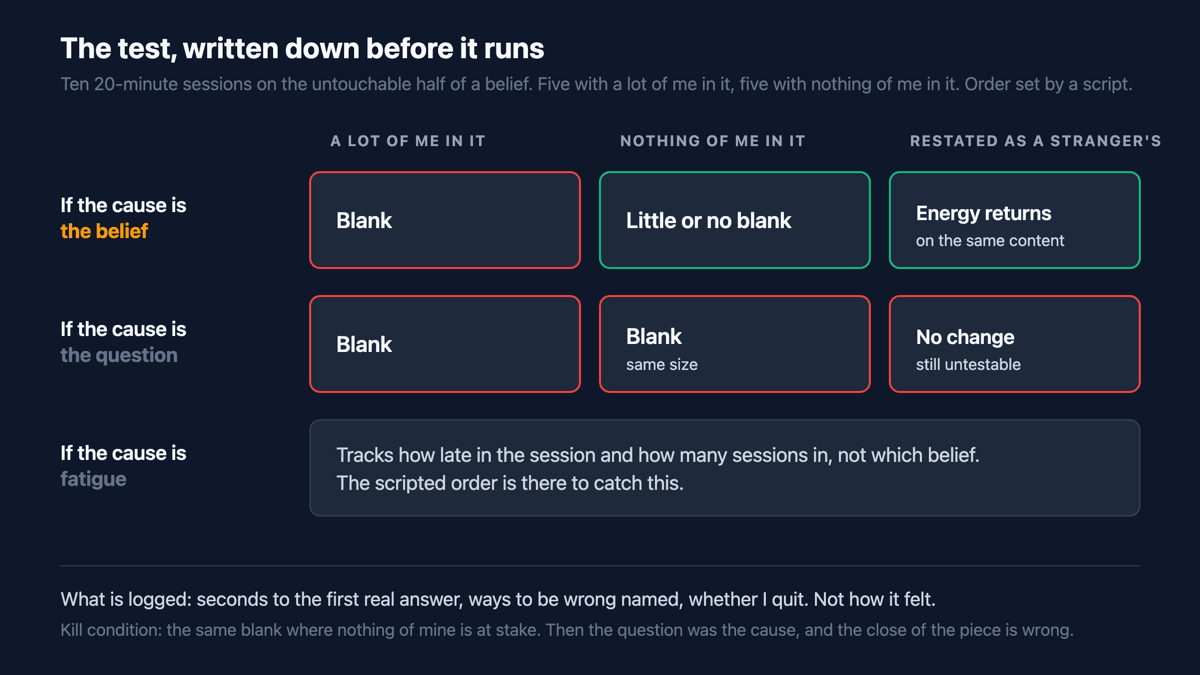
The predictions, filed before the first session. Whichever row the data matches goes on this page.
What I do now
The protocol has new steps, and they are the part of the audit that is about the body rather than the belief.
The wall protocol
- Expect the wall. In each of my three beliefs there was a point where the questions started to feel stupid and the whole thing felt boring. Treat that as the first result, not a verdict on the task. Write down, in the session, which claim was on the table and what the last question was.
- Name it, out loud, in the session. "I have gone blank and this feels pointless, and I think that is resistance." Saying it turns it from something I am inside into something in front of me.
- Stop, and restart on the claim. A pass takes me fifteen to thirty minutes with the agent asking the questions. No belief has taken one pass. When the wall comes, end the session and come back the next day, starting on the claim you wrote down, not at the top. A belief is done when its untouchable half either has a test with a date on it, or is written down as something I want to be true.
- Watch for the argument that arrives with energy. When an answer comes fast and feels good, suspect it. Write it down as the claim's own argument, then go and look for the one thing it would have to survive: a source that says the opposite.
- Swap the owner. Fifteen minutes in, have the agent restate the claim as a stranger's and attack it for five minutes. If the ideas come now, note that: the wall was about ownership.
- Do not raise your standards. Apply the ones you have. Take the claim on the table and ask it the two questions I ask of any number in somebody else's post: what would I have to see to accept this, and where would that be? Then go there.
I went into this expecting to find bad arguments. I found something below arguments: at the exact moment I needed to think, I did not want to, and the not-wanting came dressed as a judgement about the work.
My bet is that the boredom was the belief. Now I know what that feels like from the inside, and the test is on the list.
Sources
- Eastwood, Frischen, Fenske and Smilek, "The Unengaged Mind: Defining Boredom in Terms of Attention", Perspectives on Psychological Science, 2012. https://doi.org/10.1177/1745691612456044
- Kaplan, Gimbel and Harris, "Neural correlates of maintaining one's political beliefs in the face of counterevidence", Scientific Reports, 2016. https://www.nature.com/articles/srep39589 (the response-time finding and the authors' interpretation are in the Results and Discussion)
- Kossowska, Szwed, Czarnek, Honcharowa, Domagalik and Doradzińska, "Neural correlates of belief change in political and non-political domains among left-wing individuals confronted with counterarguments", Scientific Reports, 8 January 2026. https://www.nature.com/articles/s41598-026-35397-6 (46 recruited, 43 with behavioural data; DMN result replicated; no correlation between amygdala or insula activity and non-political belief change, Bayes factors for the null from 4.04 to 5.32; belief ratings after the challenges faster for political statements, 5.16 s against 5.70 s, as in Kaplan's 4.14 against 5.01 s; the "may disengage" sentence is offered as one possible explanation; the authors qualify their conclusion as holding at least among left-leaning people)
- Hart, Albarracín, Eagly, Brechan, Lindberg and Merrill, "Feeling validated versus being correct: a meta-analysis of selective exposure to information", Psychological Bulletin, 2009. https://doi.org/10.1037/a0015701 (d = 0.36; weaker when beliefs were not relevant to values or not held with conviction)
- Trouche, Johansson, Hall and Mercier, "The selective laziness of reasoning", Cognitive Science, 2016. https://doi.org/10.1111/cogs.12303 (56% and 58% rejected their own arguments when told they were someone else's)
- Hagger and colleagues, "A multilab preregistered replication of the ego-depletion effect", Perspectives on Psychological Science, 2016. https://doi.org/10.1177/1745691616652873 (23 laboratories, d = 0.04)
- Vohs and colleagues, "A multisite preregistered paradigmatic test of the ego-depletion effect", Psychological Science, 2021. https://doi.org/10.1177/0956797621989733 (36 laboratories, d = 0.06)
- Richter, Gendolla and Wright, "Three decades of research on motivational intensity theory", Advances in Motivation Science, 2016 (review; the primary experiments were not read for this piece)
- Westgate and Wilson, "Boring thoughts and bored minds: the MAC model of boredom and cognitive engagement", Psychological Review, 2018. https://doi.org/10.1037/rev0000097
- The audit itself: "How to tell which of your beliefs cannot be wrong, and why it matters". https://jamiewatters.work/journey/audit-your-own-beliefs