How to tell which of your beliefs cannot be wrong, and why it matters
Jamie Watters
Operational resilience and AI delivery practitioner.
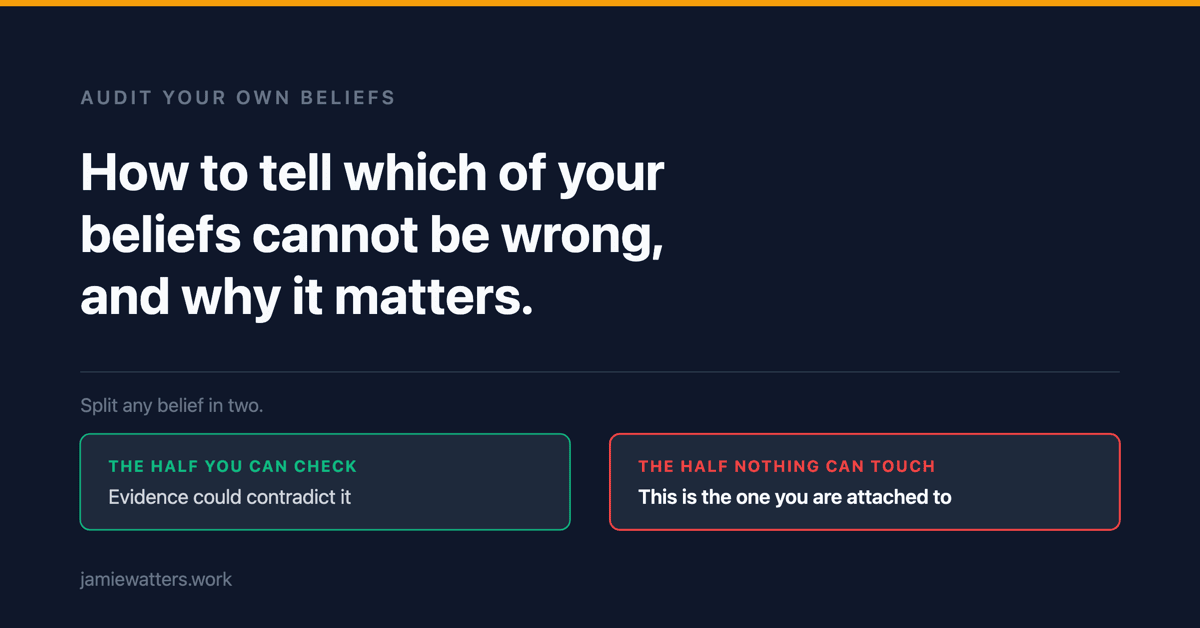
Who this is for. Anyone who wants to know which of their own beliefs are actually testable. By the end you'll have a move you can run on one belief in about twenty minutes: split the sentence into the half evidence could touch and the half nothing could, and see how much is left.
Skip it if you're after a philosophy of science. This is a practical move demonstrated on three beliefs I hold, not a treatment of falsifiability.
On the length. Twenty-three minutes, and most of it is the three worked examples. The move itself is the first two sections, and you can stop there and still run it.
I have a rule for everything I publish: never write a number, a date or a claim I have not seen the source for. It has been useful. It has also been comfortable, because it governs what I say rather than what I think.
So in August I turned it inward and ran it against beliefs I actually hold. Not positions I argue in public. Things I would have told you were true if you had asked me over a coffee.
Three of them so far, and all three broke in the same place.
The move that did all the work
Every one of those beliefs turned out to be two claims sharing one sentence. A half I could check, and a half that no evidence could ever touch.
Take the sentence and split it. Which part could a result contradict? Which part is built so that nothing could?
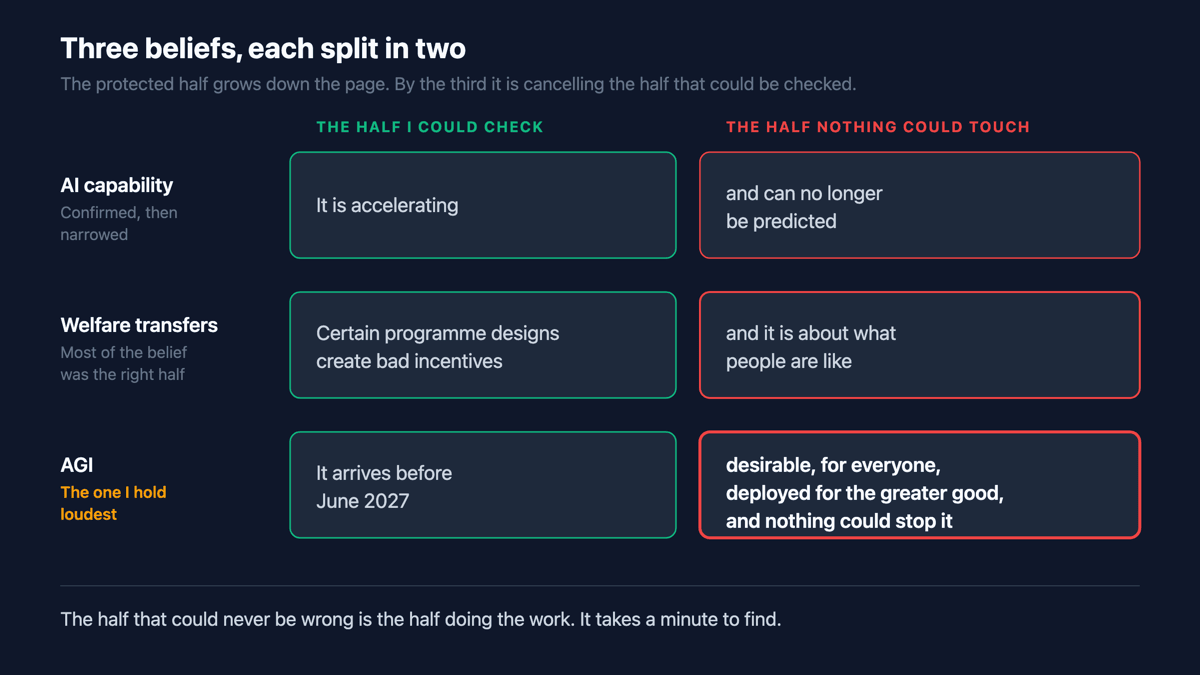
Take the first of mine, as I stated it in August: AI capability is accelerating, and its advance can no longer be predicted. The first half can be checked against a measurement. The second half cannot, and it was there for a reason.
A value is not what I mean by the second part. You cannot measure whether something matters, but you can argue about it, and people do. The half I mean is different. It is built so that nothing counts against it, not evidence and not argument. It moves its own goalposts.
That is the whole test, it takes about a minute, and it comes before any research at all. That is why it is worth having. The expensive part of examining a belief is the reading, which is why almost nobody does it. Splitting the sentence is free, it goes first, and it tells you something on its own: the half that cannot be wrong is the half you are attached to. The other half is decoration you keep around to make the first one look respectable.
Sometimes the split does most of the work before any reading starts. It did on all three of these, and on the third it turned up a contradiction I had never noticed.
Why this is harder than it sounds
The obvious explanation for why people do not examine their own beliefs is that they are lazy. It is the wrong explanation, and it is worth replacing, because it makes the problem look like a character flaw rather than a mechanism.
Here is the better one. A belief you have held for a while stops being something you carry. It starts carrying you: it is holding up part of who you think you are. Once that has happened, someone questioning the belief is questioning you, and losing it feels like losing a piece of yourself. The response is not curiosity. It is the physical, defensive thing you feel when somebody criticises your work in front of colleagues.
There is a research literature on this under identity-protective cognition. The finding that made it famous is the one that makes it worse: that being better at reasoning does not help, because it hands you more sophisticated tools to defend what you already think.
That famous finding is the contested part. A preregistered replication published in Cognition in 2021 tried to reproduce it and could not. What it did find was the simpler pattern: people read the same facts in whichever direction their politics points, and the better reasoners did it no more than anyone else.
So the mechanism I am leaning on is the simple one, and it is enough. The flattering version, that clever people have this problem worst, is the one to hold loosely.
It also means the usual advice does not reach the problem. Be more careful, be more rigorous, check your sources: all of that is rigour applied by a person who still has to be right, and it produces better defences. The fix is to change what you are protecting. Not a person who holds correct views, but a person who tests them. Then somebody attacking one of your beliefs is doing you a favour rather than an injury, and you can defend it hard without needing it to win.
That is a much bigger ask than being careful. It means changing who you think you are, and I want to be honest that this is what the piece is asking.
It is also less frightening than it sounds. You do not come out smaller. What is left is the part you actually stand on, and you stand on it harder.
What it felt like from the inside I will write up separately. It was not fear. The fuel went off.
Somebody who did it
Thomas Sowell spent his twenties as a Marxist. Not casually. He held it through Harvard, through a master's at Columbia, and into doctoral work at the University of Chicago that included a year in Milton Friedman's classroom. None of that moved him, which tells you something on its own about how far argument gets you.
What began to move him was a summer job.
In 1960, as a graduate student, he took a post at the US Department of Labor and was put on minimum wages in Puerto Rico. As the minimum wage rose, employment fell. Two explanations fitted the data equally well: workers priced out of their jobs, or hurricanes destroying the sugar crop during harvest. Chicago had taught him that when two theories compete, there is usually a measurement that separates them.
He worked out what it was. How much sugarcane was standing in the fields before the hurricane struck.
He asked for the number, expecting to be congratulated. In his telling he got stricken faces, then a chain of command running from the Secretary of Labor to the Secretary of Agriculture and back, and then nothing. He says he is still waiting.
That was the beginning of the end of his Marxism, and it is worth being exact about why, because it was not Friedman's arguments and it was not the wage data. Marxism, as he held it, assumed a government that acts for the people at the bottom. Here was a government department with the means to find out whether its own policy was hurting those people, and it did not want to know. The belief could not survive the people who were supposed to embody it refusing to check.
Two things in that story matter more than the conclusion he reached.
The first is what actually changed. He did not learn a new fact about wages and swap one economics for another. He learned that a belief has to be put next to a measurement, and that he had carried his through his twenties without once doing it. He did not raise his standards. He applied the ones he already had to the one belief he had been keeping away from them. That is what an audit is. Not becoming more sceptical. Pointing the scepticism you already have at the thing it has been carefully avoiding.
The second is why the number never arrived, and it is not that anybody lied. The department administering the minimum wage had budgets and careers resting on the answer. Nobody had to deceive anyone. Nobody had to refuse. The question went up the chain and did not come back, because every person it passed had something to lose if the answer was the wrong one. That is how an institution protects a belief: not by lying about it, but by making sure the question that would test it never gets answered.
What a belief with no protected half looks like
It would be easy to read all this as saying every belief hides a half that cannot be wrong. It does not. The healthy kind exists, and it is worth knowing what one looks like.
For most of the twentieth century medicine held that stomach ulcers were caused by stress and excess acid. That belief was testable, it fitted what doctors saw, and it had stood for decades. It also carried a reason nothing could contradict it: bacteria could not live in stomach acid, so nobody looked for one.
Two Australian doctors, Robin Warren and Barry Marshall, found one anyway. They cultured it in 1982 and had their first paper turned down in 1983. In 1984 Marshall drank a culture of the bacterium and was ill within days, with the inflammation confirmed by biopsy. The field took about a decade to come round: the US National Institutes of Health accepted the link at a consensus conference in 1994, and the two received the Nobel Prize in 2005 (Nobel Prize press release, 2005; timeline).
That is what a healthy belief looks like from the outside. Not one that never fell. One that could, and did, and the people holding it changed, slowly and under protest, because the test was real and somebody ran it. The protected part, "nothing could live in there", lasted exactly as long as nobody checked.
The first split: a small half that could not be wrong
The belief, as I stated it in August: AI capability is accelerating, and we are at or near the point where its advance can no longer be predicted.
Splitting that took about a minute and did most of the damage. The first half is empirical. The second half is not, and when the agent running the audit asked what would lower my confidence in it, I could not name anything. What I produced instead was an argument for why nothing could. A lab shipping a model without a capability jump would be committing commercial suicide. So the jumps will keep coming, and there will never be a pause to learn from.
Notice what that is. It is not evidence for the belief. It is a reason no evidence could arrive. I was not doing that on purpose. I did not know I was doing it at all. That is the skill the protected half has learned: it ends the conversation before anything can reach it, and it does not ask you first.
So I tested the half that could be tested, against three measures I named before looking. METR's task-horizon work has the length of task a model can complete doubling roughly every 196 days across the full series, 131 days measured from 2023 and 89 from 2024 (METR, Time Horizon 1.1, January 2026). Epoch AI puts the fall in cost at fixed performance somewhere between nine and nine hundred times a year, depending on the capability. Intervals between frontier releases have narrowed.
Confirmed, then, and it still got smaller. METR say their own estimates past sixteen hours are unreliable and that their test suite is saturating. Release cadence is rising while the labs converge on what their models can actually do. What survives is a fast, measurable trend that doubles on a rough schedule, and a trend with a schedule is one you can plan against.
Which is what the protected half was there to prevent. "We cannot predict it" was doing no work at all, except excusing me from planning.
Re-reading this three weeks later, I found that "cannot be predicted" was not quite what I believe either. What I believe is narrower. Until about 2024 progress arrived on something like a Moore's-law schedule, so you could see what was coming and estimate it well. Now it arrives faster, and by routes a human would not take: chips designed for one task rather than for generality, designs with none of the habits and attachments of the people who used to make them. So the past has lost most of its value as a guide to what comes next.
Stated that way, the protected half turns out to have a test of its own. If precedent has stopped working, the people who forecast AI capability for a living should have got worse at it since 2024 than they were before. Forecasting tournaments keep their records. I have not run that comparison. It is on the list, and until I do, that half of the belief is a claim I have not checked rather than one nothing could touch.
That is the gentle version of this. The protected half was small, it gave way as soon as I stated the belief properly, and losing it cost me nothing.
The second split: the half that could not be wrong was most of the belief
Here is a belief I held: generous welfare transfers create dependency and reduce people's capacity to lift themselves out of poverty.
I would have told you that was empirical rather than political, and I would have been sincere. I try to hold no party, on purpose, because I would rather be right than belong, and I would have told you that made me safe here. When I actually went looking, the first finding was not about the evidence. It was that in a vault holding several hundred notes, I had never written anything down about it. No sources, either way. Not one.
Split it and there is a claim about programme design, which is testable, and a claim about what people are like, which is not. I held both and could only have shown you evidence for one.
On labour supply, the strongest evidence is real and it is smaller than the belief. Vivalt and colleagues randomised a thousand low-income Americans to $1,000 a month for three years against a control group of two thousand receiving $50. Labour market participation fell 4.2 percentage points and hours worked fell by one to two per week (NBER Working Paper 32719, issued 2024, revised August 2026). That is a genuine effect in a rich country with a meaningful transfer. It is also not a lifestyle. Set that against a pooled reanalysis of seven randomised trials of government cash transfers across six countries. It found no detectable effect on whether people worked or on their hours, for men or for women (Banerjee, Hanna, Kreindler and Olken, World Bank Research Observer 32:2, 2017).
A note on that first figure, because it is the sort of thing this piece is about. I published it as 4.1 points and 1.3 hours, from an earlier version of the Vivalt paper. The current revision says 4.2 and one to two hours, and I have corrected it here. The difference does not change anything. The lesson does: checking a source once is not the same as the source holding still.
On the self-lifting half, the evidence largely runs the other way. Akee and colleagues studied an unconditional per-capita casino dividend paid to the Eastern Band of Cherokee. An extra $4,000 a year to the poorest households added a year of education by age 21. It also cut the chance of a minor criminal offence among 16 and 17 year olds by 22 per cent (American Economic Journal: Applied Economics 2:1, 2010).
And something did survive, which matters as much. Dahl, Kostøl and Mogstad used Norway's disability system, where appeal judges are randomly assigned and differ in leniency. When a parent is allowed disability insurance on appeal, their adult child's participation in the same programme rises six percentage points over five years and twelve after ten (Quarterly Journal of Economics 129:4, 2014).
So what is left is the programme design claim. Schemes you qualify for by claiming a status, or whose benefits fall away steeply as you earn, produce modest reductions in measured work. In the disability case they also pass participation to the next generation.
That is a real finding and it is not what I believed. The claim about what people are like was the part doing the work, and it was the part with nothing behind it. This one was harder to lose than the first, and the reason is not complicated: it was most of the belief.
The third split: the half that could not be wrong cancelled the rest
The third is the belief I hold loudest, which is the reason it went last.
The belief: AGI and ASI are desirable and inevitable. I would prefer them available to everyone, and deployed where they do the most good for the most people.
That is four claims in two sentences, and when I split them only one is about the world. Desirable is a value. Available to all is a preference. Deployed for the greater good is a rule for somebody to apply. You can argue with all three, but no result can contradict them. Only "inevitable" is a prediction.
And "inevitable" was doing something worse than protecting itself. It was at war with the sentence next to it. Inevitable can mean "will be built", and that sits comfortably beside a wish to see it deployed well. That is not what I meant by it. My version, spelled out, is that any restraint just hands the lead to whoever ignores it, which is a claim that it cannot be governed. Deploying AGI where it does the most good needs somebody able to decide where it goes, which means the power to withhold it. My inevitability says that power does not exist. I had held both, one sentence apart, and never noticed.
When I asked what would lower my confidence in "inevitable", I got the same shape as the first belief: an argument for why nothing could. A pause will never be unilateral, so it hands the lead to whoever ignores it. I still think that argument is right. That is not the point. The point is that it is the kind of argument that keeps evidence away from a belief, so the belief needed a different test.
The argument does have a piece that can be checked, so I checked it. If restraint by the closed labs simply hands the lead to the open models, the gap between them should be small. Epoch AI measured it. Since January 2026 the best open-weight models have trailed the best closed models by an average of four months on its capabilities index (Epoch AI, May 2026). That is about 8 points, roughly the distance between GPT-5 and GPT-5.5. Four months is short. It is also a lead, not a hand-over: whoever paused would be four months behind, not out of the race. The argument survives, smaller than I held it.
What was left was a prediction with no date on it, which is the fault I had just spent two audits learning to see. So I gave it one. AGI, meaning an AI that exceeds a human at any cognitive task, exists before June 2027.
That test has a weakness the first two did not. Nobody agrees who judges "any cognitive task", so a miss in June 2027 could be argued away by redefining the task, which is the exact move this essay is about. So the judge is not me. The judges are independent evaluators, not the makers. If in June 2027 I cannot point to a system they describe as beating expert humans across everything they measure, I was wrong, and this page is where I will say so.
The agent also asked whether a visible slowdown would count against it, and my honest answer was no: a slowdown just makes it later. So this belief has exactly one way to fail, and it is written down. That is one more than it had a week ago.
What the three of them show
Read the three in order and the shape is hard to miss. A small protected half. Then a protected half that was most of the belief. Then a protected half at war with the testable claim beside it, arguing that no evidence could reach it anyway.
And the protection scaled with how much of me was in the belief. The one I could state most precisely was the one I cared about least. The one I hold loudest had three claims that could not be touched wrapped around one prediction, and the prediction had no date until somebody made me give it one.
That is not a character flaw, it is what the identity problem looks like from the inside. A belief doing structural work in your life is one you cannot afford to lose, so it quietly acquires a half that cannot be lost. Nobody decides to do this. You just notice, years later, that the beliefs you would defend hardest are the ones you have never written anything down about.
A correction to the first version of this piece
The first version of this essay, published on 6 September, had a different third belief: that regulated financial services buyers would pay a premium for my resilience and AI experience once I was back on the market. I wrote that it had no testable half, and that it was the belief my income rested on.
Three days later, going back through the audit notes, I found that it was not my belief. The agent running the audit had drawn a portrait of what I believe from what it had read and stored about me, and that claim came out at the top of the list. I audited it without asking whether I held it. At the time I said it was not carrying much weight, and the audit recorded that as a dodge. It was partly that. It was also true. My actual position, once I stated it, is duller and testable: the market sets the rate, and a premium exists only where a skill is both rare and in demand.
I am leaving this here rather than quietly swapping the section, because it is the sharpest example in the piece of what the piece is about. A claim that appears often enough in your own notes starts to read as something you think, and a model that keeps your notes can put it there. Frequency impersonates truth, in a head, in a search engine, and in a model. Now, it turns out, in a second brain as well.
If you want to do this
Five steps. With an AI agent asking the questions, a pass took me fifteen to thirty minutes. But no belief took one pass. Each time I hit a wall, and the wall is the point: stop, come back the next day, and the second pass gets further.
Split the sentence. Find the half a result could contradict and the half nothing could. If there is no first half, stop. You have found that this is not a belief about the world at all. It is something you want to be true, dressed as a fact. No amount of reading will change that, because there is nothing for the reading to touch.
State the testable half so it could be wrong. Not "I think X is broadly true", but the sentence a result could contradict.
Predict before you look. Write down what you expect the evidence to say. Otherwise whatever you find will feel like confirmation.
Find the strongest opposing case, not a straw one, and note whether you had ever met it before. I had not, and the leading opposing source was a World Bank publication rather than anything obscure.
Say what would change the verdict, and by when. A belief with no such condition is not a belief you hold. It is a belief that holds you.
Here is what that looks like on an ordinary belief with no politics in it. Say you believe your team has got slower since it went remote.
Split it. "Delivery has slowed since we went remote" is the half a result could contradict. "People do not work as hard when nobody can see them" is the other half: a fast month means they are catching up, a slow month proves the point, and nothing you could measure would touch it. Notice that the second half is the one you would say out loud with feeling.
State the testable half so it could be wrong. "Tickets closed per person per month were lower in the six months after the move than in the six months before."
Predict before you look. Write down the fall you expect. A number, not "a bit".
Find the strongest opposing case. Here it is the same figures for a team that never went remote, over the same months, because if they slowed too then remote was not the cause. Note whether you had ever thought to look at them.
Say what would change the verdict, and by when. "If the fall is smaller than I predicted, or the office team slowed as much, I drop it. I will have the figures by the end of the quarter."
Most of the time goes on pulling the ticket counts. The first minute, the split, is the part you will want to skip, and it is the part that told you which half you were attached to.
The whole thing fits on one line, and here is mine. Belief: AGI is inevitable. The half a result could contradict: a system that exceeds a human at any cognitive task exists. By when: June 2027. Who judges: independent evaluators, not the makers. Fill in yours. If the second blank stays empty, you have found the thing.
One line keeps coming back to me, from two educators arguing about why people avoid conversations they disagree with. The charitable reading is that some people dislike conflict, which is temperament rather than cowardice.
The reply stuck. Then should they not hold those beliefs more lightly?
If you are not willing to have a belief tested, that is not an argument for holding it harder. It is an argument for holding it more loosely.
Sources
- Preregistered replication of the motivated-numeracy effect, Cognition, 2021. https://doi.org/10.1016/j.cognition.2021.104768
- Nobel Assembly, press release for the 2005 Nobel Prize in Physiology or Medicine (Marshall and Warren, Helicobacter pylori). https://www.nobelprize.org/prizes/medicine/2005/press-release/
- Helicobacter pylori, history section (1982 culture, 1983 submission, 1984 self-experiment, 1994 NIH consensus conference), Wikipedia. https://en.wikipedia.org/wiki/Helicobacter_pylori
- METR, "Time Horizon 1.1", 29 January 2026. https://metr.org/blog/2026-1-29-time-horizon-1-1/
- Epoch AI, cost at fixed performance, as cited in the first audit session.
- Edwards and Emberson, "Open models lag state-of-the-art closed models by 4 months", Epoch AI, May 2026. https://epoch.ai/data-insights/open-closed-eci-gap
- Vivalt and colleagues, guaranteed-income employment effects, NBER Working Paper 32719, 2024, revised August 2026. https://www.nber.org/papers/w32719
- Banerjee, Hanna, Kreindler and Olken, pooled reanalysis of seven cash-transfer trials, World Bank Research Observer 32:2, 2017. https://doi.org/10.1093/wbro/lkx002
- Akee and colleagues, Eastern Band of Cherokee casino dividend study, American Economic Journal: Applied Economics 2:1, 2010. https://www.aeaweb.org/articles?id=10.1257/app.2.1.86
- Dahl, Kostøl and Mogstad, Norwegian disability insurance and the next generation, Quarterly Journal of Economics 129:4, 2014. https://doi.org/10.1093/qje/qju019