BOS-AI had twelve XML files holding nothing
Jamie Watters
Operational resilience and AI delivery practitioner.
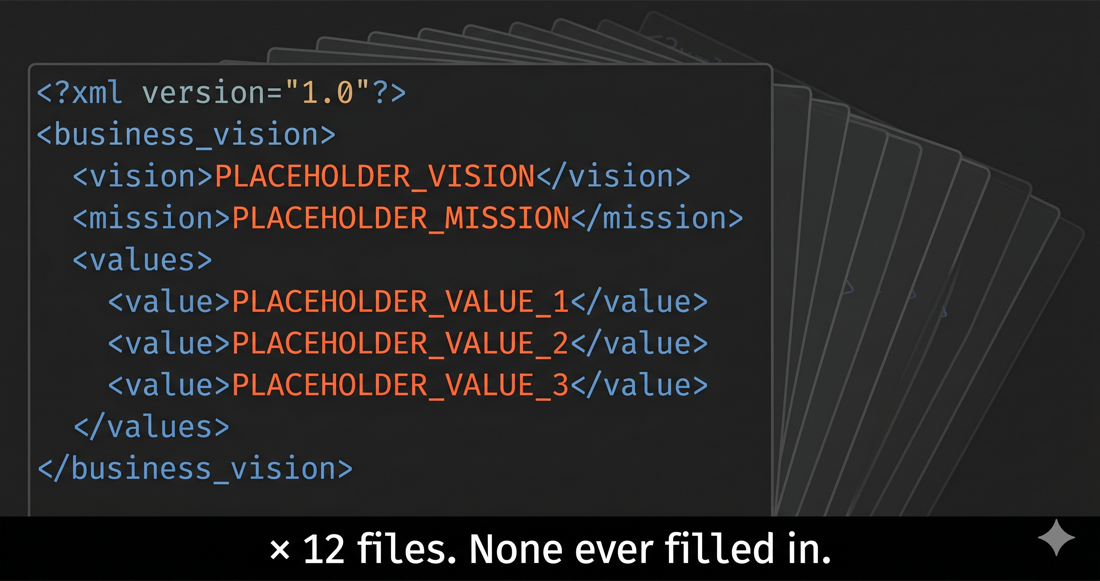
BOS-AI had twelve XML files holding nothing

Twelve XML files, dated October 2025, structured like a database schema for a small business: vision, markets, customers, growth strategies, lessons, decisions. Each file opened with <?xml version="1.0"?> and ran to about 200 lines of nested tags.
Every tag was filled with PLACEHOLDER_DATE, PLACEHOLDER_VISION, PLACEHOLDER_OBJECTIVE_1.
Not "I'll fill these in later." Not "this is the demo data." Just PLACEHOLDER everywhere, in every file, untouched since the day they were created.
This was the "institutional memory" the agents were supposed to read and update before every business decision. Eleven of the thirty agents had a MEMORY INTEGRATION PROTOCOL section listing exactly which XML files to consult. All of them pointed at placeholders.
I'd been thinking about modernising BOS-AI for weeks. The blueprint started as theory: "this looks bloated, here's what I'd strip." Then I checked out the repo and looked at the actual files.
The XML system wasn't bloated. It was decorative.
So I deleted it. All twelve files. Plus the boilerplate that referenced them. That was 17 lines per agent, 192 lines in total, agents claiming to maintain state in files that never held state.
Then I kept going.
The coordinator (coord.md) was 463 lines. Four ASCII box gates announcing 'MANDATORY PLANNING PHASE: DO THIS FIRST!' and 'MISSION STATE CHECK: DO THIS FIRST!' Three different things demanding to be first. Below those, a 'context preservation protocol' instructing every agent prompt to read four workspace files and update three others. Files that I'd archived earlier in the same session.
The coordinator was telling agents to write to files that no longer existed.
I rewrote it in 149 lines. Same dispatch, fewer rituals. The new coord.md is a literal lookup table: /coord vision-mission-creation maps to missions/foundation/vision-mission-creation.md. No fuzzy matching, no 'let me infer your intent,' just a name-to-file mapping. The Universal Router pattern I'd shipped on AGENT-11 a fortnight ago.
Then thirty agents lost their MANDATORY CONTEXT PROTOCOL blocks. Same pattern as the memory deletion: each block was 30 to 50 lines of bureaucracy instructing the agent to read X, write Y, verify Z. I replaced them all with a single paragraph pointing at the foundation documents and a five-field handoff schema. Agents went from 130 lines average to 85.
Total deletion across nine sprints: about a thousand lines of ceremony. Put another way, BOS-AI now has:
- One source of truth for business context (
/documents/foundation/) instead of two - One workspace file for active findings (
agent-context.md) instead of five - One mission routing pattern instead of three
- One voice, enforced by a Bash hook that blocks publishes containing AI tells
- Zero placeholder XML
What I added is small. A seven-rule constitution at the top of the deployable CLAUDE.md. A five-field handoff schema (Findings, Decisions, Warnings, Open, Evidence) that specialists append to agent-context.md at phase close. A routine template for the daily report so it runs on schedule instead of by hand. Done.
The thing I keep coming back to is that the XML files were obviously useless from inside the system. The agents were instructed to "read business intelligence from these files to prevent repeated mistakes." Read what? PLACEHOLDER_OBJECTIVE_1? An LLM is going to behave roughly the same with or without that file open.
But it looked legitimate from the outside. A business operating system with twelve memory files sounds substantial. Sounds like a serious tool.
That is the trap. Tools that perform usefulness instead of being useful. Agents that claim to track institutional memory while opening empty files. Coordinators announcing MANDATORY PLANNING PHASE in ASCII boxes before doing the work anyway.
BOS-AI v1 was performing business. The v2.1 cut is closer to actually doing it. Fewer files, fewer announcements, more reading the foundation documents you actually wrote.
If you've installed BOS-AI before, the migration guide is at library/migrate-from-v1.md. The summary: back up your memories/ folder in case any real content snuck in there, then pull v2.1. Most of the changes are deletions, so the upgrade is mostly a relief.