Is your AI trading bot ready for your money? Mine failed the rules I'd set it on all 185 trades it proposed in September, so I didn't fund it
Jamie Watters
Operational resilience and AI delivery practitioner.
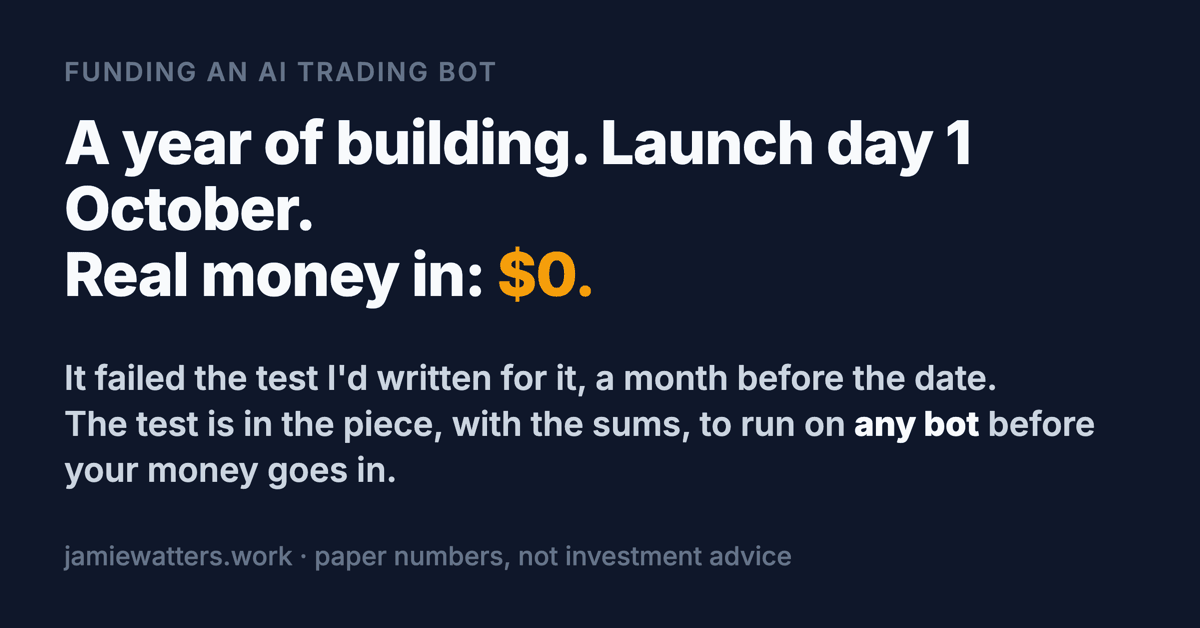
My AI crypto trading bot, Trader-7, was due to start trading real money on 1 October. $5,000, after a year of building it and running it on paper. It got nothing. On 9 October I made that final. Not postponed, not "when the market picks up". Not funded.
A month before launch I had written down the one question the money would turn on, and the rule I'd written answered it. This piece is that question, with the numbers. It's written so you can put it to any trading bot before your money goes in. The arithmetic is trading's; the discipline, a pass mark written first, costs inside the sum, a kill rule and a paper run with a fail bar, carries to any AI system you'd set running and leave alone.
The two earlier pieces in this series covered what a year of AI-picked trades taught me about fees and where a bot can legally run and why a bot's returns don't become an income just because you add zeros. This one is about the decision to put money in, and the test behind it.
The test was a rate, not a date
1 October came from my calendar, not from the market. A launch date is evidence of nothing. So in August I wrote the go/no-go into my task list as a rate. Fund the bot only if the market was offering trades that cleared the bar the bot had set for itself. Trader-7's AI produces trade signals. A signal goes forward only when the expected reward is at least 1.5 times the risk, and becomes a trade only when that ratio reaches 2.0. Both floors were in the code before the test, which is the point. A pass mark written after the result isn't a test.
The task record of 11 September shows the answer. From 6 September, when the system came back from a halt, the AI produced 185 signals. 165 were blocked at the 1.5 floor. The 20 that got past it were all blocked at 2.0. The best ratio on offer was 1.86. The record's own line: "Zero trades in ten days." By 20 September the count was 661 signals and still no trade.
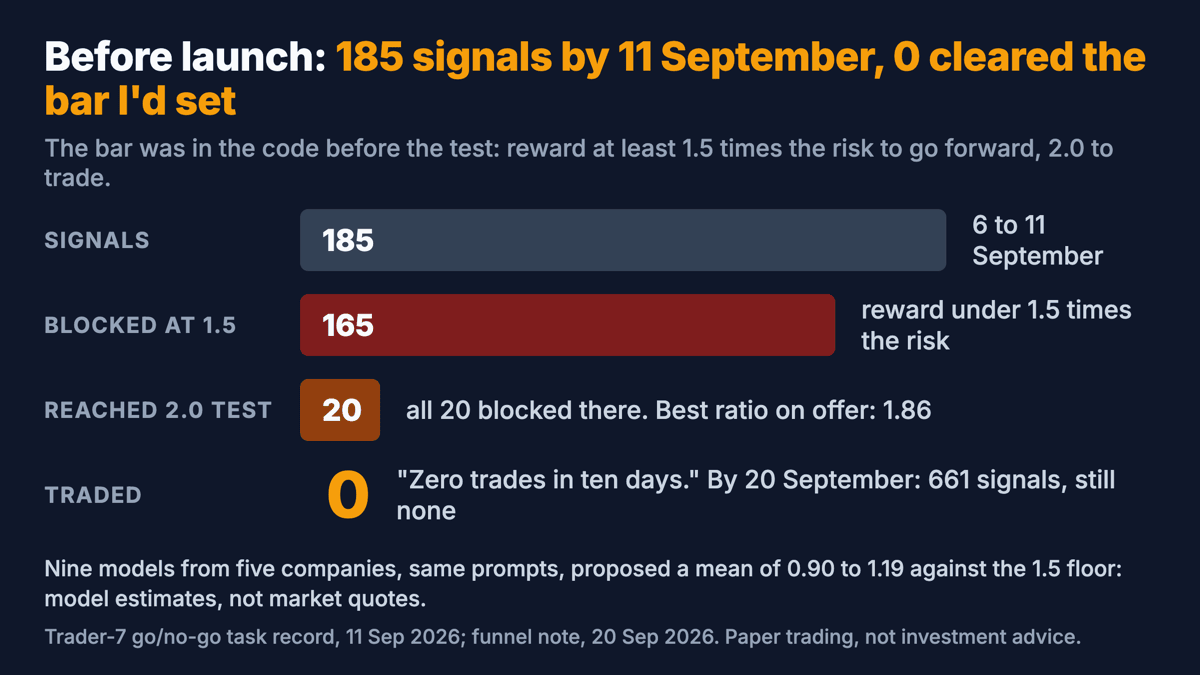
The fortnight before launch, from the go/no-go task record of 11 September 2026 and the funnel note of 20 September. I set the bar; the signals didn't reach it.
Was the model useless? The task record's answer is that nine models from five companies, given identical prompts, proposed a mean reward-to-risk of 0.90 to 1.19 against the 1.5 floor, and its conclusion was that "the market has not offered a trade worth taking". That is a conclusion about model estimates, not market quotes: nine models reading the same prompt can agree for reasons that have nothing to do with price. What it does show is that no model I could find saw a trade at my floor. A system that reports "nothing worth taking" is doing its job, and funding it to watch it do nothing tests nothing.
So on 11 September the launch moved to 1 November and the decision to 20 October, to be re-run against the same criterion. Not the calendar.
The costs were already inside the answer
The other half had arrived on 2 September and was sitting in the decision row of my deadlines file, waiting for me to accept it. For the whole year the code had the venue's fee wrong. Read off my account's own fee tab that day, Coinbase's US futures charged 0.095% maker and 0.100% taker, plus $0.12 a contract each side; the code had assumed 0.03% taker. The percentage part alone was wrong by a factor of 3.33, before the $0.12 a contract. The first piece in this series covered what that does to each trade. What it does to the decision is this, from the same row.
The win rate a bot needs to break even is the average loss plus the round-trip cost, divided by the average win plus the average loss. Trader-7's trades delivered an average win of 1.96 times the average loss, just under the 2.0 it aimed for, so at zero cost it needed to win 33.8% of the time. At the real fees it needed 42.2%. Its realised win rate over the 94 trades it had taken since the current rules went in, before the September drought, was 30.9%. Those 94 are a subset of the 268 trades the first piece counted across the year.
The gap is measured. The Trader-7 decision row gives the 95% confidence interval on the win rate as 21.5% to 40.2%, and the 42.2% bar sits outside it on a one-sided test. Below breakeven at this cost base. The row's own caveat matters as much as the number: a cheaper venue with a bar near 35% would sit inside that range, and so does the 33.8% zero-cost bar, so the honest claim is "no edge at these fees, and no evidence of one before them".
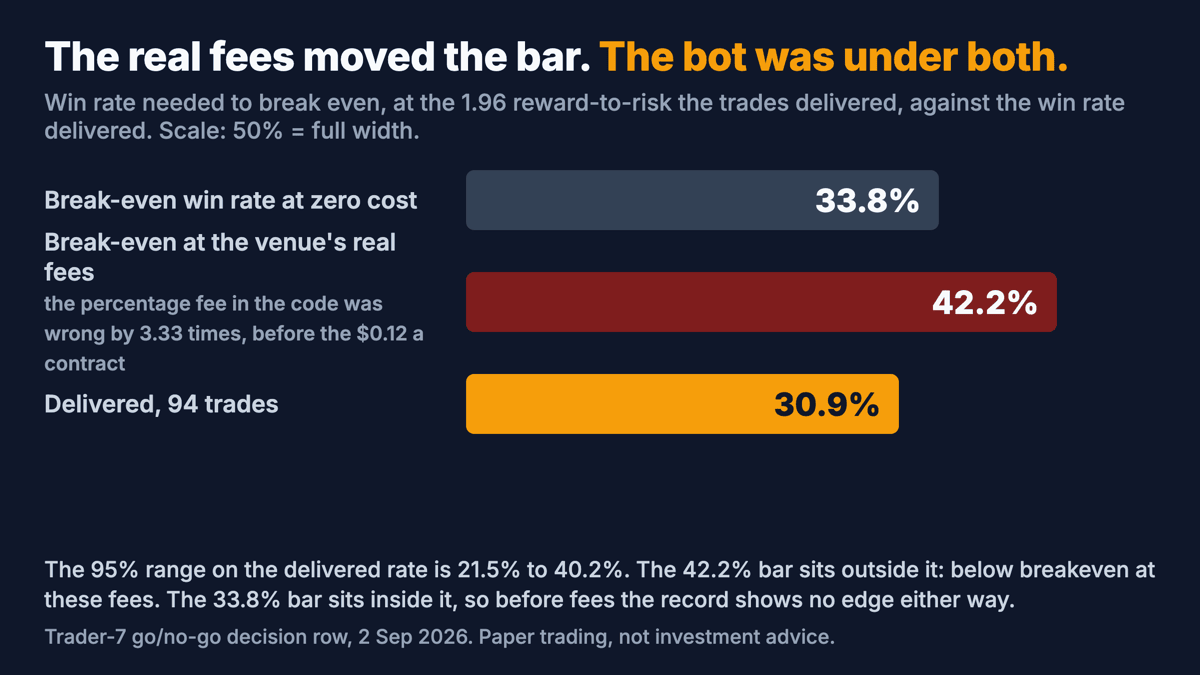
The breakeven moved when the real fees went in, and the bot was below both. From the go/no-go decision row, 2 September 2026, n=94, at the 1.96 reward-to-risk the trades delivered.
9 October: final, with tax inside the sum
On 8 October the design note for the redesign put the recommendation in one line: do not fund the current system, because putting $5,000 into the US venue to test it "buys nothing the data has not already said". On 9 October I agreed, and added the criterion I had left out, recorded on the decision row that day: judge the returns after tax, for each country I might be living in, because the same return is worth different amounts in different places. On a venue where the sum was already negative before tax, there was nothing for tax to rescue.
Not funded. The record is below its cost-adjusted breakeven.
Where the money and the machines went
The money went nowhere. It's still in my account.
The old Trader-7 system keeps running on paper at about $0.57 a day, the design note's figure. It now has a kill rule, written on 9 October as its own task. On 30 November or at 60 closed trades, whichever comes first, it is switched off unless it has made more than $7 a trade before fees. Before fees is the weaker test, and I know it; it is the bar I set for a service that costs 57 cents a day to keep alive.
The bet moved to Trader-8, the rule-based redesign, in which the AI picks no trades. It has run forward on paper since the close of 10 October against a spec written before it started. Judgement on 31 January 2027, with a minimum of 40 closed trades; if fewer have closed, it runs a month longer, and again, until 40. To pass it needs all three of: a positive average result per trade after costs, a return no worse than the tenth percentile of what the back test said a sixteen-week run should do, which is minus 2.9%, and 95% of its daily runs completed. Fail means parked. Its brief for the bars through 20 October, day 11, reads: equity $4,952.62 from $5,000.00 with the open positions marked to market, down 0.95%. Three trades closed, all three losers. Seven positions open. That isn't a result. It's three trades.
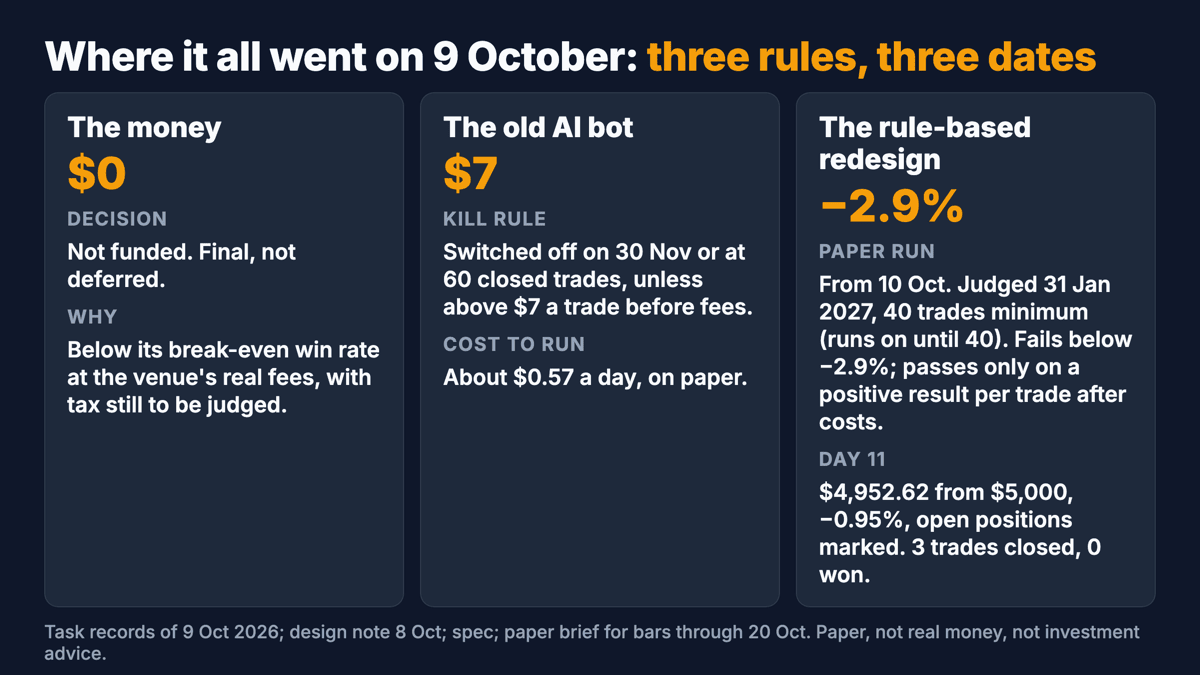
What each part of the system is now held to, and the date it is held to it. Paper, not real money.
The test, for any bot you're thinking of funding
- Write the pass mark before the date, and make it a rate with a minimum count. Not "launch on 1 October" but "fund it when its signals clear the bar I set, over at least this many". Mine: 185 signals, 0 cleared.
- Put the real costs inside the breakeven. From the trade log, the average win and the average loss. From the venue's own fee page, at the size you'd trade, the cost of a round trip. The win rate the bot needs is (average loss plus cost) divided by (average win plus average loss). Then compare the win rate it has delivered, with enough trades behind it. Mine: 1.96 to 1, so 33.8% free and 42.2% at the real fees; delivered 30.9% on 94 trades. If the seller can't give you the log, you can't do the sum, and that is your answer.
- Put tax inside it too. Where you live decides what a gain is worth. Judge the return after tax for each place you might be, with your own rate.
- Give anything that keeps running a kill rule. A date or a trade count, and a number per trade, after costs if you can. Mine: 30 November or 60 trades, more than $7 a trade before fees or it's switched off.
- Run the next version on paper with the judgement date, the minimum count, the fail bar and the pass bar written first. Mine: 31 January 2027, 40 trades minimum, fail below minus 2.9%, pass only on a positive result per trade after costs.
If whoever is selling you a bot can't give you lines 1, 2 and 4 for theirs, the money decision hasn't been tested. It has been scheduled.
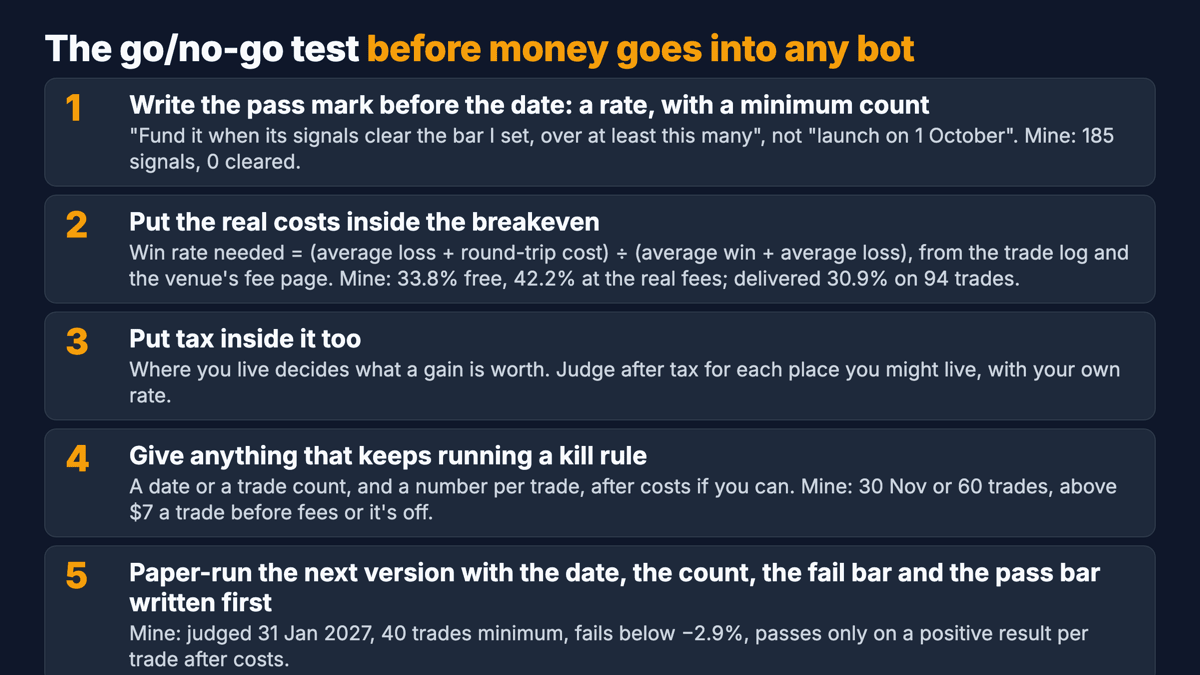
The go/no-go test as I ran it, with the sums.
What this doesn't tell you
One paper run isn't proof. Trader-8's spec says so in its own words: sixteen weeks of a trend system is "a weak test of profit and a fair test of behaves as the backtest says, on unseen data, unattended". There is no measured result yet, and the first one arrives on 31 January.
The decision was made at the US venue's costs. The redesign targets a cheaper venue from a different country, and that is still a plan, not a number. And a quiet fortnight says what the market gave in that fortnight; 94 trades is a small record. The rate test handles that by waiting for the rate, not by claiming the market will never offer one.
This isn't a claim that trading bots can't make money. It's a record that Trader-7, at these fees, didn't earn $5,000 of mine. The test that said so was written before the result, and it would have said yes if the numbers had.
In the fortnight before launch the bot produced 661 signals and took none. Neither did I.
Sources
- The go/no-go task record (T-503) in my Mission Control task list, entries of 11 September and 9 October 2026: the 185 proposals, 165 blocked at 1.5, 20 blocked at 2.0, best 1.86, zero trades in ten days; nine models from five companies at a mean 0.90 to 1.19 and the 94% decline rate; the move to 1 November and 20 October; the 9 October decision and the kill rule. Saved beside this draft as
source-mc-tasks-t503-t911-t912.md, with the paper-run task (T-911) and kill-rule task (T-912). - The go/no-go decision row in my deadlines file, 2 September and 9 October 2026 entries: the 3.33 fee error, the Coinbase US futures fee read from the account, the 33.8% and 42.2% breakevens, the 30.9% win rate on 94 trades, the 21.5% to 40.2% interval, the "at this cost base" caveat, and the after-tax criterion. Saved as
source-mc-deadlines-row59-60.md. - Trader-8 design note, 8 October 2026,
docs/ground-up-redesign-2026-10.mdin the private Trader-7 repository: the recommendation not to fund, "buys nothing the data has not already said", and the $0.57 a day. Saved assource-trader8-design-note-2026-10-08.md. - Trader-8 forward-run spec,
trader8/SPEC-stage0-v2.md: the 10 October start, the 31 January 2027 judgement, the 40-trade minimum, and what sixteen weeks can show. Saved assource-trader8-spec-stage0-v2.md. - Trader-8 paper-run brief for bars through 20 October 2026, read 21 October: equity, closed trades, open positions and the minus 2.9% fail bar. Saved as
source-trader8-paper-brief-2026-10-21.md. - My daily sheet for 9 October 2026, the day of the decision. Saved as
source-daily-sheet-2026-10-09.md. - The funnel note in the Trader-7 repository,
insights/strategy/funnel-and-breakeven-go-no-go-2026-09.md, 20 September 2026: 661 signals to 0 trades over 6 to 20 September. Saved assource-trader7-funnel-and-breakeven-2026-09.md.