The Prodigal Second Brain
Jamie Watters
Operational resilience and AI delivery practitioner.
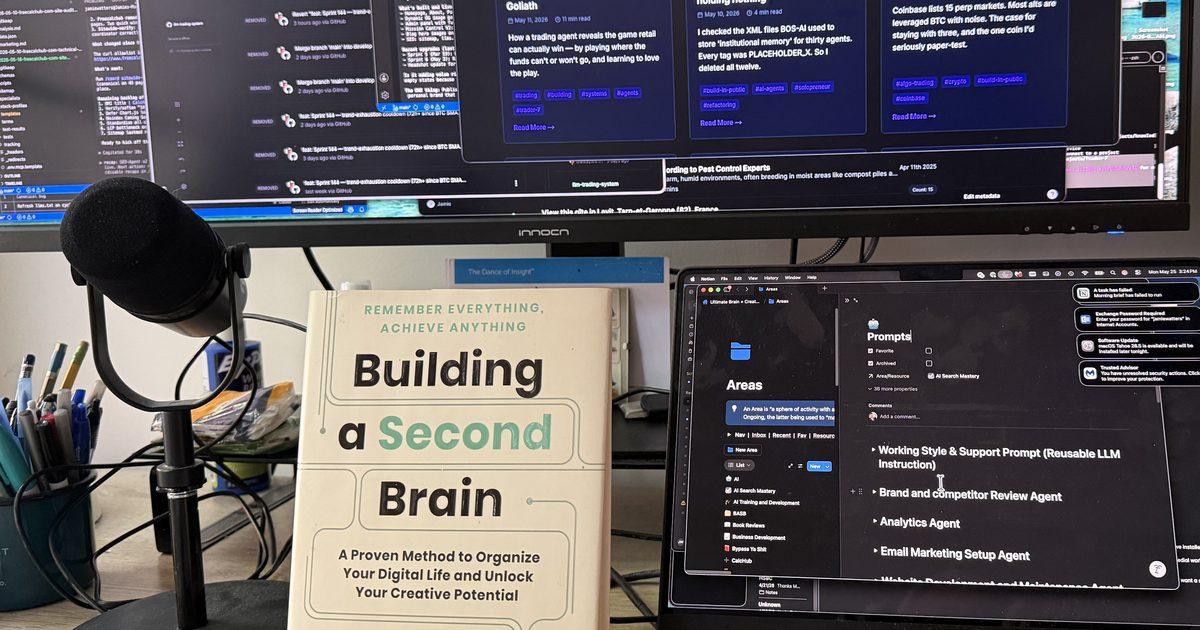
I built a second brain in 2020. By 2025 I had drowned it in my own output. The system did not fail me. I out-produced the shape it could hold.
What I have now is a folder. One door, Claude Code, three layers underneath. A project hierarchy I actually use. A knowledge wiki the LLM maintains. A handful of context packs that bridge the two. The system runs when I run it, and rests when I rest. I never file by hand. I never run a weekly review. The thing I wish I had understood three years earlier is that I had already made this same move on the product side. The pattern was sitting in my own PRD pipeline. I just did not generalise it.
PARA and CODE assumed a human did the librarian work. Filing, sorting, summarising, cross-referencing. That assumption was right when there was no other option. It is wrong now. Let the LLM do the librarian work. Spend the human attention on the work that does not get cheaper with a smarter assistant: the decisions, the products, the things you actually ship.
Tiago Forte's Building a Second Brain solved a real problem. The problem was: you, a single human with a finite attention budget, have to organise and distil a stream of inputs in order to use them later. PARA gave you four buckets: Projects, Areas, Resources, Archive. CODE gave you a verb-pipeline: Capture, Organise, Distill, Express. The whole thing assumed the bottleneck was a person doing the librarian work by hand.
That assumption was true for the entire history of writing things down. It was true when I joined Tiago's cohort in 2020. The system freed my creativity. Nothing in this piece is a takedown of PARA done well, and you should not read it as that piece.
The 2020 cohort was the best money I had spent on my own brain in a decade. I came out with a system I could lean on. Projects had outcomes. Areas had standards. Resources had a place. Archive existed so the rest could breathe. Each Sunday I distilled. Each week I expressed. The pipeline worked because I worked the pipeline, and the work was bounded because the inputs were bounded.
For three years that was enough.
Then ChatGPT shipped. I will spare you the bit where I describe what it felt like, because you remember. What I did with it is not the standard founder story. I did not get less disciplined. I got more disciplined. I started running every product vision and strategy through seven different LLMs in parallel, each critiquing the others, and distilling a PRD out of the consensus, grounded in market research I could not have done as a solo human five years earlier.
The work got better. There was just more of it.
Capture was covered. Distil was happening inside every PRD pipeline. Organise went on holiday. Express was a train that had left the station without me on board. PARA and CODE assumed the bottleneck was a human filing things by hand once a week. The new bottleneck was not a person who could not be bothered. It was a person who was bothered about too many things at once, generating high-quality material faster than any human-shaped librarian could ever put it on a shelf.
The failure was not laziness or drift. It was the wrong shape of discipline applied at a new scale. PARA's shape assumes the human is the rate limit. In 2020 the human was the rate limit. By 2024 the human was producing on a scale that needed different help, and PARA had no answer.
In January 2026 an open-source agent framework dropped and I went after it like the answer was right there. For three weeks I tried to put my AISearch business inside it. Then near-daily releases started breaking what I had built. For two months after that I spent more time keeping the agent running than I would have spent doing the work itself. The maintenance tax climbed to about 80% of my hours. I was the frog in the pan, and by May I was cooked.
The lesson is the same as the PARA one, in a different costume. I had tried to hire an unreliable employee instead of doing the simpler thing. I had bought tooling instead of buying clarity about what I was actually doing.
One pattern of work survived all of it unchanged. Engineering discipline. PRDs for every product. Git for everything. CI where it counted. Trader-7 is still moving. The last commit was yesterday. The reason engineering survived is unflattering: code lies to your face the moment you run it. The build either passes or it does not. The trade either fills or it does not. There is no way to quietly let a deployment rot the way you can quietly let a knowledge system rot.
And one new pattern arrived in the wilderness years and never left. Seven LLMs critiquing each other on the way to a PRD. That pattern is the template for everything that follows, and I should have seen it sooner. When I want to think hard about a product, I do not file the thinking. I run it through critics, distil the disagreement, and produce a document I could not have produced alone.
The same shape works for knowledge. I just needed an LLM I trusted to do the organising and distilling on a continuous basis, not a one-shot PRD critique. That is Andrej Karpathy's LLM wiki, and that is where the new system lives.
Karpathy's pattern is small enough to fit in a sentence: keep a flat, cross-linked folder of markdown pages that an LLM maintains for you, with an index and a log, and let it do the organising and distilling while you do the thinking.
My version has three layers. A project hierarchy under mission-control/ for the part of my life that genuinely is structured: one Northstar, programmes, products, one global sprint, one backlog. A knowledge wiki, flat and cross-linked, that Claude Code maintains from anything I drop into the inbox. A bridge: a short context pack per active product that lives in both the vault and the repo, so the brain feeds the code when I am building.
Five rules underneath it matter. The system does nothing when I am not there. There is no weekly review. Maintenance is near zero or the system is already dead. Projects are the point, not reading. And I do not add a new tool until the simple version has proved it cannot do the job.
I open one folder. I ask in plain English. I never navigate paths or remember IDs. The brain catches me up.
The arithmetic is straightforward. Filing, sorting, summarising and cross-referencing used to be expensive because a human had to do them. They are now the cheapest tasks in the room. Deciding, writing, shipping, choosing what matters: those are still hard and still mine. PARA asked the human to do the cheap half. That was the right ask when there was no other option. It is the wrong ask now. Move yourself up the stack. Spend the freed attention on the work the machine still genuinely cannot do for you.
I started this rebuild on Saturday. Today is Monday. I have been at this for a weekend. The project hierarchy is real. The knowledge layer is next. By the end of June I expect to have shipped one strategic decision out of the new system that I could not have shipped out of the old one. If that does not happen, the system is wrong and I will say so here.
If you built a second brain in the Tiago years and quietly let it drown in the Sam Altman years, you are not alone, and you did not waste the time. You learned the discipline. Now move it up a layer. The librarian has new help.
If this gave you something to think about, you can buy me a coffee.