The Data Said Nobody's Buying AI. Turns Out I Was Selling the Wrong Thing.
Jamie Watters
Operational resilience and AI delivery practitioner.
Last week I wrote that the data says nobody's buying AI consultancy. Eight percent of small firms hire anyone for AI help. Median spend, about $28 a month. My friend with the trusted mailing list who sells everything except the one topic that kills his open rates. I stand by every number.
But I left a question hanging, and it nagged at me. If demand is that dead, why does every survey say the same buyers are desperate for what AI does? Four in five owners drowning in admin. CEOs under board pressure to show AI progress. That is not what dead demand looks like. That is what mute demand looks like.
This week I got the missing piece, from an hour with Nate B. Jones, a product leader who spent years at Amazon and now sits in rooms with operators at every scale. His claim is simple and it reframes the whole thing:
If you are having trouble selling, you are having trouble storytelling. Nobody buys AI. AI is not valuable in and of itself.
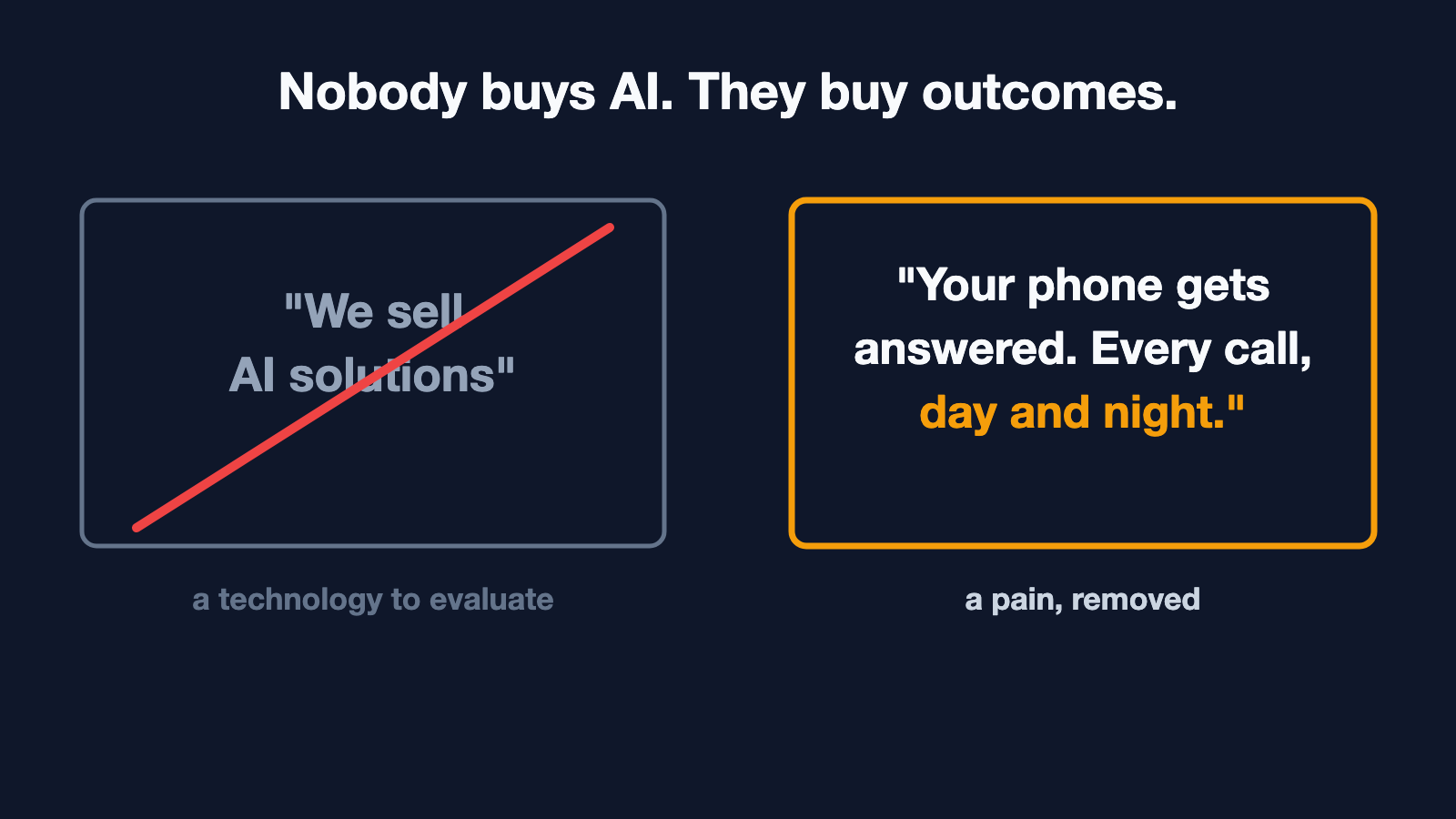
Take the smallest possible example, because it is the clearest. An HVAC company. Every one you ring has the same problem: the phone rings out, jobs go to whoever answers, and some poor soul in the back office juggles dispatch between callouts.
You can walk in selling "an AI receptionist with natural-language call handling." That is a technology, and the owner has to do the work of translating it into their life. Or you can sell "your phone gets answered, every call, day and night, and every caller feels heard." Same product. One is a thing they must evaluate. The other is a pain they already have, removed.
The AI is not what you are selling. You are selling I pick up the phone.
Read back through last week's numbers with that lens and they change meaning. The small firms that do pay premium prices pay for AI baked into tools they already run. Of course they do: nobody had to sell them "AI", the outcome arrived inside something they already trusted. The consultants who actually make a living sell judgement in one vertical to people who already know them. Same pattern. The 8 percent was never measuring appetite for outcomes. It was measuring appetite for the word.
The second mechanic is about trust, and it is the best sales story I have heard in years.
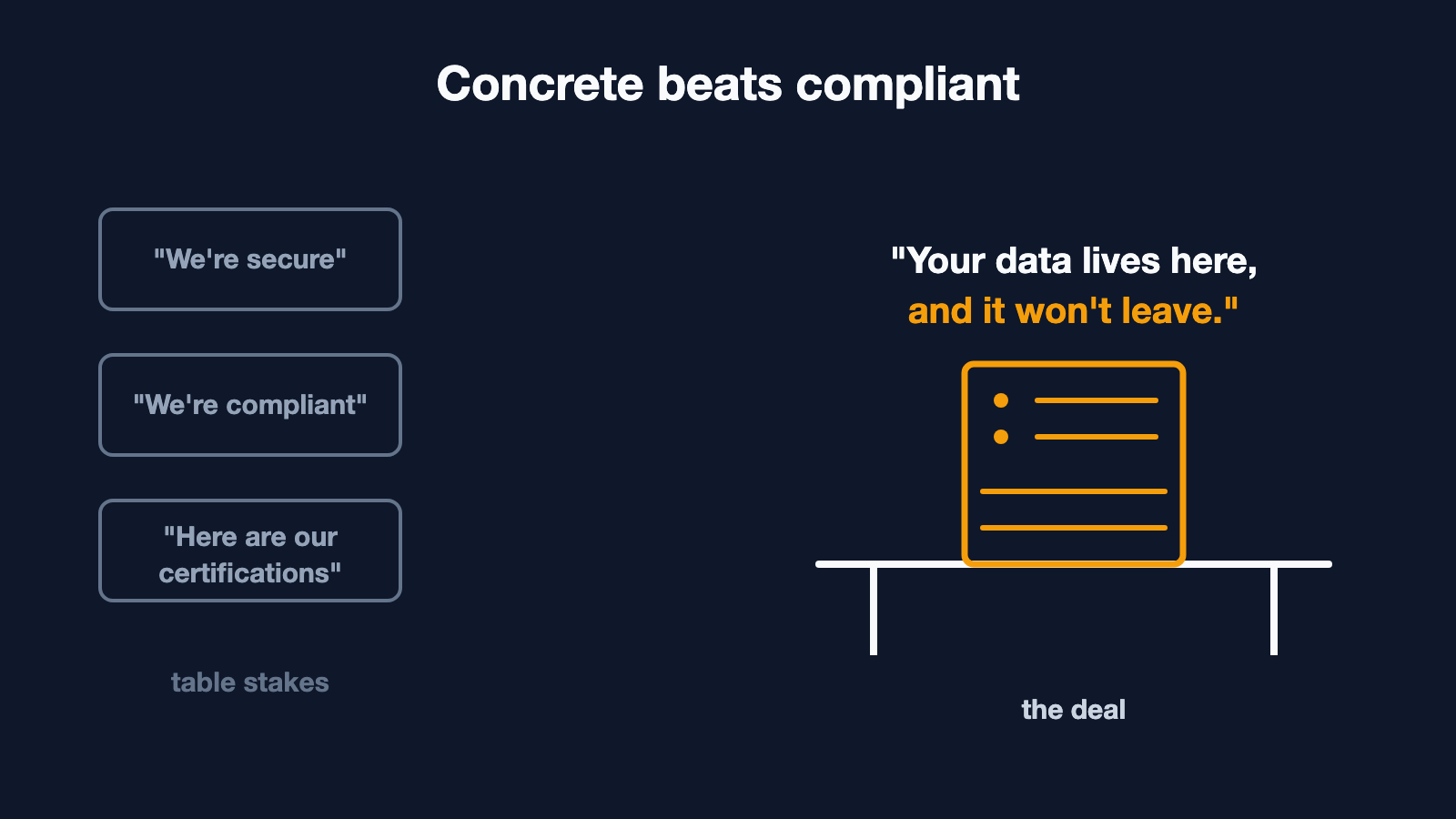
A small legal firm is choosing an AI provider. Compliance is everything: they must answer in court for where data lives. Every vendor walks in with the same lines. Secure. Compliant. Here are our certifications. All true, all table stakes, all noise.
The winner brought a physical server into the meeting, put it on the table, and said: your data lives here, and it won't leave.
That is the whole lesson. An accountable buyer does not need your credentials, they need a story they can grasp and defend to whoever holds them accountable. Concrete beats compliant. Every certification in the world loses to a box on a table.
Now the part where I turn this on myself, because that is the deal on this blog.
My portfolio mostly fails this test. AI Search Mastery has the technology in the name, twice. I have been describing my tools by what powers them rather than what they remove. Most of the portfolio is pre-revenue, and I have been treating that as a demand problem. Some of it is simply a story problem, and those are very different diagnoses, because one of them is fixable this week.
The counterexample proves it. The one product strangers respond to without prompting is Executor File, and its pitch contains no technology at all: when you die, your family can find everything. I did not plan that. But it is the only offer I have that sells the outcome, names the buyer, and carries its proof on its face. The pattern was sitting in my own portfolio and I had not noticed.
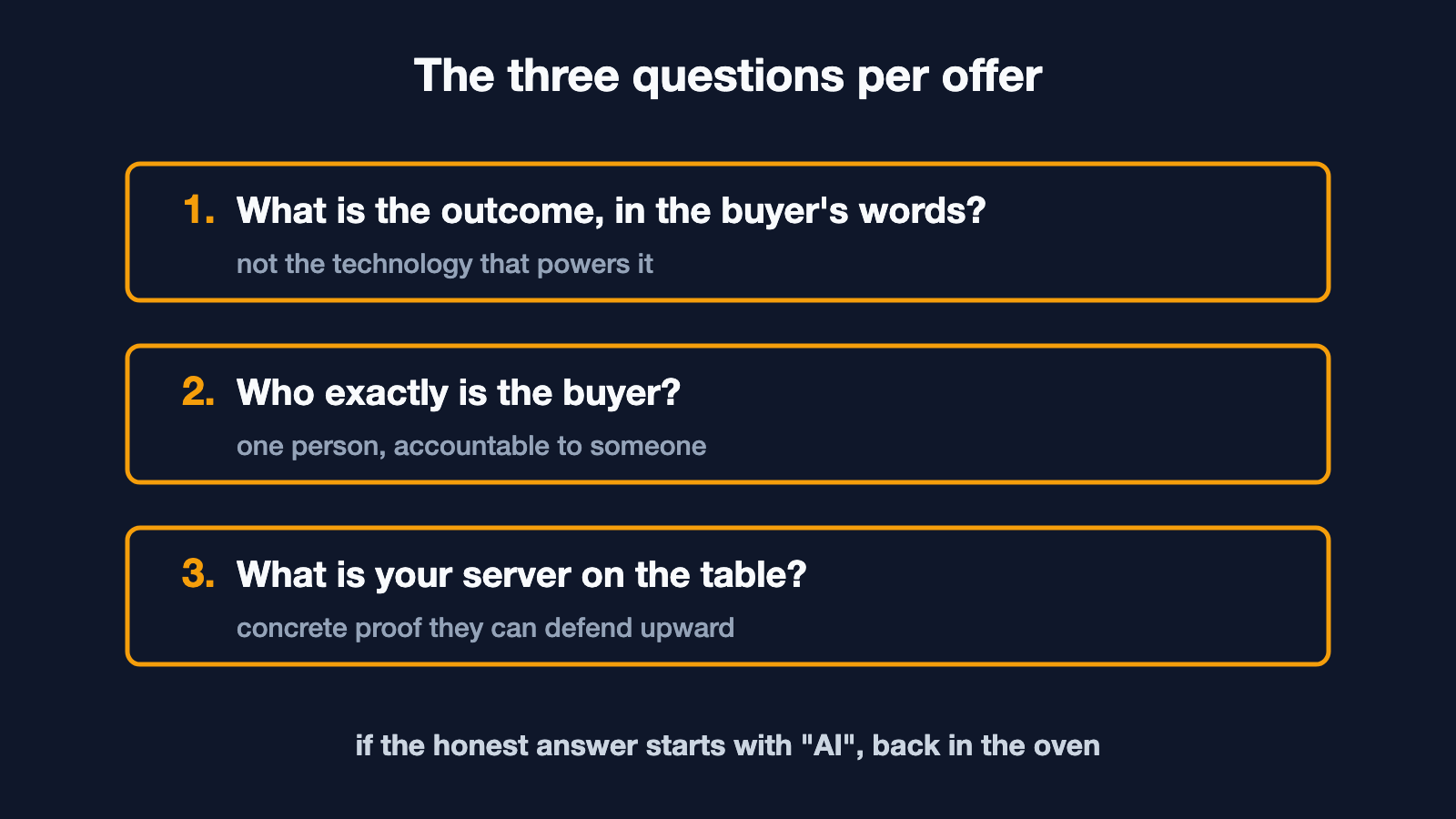
So the practical move, which I have queued as actual work rather than a resolution: an offer-framing pass across everything I ship. Three questions per product. What is the outcome, in the buyer's words? Who exactly is the buyer? And what is our server on the table, the concrete proof an accountable person could defend? Anything whose honest answer starts with "AI" goes back in the oven.
Last week's piece ended with a filter: ask where the demand comes from. If the answer is chasing strangers, walk away. That filter stands.
This week adds the second one: ask what you are actually selling. If the answer is a technology, the silence you hear is not the market saying no. It is the market waiting for you to say something it can buy.
One practitioner interview and my own pre-revenue portfolio are not a doctorate. Treat this as a working hypothesis, being tested in public on real offers, starting with mine. I will report what the numbers say, either way.
I build things in public and share what the numbers actually say, the duds as loudly as the wins, at jamiewatters.work.