Everyone's selling AI consultancy. The data says nobody's buying.
Jamie Watters
Operational resilience and AI delivery practitioner.
A playbook is doing the rounds. Sit down with a small business owner for 45 minutes, find their time drains, prescribe a handful of AI tools, and charge $999 for the privilege. Then upsell them into a retainer that works out at a thousand dollars an hour. No coding. No audience. No money to start. A doctor writing prescriptions, except this doctor needs no qualifications.
It is a good pitch. I watched the whole hour. The frameworks are fine. And I think most people who follow it will make almost no money, for a reason the playbook tells you itself without meaning to.
The tell is in the marketing.
The course lists seven ways to find clients. Knock on doors. Cold-message local owners on LinkedIn. Host a meetup and work the room. Do free mini-audits for people at your gym. Every one of them is manual outbound, one conversation at a time. Not a single method is "people come looking for this."
That is the tell. When a business solves an expensive, urgent problem, you do not have to knock doors to sell it. The buyers arrive. Plumbers do not cold-message you during a flood. So when the entire acquisition plan is door-to-door graft, that is not a motivational challenge to overcome. It is the sound of weak demand.
I wanted to test that instinct against real numbers rather than just distrust a video. So I did.
The demand is not there yet, and the numbers are stark.
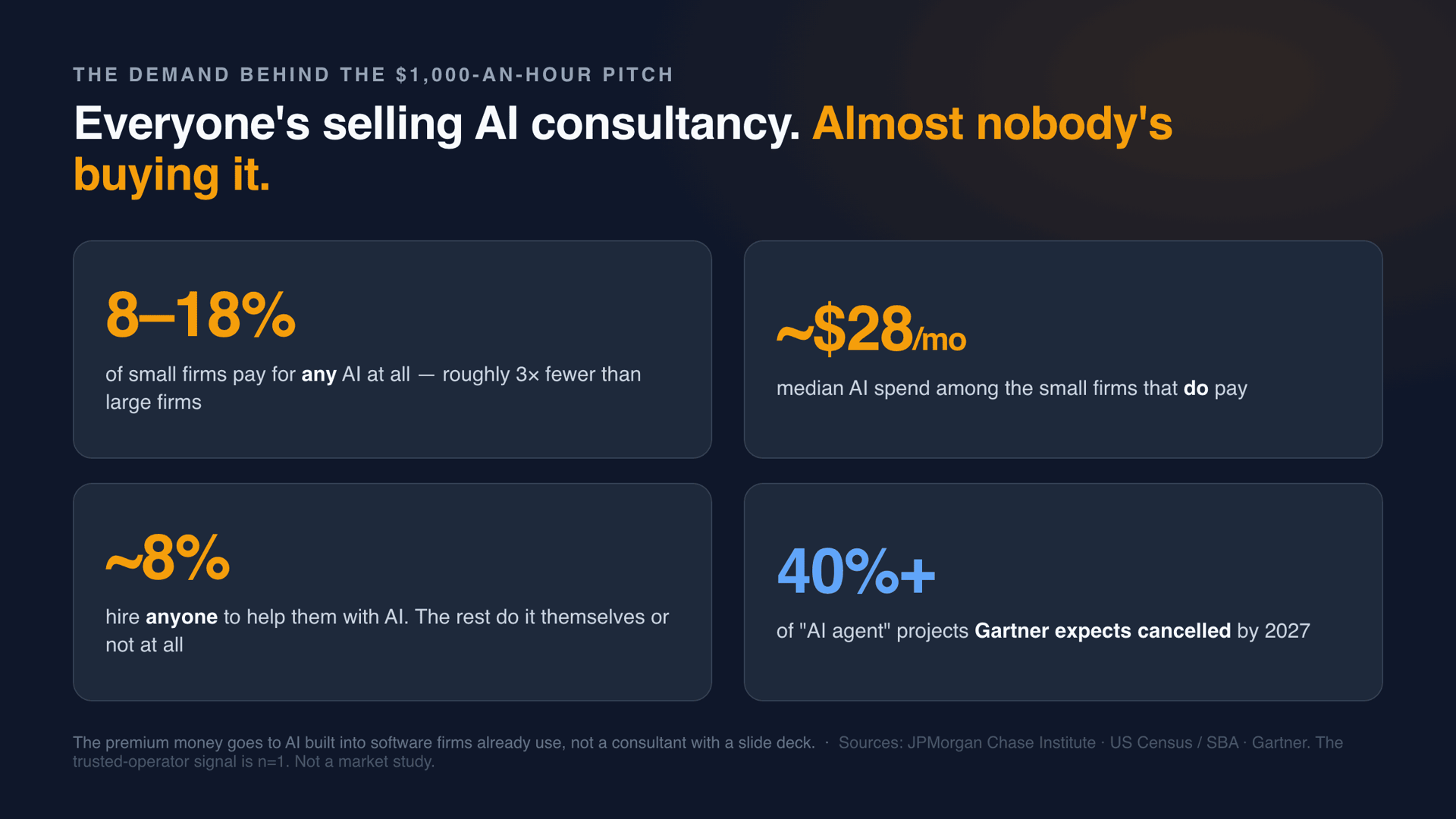
Only 8 to 18 percent of small firms pay for any AI at all, depending on whose data you use: the JPMorgan Chase Institute, tracking actual payments, puts it near 18 percent; the US Census production-use measure is under 9. Either way it is roughly three times lower than large firms.
Of the ones that do pay, the median spend is about $28 a month. Sixty-one percent spend under $100 a month. Half the small firms using AI have spent nothing on it at all.
Then the number that should stop a would-be consultant cold: about 8 percent of small firms hire anyone to help them with AI. Eight. And when a small business does spend on something premium, it pays for AI baked into software it already runs, the assistant button inside the tools it already owns, not a stranger with a slide deck telling it which apps to buy.
Around this sits a market that is nervous, not hungry. Gartner expects more than 40 percent of the ambitious "AI agent" projects to be cancelled by 2027. Nearly four in five owners say they do not yet trust AI to do simple work unwatched. This is not a market holding its breath for a $999 assessment.
Which brings me to my friend.
He runs an IT services firm in New York, serving small and medium businesses across the country. He has a mailing list built over years, full of people who know him and trust him. His open rates are excellent on every topic he writes about, and his conversion is good right across the board. With one exception. When the subject is AI, the buying stops. Same list, same sender, the same trust that sells everything else, and on this one thing the replies dry up.
That is the cleanest version of the signal, because only one thing changed: the topic. Not his reach, not his reputation, not his list. His customers, who buy plenty from him, simply will not buy AI. That is not bad luck or bad targeting. It is the rule, showing up a little early.
Now the part that keeps me honest, because without it this is just a cheap shot.
Advisory is not dead. AI advice does work. It simply does not work the way the playbook sells it.
The consultants who make a real living from this do not knock doors. Something close to 93 percent of independent advisers get their clients through referral, from people who already trust them, and the field is dominated by operators with fifteen years or more behind them. What they sell is not a list of tools anyone could Google. It is judgement, a relationship, and a point of view about one specific industry. The AI is the cheap part. The trust is the moat.
So the honest version of the model is almost the mirror image of the one on offer. Not generic, but a single vertical you know cold. Not cold outreach, but the network you already have. Not "here are seven apps," but "here is the outcome, and here is who is accountable for it." That business is real. It is also slow, relationship-led, and impossible to start from nothing over a weekend, which is precisely why nobody sells a course about it.
So here is the filter, if someone is selling you the dream.
Ask one thing: where does the demand come from? If the answer is a list of ways to chase strangers, you are being sold a job, and a hard one. If the answer is "the people who already trust me, in the one field I understand better than they do," you are looking at something that might actually hold.
I am not calling anyone a fraud. The frameworks in that video are sound and the man plainly closes deals. But an offer that needs door-knocking to move is telling you the truth about its demand, whatever the sales page says. The market for AI advice is real. It is just smaller, slower, and far more about trust than the thousand-an-hour headline wants you to believe.
This is one trusted operator and a stack of American survey data, not a doctorate. Treat it as a strong signal, not a verdict. It is a signal I would bet on.
I build things in public and share what the numbers actually say, the duds as loudly as the wins, at jamiewatters.work.