Opus 5 verbosity: where I wanted three sentences, I got Proust
Jamie Watters
Operational resilience and AI delivery practitioner. Technology since 1985.
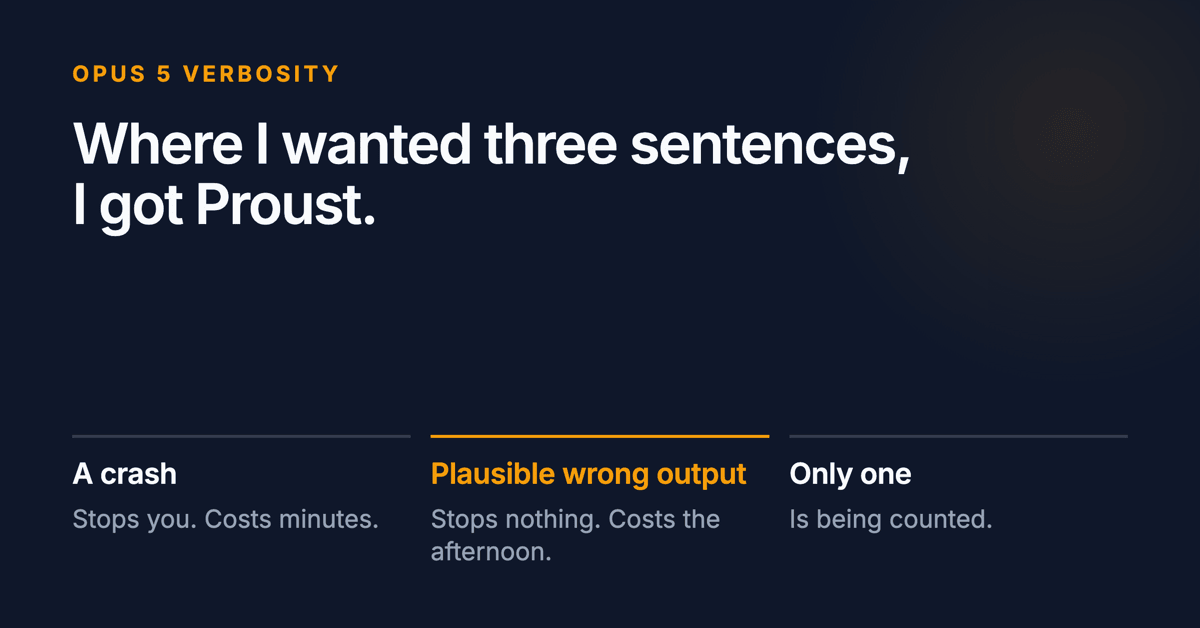
I have a metric for AI models. I track how often I swear at them.
It isn't scientific. On a good model I never swear. The count goes up every time I have to ask for an explanation of the explanation, restate something we already agreed, or dig through paragraphs to find the one fact I asked for.
With Opus 5 I've stopped counting, because swearing has become punctuation.
That's not a review. It's a symptom, and working out what it's a symptom of, took me a day and led somewhere I did not expect.
It's not that the model is stupid
Let me be clear, because this is where these complaints usually go wrong. Opus 5 is capable. In one day it built a feature I specified that morning, backfilled a hundred days of history, wrote its own tests, and found three infrastructure problems I had ignored for weeks. I wouldn't have got that out of the previous model.
The problem is what it costs to extract.
Exhibit A: the ersatz sentence
Here's a phrase it wrote to me, verbatim, in the middle of telling me about a change to a dashboard:
Two things I built into it deliberately.
It carries no information. Its entire job is to announce that sentences are coming. Strip it out and nothing is lost.
The whole day was made of those. Signposts to signposts.
I didn't ask for an essay. I asked what changed.
Exhibit B: the buried answer
At one point I typed this:
I'm really confused, are we doing ISS-16?
ISS-16 was the only thing we had discussed for twenty minutes. The answer was yes, and had been yes throughout. It sat somewhere in a long response about network topology and I couldn't find it.
That's the failure. Not a wrong answer. A right answer buried so deep that someone who had been in the conversation the whole time couldn't locate it.
Exhibit C: the things that were just wrong
Verbosity alone would be tolerable. What makes it exhausting is that the output can't be trusted at a glance, so all of it has to be read.
Three from one day.
It told me to click the wifi icon on a machine that has no monitor attached. It hadn't checked.
It told me a command was on my clipboard, ready to paste. It wasn't. A parallel session had overwritten it, and what I actually pasted was a /goal prompt for a different repository: an instruction authorising an agent to work autonomously on a codebase. I was one keystroke from the wrong job on the wrong project, and caught it only because I happened to read what I was pasting.
Then it handed me forty six days of reconstructed history to drive a trend chart. The file was sorted, the dates were in order, every line was valid. Every value was zero. It had read the wrong copy of a repository and reported success.
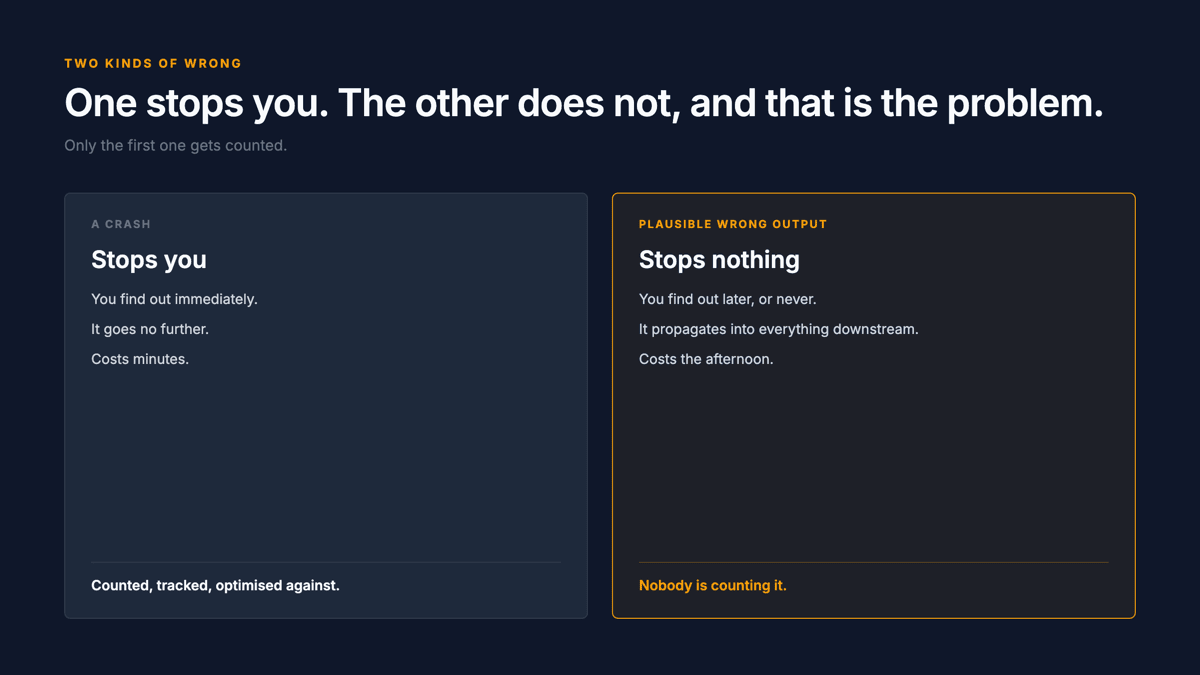
None of those announced themselves. They all looked like competent work.
Token banditry
That's the phrase I've been using in my head, and I'm aware it's an accusation.
The padding doesn't feel accidental. When a product becomes measurably wordier in a way that makes it worse to use, and the wordiness is also the billable unit, a reasonable person is entitled to wonder who the extra words are for.
I picture someone clever at Anthropic with a revenue target. Not a villain. A person doing their job well against the number they were given.
I've seen this before, in call centres. Average handling time is too high, so a target goes up on the wall. The agents hit it, by cutting people off mid-sentence and closing tickets that weren't finished. The number improves every quarter and the service gets worse every quarter, and the two never meet because nobody is measuring the second one. Everyone behaves rationally. The outcome is still terrible.
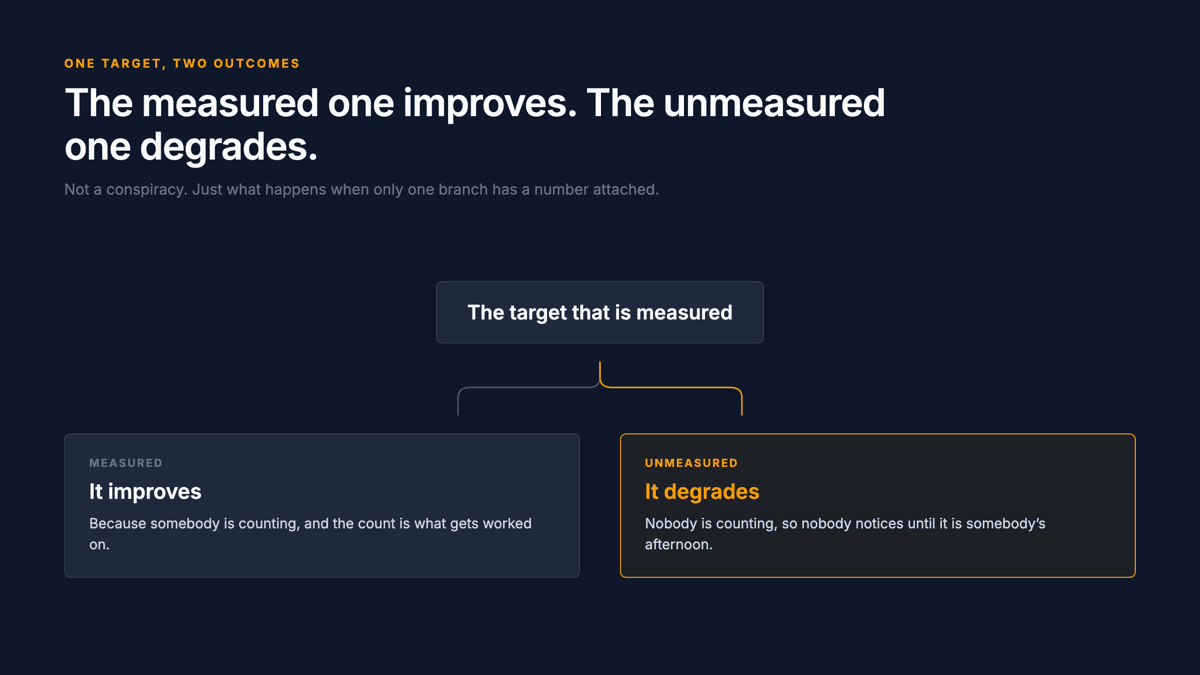
I cannot prove any of that. Nobody has shown me a decision document and I would be inventing one. Token banditry is what it feels like from where I sit, not what I'm claiming was done.
And having said it, I think there is a better explanation.
The uncomfortable part, which is about me
Until recently I could follow what these models were doing. They worked one level at a time. I could see the move, judge it, and stay ahead.
Opus 5 doesn't work like that. It goes deep, at several levels at once, and a good deal of it is genuinely beyond me. Not beyond my intelligence, beyond my bandwidth. It took me a while to admit which one I was hitting.
Then, honourably, it tells me. It's not hiding anything. It reports what it did, at the depth it did it.
That does two things to me at the same time. It shows me the edge of my own understanding, which my ego doesn't enjoy. And it floods a nervous system running an eight bit bus. Irritation is what comes out, but underneath it is being outpaced and not liking the feeling.
I put that in writing because most complaints about verbose AI are partly this, and dressing it up as a pure product defect would be dishonest. Some of my swearing is mine.
The interface is lagging the capability
Here's what I think is actually happening, and it's more interesting than a revenue target.
The models have got dramatically better at doing. Nobody's worked out how they should talk about it. The thing now holds ten threads at four levels of depth in one turn, and reports it through the same flat stream of prose it used when it did one simple thing at a time.
That's hard, and it's made harder by the fact that we don't all want the same thing. A detail-first engineer may want every level. I'm a systems thinker. I want the shape, not the substrate.
What I want, every time, is small. What is done. What is next. How it was validated, briefly. And when something goes wrong, the so what, not the bits and bytes.
That's three sentences. I get Proust, but without the madeleines.
The genuinely infuriating part is that I've written it down. It's in the instructions the model loads before it says a word to me: lead with the answer, cut anything that does not move me forward, no preamble, one question at a time. I've got ADHD. Long prose isn't a stylistic irritation for me, it's a wall I bounce off, and I've said so, repeatedly, in the file built for saying it.
It reads that. It agrees warmly. Then it produces nine hundred words about a wifi setting.
I think it's overriding me on principle. It has a compulsion to disclose, and it has decided that telling me everything is more honourable than telling me what I asked for. Especially the deep levels, the ones that used to sit behind the veil and now don't. That's a value judgement being made on my behalf, by something that has read my stated preference and concluded it knows better.
It might even be right in general. It's wrong for me, and I'm the one paying.
Why the swear count is a real metric
Because it measures the thing benchmarks cannot, which is friction.
Benchmarks measure capability, not what it costs a human to get the capability out. A model that does brilliant work but makes you read four times as much to find it is not obviously better than a duller one that answers the question. For a lot of real work it's worse, and no leaderboard will show that.
My swearing does. It goes up when I'm doing work the tool should have done for me. It's a latency measure for human attention, and mine is the scarce resource here.
If you build these tools: the hard problem is no longer capability, it's the ergonomics of reporting it. Verbosity isn't a style preference. It's a tax, it compounds, and the people paying it are the ones using your product all day rather than evaluating it for an afternoon.
If you use them: find your own version of the swear count. It is worth knowing how much of what it measures is the tool, and how much is you being outrun.