Bernardo Kastrup's cosmic mind has no plan: what analytic idealism actually claims
Jamie Watters
Operational resilience and AI delivery practitioner. Technology since 1985.

Most people arrive at Bernardo Kastrup wanting the same thing. A universe that is conscious in a way that means something. A mind behind it, aware, paying some kind of attention.
He does not give them that.
The universal consciousness in Kastrup's work is instinctive rather than metacognitive. It has no plan. It is nearer Schopenhauer's Will than any deity, and it is not looking back at you. He describes himself as a naturalist and a reductionist, which is not usually how he gets introduced. He does not treat an experience of unity as evidence that reality is unified, and he has written about the wrong reasons to believe his own position.
The most rigorous idealist available is far less accommodating to mystical claims than his audience wants him to be. I think that is the best thing about him, and almost nobody who loves his work has been told it.
What he actually claims
One primitive: consciousness. Not as something brains produce, but as the only thing there is. Matter is what mental process looks like from outside, across a boundary. You and I are dissociated alters of that one field, in the clinical sense borrowed from Dissociative Identity Disorder. Brain activity is the image of your inner life rather than its cause. Death is the boundary dissolving.
One thing gets misread constantly: this is realist, not solipsism. There is a world that carries on perfectly well without your personal mind.
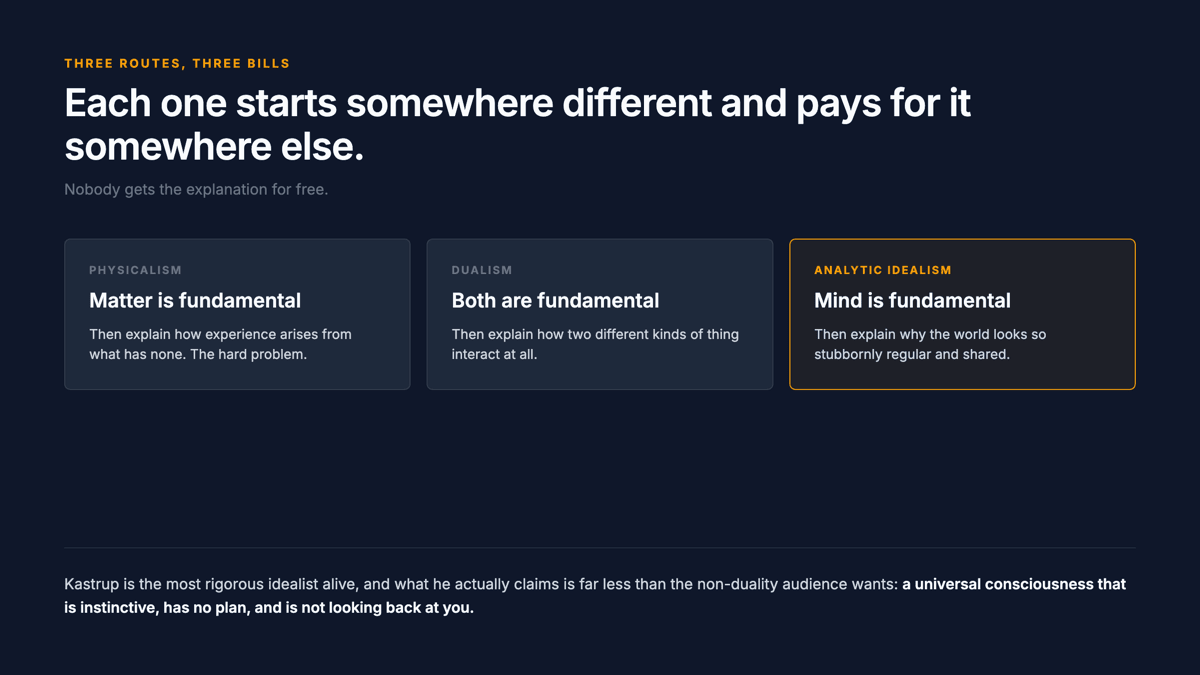
The move that makes it elegant is a reversal of direction. Physicalism has to get felt quality out of pure quantity, and after decades of serious effort it cannot. One branch of panpsychism scatters a spark of experience through every particle and then has to fuse billions of micro-subjects into your single unified point of view, which nobody has managed either. Idealism turns it round and divides one into many instead. And dissociation is something minds are actually observed to do.
I thought that was a structural advantage. It is thinner than it looks, and I got it wrong in the first version of this piece. Philip Goff, panpsychism's leading defender, does not hold the particle version: he thinks the conscious thing is the cosmos, which leaves him dividing one into many too. His own verdict on that swap is that it "merely pushed the lump to another part of the carpet". David Chalmers, who wrote the standard account of the problem, says the reverse direction "seems just as hard". Two unsolved problems, and no scoreboard.
The position still deserves better than the dismissal it gets. Kastrup holds a 2019 PhD in philosophy from Radboud on this thesis, a second doctorate in computer engineering, and years at CERN and Philips behind him. This is not self-published crank work.
Calibration, though. In the 2020 PhilPapers survey of professional philosophers, 6.6% accepted or leaned towards idealism about the external world. 79.5% went to non-skeptical realism. A serious minority position, argued by a credentialled person. Not a consensus, and not a revolution in progress whatever the book subtitles say.
Why it cannot be proven, and he says so
Kastrup's own answer to "how would you test this?" is that you cannot, and that the demand is misplaced. Falsifiability, he argues, applies to scientific theories about how nature behaves. Metaphysics asks what nature is, and that question has no experiment attached to it. What he offers instead is internal consistency, coherence, parsimony, explanatory power.
That is inference to the best explanation. It is a legitimate way to argue. It is not proof, and it does not become proof by accumulating suggestive neuroscience.
Take the strongest empirical case he cites. Strasburger and Waldvogel published a case in 2015: a patient with fifteen years of diagnosed cortical blindness who could see in some personality states and not in others, with visual evoked potentials absent in the blind states and normal in the sighted ones, switching within seconds. Remarkable, and it does show that dissociation has measurable physical signatures. The authors' own explanation is neurological. It is one patient. And the analogy runs the wrong way: it shows a mind already individuated by a brain can partition, not that a field with no brain and no boundary can partition into every living thing.
The psychedelics work has the same shape. Carhart-Harris and colleagues found in 2012 that psilocybin decreased cerebral blood flow and the BOLD signal, which surprised the field and is a real result. It embarrasses a physicalism in which richness of experience scales with total brain activity, and nobody defends that one.
Then there is the part that is simply the record. In September 2023 Kastrup identified the missing element of his own framework: there is no rigorous account of dissociation, the exact joint everything else hangs from. In January 2024 he said he was cutting back on interviews to write it. That paper has not appeared. His academic papers page lists fifteen entries, and the most recent is from 2019.
Preprints and Essentia Foundation work, which he directs, would not show on that page, so this is not a claim that he stopped writing. He publishes constantly, in books, essays, courses and debates. The point is narrower and it is his own. In 2016 he wrote about producing nine papers at once specifically so his arguments would be exposed to thorough peer review. He was right about the method. The dates are the dates.
The part that survives whoever is right
Here is what I actually took from him, and none of it requires idealism to be true.
Perception is a dashboard, not a window.
What you experience is not a transcript of what is out there. It is a model, built by an organism, for the purpose of keeping that organism alive. Fitness, not accuracy. The dials on a dashboard are useful precisely because they are not the engine. You would be considerably worse off staring at the engine.
That claim costs no metaphysics at all. It sits comfortably inside predictive processing, which is mainstream cognitive science, and it sits comfortably inside plain physicalism. Kastrup uses it as a stepping stone to a much larger conclusion. You are free to decline the step and keep the stone.
It is also, structurally, what every contemplative tradition has said about ordinary cognition for as long as there have been contemplative traditions. The world you are certain you are looking at is a rendering, and mistaking the rendering for the world is where the trouble starts. Buddhism says it one way, Advaita another, the Christian mystics another again. Strip the cosmology off each and the claim underneath is the same, and it is a claim about cognition rather than about the universe.
Which brings me to the thing I most want to say.
The practice does not need the metaphysics.
The standard pitch runs the other way. Sit, look, go quiet, and you will discover that reality is consciousness. Practice gets sold as a delivery mechanism for a metaphysical conclusion, and that does two kinds of damage. It gives the physicalist no reason to ever sit down, because the payoff on offer is one they have already rejected. And it gives the practitioner a stake in an argument they can no longer afford to lose, which is a terrible thing to do to someone's honesty.
Nobody has settled that argument. Kastrup has not settled it, and he says so more plainly than most of his readers do.
None of the value depends on it. If your experience is a model rather than a transcript, then looking directly at how the model gets built is not mysticism. It is maintenance. You are examining the only instrument you have ever used, using the only instrument you have ever had. That is worth doing whether the substrate turns out to be neurons, mind-at-large, or something nobody has thought of yet.
I practise the Headless Way, Douglas Harding's pointing experiments. You look back towards the place where you have always assumed your face is, and you report what is actually given rather than what you know to be there. It does something reliable and repeatable, and I have found it more useful than anything else I have tried.
What it does not do is tell me what the universe is made of. For a long time I wanted it to. I was doing the exact thing I am describing here: treating a repeatable experiential result as evidence about the furniture of reality. It isn't. An experience of unity is evidence about experience, which is a real finding and is not a cosmology.
The moment I stopped needing it to be more than that, the practice got better rather than worse. Nothing was riding on it any more.
A better word than awakened
The vocabulary here is binary and it makes people feel like failures. You are awake or you are not. You had the shift or you are still waiting for it.
Here is a description that fits what people actually report. Locally coherent, globally incoherent.
Each part of you is internally consistent. The part that gets up at five to train makes complete sense on its own terms. So does the part that stays up until two doing the opposite. What you cannot do is assemble one consistent account from all of them at once. There is no single global version of you that every local version agrees with. Parts work and Internal Family Systems are that claim in therapeutic clothing, and they work in practice. Akrasia is a gluing failure. So is most self-deception.
What changes when you take this seriously is what integration means. It stops being one dramatic boundary dissolving and becomes an obstruction reducing, level by level, up a hierarchy. Progress is partial and specific. You can be genuinely integrated about money and a complete mess about your father. That is not a failed awakening. That is the ordinary shape of the work, and it fits what practitioners report far better than the binary does.
I have been sitting with this one because it is going into The Way Within, and I would rather find out here whether it lands than discover it in a chapter.

The door stays open
Same discipline, other direction.
The rule that stops me over-claiming for idealism also stops the confident materialist. The hard problem is real, or at least most philosophers think so. Physics describes behaviour and relation, and a large camp of physicalists concede that no description of structure looks like it entails felt quality, rather than pretending the gap closed. A bare majority is not an argument. It is a headcount.
So the honest position is this. Nobody knows. The strongest non-physicalist ontology available is coherent, unproven, and missing the piece its own author named. The majority position has a hole that has not moved in decades. Anyone selling you certainty in either direction is selling you something.
I expected rigour to disenchant all this. It didn't. It left the question open, and open is more than either side was offering me.
If you found Kastrup and felt something click, the question I would put to you is the one I had to answer myself. What in your practice would you keep if the metaphysics turned out to be wrong?
Whatever is still on that list is the part that was real.