An AI agent can switch your car insurance tonight. The cheap deal it chases may not survive
Jamie Watters
Operational resilience and AI delivery practitioner.
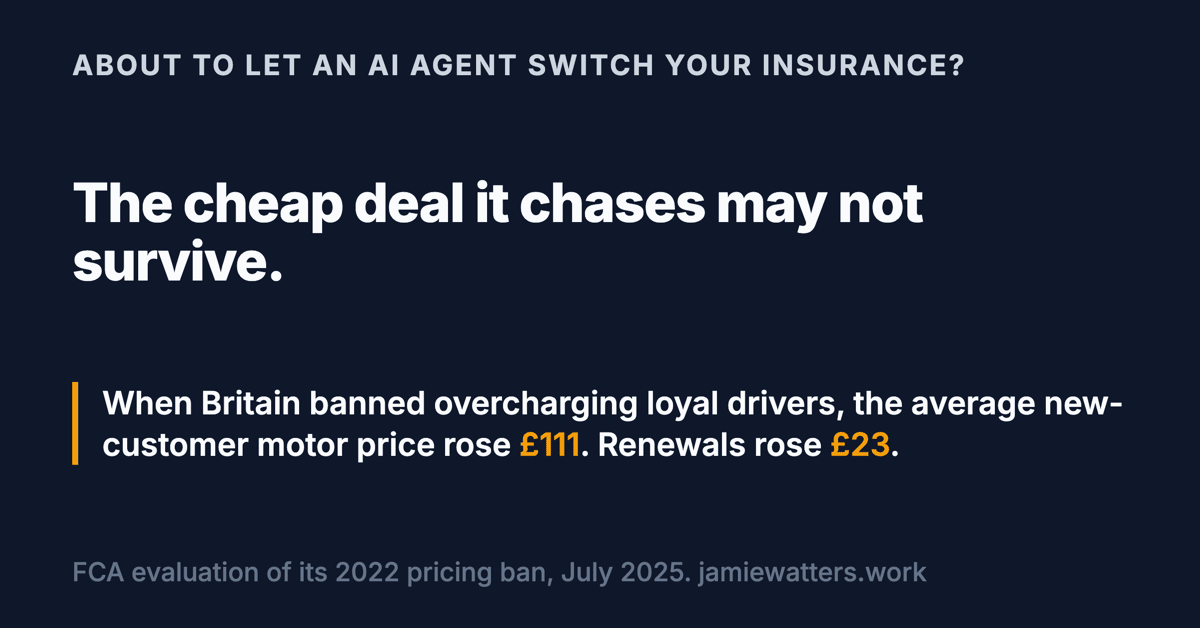
Marc Rubinstein, who writes the Net Interest newsletter on banking, asked an AI agent called Instinct to look at his car insurance. His premium had gone up 83% at his last renewal. The agent got him quotes and offered to automate the switch overnight (Rubinstein, "The Agents Revolt", Net Interest).
That is the promise of this autumn's AI agents: they do the checking most of us don't get round to. Your insurer and your bank make real money from you not checking, so Rubinstein's question is the right one. What happens to their margins when customers start using AI agents?
I spent years inside a bank, so I went looking for the answer in the evidence rather than the excitement. Britain has already run the experiment once, for car insurance. Since it stopped insurers overcharging the customers who don't switch, the cheap deal for the customers who do has got dearer. The regulator expected that.
Britain already removed the loyalty penalty for drivers
Until 2022, British insurers routinely charged a loyal customer more than they would charge the same person as a new customer. The regulator calls it price walking. From January 2022 the Financial Conduct Authority banned it: insurers must offer a renewing customer a price no higher than they would pay as a new customer. In effect, the regulator removed the loyalty penalty for every renewing customer at once.
The FCA forecast savings of £4.2bn over ten years, £2.5bn of it in motor. In July 2025 it checked its own work. The central estimate for motor came in at £1.59bn, about two-thirds of the forecast (with a wide range, £163m to £3.0bn). For home insurance it found no statistically significant effect on prices (FCA evaluation paper EP25/2).
Then look at where the prices went. Before the ban, a new motor customer paid £458 on average and a renewing one £437. After it, new customers paid £569 and renewing ones £460 (FCA, 2025). The average new customer paid £111 more. The average renewal paid £23 more.
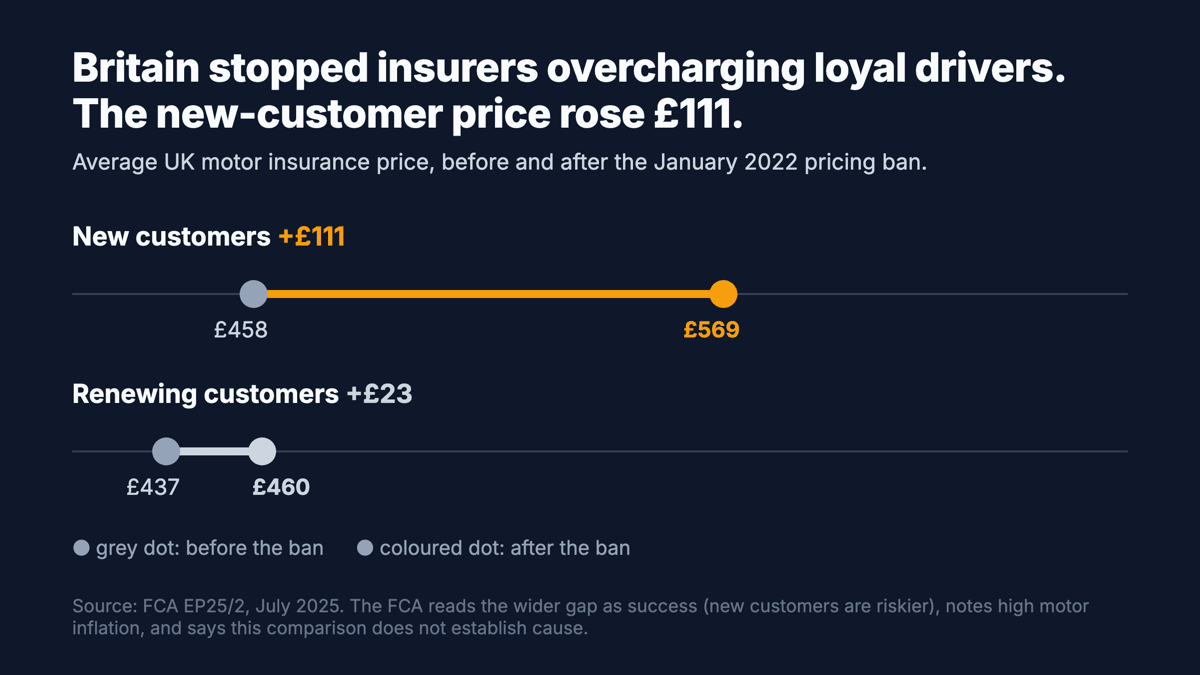
Source: FCA EP25/2, July 2025.
The FCA's own account of the old market is the point. It says loyal customers were lower risk but were not priced that way, and it expected that, once the overcharge stopped, firms would "no longer offer unsustainably low-priced deals to new customers". It reads the wider gap as a good result, since new customers are riskier on average. Motor prices were also rising with high inflation, and the FCA says this before-and-after comparison "does not establish a causal link".
That is the catch in an agent that switches you every year. It chases a discount that exists because other people don't look. If agents turn the people who don't look into people who do, that discount may not be there to find. What's left is insurers disagreeing about your risk, which an agent can still win. If you're in Britain, the rule already stops your insurer charging you more for staying on home or motor cover. An agent can still find you a cheaper insurer. What it can't win back is a loyalty overcharge the regulator has already largely removed.
The same money sits in your savings account
UK easy-access accounts held about £909bn in mid-2024, barely changed from a year before. At the end of June 2024 they paid 2.11% on average with Bank Rate at 5.25%, while in August 174 instant-access accounts paid over 4% (FCA cash savings update, September 2024). The better rates were there for anyone who moved.
Rubinstein asked his question over a chart he headed "Banks with more inattentive depositors offer lower rates". It comes from a US study by Xu Lu and Lingxuan Wu (NBER Working Paper 34783, revised April 2026). Their test is one most of us would fail. A tax refund lands in an account paying almost nothing: how long before you move it? Banks serving the customers who leave it sitting longest pay less on savings, every year from 2009 to 2021. The authors' conclusion: "inattention is a key source of banks' market power".
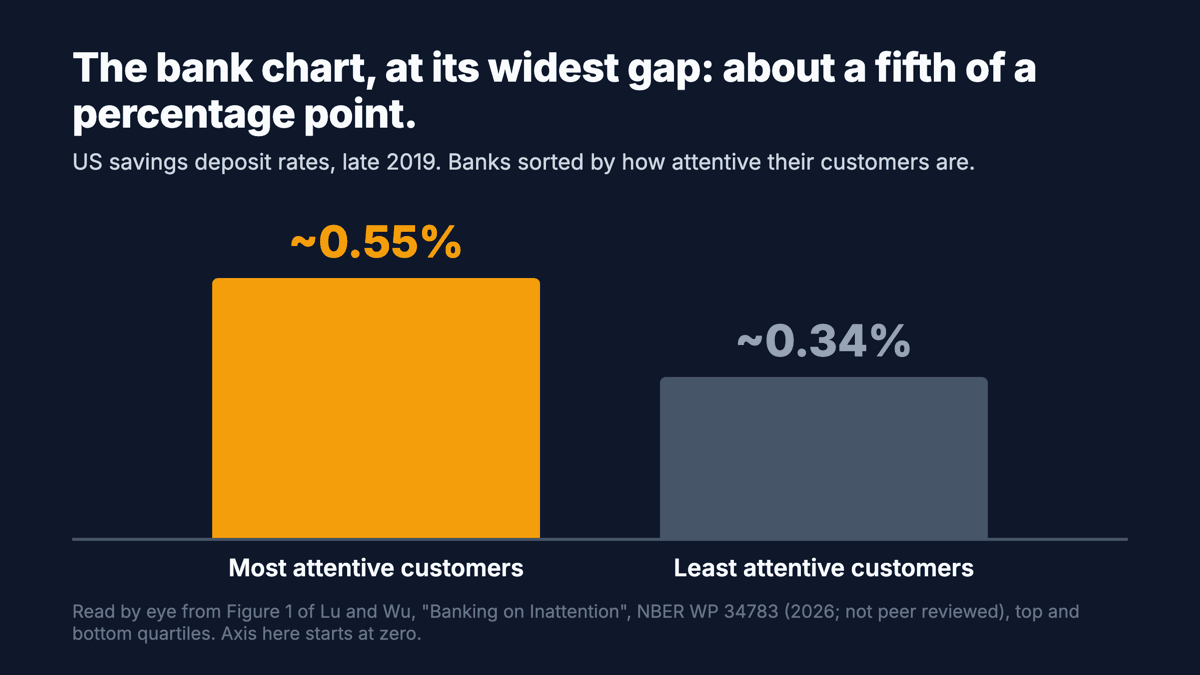
Read by eye from Lu and Wu's Figure 1.
At its widest, in late 2019, the gap was about a fifth of a percentage point, read off the chart (Lu and Wu, 2026). Small on one account, large on every dollar a bank holds. The paper is not peer reviewed, and its data stop in 2021, before the big rate rises. An agent that moves your savings goes after that gap too.
The agents have arrived. The switching hasn't been counted
Meta launched Muse on 8 September, calling it "a secure, private personal AI agent that proactively helps with people's goals" that can "negotiate on their behalf" (Meta). The app tracker Sensor Tower estimated 2.8 million downloads in its first two weeks, and it reached number one on the US App Store on 18 September (TechCrunch, 25 September 2026). Downloads are not users.
Investors moved before customers did: Goldman Sachs keeps a basket of "consumer inertia" stocks, firms that earn from customers who stay put, and named the insurers Allstate and Progressive as exposed. It fell 2.6% on 22 September and had lost 10% since Muse launched (Dow Jones via Tiger Brokers, 24 September 2026).
What I could not find is anyone counting switches. One story doing the rounds says Muse saved a driver $3,500 a year by switching insurers. Rubinstein cites a social post; I could not open it, so it stays a story. Allstate published its third-quarter results on 4 November, and the release does not mention consumer AI agents (Allstate Q3 2026 release, SEC filing). Its investor call the next morning talked about Muse at length and still put no number on it. Agents are "likely going to do more price comparisons", it said, and "I do not know how rapidly it will grow" (Allstate Q3 2026 earnings call transcript, 5 November 2026).
Who picks up the money
Looking does cut prices. Comparison sites arrived for US term life insurance in the 1990s. Prices fell by an estimated 8 to 15%, and only for the policies the sites covered (Brown and Goolsbee, NBER Working Paper 7996, 2000).
But the middle takes its cut. In 2014 Britain's Competition and Markets Authority found that some comparison sites' contracts stopped car insurers offering a lower price on other websites. Those clauses were "restricting competition and leading to higher car insurance premiums overall" (CMA, 24 September 2014).
The same middle is forming around agents. In September the insurance marketplace Insurify blocked Muse, saying "each quote request can trigger paid data checks, such as driving records" and that bulk quoting by agents brings carriers "no new customers". By 28 October it had reopened to agents through what it calls an "AI Agent Gateway" (Insurify). Someone now controls the gate between your agent and the price.
Allstate wants to be a gate too. On its 5 November call it said it will launch its own insurance agent in early 2027. It will quote over 30 insurers through its Answer Financial business, and "our PAA will serve other PAAs", the personal agentic assistants such as Muse (Allstate Q3 2026 earnings call transcript).
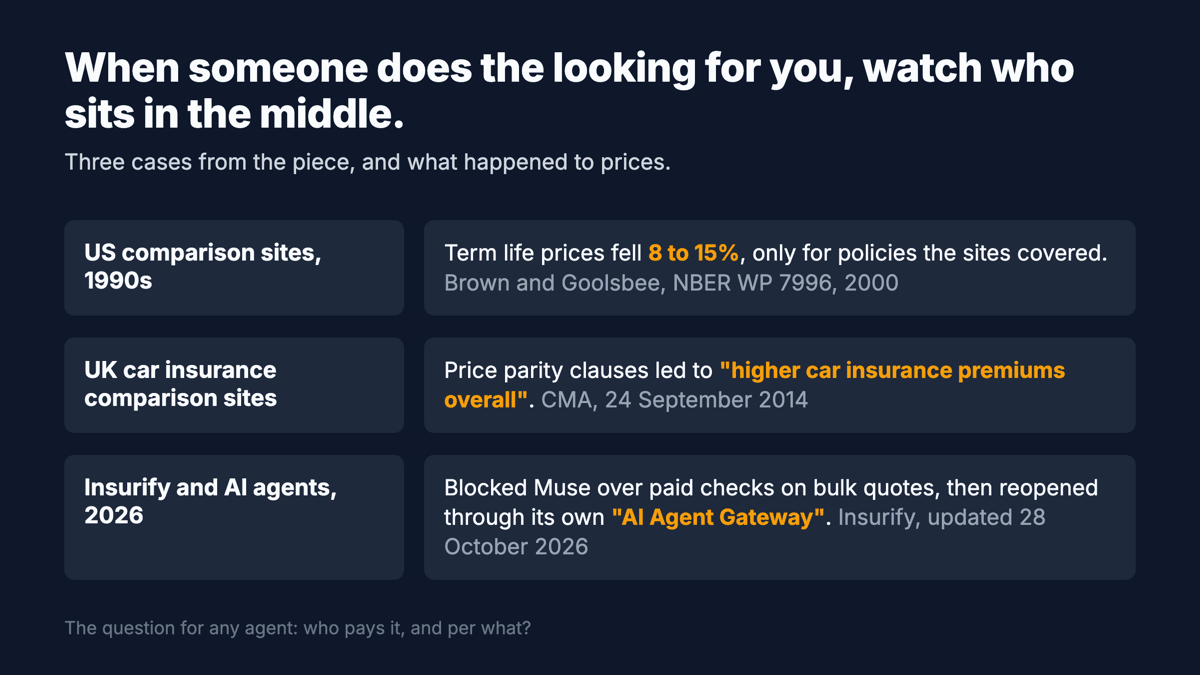
So on the evidence so far, the losers are firms whose profit depends on customers who don't check. The likely winners are whoever sits between the agent and the price, and the customers who were already half-awake.
The best argument against all this
The strongest case against all of the above: the people who pay the most for not checking are the people least likely to let software check for them. Switching savings was already a few clicks, and most of the £909bn in easy access sat at an average 2.11% while 174 accounts paid over 4% (FCA, 2024).
Consumer Reports asked 4,073 US adults in late 2025, before Muse launched. Just 1% had used a financial service where AI took actions for them. Then it asked about an AI agent "switching me to a less expensive insurance or credit option when it finds a better deal", without needing approval each time. 56% said they would be uncomfortable and 31% comfortable (Consumer Reports, AI in Financial Services 2025).
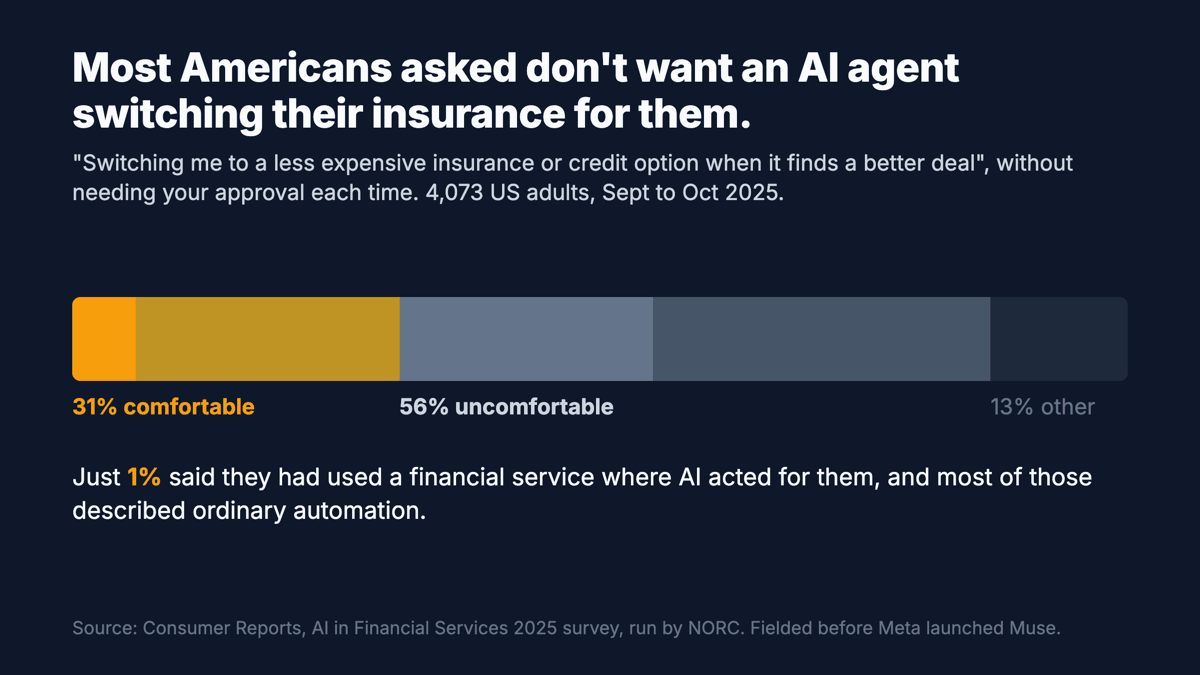
I think that argument is right about speed and wrong about reach. When a firm can't tell which customers are looking, a minority who look can move prices for a whole group. In Brown and Goolsbee's data, a 10% rise in the share of a group using the internet cut that group's average life insurance price by as much as 5%. What would settle it is an insurer or bank publishing how many switches came from agents. I found none so far.
The checks to run yourself before your next renewal
Until the agents prove themselves, let one fetch the quotes and make the switch yourself. The looking takes three checks:
1. Savings: find your easy-access rate. Compare it with the top
   easy-access rate on a best-buy table. The gap, on your balance, is
   roughly what not checking costs you a year.

2. Insurance: before you renew, get a new-customer quote from your own
   insurer and two others, with the same excess. In the UK, on home and
   motor, your renewal can be no higher than your insurer would charge
   you as a new customer through the same channel.

3. Any agent or comparison site: ask who pays it and which firms it
   covers. If insurers or banks pay it per sale, its best deal is the
   best among the firms that pay it.
When Britain removed the loyalty penalty for every driver at once, the motor saving came in at about two-thirds of the forecast, and the average new customer paid £111 more (FCA, 2025). That is the precedent your AI agent is walking into.
Sources
- Lu, X. and Wu, L., "Banking on Inattention", NBER Working Paper 34783, January 2026, revised April 2026 (not peer reviewed): https://www.nber.org/papers/w34783
- FCA, "EP25/2: An evaluation of our GIPP remedies", July 2025: https://www.fca.org.uk/publication/corporate/ep25-2.pdf
- FCA, "General Insurance Pricing Practices: Q&As on the published rules", updated 13 September 2024 (the same-channel rule, Q1.22): https://www.fca.org.uk/publication/policy/ps21-5-questions-answers.pdf
- FCA, "FCA update: cash savings", September 2024: https://www.fca.org.uk/publications/multi-firm-reviews/fca-update-cash-savings-september-2024
- Meta, "Introducing Muse", 8 September 2026: https://about.fb.com/news/2026/09/introducing-muse-personal-ai-agent/
- TechCrunch, Sarah Perez, 25 September 2026: https://techcrunch.com/2026/09/25/meta-is-putting-its-muscle-behind-muse-as-the-ai-app-takes-off/
- Dow Jones via Tiger Brokers, 24 September 2026: https://www.itiger.com/news/2669435472
- Allstate, Q3 2026 earnings release (Form 8-K, Exhibit 99.1), 4 November 2026: https://www.sec.gov/Archives/edgar/data/0000899051/000089905126000156/allcorp93026earningsreleas.htm
- Allstate, Q3 2026 earnings call transcript, 5 November 2026 (Yahoo Finance, powered by Quartr): https://finance.yahoo.com/quote/ALL/earnings/ALL-Q3-2026-earnings_call-726408.html
- Insurify: https://insurify.com/press/news/insurify-blocks-muse-from-its-marketplace/
- Rubinstein, M., "The Agents Revolt", Net Interest, 25 September 2026: https://www.netinterest.co/p/the-agents-revolt
- Brown, J. R. and Goolsbee, A., "Does the Internet Make Markets More Competitive?", NBER Working Paper 7996, 2000: https://www.nber.org/papers/w7996
- CMA, "CMA finalises changes for car insurance", 24 September 2014: https://www.gov.uk/government/news/cma-finalises-changes-for-car-insurance
- Consumer Reports and NORC, "AI in Financial Services" 2025 survey: https://innovation.consumerreports.org/wp-content/uploads/2026/04/Consumer-Reports-AI-in-Financial-Services-2025-Report.pdf