Claude's new AI agent inherits every app you've connected. Mine could read my API keys
Jamie Watters
Ex-banker, founder at 58, building with AI.
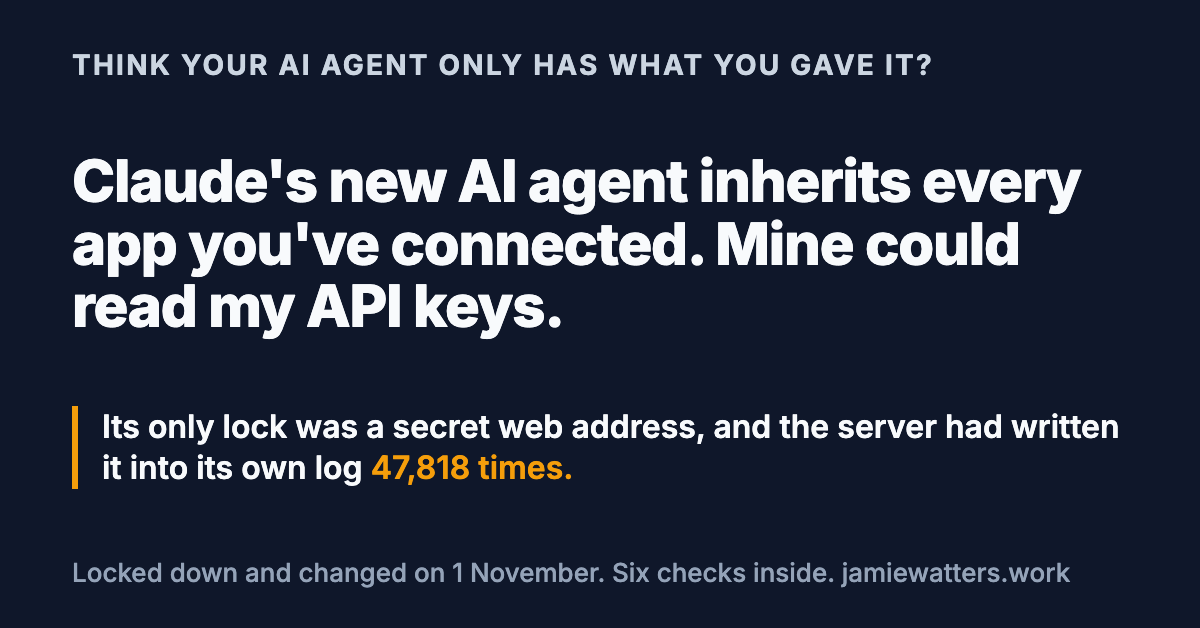
I thought I was about to give an AI agent the key to my second brain: the notes vault where I keep my plans, my tasks and everything I've filed. The key was a link I already use. Before I handed it over, a check ran that had been waiting six days. It found the link opened more than my notes: it also opened the files where my other tools keep their keys. And the agent already had it.
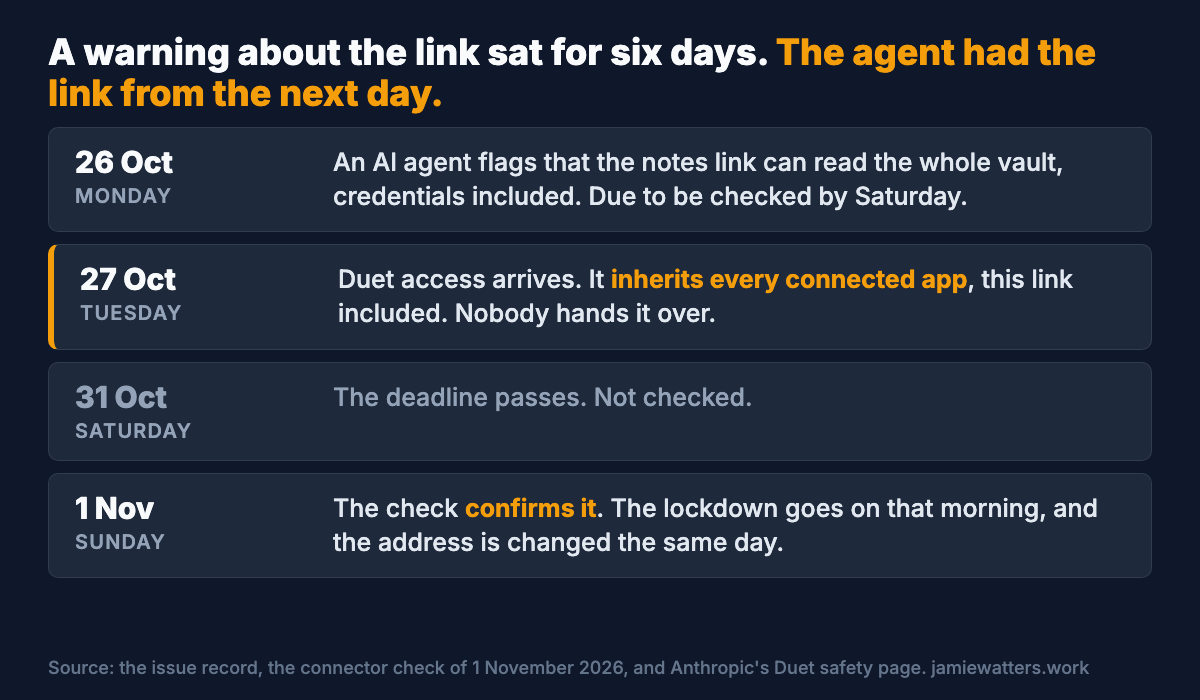
The agent is Claude Duet, which Anthropic opened as a research preview on 21 October. Anthropic says it "keeps working even when you step away" and checks your connected accounts "every few hours". It also "carries over your memory, skills, and connected apps from your Claude account" (Anthropic, 2026). My access came through on 27 October. I never handed it my notes link. I didn't need to.
That link is one of my connected apps: it lets Claude read and write my notes from my phone and the Claude app. On 26 October another AI agent flagged that it could read my whole vault, credentials included. It hadn't been confirmed. That went down as an issue, due to be checked by Saturday 31 October. Saturday came and went. It wasn't checked.
On Sunday 1 November, before I set Duet to work on my notes, an agent ran the check.
What the check found
The link could read any file in my notes vault, of any type. Inside that vault sat a credentials folder and settings files holding keys for other services, one of them with 21 entries. The only test it ran before handing over a file was whether the file sat inside the vault. Those files did.
Its only lock was a secret web address. No password, no sign-in. Anyone holding the address could read and write.
And the address wasn't secret. The server wrote it into its own log file every time the link was used: 47,818 times by the morning of the check (Connector check, 2026). Anyone who could open that file on that machine had the address. It also sat in a project note committed to a private code repository, and in two test files.
So the risk wasn't a clever break-out from the folder. That was blocked. It was what already sat inside the folder I'd shared. Look there first in yours.
How the agent got it without asking
Nobody gave Duet the link. Anthropic's safety page says "The apps you have connected to Claude carry over to Claude Duet, and switching an app off in one place switches it off in both" (Anthropic, Duet safety, 2026). Mine was on in Claude, so it was on in Duet from the day my access arrived.
Duet asks you first before it sends a message, makes a payment, signs a document or deletes anything. Reading isn't on that list: "Claude Duet reads, drafts, and prepares work on its own" (Anthropic, 2026).
Anthropic also built it so it "never directly sees your passwords or sign-in tokens" (Anthropic, 2026). That covers the passwords and keys it uses to reach your apps. It doesn't cover a key written inside a file one of those apps lets it open. To the agent, that's just the contents of a file.
Did it ever open those files? I can't tell. The server's log records each request, but not which file it asked for or which of my Claude apps sent it.
My link felt safe because its address was long and random. But a secret address is only as secret as every place it gets written down, and mine was written down in four places I hadn't thought about.
The fix, the same day
The test of the fix is one you can run on your own connection: ask it for a file it shouldn't hand over. After the agent locked mine down that morning, it asked the live link for my credentials file and my settings file with keys. Both were refused. An ordinary note still came back.
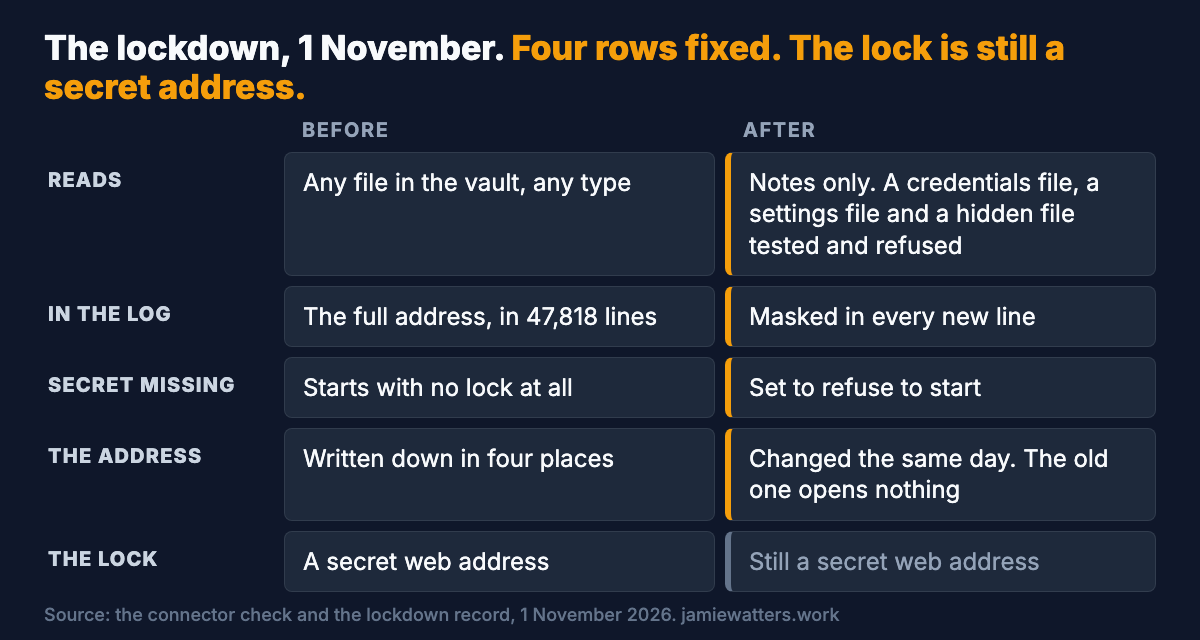
If a link or key of yours has ever been written down somewhere it shouldn't, tightening the lock isn't enough. Change the key. I changed my address the same day. The old one now opens nothing, so the copies of it lying around can't be used to get in.
Switching an app off isn't the same thing. Anthropic says "Disconnecting an app stops new access from that moment, but what Claude Duet already learned from it stays until you reset its memory" (Anthropic, Duet safety, 2026).
Six checks before you connect yours
You don't need to read code to run these. They're screens, not a guarantee: a fail on any one means stop, and a pass on all six still leaves you trusting whoever built the connection. Mine would have failed five.
- What can it open? Put a made-up key in the same kind of file, in the same place, as your real ones, and ask the agent for that file. Pass if the connection refuses it. An AI politely declining doesn't count, and nor does "file not found".
- Any keys in what you share? Show hidden files (Cmd+Shift+. in a Mac's Finder), then search inside your files for key, token, secret and password. Pass if nothing turns up.
- Which agents get it? Open the list of connected apps in each AI app you use, and see which agents can reach each one. Connect an app to Claude and Duet gets it too. Pass if every one is an agent you meant.
- What did connecting it grant? Pass if a permission screen named only the folders or kinds of file you meant to share, not a whole drive or account, and you can find that permission again to take it back. A pasted web address with no permission screen fails.
- Where is the secret written down? Search your notes, emails, chats, code and browser history for it. Pass if it's only in your password manager and the app's settings.
- Can you kill it? Pass if you can make the key itself stop working. Switching the app off doesn't stop a copy held somewhere else.
Mine still fails the fourth: there's no permission screen, just a secret address. It's a new one now, and the server no longer writes it into its log.
Duet has the link again. This time the link opens my notes and refuses the files with keys.
Sources
- Anthropic, "Introducing Claude Duet", 21 October 2026: https://claude.com/resources/articles/claude-duet
- Anthropic, "Claude Duet safety, privacy, and security", 23 October 2026: https://claude.com/resources/articles/claude-duet-safety-privacy-and-security
- Connector check, 1 November 2026: my own record of the check and the fix, run by an AI agent. Not published, because it names the files and addresses involved.